A beginner workout schedule works best when it is built around real availability, not an idealized seven-day streak. Start with a few dependable anchor sessions, add optional movement blocks, define a smaller version for difficult days, and leave enough space between repeated strength sessions. The schedule should also include a simple rule for missed workouts so one disrupted day does not turn into an overloaded week. After two weeks, adjust only the part that caused the most friction.
A Week Should Be Able to Survive Real Life
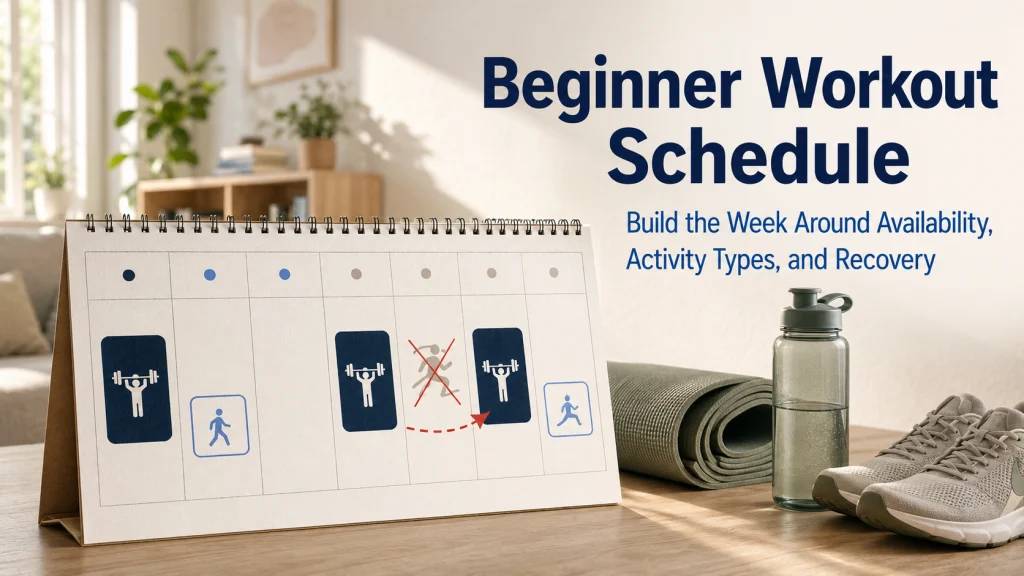
Two calendars can contain the same total planned activity and still behave very differently. One can demand a workout every day with no room for a late meeting, poor sleep, family responsibilities, or a longer setup than expected. The other can use three dependable sessions, two optional movement opportunities, and two recovery windows. Both may look organized on paper, but only one has a clear way to absorb disruption.
A useful beginner workout schedule is therefore a resilience system, not a row of perfect checkmarks. It should show what matters most, what can move, what can shrink, and what happens after a missed day. That structure is especially important at home, where changing clothes, clearing floor space, finding equipment, and handling interruptions can reduce the time available for actual movement.
| Day | Rigid calendar | Resilient calendar |
|---|---|---|
| Monday | Required 20-minute workout | Recovery or normal daily movement |
| Tuesday | Required 20-minute workout | 30-minute anchor session |
| Wednesday | Required 20-minute workout | Optional 25-minute movement block |
| Thursday | Required 20-minute workout | 30-minute anchor session |
| Friday | Required 20-minute workout | Optional 25-minute movement block |
| Saturday | Required 20-minute workout | 30-minute anchor session |
| Sunday | Required 20-minute workout | Recovery or normal daily movement |
In this example, both calendars plan 140 minutes. The difference is not the total. It is the way the week handles a conflict. Missing one daily requirement makes the rigid calendar feel broken, while the resilient calendar keeps its priorities visible and allows optional blocks to remain optional.
For the broader decisions that come before scheduling, use the guide to exercise at home safely and practically. For help choosing a realistic starting approach, review how to start working out at home before filling every open space on the calendar.
List Fixed Obligations and Honest Workout Windows
Begin with the parts of the week that cannot easily move. Work shifts, school pickups, caregiving, commuting, recurring appointments, meal preparation, and regular sleep times should enter the calendar before exercise. This prevents the plan from treating leftover time as if it were dependable time.
Next, mark workout windows in three categories:
- Reliable windows: times that are available most weeks and can support an anchor session.
- Conditional windows: times that may work if the day runs normally and can support optional movement.
- Unrealistic windows: times that technically appear open but are usually lost to travel, fatigue, household transitions, or competing tasks.
Be specific about the beginning and end of each window. “Tuesday evening” may sound available, but “6:30 to 7:00 p.m. after dinner cleanup” reveals whether the window is truly usable. A smaller reliable window is more valuable than a larger block that repeatedly disappears.
The number of available windows does not automatically determine how many sessions belong in the week. Use the separate guidance on how often beginners should work out when deciding whether the calendar contains too many demanding sessions for a starting week.
Separate Movement Opportunity From Actual Exercise Time
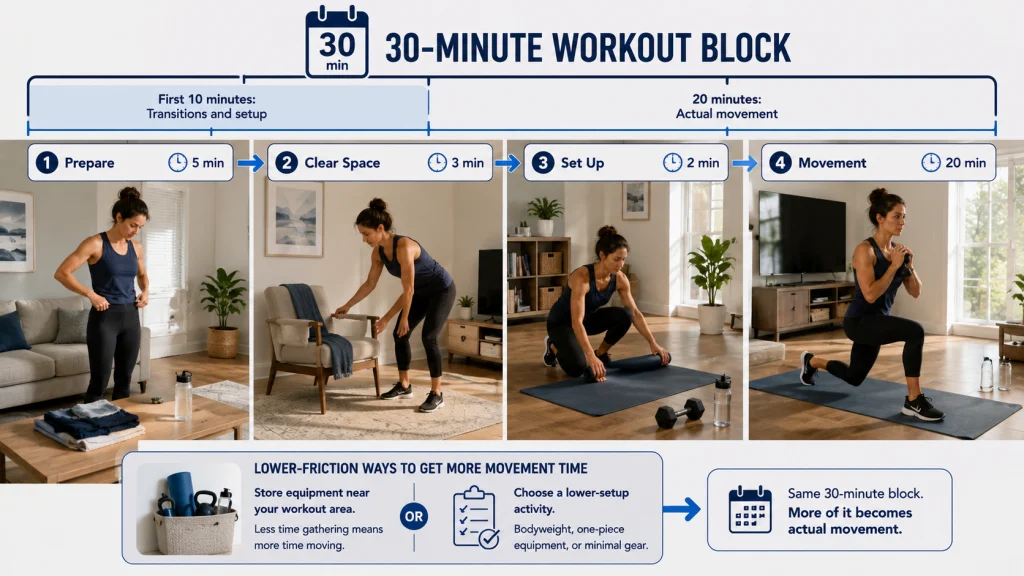
A calendar block is not the same as movement time. At home, a scheduled session may include changing clothes, moving furniture, setting up a mat or equipment, opening an app, finding water, and putting everything away. Ignoring those steps makes the planned session longer than the time actually available.
| Part of a 30-minute calendar block | Example time |
|---|---|
| Change clothes and prepare | 5 minutes |
| Clear the floor | 3 minutes |
| Set up and begin | 2 minutes |
| Actual movement | 20 minutes |
This calculation does not mean every home workout requires ten minutes of preparation. It shows why a thirty-minute calendar block may contain only twenty minutes of movement. The practical response is to reduce setup friction, reserve a slightly longer block, or choose an activity that fits the space already available.
Decide the session length only after accounting for transitions. The guide to choosing a beginner workout length can help separate a realistic movement target from the total time that must be protected on the calendar.
Add Activity Categories Before Choosing Exact Workouts
Once the available windows are visible, label the purpose of each session before selecting a routine. A simple weekly plan generally needs room for aerobic movement, muscle-strengthening activity, and recovery. The exact activity can remain flexible until the week is tested.
Use broad placeholders such as:
- Aerobic: a session intended to raise breathing and heart rate to a manageable level.
- Strength: a session that challenges major muscle groups without turning the calendar into a detailed body-part split.
- Optional movement: lower-pressure activity that can support consistency without becoming another required workout.
- Recovery: time without another demanding session for the same muscles, while ordinary daily movement may continue as appropriate.
These labels keep the schedule useful even when the exact activity changes. A rainy day, crowded room, low-energy evening, or equipment problem may change the activity choice without changing the purpose of the block. Detailed exercise selection belongs in the separate guides to strength training at home and cardio workouts at home.
Place Recovery Around Repeated Muscle Use
Recovery is part of the weekly structure, not a reward for completing every session. When two strength sessions challenge many of the same muscles, placing them on consecutive days may be harder to repeat than leaving a day between them. A beginner calendar should make that spacing visible before optional activities fill the gaps.
A recovery day does not need to mean complete inactivity. It may include normal walking, household movement, or a gentle activity that does not recreate the same demand. The important question is whether the next planned session can be completed with reasonable comfort, control, and daytime function.
Do not use soreness as the only measure. Sleep, unusual fatigue, reduced coordination, persistent discomfort, and difficulty completing ordinary tasks can also show that the week needs more space. For a fuller explanation of how to arrange those decisions, use the guide to rest days for beginners.
Define Anchors, Optional Sessions, and Minimum Versions
Every planned block should have a status. Without that status, an optional walk can quietly become a requirement, and one busy day can make the entire week feel unsuccessful.
- Anchor session: one of the few sessions that gives the week its structure. It receives the most protected time.
- Optional session: a useful opportunity that can be completed when time and recovery allow, but can be skipped without repayment.
- Minimum version: a smaller version of an anchor session that preserves the routine when the full block no longer fits.
A minimum version should be decided in advance. It may be a shorter period of the same activity, one simplified circuit instead of several rounds, or a brief movement block that starts and ends cleanly. It should not require a new plan during an already difficult day.
The minimum version is not a hidden test of willpower. It is a scheduling tool. If the smaller version repeatedly feels too demanding, the anchor itself may be too large, too frequent, or placed in the wrong window.
Three Sample Weekly Templates
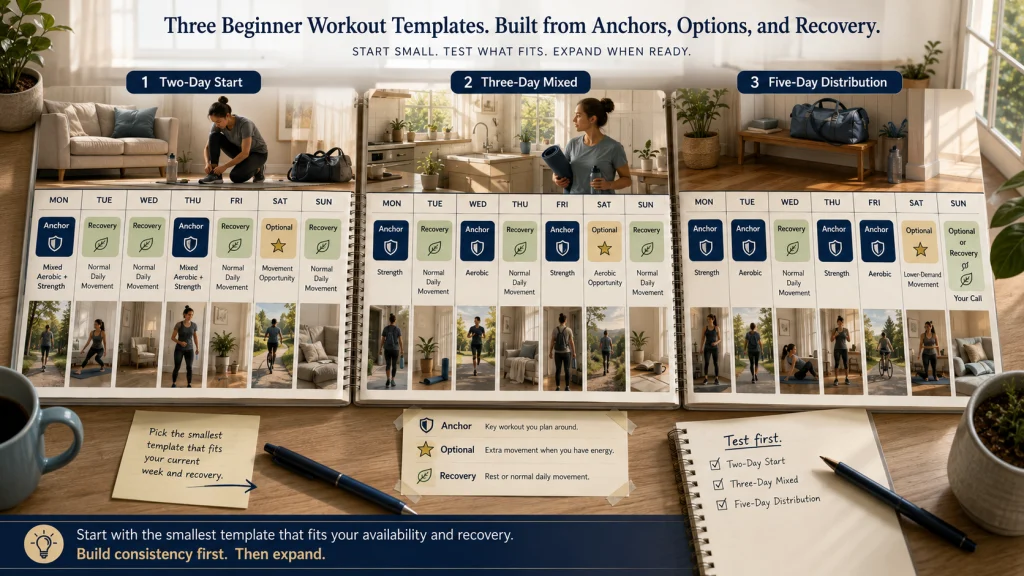
These examples show different ways to distribute a week. They are starting structures, not mandatory programs. Choose the smallest one that fits current availability and recovery, then test it before adding more.
Two-Day Start
| Day | Planned role |
|---|---|
| Monday | Recovery or normal daily movement |
| Tuesday | Anchor session with mixed aerobic and strength time |
| Wednesday | Recovery |
| Thursday | Optional movement |
| Friday | Recovery or normal daily movement |
| Saturday | Anchor session with mixed aerobic and strength time |
| Sunday | Recovery |
This structure suits a reader who needs to prove that two dependable windows exist before expanding the week. The optional block can remain light and does not become a missed workout when skipped.
Three-Day Mixed Week
| Day | Planned role |
|---|---|
| Monday | Strength anchor |
| Tuesday | Recovery or optional easy movement |
| Wednesday | Aerobic anchor |
| Thursday | Recovery |
| Friday | Strength anchor |
| Saturday | Optional aerobic movement |
| Sunday | Recovery |
This version separates repeated strength work and gives aerobic movement its own anchor. It also leaves one optional opportunity for a week with more time or energy.
Five-Day Activity Distribution
| Day | Planned role |
|---|---|
| Monday | Strength anchor |
| Tuesday | Aerobic anchor |
| Wednesday | Optional lower-demand movement |
| Thursday | Strength anchor |
| Friday | Recovery |
| Saturday | Aerobic anchor |
| Sunday | Optional movement or recovery |
Five active days do not need to mean five demanding workouts. In this example, one day is intentionally lower demand and another can become recovery. This distribution is better suited to someone who already has several reliable windows and can recover between the more demanding sessions.
Use a Priority Template for Irregular Shifts
A fixed Monday-to-Sunday pattern may not work when shifts rotate or household demands change each week. In that situation, keep the session roles stable and assign them after the work schedule is known.
- Choose the two or three most important session roles for the coming week.
- Place the first anchor in the earliest reliable window.
- Place the next demanding anchor after a suitable recovery gap.
- Add one or two optional movement windows only after the anchors fit.
- Leave at least one open recovery window that is not treated as unused space.
For example, a rotating-shift week might use “strength anchor A,” “aerobic anchor,” and “strength anchor B” instead of naming fixed weekdays. The roles stay recognizable even when Tuesday becomes Friday from one week to the next.
Keep setup needs attached to each role. A short window after a late shift may support a low-setup aerobic option but not a session that requires moving furniture and assembling equipment. The calendar should reflect the real transition cost, not only the movement itself.

Use a Missed-Session Rule That Resumes Instead of Doubling
A missed session should trigger a decision, not a punishment. Trying to repay the week by doubling the next workout can remove recovery space and turn one scheduling problem into several difficult sessions.
- Check the next anchor: If it can happen as planned, resume there and let the missed session go.
- Use an optional window only when it fits: Move the missed session only if the new position preserves recovery and does not displace another important obligation.
- Use the minimum version when the original window partly remains: A smaller session may preserve the routine without forcing a full block.
- Do not stack demanding sessions to repair the calendar: Protect spacing and continue with the next useful session.
If the same anchor is missed repeatedly, the problem is probably the placement, setup, or size of that session. Move it to a more reliable window or reduce its minimum version rather than adding more discipline language. The guide to making exercise easier to repeat can help when the schedule works on paper but the starting cue or routine remains inconsistent.
Review the Schedule After Two Weeks
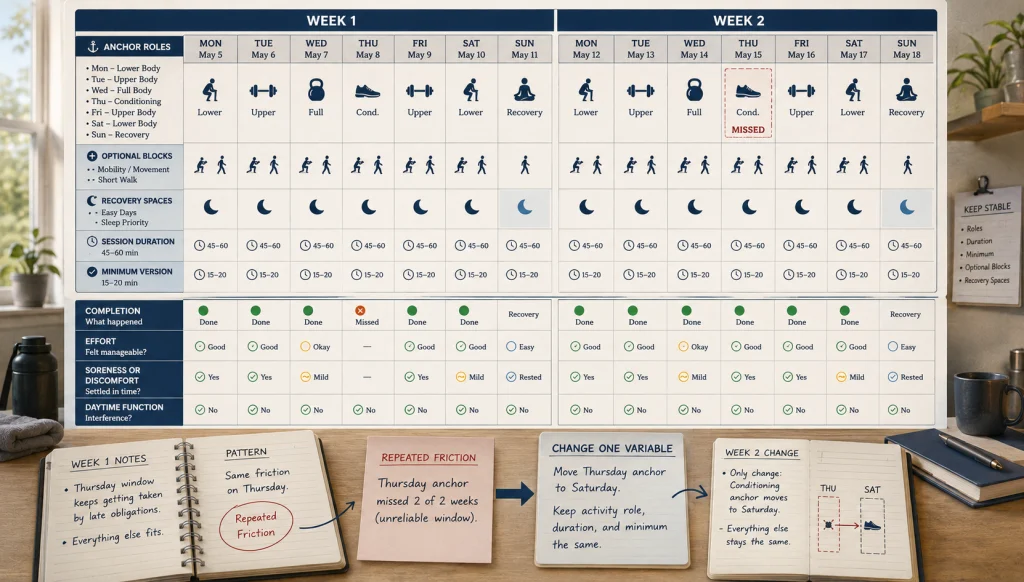
Two weeks is long enough to reveal repeated friction without requiring a long commitment to a poor fit. Keep the main structure stable during the test. Avoid changing the days, session roles, duration, and minimum version all at once, because that makes it difficult to identify what helped.
| Review item | Question to record | Possible adjustment |
|---|---|---|
| Completion | Which anchors, optional blocks, and minimum versions were actually completed? | Move one repeatedly missed anchor to a more reliable window. |
| Effort | Did the planned sessions feel manageable enough to repeat? | Reduce the size or demand of one session before adding frequency. |
| Soreness or discomfort | Did discomfort settle before the next demanding session? | Add recovery space or avoid repeating the same muscle demand too soon. |
| Daytime function | Did the schedule interfere with sleep, work, caregiving, concentration, or ordinary tasks? | Change the timing, setup burden, or number of demanding sessions. |
Choose one change for the next two-week test. For example, move the Thursday anchor to Saturday while leaving the activity category and minimum version unchanged. A single-variable adjustment makes the result easier to interpret.
When a Generic Schedule Is Not Appropriate
This framework is intended for generally healthy adults arranging ordinary home activity. It does not diagnose pain, prescribe rehabilitation, create condition-specific exercise, or replace individualized guidance from a physician, physical therapist, or qualified exercise professional.
Persistent joint or muscle pain, neurological symptoms, pregnancy, recent surgery, chronic conditions, disability-related limitations, or a long period of inactivity may change what activity, frequency, duration, or recovery spacing is appropriate. Seek individualized guidance when those factors make a generic weekly template uncertain or difficult to use safely.
Stop exercise and seek appropriate help for chest pain or pressure, extreme shortness of breath, fainting, severe dizziness, sudden weakness, a serious injury, or severe pain. Do not use the missed-session rule or a smaller workout version to continue through these warning signs.
Write the Rules Before Filling the Week
Start by writing two or three anchor sessions, one or two optional movement blocks, a minimum version for each anchor, and a clear missed-day rule. Then place those roles into honest windows that include setup and transition time.
Test the structure for two weeks before expanding it. A workable weekly workout plan for beginners should make the next action easier to identify, even after a busy day, a missed session, or a change in household demands.
FAQs
📅 Do beginners need to work out every day?
No. A beginner schedule can start with a few dependable sessions and leave room for recovery and normal daily movement. The right number depends on the activity, session demand, recovery, and real availability.
⏱️ Does a 30-minute calendar block mean 30 minutes of exercise?
Not always. Changing clothes, clearing space, and setting up may reduce the actual movement time. Plan the full calendar block around those transitions rather than treating them as invisible.
🧭 What is the most important session in the week?
The most important sessions are the anchors you can protect and repeat. They should fit reliable windows and represent the main activity categories you are trying to maintain.
🔁 Should I make up a missed workout the next day?
Usually, resume with the next planned anchor instead of doubling. Move a missed session only when the new position still protects recovery and does not crowd another important obligation.
🪶 How small can a minimum workout be?
It can be much smaller than the full session, provided it is clear, practical, and safe for the planned activity. Decide it before the week begins so you do not have to redesign the workout during a difficult day.
🛑 When should I stop using a generic template?
Use individualized guidance when health conditions, recent surgery, pregnancy, disability-related limitations, persistent pain, neurological symptoms, or a long period of inactivity make the template uncertain. Stop exercise and seek appropriate help for urgent warning signs such as chest pain, fainting, severe dizziness, sudden weakness, serious injury, or severe pain.