A consistent sleep schedule should make the week easier to return to, not force every night into the same minute. Choose a realistic timing range and one reliable anchor, then decide in advance how late events and free mornings will be handled. Before limiting weekend sleep, check whether the weekday schedule provides enough opportunity to rest. The result should support work, family, and social life without turning the clock into another source of pressure.
Look for the weekly pattern, not one good or bad night
Imagine a seven-day chart with one dot for the midpoint of each sleep period. Monday through Friday form a close cluster. Saturday and Sunday sit far to the right because bedtime and wake time both moved several hours later.
| Day | Illustrative sleep midpoint | Position in the weekly pattern |
|---|---|---|
| Monday | 2:15 a.m. | ● Workday cluster |
| Tuesday | 2:05 a.m. | ● Workday cluster |
| Wednesday | 2:20 a.m. | ● Workday cluster |
| Thursday | 2:10 a.m. | ● Workday cluster |
| Friday | 2:25 a.m. | ● Workday cluster |
| Saturday | 4:45 a.m. | ● Weekend outlier |
| Sunday | 4:30 a.m. | ● Weekend outlier |
The chart tells a familiar story. Workday alarms keep the first five dots together, then a late breakfast and an open Sunday morning pull the weekend later. By Sunday evening, the usual sleep window may no longer feel close even though no single night looked disastrous.
The useful question is not whether Saturday was “good” or “bad.” It is whether the weekly swing keeps making ordinary obligations harder to re-enter.
Consistency is a range plus a recovery rule, not seven identical nights.
Define regularity separately from duration and quality
Sleep regularity describes how much the timing of sleep and wake periods changes across the week. Sleep duration describes how much time is spent asleep. Sleep quality describes how restorative or disrupted the sleep feels. These are related, but one cannot stand in for the others.
A tidy timing chart can still hide an inadequate sleep window. Adequate duration can also sit inside a schedule that shifts several hours on free days. Regular timing, sufficient sleep opportunity, and restorative sleep each answer a different question, so improving one does not automatically solve the others.
Key decision: Improve timing regularity only after checking that the schedule also leaves a realistic opportunity for enough sleep.
Use the broader sleep schedule decision guide when you are unsure whether the main problem is maintenance, temporary drift, naps, work timing, travel, or a weekday and weekend mismatch.
Allow a workable range instead of demanding identical minutes
Real households include late dinners, guests, caregiving, deadlines, celebrations, and mornings without fixed obligations. A schedule that allows no variation may look precise, then collapse the first time the evening runs differently.
Durable product routines account for charging, replacement, and the occasional failure to work as expected. A durable household routine needs the same kind of practical thinking: what normally happens, which exceptions are acceptable, and how the next day returns toward the usual pattern.
A smart alarm can enforce a time, but it cannot decide whether a late family dinner is worth an exception or how much weekend variation the household can absorb. Those decisions depend on obligations, sleep opportunity, and how difficult the return feels afterward.
Editorial observation: A routine is more durable when the exception has already been designed. Travel, guests, caregiving, illness, and late events should bend the system without erasing it.
Check weekday sleep opportunity before reducing weekend catch-up
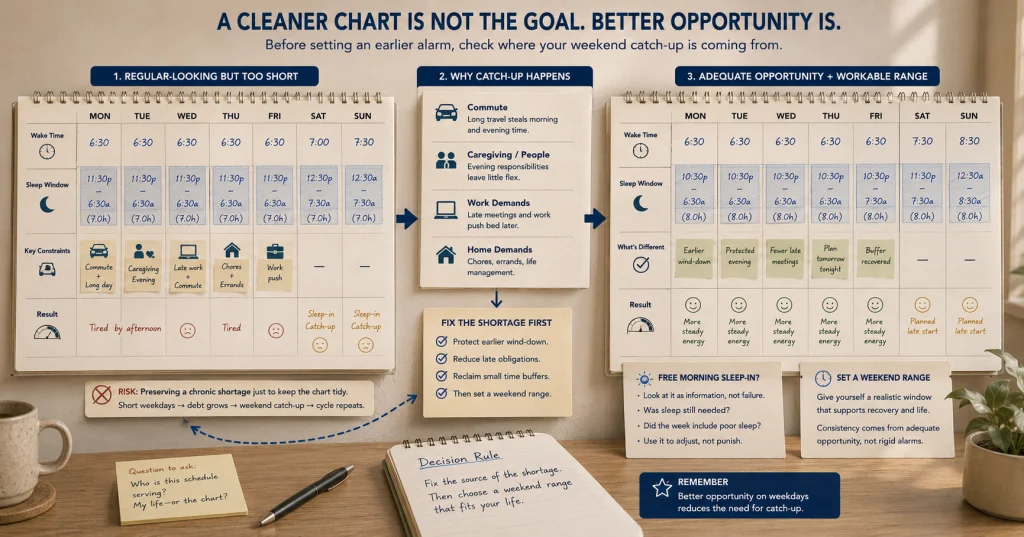
A large weekend sleep-in may reflect schedule variability, but it may also reflect a weekday pattern that leaves too little time for sleep. Reducing the weekend difference without fixing the weekday shortage can make the chart look more regular while leaving the person more tired.
Regularity versus insufficient weekday sleep: Do not maintain a consistent schedule by protecting a chronically shortened sleep window. First review whether work, commuting, caregiving, evening tasks, or an unrealistic bedtime repeatedly reduce weekday sleep opportunity.
Limited catch-up sleep on a free day should not be treated as a moral failure. The better question is why it is needed, how large the timing change becomes, and whether the weekday schedule can be adjusted so that recovery does not require a complete weekend reversal.
If the current schedule is several hours away from the required target rather than merely variable, use the sleep schedule repair guide before building a maintenance rule.
Choose a wake-time anchor, bedtime window, or both
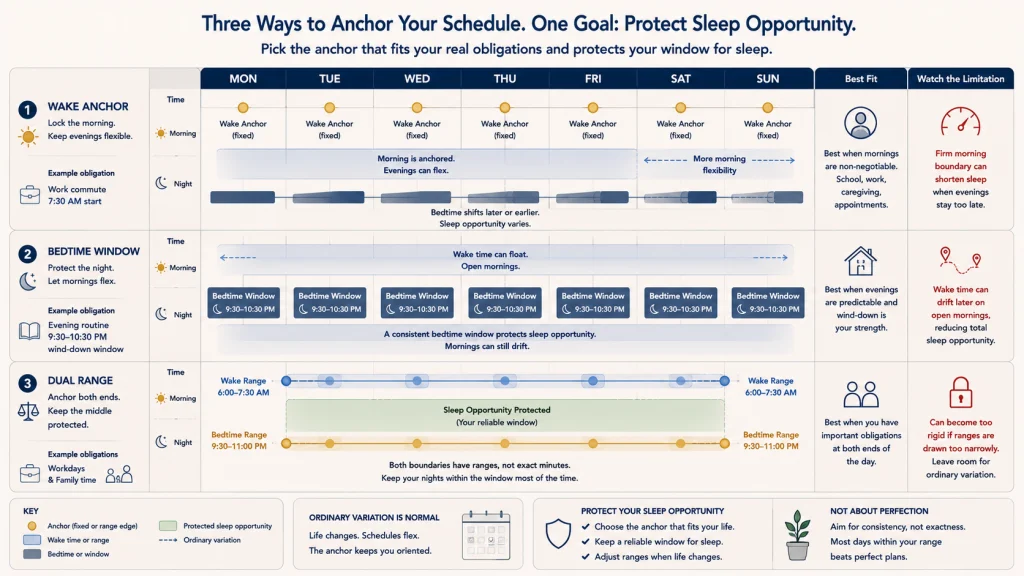
An anchor is the part of the schedule that remains most stable when the rest of the day changes. Different lives need different anchors.
| Anchor type | When it may fit | Main advantage | Main limitation |
|---|---|---|---|
| Wake-time anchor | Work, school, caregiving, medication routines already set by a professional, or morning commitments create a firm start. | Gives the week a clear morning boundary. | Can reduce sleep opportunity if evening obligations remain too late. |
| Bedtime window | Morning timing is flexible, but evening sleepiness and household routines are fairly predictable. | Protects a repeatable opportunity to wind down and sleep. | May allow wake time to drift when mornings remain completely open. |
| Dual anchor | Both morning obligations and evening routines can stay within practical ranges. | Keeps the entire sleep window from stretching or sliding too far. | Can become rigid if the ranges are too narrow for ordinary life. |
Choose the anchor that is easiest to protect without shortening sleep. A person with a fixed commute may need wake time to lead. A remote worker with flexible mornings may need both a latest wake time and a bedtime window so that free mornings do not pull the schedule later.
Set the normal range from your obligations
Do not begin with a universal number for how much timing may vary. Start with the earliest required morning, the latest realistic evening, and the amount of sleep opportunity the schedule must protect.
Write a normal range for the chosen anchor. A wake-time range might cover the earliest and latest planned wake times on ordinary days. A bedtime window might define when evening preparation begins and the latest time the sleep opportunity should start.
The range should answer three practical questions:
- Does it support the earliest recurring obligation?
- Does it leave enough opportunity for sleep rather than only enough time to be in bed?
- Can it survive a normal weekend without requiring a full reset on Sunday night?
If the answer to any question is no, widen or reposition the range before trying to enforce it.
Identify the disruptors that repeat every week
One unusual night is less important than the event that moves the schedule every Friday, Saturday, or work-from-home morning. Look for the recurring point where the normal range loses its boundary.
- Social events: late meals, gatherings, entertainment, or travel home.
- Caregiving: unpredictable needs at night or early in the morning.
- Gaming and streaming: activities without a clear stopping cue.
- Remote work: flexible mornings that remove the need to get up at a defined time.
- Chores: household work saved until the final part of the evening.
- Partner schedules: different work hours, alarms, meals, or preferred social times.
Choose the disruptor that causes the largest or most frequent shift. A useful maintenance plan changes the boundary around that event instead of adding unrelated sleep rules.

Build an exception rule for one late night
An exception rule defines what happens before, during, and after a planned late event. It prevents the event from becoming an unplanned two- or three-day schedule change.
| Exception-rule question | Write your answer |
|---|---|
| Which event qualifies as an exception? | Name the event, such as a celebration, guest visit, caregiving need, or rare deadline. |
| How late may bedtime move? | Set a realistic outer boundary rather than leaving the night open-ended. |
| What happens to wake time? | Decide whether it stays in the normal range or moves within the sleep-in ceiling. |
| What protects safety and function? | Plan transportation, morning obligations, and any task that requires alertness. |
| What is the next recovery action? | Name the first normal anchor that resumes after the event. |
The exception rule should be easier to remember than a long list of instructions. For example: “Saturday may run later for a planned event, Sunday wake time stays inside the ceiling, and Monday returns to the normal morning anchor.”
Set a sleep-in ceiling without treating all catch-up as harmful
A sleep-in ceiling is an outer boundary for a free morning, not a punishment for staying out late. It leaves room for recovery while preventing one exception from moving the entire weekend.
Set it by looking ahead to the next required morning and back at the sleep opportunity the week actually provided. When the weekday window has been too short, the first correction belongs in the weekday schedule rather than in a harsher weekend alarm.
When the mismatch between workdays and free days is the main issue rather than ordinary maintenance, use the weekday and free-day timing guide.
Use light, meals, activity, and bedtime routine as secondary anchors
The primary anchor sets the boundary, while familiar cues help the day feel recognizable. Brighter morning conditions can mark the start of the day. Meals and routine activity can remain close enough in timing that free days do not feel completely detached from workdays. A short bedtime sequence can make the evening transition easier without becoming a complicated ritual.
Choose only the cues that already fit daily life. They should support the schedule rather than create another set of rules to monitor. Use the morning light timing guide when light is the cue that needs closer attention, or the healthy sleep habits guide for broader routine and bedroom guidance.
Recover after travel, illness, guests, or a missed alarm
Some disruptions affect more than one night. Travel, illness, houseguests, caregiving, and device failure can remove both the evening and morning anchors. The maintenance plan should state how to restart without demanding an instant return.
Begin with the next anchor that is both safe and realistic. That may be the next required wake time, the next evening window, or a gradual return after several disrupted days. Keep secondary cues simple and avoid changing several parts of the routine at once.
If the schedule has moved far from the target, maintenance rules may no longer be enough. Use the repair process rather than repeatedly applying a one-night exception rule to a larger drift.
Stop tracking when regularity becomes rigid or anxiety-producing
Tracking can reveal a weekly pattern, but it should not turn bedtime into a test that must be passed. Exact minute-by-minute comparison can create more attention to the clock than the decision requires.
Use broad entries such as “inside range,” “outside range,” “planned exception,” and “recovery day.” Review the pattern weekly or monthly rather than grading every night as soon as it ends.
Pause detailed tracking when it increases anxiety, creates conflict in the household, encourages intentional sleep restriction, or makes the person ignore daytime function in pursuit of a cleaner chart. Persistent sleep-related distress deserves qualified guidance.
Compare three realistic weekly schedules
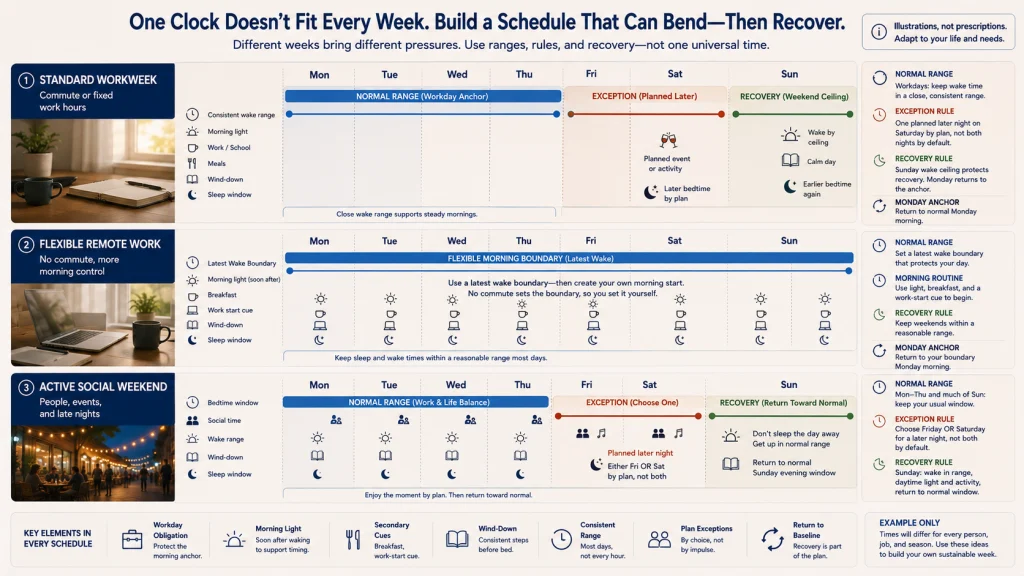
The framework changes shape with the week. An office worker may need the morning to hold steady. A remote worker may need a latest wake boundary because no commute creates one automatically. Someone with an active social weekend may need a clear choice about which night moves later. The times below are illustrations, not universal targets.
| Situation | Normal range | Exception rule | Recovery rule |
|---|---|---|---|
| Standard workweek | Wake between 6:15 and 6:45 a.m. on workdays, with a weekend ceiling of 7:45 a.m. | One planned late Saturday event may move bedtime later without opening the entire weekend. | Sunday stays inside the ceiling, and Monday resumes the workday wake range. |
| Flexible remote work | Wake between 7:00 and 8:00 a.m., with work beginning only after the morning anchor is complete. | A late night may move wake time within the range but not beyond the latest boundary. | The next morning resumes light, breakfast, and work-start cues in the usual order. |
| Weekend social activity | Bedtime usually falls within a one-hour window, while wake time stays close enough to protect Sunday night. | Friday or Saturday may be later for a planned event, but not both by default. | The following day avoids a full afternoon sleep period and returns toward the normal evening window. |
Each example protects a different pressure point. The useful schedule is the one that leaves enough room for sleep and keeps the next required day from feeling like a complete restart.
Review the schedule monthly using function and adherence
A monthly review is usually enough once the pattern is stable. Look at whether the chosen anchor stayed inside its normal range, whether exceptions remained limited, and whether the weekday schedule still protected enough opportunity for sleep.
Then look beyond the clock. Was alertness adequate for work, driving, caregiving, and other important tasks? Did the routine fit partner schedules, chores, guests, and family responsibilities, or did the same conflict break it every week?
Change one boundary at a time. When the plan repeatedly fails for the same reason, revise that part of the system instead of adding more alarms or stricter tracking.
Seek help when timing remains difficult or daytime impairment is severe
A maintenance plan does not diagnose or treat insomnia, a circadian disorder, medication effects, a mood condition, breathing-related sleep problems, or another medical cause. It also does not prescribe melatonin, sedatives, stimulants, medication timing, or clinical light therapy.
Safety warning: Do not drive or perform another attention-sensitive task when you are struggling to stay awake, having unintended sleep episodes, or unable to maintain attention. Stop the activity and arrange a safer alternative.
Seek qualified evaluation when the schedule remains difficult to maintain despite adequate sleep opportunity and a realistic range, or when severe daytime sleepiness, major mood or behavior change, breathing concerns, persistent impairment, or an unexplained pattern appears. A stricter alarm is not an appropriate answer to a problem that may need assessment.
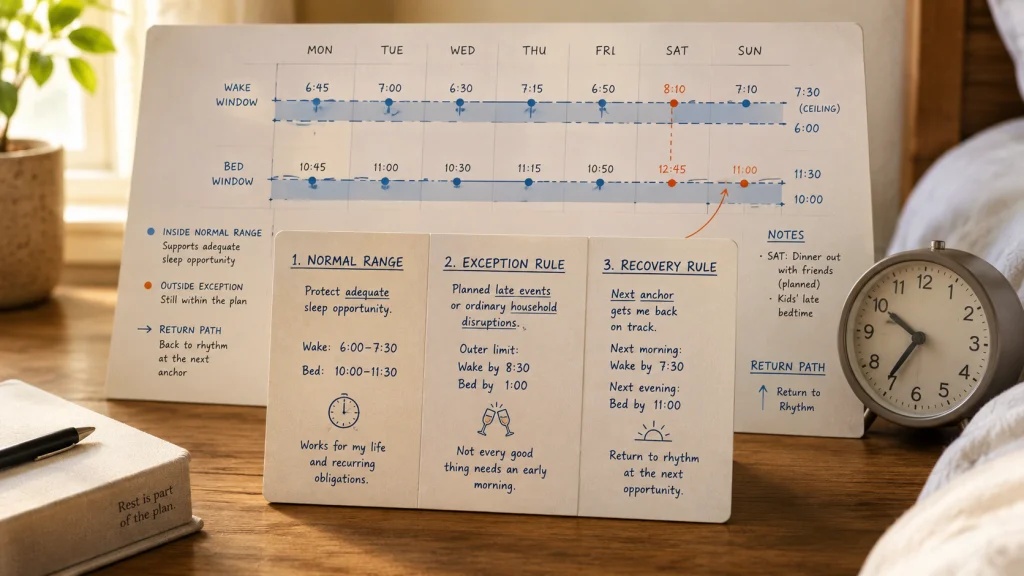
Write the normal range, exception rule, and recovery rule
The final plan should be easy to remember on the night when life does not follow the usual script. Write three short statements:
- Normal range: State the wake-time anchor, bedtime window, or dual range that fits ordinary obligations and adequate sleep opportunity.
- Exception rule: Define which events may move the schedule and the outer limit of that change.
- Recovery rule: Name the next anchor that resumes after the exception.
A complete plan might read: “My normal wake range is 6:30 to 7:00 a.m. on workdays and no later than 8:00 a.m. on free days. A planned late event may move bedtime once during the weekend. The following morning stays inside the ceiling, and the next evening returns to the normal preparation window.”
Use the broader sleep improvement guide when timing is only one part of the sleep problem. The point is not to protect a perfect chart. It is to know how the household returns to a workable rhythm after a late dinner, a missed alarm, a guest, or an ordinary change of plans.
FAQs
🕒 Does a consistent sleep schedule require the exact same time every day?
No. A practical schedule can use a normal range, an exception rule, and a recovery rule. The range should be stable enough to preserve the pattern without demanding identical minutes.
🌅 Is wake time more important than bedtime?
Wake time may be the stronger anchor when morning obligations are fixed. A bedtime window may lead when mornings are flexible but evenings are predictable. Some people need both.
😴 Is sleeping later on weekends always bad?
No. Limited catch-up may matter when weekday sleep opportunity has been insufficient. The goal is to avoid a large repeated reversal while correcting the weekday schedule that creates ongoing catch-up pressure.
📅 How should I handle one late social event?
Use a written exception rule that sets an outer bedtime boundary, a wake-time ceiling, and the next recovery anchor. A planned exception does not need to become a full weekend shift.
🏠 What if my partner or household follows a different schedule?
Choose the anchor you can protect independently, then coordinate shared light, meals, alarms, chores, and quiet periods where possible. The plan should acknowledge household reality rather than assume everyone follows one clock.
📱 Should I track my sleep schedule every night?
Not necessarily. Broad labels such as inside range, planned exception, and recovery day may be enough. Reduce or stop detailed tracking when it becomes rigid, upsetting, or more important than daytime function.
🔄 What if travel or illness moves the schedule for several days?
Resume the next safe and realistic anchor rather than demanding an instant return. When the schedule has shifted far from the target, use a repair plan instead of repeating the one-night exception rule.
🚗 When should I seek professional guidance?
Seek qualified evaluation when timing remains difficult despite adequate sleep opportunity and a realistic plan, or when severe sleepiness, unintended sleep, major mood change, breathing concerns, or persistent impairment appears. Do not drive when you are struggling to stay awake.