A workable personal hygiene routine for adults does not force every task into one morning or evening block. Start with the tasks already selected, assign each one to the timing type that actually fits, place active supplies where the task happens, and keep backups separate. Build minimum, standard, and expanded versions so the routine can continue through busy or disrupted days without doubling or over-washing later. Review the system after two weeks and change one timing or friction point at a time.

The Same Seven Tasks Can Create Two Very Different Routines
Two adults may choose the same seven hygiene tasks and still end up with routines that feel completely different. One person places all seven into a forty-minute morning block. The other uses a short morning anchor, an evening anchor, two event triggers, one periodic review, and a minimum fallback for difficult days.
| Same selected task | Overloaded version | Structured version |
|---|---|---|
| Morning care task | Added to one long sequence regardless of the day | Placed in a short morning anchor because that window supports it |
| Evening care task | Repeated in the morning for convenience | Kept near the end of the day because it connects naturally to bedtime |
| Hand-care action | Counted as one daily checkbox | Connected to the event that activates it |
| Post-activity care | Forced into a fixed clock time | Triggered after exercise, sweat, swimming, or another relevant event |
| Supply check | Added to every morning | Handled during a periodic review |
| Optional grooming | Treated as required baseline care | Placed in an expanded version that can be skipped |
| Fallback | No smaller version exists | A minimum version protects the most important selected tasks |
The tasks did not change, but the timing system did. A routine becomes more usable when each action has the right trigger, location, supply, and fallback instead of being squeezed into one long sequence.
Use the broader personal hygiene overview when you are still mapping the full care category. For the basic task framework, review personal hygiene basics before arranging the selected items into a routine.
Define the Parts of the Routine Before Scheduling Them
A routine becomes easier to adjust when each term has a clear role. Otherwise, an anchor can turn into a long checklist, a backup can become a second full setup, and a missed task can trigger unnecessary repetition.
| Term | What it means in this routine |
|---|---|
| Routine | The care actions you have chosen, along with when they happen, where they happen, what they require, and what happens on a disrupted day. |
| Anchor | A reliable part of the day that helps start a small group of appropriate tasks. |
| Event trigger | An action or situation that activates a task, such as toilet use, food handling, exercise, sweat, contamination, swimming, or product use. |
| Periodic review | A separate check for supplies, tools, personal items, and whether the routine still fits. |
| Minimum version | The shortest safe version that keeps the most important selected care actions visible. |
| Standard version | The usual personally selected routine when ordinary time, energy, and access are available. |
| Backup | A replacement supply or alternate plan stored separately for a defined disruption. |
| Restart | The rule for returning to the next appropriate task after a missed or disrupted window. |
These terms describe routine design, not health frequency. Exact timing for bathing, oral care, hair, menstrual care, intimate care, clothing, tools, or other body-area tasks belongs with the guidance that owns that topic.
Begin With the Completed Checklist
Do not build the routine by copying a morning sequence from another person. Begin with the care tasks already chosen for your own needs, then decide where each one fits in real life.
The personal hygiene checklist separates regular baseline care, event-triggered actions, periodic maintenance, optional grooming, and concerns that should be routed elsewhere. Bring those task names into the routine without changing their category.
For each task, write:
- A plain-language task name, such as the care step you complete before leaving home or the item you handle after use.
- The timing type that fits it.
- The location where it happens.
- The active supply needed at that location.
- The completion point that ends the task.
- The minimum version, when one is appropriate.
If a task cannot be placed without inventing a frequency, leave the timing open and route the question to the relevant detailed guidance. Routine design should organize an appropriate task, not create the health instruction itself.
Use Morning Anchors Only When the Window Helps
A morning anchor is useful when a care step fits naturally before leaving home, beginning work, or starting ordinary daytime activities. It is not a rule that every person must complete the same long sequence after waking.
Keep the anchor small enough to survive a normal delay. A routine that requires a completely open bathroom, several products, multiple setup steps, and forty uninterrupted minutes may fail whenever another household member needs the space.
Ask three questions:
- Does this task benefit from happening in the morning rather than at another suitable time?
- Are the required supplies available where the task occurs?
- Can the task still happen when the morning starts late?
When the answer to the third question is no, create a smaller version or move the task to a more reliable window. The anchor should protect useful care, not turn a late start into a failed day.
Use Evening Anchors for Tasks Tied to the End of the Day
An evening anchor works best for care steps that connect naturally to changing clothes, preparing for sleep, handling a used towel or tool, or closing down the bathroom area. It should not become a second long routine that repeats everything from the morning.
Choose a stable cue that usually occurs, such as entering the bathroom before bed or putting away the day’s clothing. Then place only the tasks that belong to that window.
Consider cleanup time as part of the routine. A product that requires drying, a tool that must be returned safely, or an item that needs to move to laundry adds steps beyond the visible care action. If those steps are ignored, the routine may look shorter on paper than it is in practice.
When the end of the day varies, use a flexible evening anchor rather than a fixed clock time. The cue should follow the person’s real schedule instead of demanding the same hour every night.
Use Event Triggers Instead of Forcing Every Task Into a Clock Time
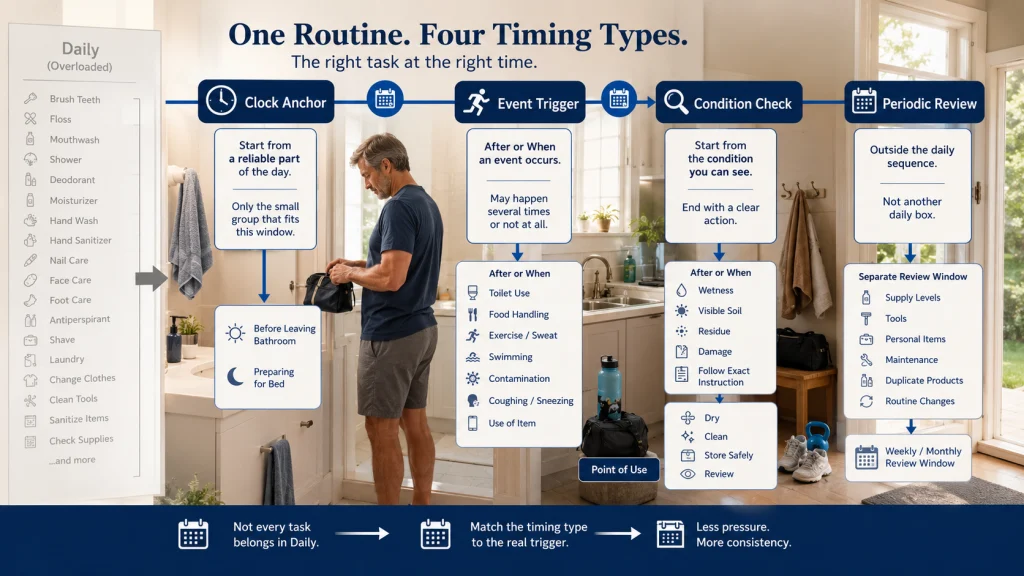
Some hygiene actions make sense only after something happens, not because the clock reaches morning or night. The task may be activated by toilet use, food handling, exercise, sweat, contamination, swimming, coughing or sneezing, or use of a personal item.
| Timing type | What activates it | Example routine wording | Where it belongs |
|---|---|---|---|
| Clock-based anchor | A reliable part of the day | Complete the care step assigned to the morning anchor after entering the bathroom. | Morning or evening routine |
| Event-triggered | A specific action or exposure | Complete the care step connected to that event, then return or dispose of the used item as planned. | At the point of use |
| Condition-based | A visible condition or exact instruction | Check for soil, wetness, residue, or the stated product condition. | Where the item is used or stored |
| Periodic | A review window or maintenance cue | Review supplies, tools, and personal items during the scheduled check. | Separate review list |
Writing the trigger makes the routine more accurate. It also prevents the person from counting one daily checkbox as complete when the task is actually linked to several different events.
Use Condition Checks for Soil, Wetness, Residue, and Product Instructions
Some tasks are activated by a visible condition rather than a clock or a repeated event. Examples include noticing that an item is wet, visibly soiled, holding residue, damaged, or no longer meeting the exact condition stated in its instructions.
A condition check should describe what the person is looking for. “Check personal items” is too vague. “Move the wet item to the drying location” or “Clean the used tool before storage according to its instructions” gives the routine a clear ending.
Do not create condition rules from guesswork. When a product has storage, drying, replacement, or safety instructions, follow the exact directions that apply to that item. When the question concerns body-area timing or symptoms, move it outside this routine-design article.
Condition checks are especially useful when a daily box would create unnecessary repetition. They keep maintenance connected to the actual state of the item rather than an arbitrary schedule.
Use Periodic Reviews for Supplies, Tools, and Routine Updates
A periodic review keeps maintenance out of the daily routine. It can cover supply levels, tool condition, personal items, storage problems, duplicate products, and tasks that no longer fit the person’s schedule.
During the review, check:
- Which active supplies are close to the refill point.
- Whether backups are still available and stored safely.
- Which tools or personal items need cleaning, drying, repair, or replacement according to their instructions.
- Whether any task has moved to a different point of use.
- Whether a morning or evening anchor has become unreliable.
- Whether optional grooming has slipped into the minimum routine.
The review should reduce routine clutter. If it only adds more boxes without changing any decision, shorten it to the checks that actually prevent disruption.
Keep Active Supplies at the Point of Use
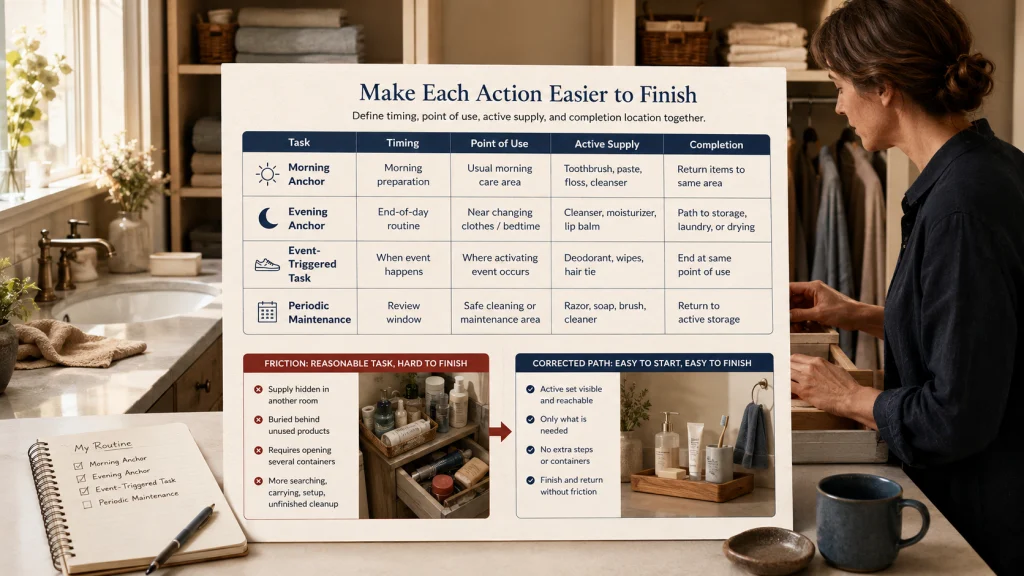
A care step becomes harder when its supplies live in another room, are hidden behind unused products, require several containers to be opened, or must be moved back and forth each day. Point-of-use organization places the active item close to the action while still following storage and safety instructions.
| Routine task | Timing type | Point of use | Active supply | Completion location |
|---|---|---|---|---|
| Care step assigned to the morning anchor | Morning anchor | Usual preparation area | One active set of required supplies | Returned to the same accessible place |
| Care step assigned to the evening anchor | Evening anchor | End-of-day care area | Only the items needed for that task | Storage, laundry, disposal, or drying location |
| Event-triggered task | After the defined event | Where the event occurs | Supply available without searching | Task ends at the same location |
| Periodic maintenance | Review window | Safe maintenance area | Permitted cleaning or replacement supplies | Item returned only when the maintenance step is complete |
Do not crowd the point of use with every product owned. Keep the active set visible enough to use, and move extras to a separate backup area. A clear sink edge or one reachable shelf can reduce more friction than adding another reminder to the phone.
Store Backups Separately and Use One Refill Trigger
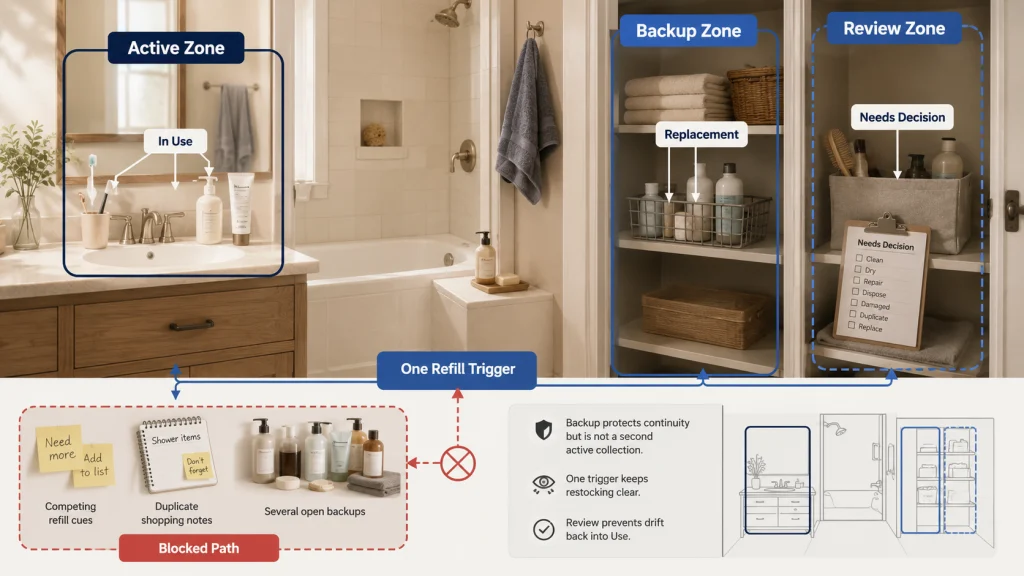
A backup should protect the routine from running out, not create a second active collection beside the sink or shower. Store replacements separately in a location that is safe, dry, and easy to review.
| Storage zone | What belongs there | Purpose |
|---|---|---|
| Active zone | The items currently in use for the routine | Keep the routine easy to see and complete. |
| Backup zone | One or more replacements kept according to storage instructions | Prevent interruption without crowding the point of use. |
| Review zone | Items that need a decision about cleaning, repair, disposal, or replacement | Keep uncertain items out of the active routine. |
Choose one refill trigger. It may be opening the final backup, reaching a marked supply level, or noticing during the periodic review that no replacement remains. Multiple competing triggers create duplicate shopping notes and make it harder to know whether the task is already handled.
The guide to selecting personal hygiene supplies can help reduce duplicates and identify what function each item serves without turning the routine into a shopping list.
Remove Duplicate Products and Optional Grooming From the Minimum Routine
Separate product lists can create separate routines for the same basic task. One item may be stored in the shower, another by the sink, and a third in a travel bag, even though all three are trying to support the same selected action.
Review the routine by function:
- Which real action in the routine does this item support?
- Is another active item already serving that function?
- Does the product require a separate setup or cleanup step?
- Is it part of baseline care or optional grooming?
- Does it belong in the active zone, backup zone, or review zone?
Optional grooming can remain in the routine when it matters to the person, but it should not sit inside the minimum version. Keeping it separate makes the fallback shorter and prevents appearance choices from being treated as universal care requirements.
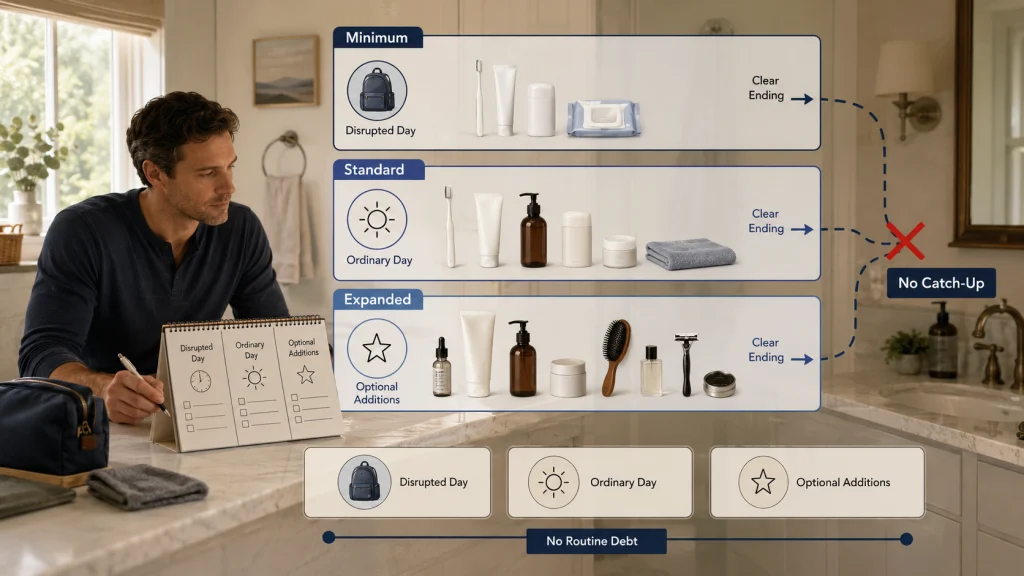
Build Minimum, Standard, and Expanded Versions
One routine cannot fit every day. A shorter version is useful during schedule disruption, fatigue, travel transfer, limited bathroom access, or a temporary household problem. An expanded version holds optional steps without making them part of baseline completion.
| Version | Purpose | What belongs here | What stays out |
|---|---|---|---|
| Minimum | Protect the most important care actions when time or access is reduced. | The few baseline actions and event-triggered steps that matter most on a disrupted day. | Optional grooming, duplicate products, extra setup, and tasks that can wait for periodic review. |
| Standard | Represent the usual routine on an ordinary day. | Morning or evening anchors, relevant event triggers, and normal cleanup. | Every possible task or product owned. |
| Expanded | Add preference-based grooming or extra care when time and interest allow. | Chosen styling, appearance, comfort, or occasion-based steps. | Symptoms, clinical care, or tasks that require individualized support. |
The minimum version should have a clear ending, so a busy morning or difficult evening does not remain open in the person’s mind. It is not a promise to complete the missing optional steps later. The standard version can return at the next suitable window without turning the day into a catch-up project.
Create a Missed-Task Rule Without Doubling or Over-Washing
A missed task should trigger a restart decision, not a penalty. Repeating a task, using more product, or adding extra washing does not repair the calendar and may create new irritation or friction.
- Check the next appropriate trigger: Resume when the task normally belongs instead of forcing it into an unrelated window.
- Use the minimum version when the current window partly remains: Keep only the care actions that still fit safely in the remaining time.
- Do not combine two full versions: A missed morning anchor does not require a double evening sequence.
- Record repeated disruption: If the same task is missed several times, review the timing, location, supply, setup, or cleanup burden.
The restart rule should make the next step obvious. When the problem is repeated cue failure rather than the routine structure itself, the guide to building hygiene habits can help connect tasks to workable reminders and restarts.
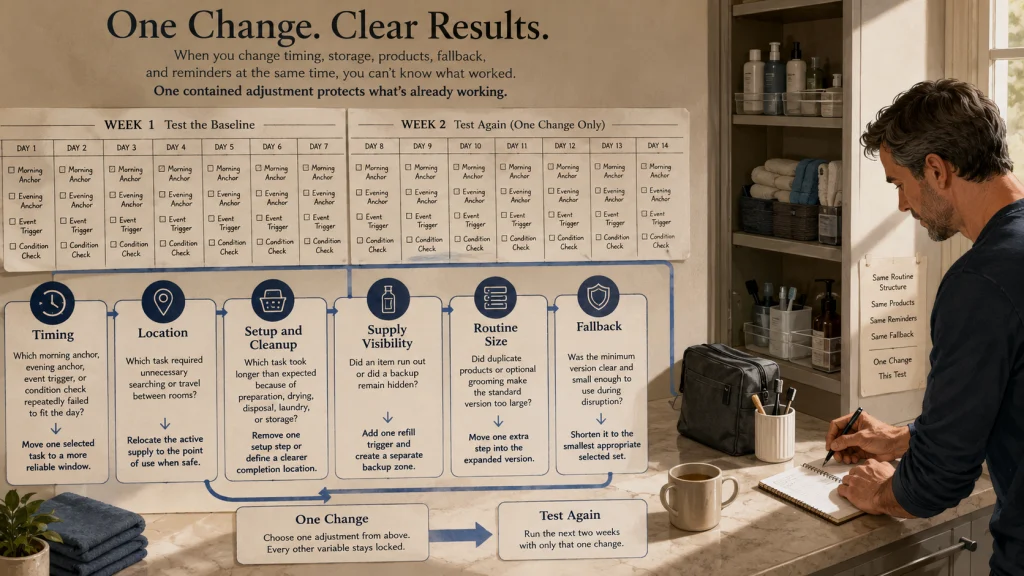
Test the Routine for Two Weeks and Change One Variable
Keep the main structure stable long enough to see where friction repeats. Changing the timing, product set, storage, fallback, and reminders all at once makes it difficult to know what improved the routine.
| Review area | Question | One possible change |
|---|---|---|
| Timing | Which anchor or trigger repeatedly failed to fit the day? | Move one task to a more reliable window. |
| Location | Which task required unnecessary searching or movement between rooms? | Relocate the active supply to the point of use when safe. |
| Setup and cleanup | Which task took longer than expected because of preparation or storage? | Reduce one setup step or define a clearer completion location. |
| Supply visibility | Was a task missed because an item ran out or a backup was hidden? | Use one refill trigger and a separate backup zone. |
| Routine size | Did optional grooming or duplicate products make the standard version too large? | Move one extra step to the expanded version. |
| Fallback | Was the minimum version clear enough to use during disruption? | Shorten it to the smallest appropriate set of care actions. |
Choose one change for the next two-week test. A small adjustment keeps the result easier to interpret and protects the parts of the routine that are already working.
Route Major Access, Disability, Distress, and Caregiving Barriers Elsewhere
Some barriers are not ordinary schedule friction. Significant mobility limitations, cognitive changes, severe executive-function difficulty, depression, obsessive-compulsive symptoms, trauma responses, dementia, supported care, caregiver dependence, homelessness, limited water access, or unsafe facilities may require individualized planning and qualified support.
Do not respond by making the routine stricter, adding more reminders, or assuming that a shorter checklist solves the underlying problem. The appropriate next step may involve accessible equipment guidance, environmental changes, caregiver planning, mental health support, social services, or medical evaluation.
Use appropriate support: When essential personal care cannot be maintained safely, or when the routine causes significant distress, injury risk, repeated skin damage, or conflict with a care plan, seek individualized assistance. This article does not create disability, caregiver, crisis, clinical, or condition-specific routines.
Write the Tasks, Timing, Locations, Fallback, and Review Date
Start with the care tasks already chosen, then assign each one to a morning anchor, evening anchor, event trigger, condition check, or periodic review. Record the point of use, active supply, backup location, and completion point.
Build minimum, standard, and expanded versions, then write a restart rule that resumes at the next appropriate trigger without doubling. Test the system for two weeks and change one timing or friction variable. A useful adult hygiene routine should fit the available bathroom, household schedule, storage, and real daily capacity rather than asking every task to happen in the same block.
FAQs
🌅 Does every adult need the same morning hygiene routine?
No. A morning anchor should contain only the care steps that benefit from that window and fit the person’s real schedule. Other tasks may belong in the evening, after an event, or in a periodic review.
🌙 Should the evening routine repeat everything from the morning?
No. Keep only the tasks tied to the end of the day, changing clothes, bedtime preparation, or handling used personal items. Repeating the full morning sequence can create unnecessary work.
⏱️ What is an event-triggered hygiene task?
It is a task activated by something that happens, such as toilet use, food handling, exercise, sweat, swimming, contamination, or product use. It belongs near the event rather than in one daily checkbox.
🧴 Should backups stay beside the active products?
Usually, active supplies and backups are easier to manage in separate zones. Keep the current items at the point of use and store replacements safely where one refill trigger can be reviewed.
🪶 How short can a minimum routine be?
It can be much shorter than the standard version, provided it keeps the few care actions that matter most in that situation. Optional grooming and duplicate steps should stay outside it.
🔁 Should I make up every missed hygiene task later?
No. Resume at the next appropriate trigger or use the minimum version when part of the current window remains. Do not combine two full routines or add extra washing to compensate for a missed time.
🧭 When is routine advice not enough?
Seek individualized support when disability, cognitive change, severe distress, caregiving needs, unsafe access, or another major barrier prevents essential care from being maintained safely. Those situations need more than schedule adjustments.