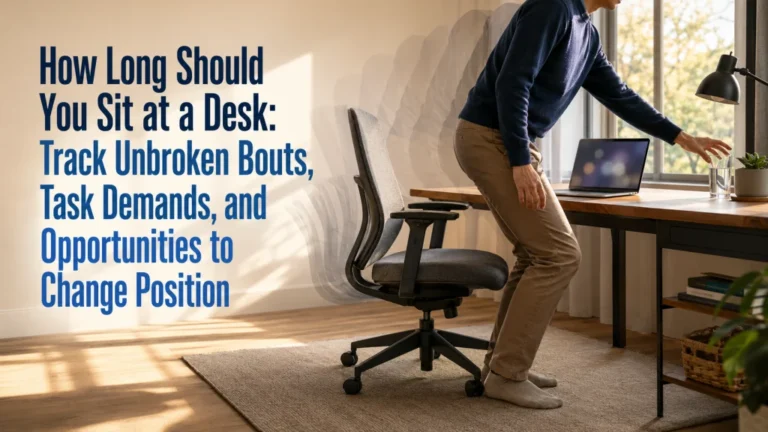
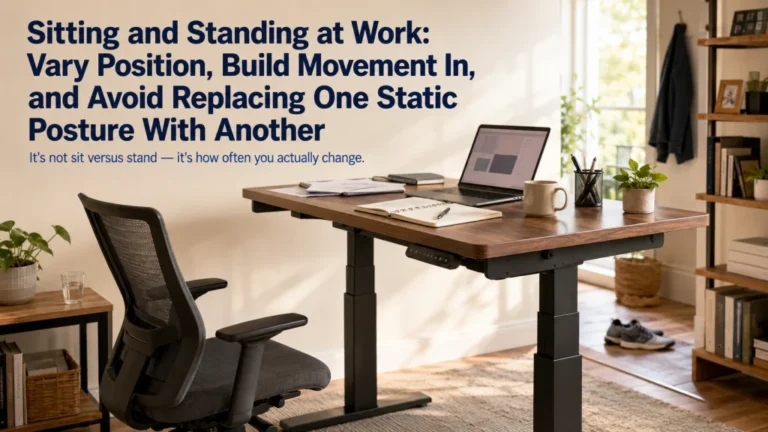
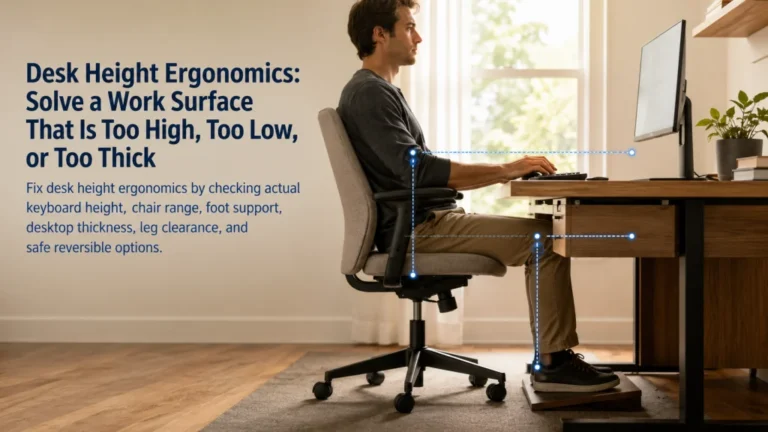
A neutral spine position is a comfortable reference that keeps the spine’s natural curves without pressing the back flat or forcing a larger arch. It is not one angle to copy or a pose to hold from morning to night. The useful position changes with the task, the support under the body, and the amount of movement available. Explore it gently in an ordinary unloaded position, use only the effort you need, and stop when symptoms or injury make self-guided positioning inappropriate.

Use a Three-Position Dial Instead of Hunting for One Exact Point
If you have ever been told to “keep your spine neutral,” you may have responded by correcting everything at once. The lower back gets flattened, then arched. The shoulders are pulled back. The pelvis is adjusted again. Soon, more attention is going into holding the pose than into the task itself.
A dial offers a calmer way to understand the idea. One end represents a more flexed or flattened position. The other represents a more extended or arched position. Between them is a usable area where the body is not pressing hard toward either end.
| More flexed or flattened | Usable reference area | More extended or arched |
|---|---|---|
| The trunk and pelvis move toward one end of the available motion | The body settles away from both extremes with manageable effort | The trunk and pelvis move toward the opposite end |
| May appear during a brief task, rest, or movement | Can serve as a starting point for many ordinary unloaded tasks | May appear during reaching, looking upward, or another short activity |
| Appearance alone does not prove harm | The exact look varies with the person, surface, and task | Appearance alone does not prove harm |
The useful part of the dial is the ability to move through it. You can notice both ends, then settle somewhere that feels less forced. That location may shift when you move from a chair to standing, when a backrest is added, or when the work moves closer.
Neutral is a range: Treat it as a reference area rather than a geometry score. Small changes can remain useful, and a task can briefly take the body outside that area before it returns.
The broader guide to what good posture means explains why a side-view outline cannot show effort, support, comfort, or task demands by itself.
A Neutral Spine Keeps the Natural Curves Available
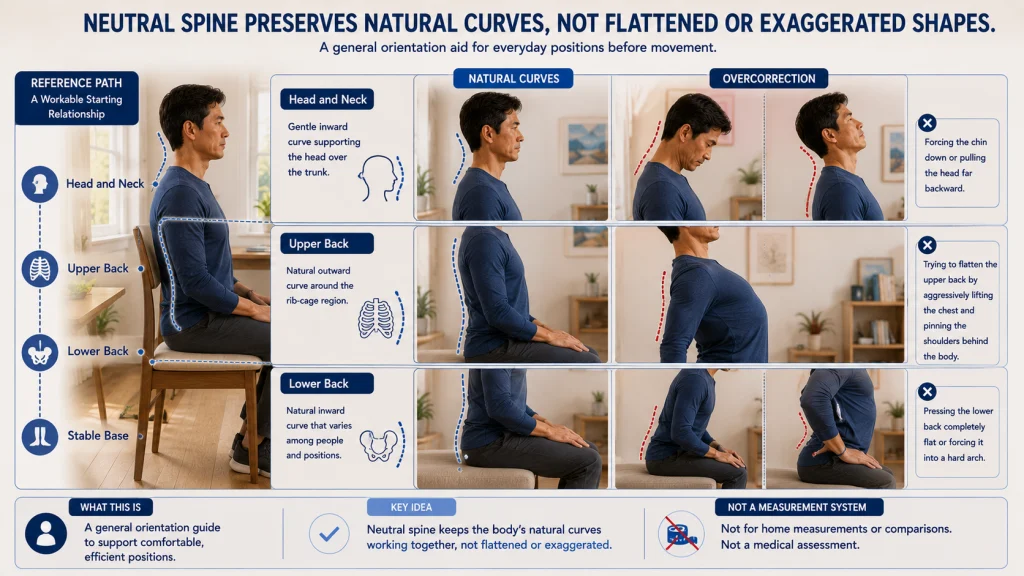
The spine is not one straight rod. From the side, it normally changes direction through the neck, upper back, and lower back. A neutral reference allows those curves to remain instead of trying to erase or exaggerate them.
| Side-view sequence | Natural curve | Common overcorrection |
|---|---|---|
| Head ↓ Neck | A gentle inward curve supports the head over the trunk | Forcing the chin sharply down or pulling the head far backward |
| Rib cage ↓ Upper back | A natural outward curve follows the rib cage region | Trying to flatten the upper back by pinning the shoulders behind the body |
| Pelvis ↑ Lower back | A natural inward curve varies among people and positions | Pressing the lower back flat or forcing it into a hard arch |
This diagram is a general orientation aid, not a home measurement system. A photograph cannot reveal exact spinal position, and this article does not prescribe pelvic angles, lumbar curve measurements, or a universal wall gap.
The purpose of the reference is practical. It gives the head, rib cage, pelvis, and spinal curves a workable starting relationship before the task introduces more movement.
Neutral Does Not Mean Making the Back Look Straight
The word “neutral” is easy to mishear as “straight.” That interpretation often produces a posture that looks controlled but feels like work. The lower back is flattened, the chest is lifted, the shoulders are pulled behind the body, and the chin is held in place.
A more useful reference is quieter. The natural curves remain visible, the rib cage is not being lifted aggressively, and the pelvis is not held at one forced angle. The head rests over the trunk without a dramatic correction.
The difference may be subtle in a photograph and obvious to the person holding it. One position asks for constant supervision. The other leaves more attention available for reading, working, or simply breathing normally.
Explore Both Directions Gently, Then Settle Away From the Extremes
A simple exploration can make the dial easier to understand. Use an ordinary unloaded position, such as sitting securely on a stable chair or standing comfortably without carrying anything. This is awareness practice, not stretching, treatment, or exercise technique.
Begin where you are. Move the trunk and pelvis a little toward a more rounded or flattened shape. Notice which parts follow. Then move gently in the other direction toward a larger arch. Keep both movements small enough that they feel controlled and easy to stop.
Now reduce the motion. Let the body settle somewhere that is no longer pressing toward either end. You may find a broad area rather than a precise spot, and it may not look exactly the same the next time.
- Use a stable base and an unloaded position.
- Keep the movement small and comfortable.
- Avoid copying an angle from a photograph or another person.
- Stop if the movement produces pain, numbness, tingling, weakness, dizziness, or loss of balance.
Note: This exploration does not test spinal health or correct pelvic position. It simply helps you notice the available motion and return to a less forced reference for an ordinary task.
Let the Head, Rib Cage, and Pelvis Settle Into an Easy Relationship
After exploring both directions, notice how the larger body regions are arranged. The goal is not to stack them like rigid blocks. It is to let them relate without one region being held far forward, far back, or under constant tension.
The head can rest over the rib cage without being pulled backward. The rib cage can sit over the pelvis without being lifted high. The pelvis can settle without being deliberately tucked or tipped.
Several small releases may help:
- Ease out of an exaggerated chin tuck or lift.
- Let the shoulders rest instead of pinning them backward.
- Release unnecessary chest lifting.
- Allow the pelvis to settle after exploring both directions.
- Use the seat, floor, backrest, or work surface when contact makes the task easier.
You should be able to return your attention to the activity. When the position requires constant monitoring, the chair, surface height, reach distance, or available support may be doing more to create the problem than your awareness is.
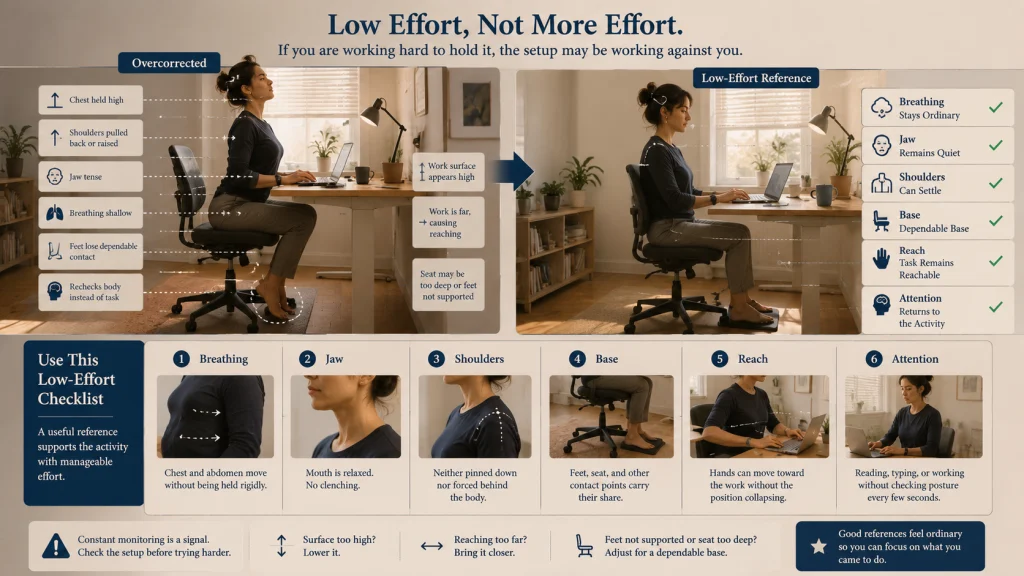
Notice the Signals That a Correction Is Costing Too Much Effort
Overcorrection often announces itself through small habits. Breathing becomes shallow. The jaw tightens. The shoulders rise or are pulled backward. The feet lose steady contact because the body is concentrating on the shape above them.
- Breathing stays ordinary. The chest and abdomen are not being held in place.
- The jaw remains quiet. Posture correction is not turning into clenching.
- The shoulders can settle. They are not being pinned down or back.
- The base feels dependable. Feet, seat, and other contact points are carrying their share.
- The task remains reachable. The position does not immediately collapse when the hands move toward the work.
- Attention returns to the activity. You are not checking the position every few seconds.
These signals are useful because they connect the position to real function. Raised shoulders may point to a high work surface. Repeated reaching may mean the task is too far away. Sliding in the chair may reflect seat depth or missing foot contact.
They are not medical tests. They help identify ordinary setup friction. The article on why a posture change can feel uncomfortable helps separate unfamiliarity from signs that self-guided positioning is no longer appropriate.
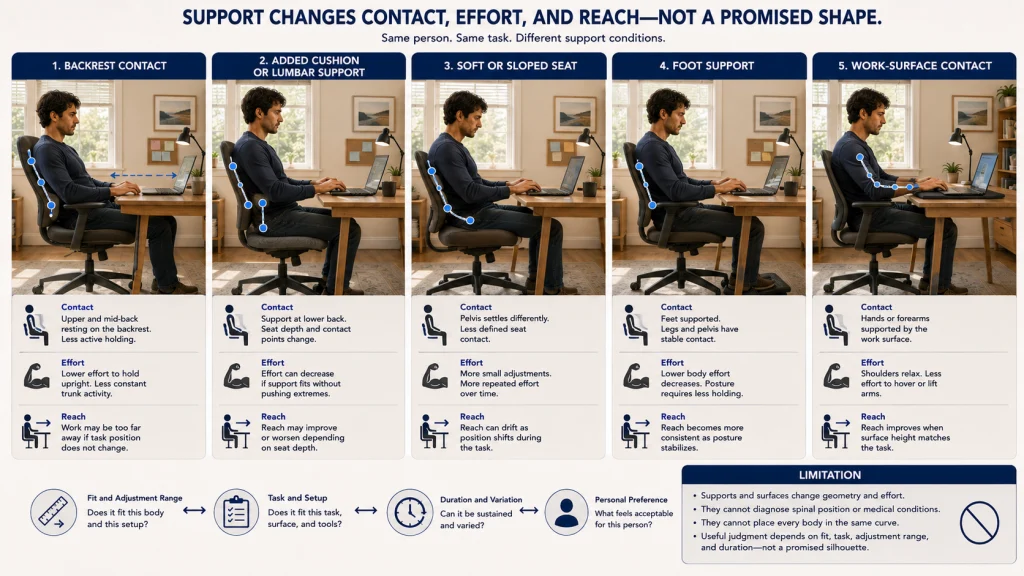
Chairs, Cushions, and Surfaces Change How the Body Settles
A person does not find neutral in empty space. A deep seat, firm backrest, soft cushion, reclined chair, sloped surface, or unsupported feet can change the relationship among the pelvis, rib cage, and work area.
| Support condition | What may change | Useful question |
|---|---|---|
| Backrest contact | The trunk may rest farther back with less active holding | Does the support fit the task, or place the work outside comfortable reach? |
| Added cushion or lumbar support | Seat depth, contact points, and the shape of the supported area may change | Does it reduce effort without pushing the body toward an extreme? |
| Soft or sloped seat | The pelvis may settle differently and foot contact may become less stable | Can the body stay balanced without repeated repositioning? |
| Foot support | The lower body may become steadier, changing how the trunk rests | Do the feet have dependable contact without pressing or reaching? |
| Work-surface contact | Forearm or hand support may reduce work higher in the body | Does the surface help without forcing the shoulders upward? |
A support can make a task easier, but it cannot identify a medical spinal position or prove that a curve has been corrected.
Editorial observation: Lumbar rolls, seat backs, cushions, recline, and seat depth all change contact and geometry. Their usefulness depends on fit, adjustment range, task, and duration rather than a promise that every user will be placed in the same spinal shape.
The guide to checking posture without diagnosing it offers a broader way to observe body position, support, and task setup.
Sitting, Standing, Reaching, and Movement Use Different References
A seated position cannot look identical to a standing one because the base of support has changed. Reaching alters the picture again because the body may incline, rotate, or shift weight to bring the hands where they need to go.
In sitting, the seat, feet, backrest, and work surface shape the position. In standing, the floor and the placement of the feet become more important. During reaching, the body may move away from its quiet reference and return when the larger movement is no longer needed.
That departure is part of normal movement, not evidence that the posture has failed. The reference matters because it gives the body an organized place to begin and return to, not because every task must remain inside one silhouette.
Body proportions also change appearance. Two people can use the same general idea and still show different curves, head positions, or distances from the work.
The wider posture improvement process connects positioning with awareness, movement, and environmental changes instead of asking one shape to solve every task.
Even a Well-Supported Reference Can Become Tiring
A position may feel easy at the start of a task and less useful later. That change does not mean you chose incorrectly. Contact pressure builds, attention shifts, and muscles continue working even when the outline still looks unchanged.
Think of a long phone call. You may begin sitting forward with notes, settle against the backrest while listening, stand to find a document, and return in a different position. Each change serves a different part of the same task.
Small variations count. Move one foot, change where the forearms rest, lean back briefly, stand for another part of the activity, or walk before returning.
The guide to static and dynamic posture explains why stillness and movement both have roles.
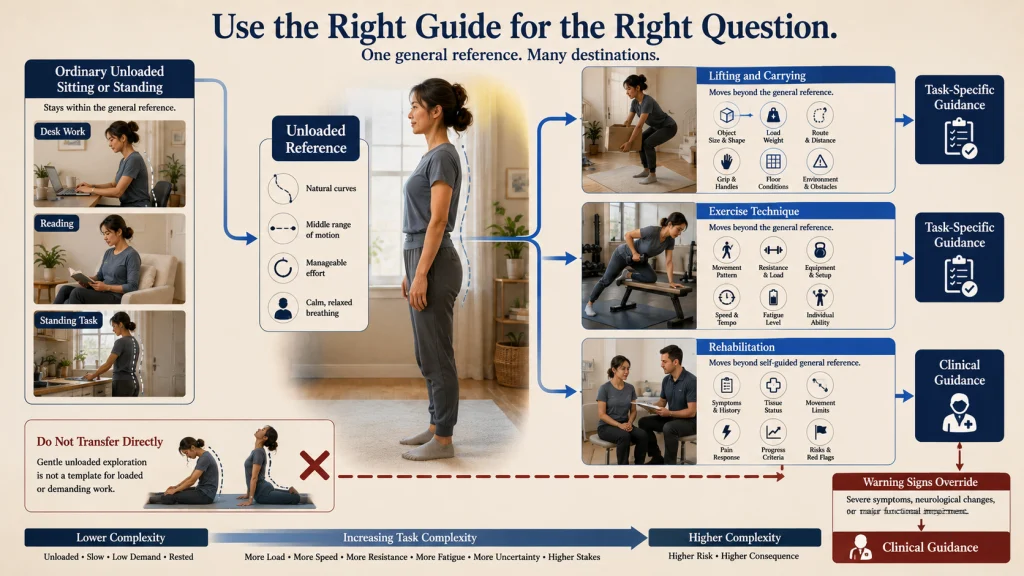
Keep Lifting, Exercise Form, and Rehabilitation Outside This General Reference
Neutral spine language is often used during lifting and exercise, but those activities add load, speed, resistance, fatigue, and technique demands that are not covered by this general unloaded exploration.
- Ordinary unloaded sitting or standing: Use this article to understand the middle-range concept.
- Lifting or carrying: Use task-specific guidance that accounts for the object, load, route, grip, and environment.
- Exercise technique: Use instruction appropriate to the movement, resistance, equipment, and individual ability.
- Rehabilitation or symptom treatment: Use qualified clinical guidance rather than general posture cues.
Do not transfer a gentle seated exploration directly into a loaded lift or exercise. A cue that helps one unloaded task may be incomplete or unsuitable when force and speed change.
The broader posture and ergonomics overview helps place neutral spine within a larger set of task, movement, and environment decisions without turning it into a universal technique.
Stop for Pain, Neurological Symptoms, Injury, or Major Asymmetry Concerns
Self-guided exploration should stop when the issue is more than an ordinary positioning question. Do not keep moving between flexion and extension in an attempt to diagnose or correct a symptom.
Seek appropriate professional evaluation: New, severe, persistent, worsening, or unexplained pain; numbness; weakness; tingling; balance changes; symptoms after a fall or injury; or a visible change that is new, progressive, or limiting normal function should be assessed by a qualified professional. Loss of bowel or bladder control, chest pain, severe shortness of breath, or fainting requires immediate appropriate help.
A major asymmetry concern cannot be evaluated from a mirror, wall test, photograph, or comparison with an online diagram. Do not use a cushion, brace, app, or posture cue to diagnose a spinal, joint, nerve, balance, connective-tissue, or musculoskeletal condition.
Lifestyle troubleshooting ends when symptoms or functional limits suggest that ordinary support and positioning changes are not enough.
Use Neutral as a Starting Place, Then Let the Task Continue
Neutral spine is a practical reference between more flexed and more extended positions. Find it gently in an ordinary unloaded position, keep the natural curves available, and avoid turning the head, rib cage, or pelvis into something that must be held perfectly still.
The position has done its job when it helps you begin with less unnecessary effort and leaves enough freedom to breathe, reach, and move. It is a starting place you can return to, not a pose that should take over the rest of the day.
FAQs
🧭 What is a neutral spine position?
It is a comfortable middle range that preserves the spine’s natural curves without forcing the back flat or exaggerating an arch. The exact appearance changes with the person, support, and task.
🌿 Is neutral spine one exact angle?
No. Neutral is a usable range rather than one measurement or frozen point. Small changes can remain within a practical middle, especially when the task or support changes.
🪑 Can a cushion help me find neutral?
A cushion can change contact, seat depth, and how the pelvis or trunk is supported. It may reduce effort for one person or task, but it cannot identify a medical spinal position or place every body in the same shape.
🔄 Should I hold neutral spine all day?
No. Even a comfortable middle can become tiring when held. Use it as a reference, then allow small shifts, different support, standing, or movement when another position fits the task better.
🏋️ Does this neutral spine method apply to lifting and exercise?
Not by itself. Lifting and exercise involve load, movement, fatigue, equipment, and task-specific technique. Use guidance that is designed for the actual activity rather than transferring an unloaded positioning cue directly.
🚩 When should I stop exploring the position on my own?
Stop when pain is new, severe, persistent, worsening, unexplained, or linked to an injury, or when numbness, weakness, tingling, balance changes, or functional limits are present. Emergency signs require immediate appropriate help.