Posture claims become easier to evaluate when the promised outcome and evidence type are separated. A position may affect comfort, workload, reach, or short-term symptoms during a task without proving the cause of a medical condition or predicting long-term damage. One photograph cannot establish causation, standing is not automatically better than sitting, and a chair, brace, or sensor cannot correct the task by itself. Ask who the claim applies to, what task and duration were studied, whether the evidence shows association or causation, and what limits remain. Use neutral positioning, task fit, position variation, and symptom monitoring as practical tools, while routing persistent or concerning symptoms to appropriate professional evaluation.
Four Posture Claims Need Four Different Evidence Questions
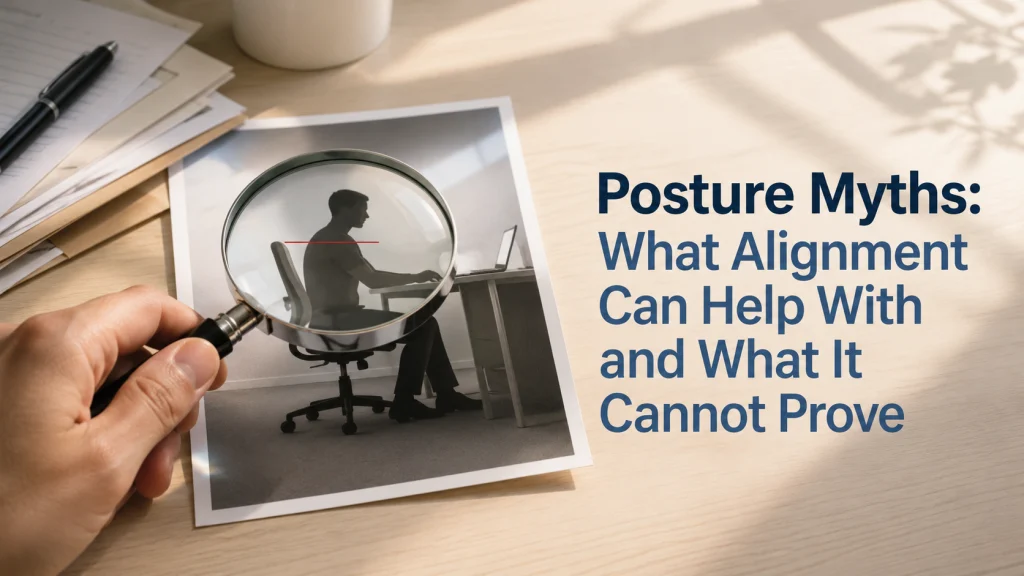
A clinic-style diagram shows one upright outline beside a rounded one. A product package promises alignment support. A social post places a red line over a side-view photograph. A research abstract reports an association between a position and discomfort.
Seeing these messages in the same week can leave a person unsure whether to correct every visible curve, ignore posture entirely, or buy something that promises certainty. The confusion is understandable because all four surfaces may look authoritative at a glance while making very different kinds of claims.
- Clinic-style diagram: Is this a general reference, a task-specific suggestion, or a diagnostic statement?
- Product package: What mechanism, adjustment, wear limit, user fit, and evidence level support the wording?
- Social photograph: Can one still image show duration, movement, symptoms, task demand, or medical cause?
- Research abstract: Does the study report comfort, immediate symptoms, association, a clinical episode, or long-term causation?
The first useful move is not to stamp each card true or false. It is to ask what outcome the claim is trying to explain and whether the evidence can support that level of certainty.
The broader posture and ergonomics framework provides practical context for tasks, supports, reach, and movement. This article focuses on evaluating the claim itself.
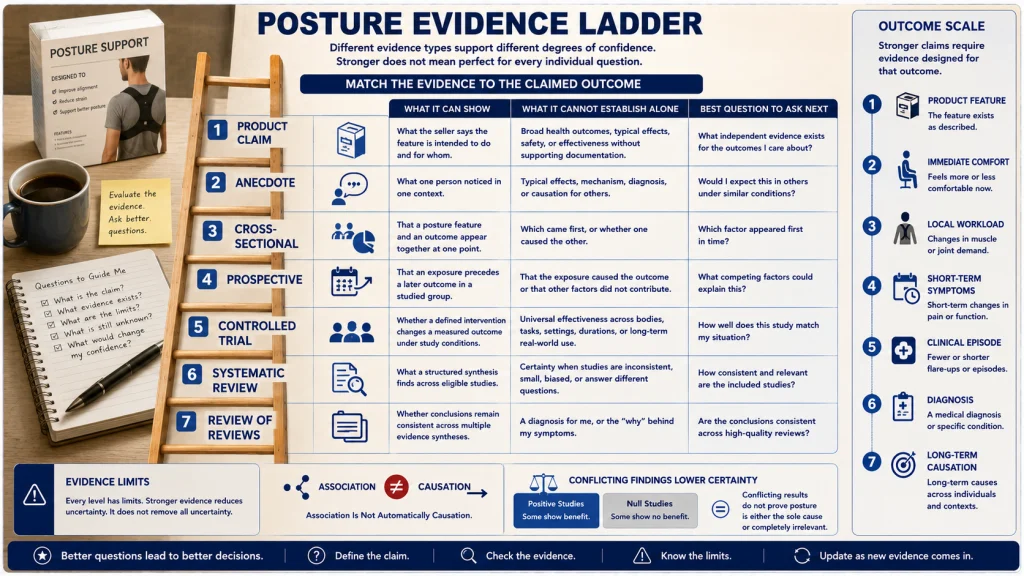
Build an Evidence Ladder From Marketing and Anecdote to Reviews
Evidence types answer different questions. Moving upward on the ladder can improve confidence, but no study design automatically answers every posture question.
| Evidence level | What it can show | What it cannot establish alone |
|---|---|---|
| Product claim | What a seller says a feature is intended to do | General health outcomes beyond the exact supporting documentation |
| Personal anecdote | What one person noticed in one context | Typical effects, mechanism, diagnosis, or causation for others |
| Cross-sectional observation | Whether a posture feature and an outcome appear together | Which came first or whether one caused the other |
| Prospective observation | Whether an exposure precedes a later outcome in a studied group | Complete control of other contributing factors |
| Controlled trial | Whether a defined intervention changes a measured outcome under study conditions | Universal effectiveness across bodies, tasks, settings, and durations |
| Systematic review | What a structured synthesis finds across eligible studies | Certainty when the included studies are inconsistent, limited, or answer different questions |
| Review of reviews | Whether conclusions remain consistent across multiple evidence syntheses | A diagnosis or individualized explanation for one person’s symptoms |
An umbrella review of spinal posture, physical exposure, and low back pain reported both positive and null associations across prior reviews and did not find consensus on causality. That does not prove posture is irrelevant. It shows why an observed association should not be promoted into a single-cause explanation.
Myth: One Posture Is Correct for Every Body and Task
A workable position for reading a document is not automatically the best position for lifting, driving, cooking, gaming, or resting. Body dimensions, task reach, visual demand, support, force, and time all change the problem.
A reference position can still be useful. It may help someone notice whether the feet have support, the work is within reach, breathing feels unrestricted, or one joint is held near an uncomfortable end range.
The mistake is turning that reference into a universal silhouette that must be held all day. Even a low-effort position can become tiring when the person is static for too long or the task requires repeated force and reach.
Use a workable posture reference to compare effort and task fit without treating one visible shape as a rule for every situation.
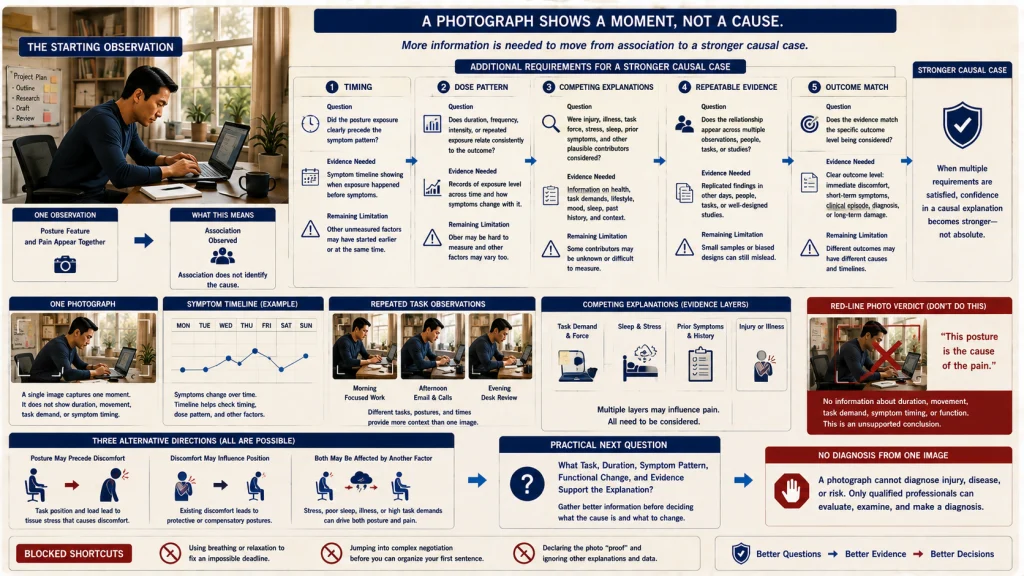
Myth: Visible Slouching Proves the Cause of Pain
A photograph can show a position at one moment. It cannot show how long the person stayed there, how often the position changed, what the task required, when symptoms began, or whether another condition is involved.
Pain and posture can also influence each other in more than one direction. A person may choose a position because it feels easier during symptoms. Another person may notice discomfort after a sustained task. A third may use a similar visible position without the same experience.
Posture feature and pain appear together → association observed
Association + timing + dose pattern + competing explanations + repeatable evidence → stronger causal case
One photograph or one correlation → insufficient to identify an individual cause
The better question is not “Does this image look wrong?” It is “What task, duration, symptom pattern, functional change, and evidence support the explanation being offered?”
Myth: Posture, Duration, Task, and Discomfort Have No Practical Relationship
Rejecting fear-based claims does not require pretending that every position and task demand feels the same. Work that stays distant, repetitive, forceful, or static can change local effort and comfort.
NIOSH risk guidance treats awkward posture, static posture, force, repetition, intensity, frequency, and duration as parts of work-task assessment. This is a task-risk framework, not proof that one visible posture explains every symptom.
A separate sitting review found that prolonged sitting was associated with immediate increases in reported low back pain in the included studies, while stating that conclusions about clinical episodes could not be made. Immediate symptom reporting and a diagnosed or persistent pain condition are not interchangeable outcomes.
The more useful middle position is practical: reduce avoidable task strain, vary positions when possible, and monitor what changes during the actual activity without promising a medical result.
Myth: Shoulders Back and Constant Core Bracing Are Universal Corrections
Pulling the shoulders back or tightening the abdomen can create the appearance of correction without addressing the screen, reach, chair, workpiece, or task duration that produced the position.
For some people, the cue also adds effort. The ribs may lift, breathing may feel restricted, the jaw may tighten, or the upper back may fatigue. Those responses do not prove that the previous position was ideal. They show that the correction itself deserves review.
A lower-force reset is more informative: make the target easier to see, move the task closer, reconnect available support, reduce unnecessary bracing, and allow another workable position.
If an upright attempt creates persistent or concerning discomfort, review why posture correction can feel uncomfortable rather than forcing the cue harder.
Myth: One Photo or Wall Test Diagnoses the Problem
A photograph or wall check can create a repeatable observation. It may show where the head, shoulders, trunk, or pelvis appeared relative to a reference at that moment.
It cannot diagnose a spinal, joint, nerve, balance, connective-tissue, or musculoskeletal condition. It also cannot establish the cause of pain or determine which treatment a person needs.
Use a check for a narrow practical purpose: compare the same task before and after moving a screen, changing reach, or adding stable support. Record comfort, breathing, effort, and function rather than treating visual symmetry as a medical result.
The guide to checking posture in context keeps the observation tied to the task and its limitations.
Myth: Standing Is Automatically Better Than Sitting
Sitting and standing change how the body meets the surface and reaches the task. Neither label tells you whether the work area fits, the position has continued too long, or symptoms are changing.
A standing setup can still involve a low screen, distant keyboard, locked knees, leaning on one side, unsupported arms, or prolonged effort. A seated setup can still allow stable support, ordinary movement, and close task reach.
The better comparison is task-specific: which position supports the work with less unnecessary effort, and when would changing position make the task easier?
Movement and position variation may be useful without turning either sitting or standing into the superior state for every person and every task.
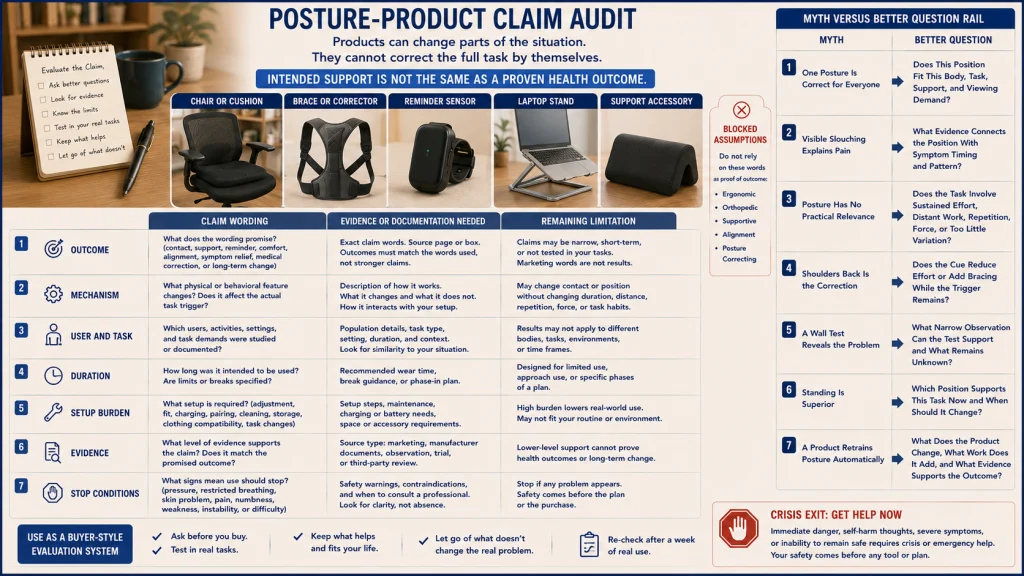
Myth: A Chair, Brace, or Sensor Corrects Posture by Itself
A product can change contact, height, reach, feedback, or available support. It cannot independently decide whether the task fits, whether the user understands the controls, or whether the new position is sustainable.
Nora’s merchandising lens begins with the words on the package. Terms such as “ergonomic,” “posture correcting,” “orthopedic,” “supportive,” and “alignment” may describe an intended feature without stating the exact mechanism, required adjustment, user fit, wear limit, or evidence level.
- What exact outcome is claimed: contact, reminder, comfort, alignment, symptom relief, or medical correction?
- What mechanism is described, and does it change the actual task trigger?
- Which users, tasks, and durations were studied?
- What adjustment, setup, charging, cleaning, storage, or wear limit is required?
- Does the documentation distinguish intended support from health outcomes?
- What discomfort, pressure, restricted breathing, skin problem, or functional issue means use should stop?
- Does the claim require current manufacturer documentation or professional interpretation?
After the individual myths are separated, each can be replaced with a question that is specific enough to evaluate.
| Claim | Better question |
|---|---|
| One posture is correct for everyone | Does this position fit this body, task, support, and viewing demand? |
| Visible slouching explains pain | What evidence connects this observed position with the symptom pattern and timing? |
| Posture has no practical relevance | Does the task involve sustained effort, distant work, repeated motion, or too little variation? |
| Shoulders back is the correction | Does the cue reduce effort, or does it add bracing while the trigger remains? |
| A wall test reveals the problem | What narrow observation can the test support, and what remains unknown? |
| Standing is superior | Which position supports this task now, and when should it change? |
| A product retrains posture automatically | What does the product change, what work does it add, and what evidence supports the promised outcome? |
These questions reduce certainty without making the topic meaningless. They turn a visual slogan into a claim that can be checked against task details, documentation, evidence type, and limitations.
General product comparison belongs in the ergonomic equipment workflow. This article does not recommend a brace, medical device, chair, or sensor.
What Neutral Positioning, Task Fit, Variation, and Symptom Monitoring Can Support
Reasonable ergonomic principles do not require a promise of disease prevention or permanent correction.
Neutral positioning can provide a lower-effort reference away from an uncomfortable end range. Task fit can make the work easier to see and reach while reducing unsupported holding. Position variation can reduce the demand to maintain one shape continuously. Symptom monitoring can show whether comfort, breathing, effort, or function changes during a real task.
These tools support troubleshooting. They do not prove the cause of pain or guarantee that changing a position will prevent injury.
The neutral spine guide explains a flexible reference rather than a rigid pose. The article on repeated slouching triggers shows how task demand can pull someone back into the same position.
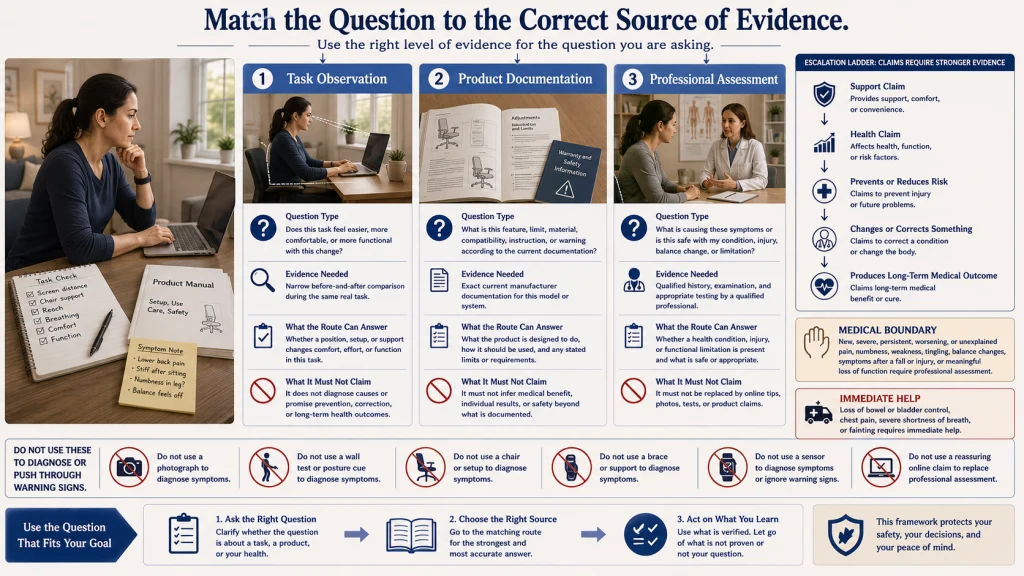
Know When a Claim Needs Documentation or Professional Assessment
A product claim needs current documentation when it refers to an exact adjustment function, wear instruction, compatibility limit, material, warranty, sensor behavior, or intended use.
A health claim needs stronger evidence when it moves from comfort or support into preventing injury, correcting a condition, treating pain, changing anatomy, or producing a long-term medical outcome.
Professional assessment becomes appropriate when a person’s question is no longer “Does this task feel easier?” and becomes “What is causing these symptoms?” or “Is this safe with my condition, injury, balance, or functional limitation?”
Medical boundary: Seek appropriate professional evaluation for new, severe, persistent, worsening, or unexplained pain; numbness; weakness; tingling; balance changes; symptoms after a fall or injury; or a meaningful loss of function. Loss of bowel or bladder control, chest pain, severe shortness of breath, or fainting requires immediate appropriate help. Do not use a posture cue, photograph, brace, chair, sensor, or online claim to diagnose or push through these signs.
Ask What Outcome, Population, Task, Duration, Evidence, and Limitation Support the Claim
Begin with the outcome. Is the claim about immediate comfort, local workload, short-term symptoms, a clinical episode, diagnosis, long-term causation, or a product feature?
Then ask who was studied, what task they performed, how long the exposure lasted, how the posture was measured, what comparison was used, and which competing explanations remain.
A careful answer may feel less satisfying than a red line on a photograph or a correction promise on a package. It does not offer the quick certainty that many worried readers are looking for. What it offers instead is a safer way to make a practical change without turning one image, one cue, or one product into the explanation for everything.
Use the posture improvement framework when the next question is practical rather than evidentiary. Change the task, support, reach, or position for a clear reason, monitor the result, and stop when symptoms or functional limits require professional evaluation.
FAQs
🧍 Is there one correct posture for everyone?
No single position fits every body, task, surface, and duration. A neutral reference can help compare effort and support, but it should allow ordinary movement and task-specific variation.
📷 Can a posture photo explain why someone has pain?
A photo shows one moment and cannot establish causation or diagnosis. It does not capture duration, movement, symptom timing, task demand, or competing medical explanations.
🪑 Does posture have no relationship to discomfort?
That conclusion is also too broad. Reach, force, repetition, static effort, contact, and duration can affect comfort and task workload without proving that one posture caused a medical condition.
💪 Should I keep my shoulders back and core tight?
Constant bracing is not a universal correction and may add effort or breathing restriction. A lower-force reset should address viewing, reach, support, and position variation.
🧱 Can a wall test diagnose a posture problem?
No. A wall test may provide a repeatable visual observation, but it cannot diagnose a spinal, joint, nerve, balance, or musculoskeletal condition.
⬆️ Is standing always better than sitting?
No. Both positions can be supportive or demanding depending on task fit, reach, contact, force, and duration. The useful goal is a workable position with opportunities to change.
🏷️ Do ergonomic products correct posture automatically?
A product may change contact, height, support, or feedback, but it cannot correct the complete task by itself. Review the exact claim, setup burden, fit, limitations, and current documentation.
🚩 When does a posture question need professional evaluation?
Seek evaluation for new, severe, persistent, worsening, or unexplained pain; numbness; weakness; tingling; balance changes; injury-related symptoms; or meaningful loss of function. Emergency signs require immediate appropriate help.