Improving indoor air quality at home begins by noticing what changes before reaching for a product. Handle alarms, smoke, gas, combustion, and severe symptoms first, then connect the room condition with a source, activity, or air pathway. Reduce what can be controlled, use local exhaust where moisture or pollutants are created, bring in outdoor air only when conditions are suitable, and use filtration for the particles and space it can reasonably address. A short record of the event and the result can show whether the first change helped or whether the problem belongs with a building professional, utility, property manager, or medical professional.
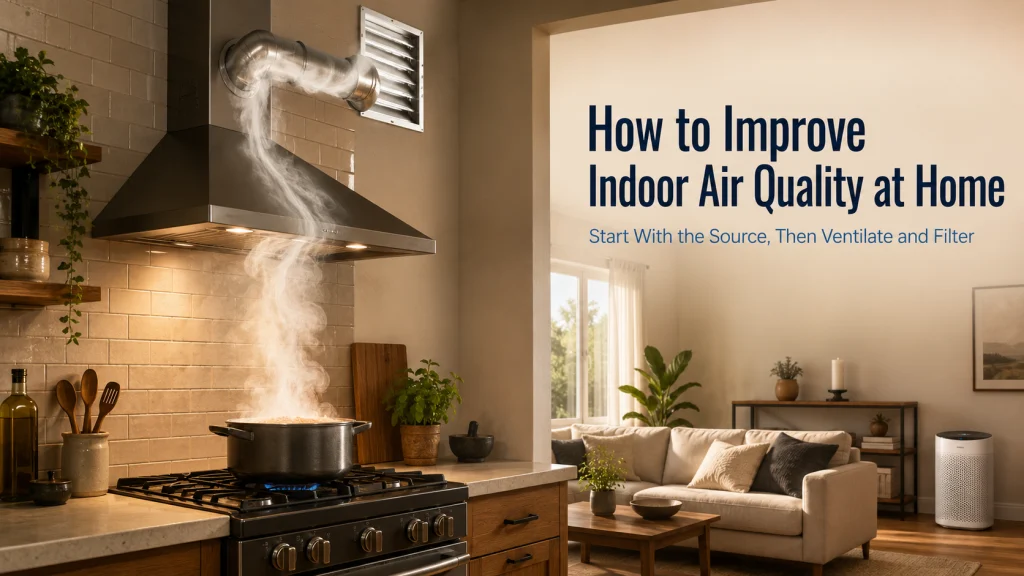
The Fragrance Changes the Smell, but the Cooking Source Remains
Picture a kitchen opening into a living room. A scented product is running because dinner odors have spread beyond the kitchen. A portable air cleaner is working nearby, while the range hood recirculates air back into the room instead of sending it outdoors.
The room may smell different after the fragrance is added. The air cleaner may capture some particles that reach it. Neither action changes the fact that cooking is still producing heat, moisture, particles, gases, and odor at the stove.
| Response | What it changes | What remains unresolved |
|---|---|---|
| Add fragrance | The sensory experience of the odor | The source event and the material released during cooking |
| Run a portable filter | Selected airborne particles that pass through the unit | Gases, moisture, source strength, and material that never reaches the filter |
| Reduce the source | The amount created during the activity | Any material already spread through the home |
| Exhaust outdoors at the source | Air and contaminants removed near the cooking area | Conditions the exhaust does not capture and outdoor-air limits |
| Ventilate when outdoor conditions allow | Dilution and replacement of some indoor air | An ongoing source that continues faster than the air exchange can manage |
This comparison sets the order for the whole article. Start with the event creating the condition. Then consider the pathway carrying it, the local exhaust available, the suitability of outdoor air, and only after that the role of filtration.
Editorial observation: Retail displays make purifiers, odor absorbers, candles, sprays, humidifiers, dehumidifiers, vacuum cleaners, HVAC filters, and fans easy to compare as purchases. The easiest item to place on a shelf is not always the control that reaches the source.
The guide to understanding indoor air quality explains the source, pathway, condition, and control model behind this order.
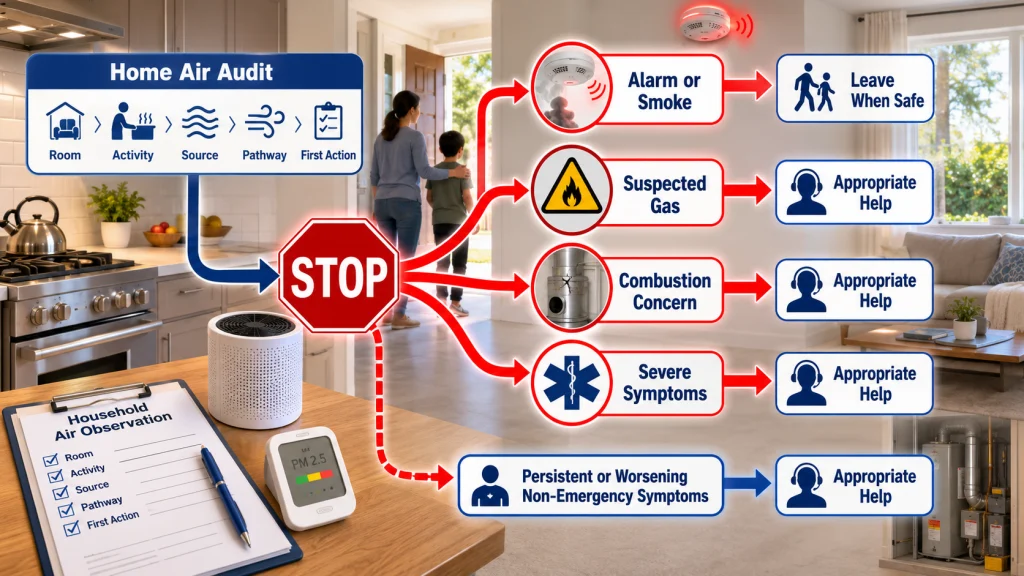
Start With Alarms, Gas, Smoke, Combustion, and Severe-Symptom Stop Conditions
Do not begin a household air audit while an urgent danger may be active. A sounding alarm, visible smoke, a suspected gas leak, or severe symptoms takes priority over windows, filters, cleaning, or monitor readings.
Emergency action: If a smoke or carbon monoxide alarm sounds, fire or smoke is visible, or a gas leak is suspected, leave the area when it is safe to do so and contact emergency or utility services as appropriate. Severe breathing difficulty, chest pain, fainting, confusion, blue or gray lips, or other emergency signs require immediate appropriate help.
Do not silence an alarm and remain inside to compare odors. Do not use a consumer monitor to clear the space. Do not attempt to modify a combustion appliance, flue, vent, or fuel connection as part of ordinary indoor-air troubleshooting.
Possible combustion backdrafting, repeated alarm activation, appliance defects, and building-system concerns require appropriately qualified assessment. Persistent or worsening symptoms require qualified medical guidance even when a household pattern seems obvious.
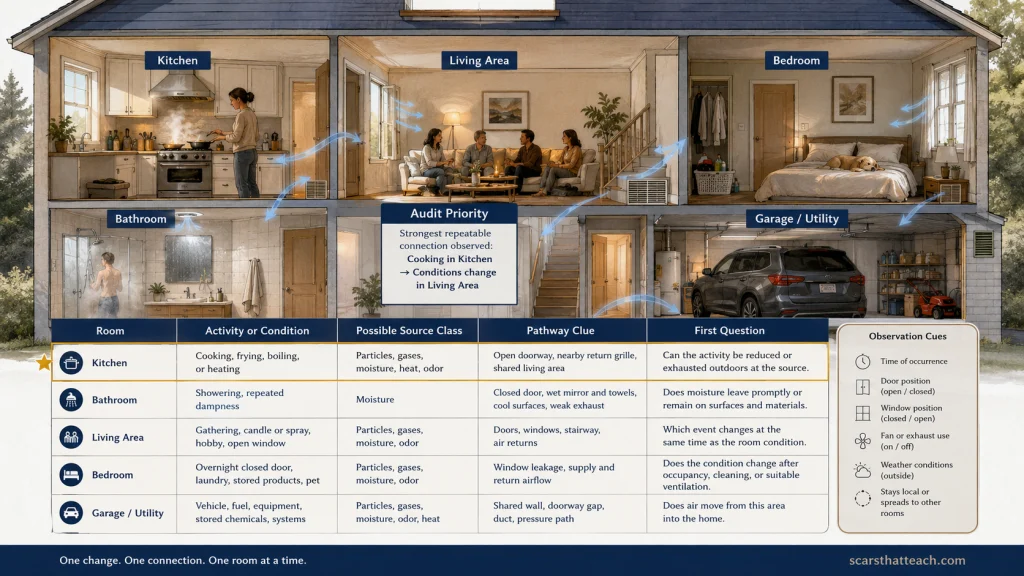
Build a Room-by-Room Source and Activity Inventory
After urgent conditions have been ruled out, walk through the home at the time the concern usually appears. The useful clues are often ordinary: a bathroom mirror that stays wet long after a shower, a bedroom that feels different only after the door has been closed overnight, or a hobby odor that travels farther than expected.
The goal is not to name every pollutant. It is to connect a repeatable change with a room, activity, material, or pathway so the first action has something specific to address.
| Room or area | Activity or condition | Possible source class | Pathway clue | First question |
|---|---|---|---|---|
| Kitchen | Cooking, frying, boiling, or heating | Particles, gases, moisture, heat, odor | Open doorway, nearby return grille, shared living area | Can the activity be reduced or exhausted outdoors at the source? |
| Bathroom | Showering, bathing, repeated dampness | Moisture and conditions that support growth | Closed door, weak exhaust, cool surfaces | Does moisture leave the room promptly, or remain on surfaces and materials? |
| Living area | Gatherings, candles, sprays, hobbies, open windows | Particles, vapors, outdoor air, moisture, odor | Windows, doors, stairways, air returns | Which event changes at the same time as the room condition? |
| Bedroom | Closed overnight, laundry, stored products, pets | Particles, moisture, vapors, biological material | Door position, window leakage, supply and return airflow | Does the condition change after occupancy, cleaning, or ventilation? |
| Garage or utility connection | Vehicles, fuel, equipment, stored chemicals, combustion systems | Gases, vapors, particles | Shared wall, door gaps, ducts, pressure differences | Does air move from this area into occupied space? |
Write down what happened without turning the observation into a diagnosis. Time, room, activity, door and window position, fan use, weather, and whether the condition stayed local are usually enough for a first pass.
A pattern can make the next step feel less vague. It may show one event worth changing first, or reveal that several different concerns have been grouped together even though moisture, dust, product vapors, and combustion need different routes.
Audit priority: Start with the strongest repeatable connection between an event and a room condition, especially when the source is active, controllable, and close to occupied space.
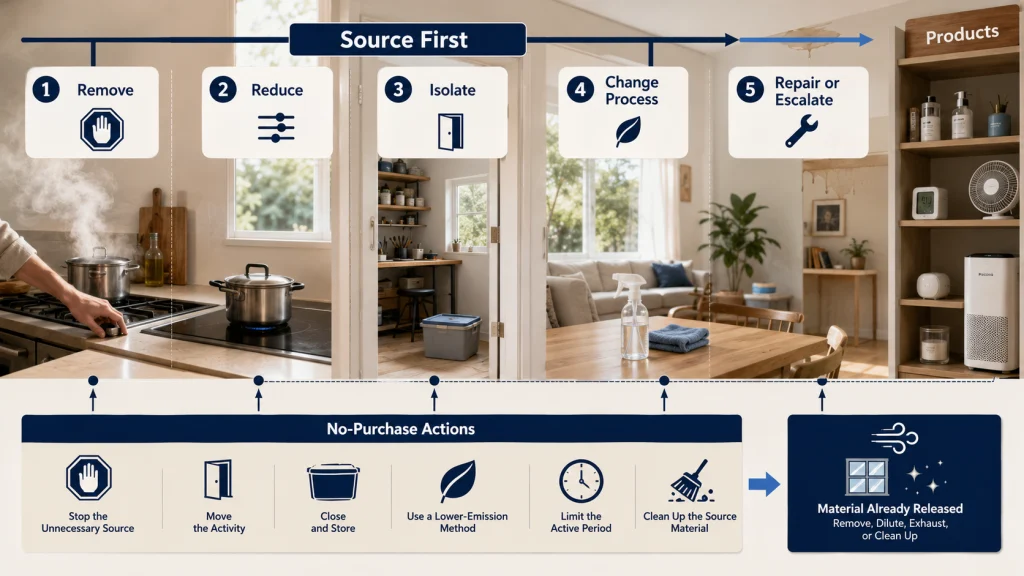
Remove, Reduce, Isolate, or Change Controllable Sources Before Adding Equipment
Source control acts before a condition spreads. It may mean stopping an unnecessary activity, changing how or where it happens, closing a container, moving a material away from occupied space, repairing a moisture entry point, or shortening the time a source remains active.
| Priority | Control type | Household example | Limit |
|---|---|---|---|
| 1 | Remove | Stop using an unnecessary scented or emitting item in the affected room | Material already released may remain until removed or diluted |
| 2 | Reduce | Use less of a product, shorten the activity, lower cooking intensity, or keep lids on containers when appropriate | The source still exists and may require exhaust or cleanup |
| 3 | Isolate | Keep an activity in a better-controlled area and close pathways to occupied rooms | Air can still move through gaps, doors, ducts, or pressure differences |
| 4 | Change the process | Use a method that creates less smoke, spray, dust, or moisture for the same task | The alternative still needs to fit safety and task requirements |
| 5 | Repair or escalate | Address a leak, exhaust defect, combustion concern, or material hazard through the appropriate qualified person | Some conditions are outside renter or homeowner self-service |
Source control is not limited to removing products. It includes changing behavior, timing, location, and the connection between a source and occupied space.
- Stop an unnecessary fragrance, spray, smoke-producing activity, or open-container source.
- Move a hobby or dusty task away from frequently occupied rooms when appropriate.
- Close a container and store it as directed rather than leaving it open.
- Use lids, lower-intensity methods, or shorter active periods when they fit the task.
- Keep doors closed between a source area and occupied space when that does not conflict with safety or needed airflow.
- Clean up the source material rather than adding a masking scent.
These actions cost little or nothing, but they require a clear source. A generic cleaning session is not a substitute for identifying where the condition begins.
Use Outdoor-Vented Kitchen and Bathroom Exhaust at the Point of Generation
Local exhaust is most useful before moisture, particles, gases, or odor have spread through the home. It removes air near the activity instead of asking the rest of the building to manage the condition afterward.
The difference is easy to see in a bathroom. A mirror may clear quickly while the walls, ceiling, and towels remain damp. The room can look better before the moisture has actually left. Outdoor exhaust gives that moisture an exit path, while a fan that only stirs room air changes how the space feels without removing air from the building.
In a kitchen, an outdoor-vented hood or exhaust path serves the same source-area role during cooking. A recirculating hood moves air through its own components and returns it to the room, so it should not be treated as equivalent to outdoor exhaust.
Check the simple conditions first: whether the exhaust is actually used, whether the path leads outdoors, whether grilles are blocked, whether the fan sounds or behaves differently, and whether moisture or odors continue to spread.
Do not alter ducts, electrical connections, roof penetrations, combustion systems, or building pressure relationships as a casual household repair. The guides to kitchen ventilation and bathroom ventilation cover those rooms in more detail.
Bring In Outdoor Air Only When Outdoor Conditions and Safety Allow
Opening a window can feel like the most natural answer to stale or noticeable indoor air. Sometimes it is useful. At other times, the open window exchanges one concern for smoke, pollen, humidity, heat, cold, traffic exhaust, or a nearby outdoor odor.
Before opening the home, check the outdoor air quality, nearby smoke, pollen conditions relevant to the household, humidity, temperature, rain, and any local source event. Also consider window security, children, pets, and whether the opening creates a safe and useful path through the room.
Air needs somewhere to enter and somewhere to move or leave. One open window in a closed room may create little useful flow when wind and pressure do not support it. A second opening or an appropriate exhaust path may change the result, but the arrangement still depends on the building and outdoor conditions.
During smoke events or poor outdoor conditions, limiting outdoor-air entry may be more appropriate than routine airing. The article on when to open windows for ventilation helps separate suitable conditions from times when the home should remain closed.
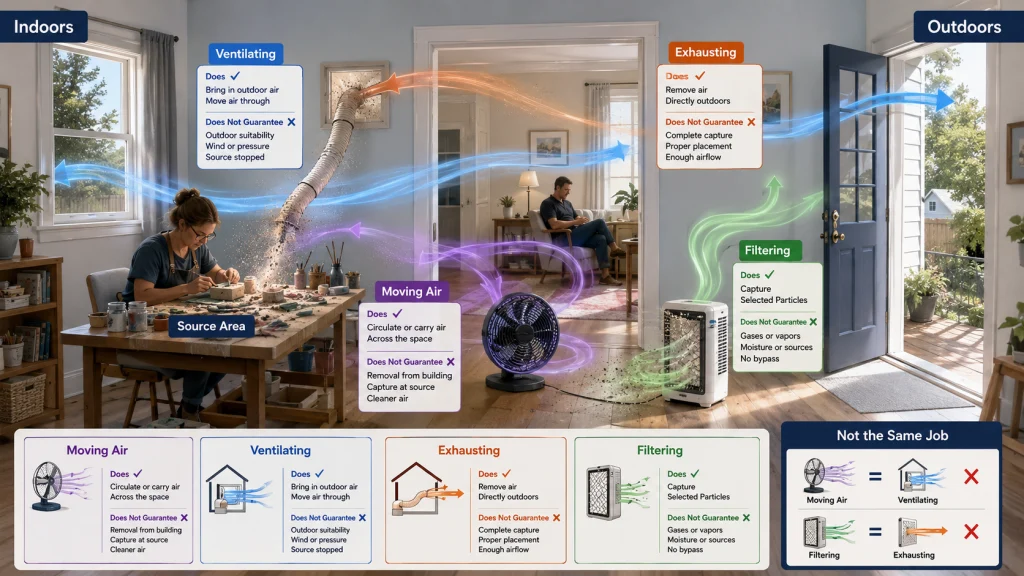
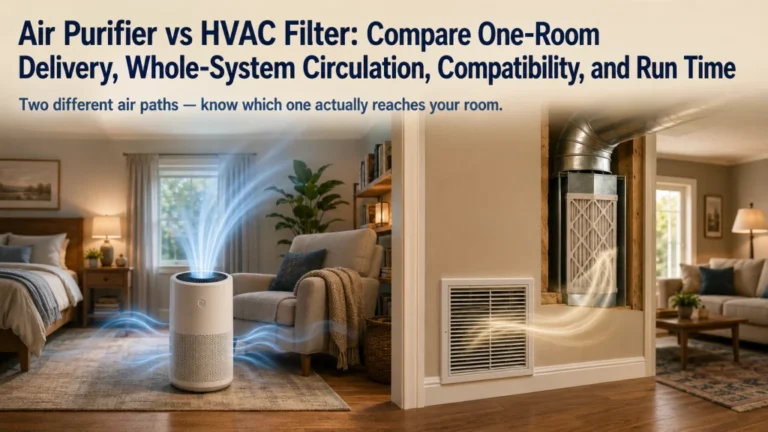
Moving Air, Ventilating, Exhausting, and Filtering Are Different Actions
A fan, an open window, an exhaust system, and a filter can all involve moving air, but the similarity ends there. A room can feel less stuffy while the original material is simply being carried somewhere else.
| Action | What it does | What it does not guarantee |
|---|---|---|
| Moving air | Circulates air within or across a space | Removal from the building or capture of a pollutant |
| Ventilating | Brings outdoor air in and allows indoor air to leave through a planned or available pathway | That outdoor air is suitable or that the source has stopped |
| Exhausting | Removes air from a source area to outdoors | Complete capture when placement, use, or airflow is inadequate |
| Filtering | Captures selected airborne material when air passes through a suitable filter | Removal of every gas, vapor, moisture source, or settled material |
Consider a dusty craft project near a doorway. A portable fan may move the dust toward the next room. Closing the source area and using a suitable outdoor exhaust path, when one exists and the activity allows it, serves a different purpose. A filter may capture selected particles later, but only if the affected air reaches it.
Keeping these actions separate prevents a comfort improvement from being mistaken for source removal. The guide to ventilating a house goes deeper into entry paths, exit paths, pressure, and room-to-room airflow.
Route Moisture, Dust, Allergens, and Chemicals to Their Own Decision Paths
It is tempting to keep adding household tips when a concern has already become specific. Once the issue is clearly moisture, a hazardous material, a known product exposure, or a building defect, broad indoor-air advice has reached its limit.
Moisture concerns need attention to water entry, repeated dampness, damaged materials, and whether qualified assessment is required. Dust questions involve sources, settling surfaces, resuspension, and cleaning methods. Suspected allergens cannot be diagnosed from symptoms or dust appearance. Product vapors require the use, storage, ventilation, and disposal instructions that belong to that material.
Suspected asbestos, lead, radon, combustion backdrafting, hazardous chemicals, major mold, or building-system defects require appropriately qualified assessment. Continuing through a general checklist can delay the person or service that actually owns the problem.
The broader healthy home environment overview helps route concerns that overlap with moisture, cleanliness, water, lighting, noise, and building comfort.
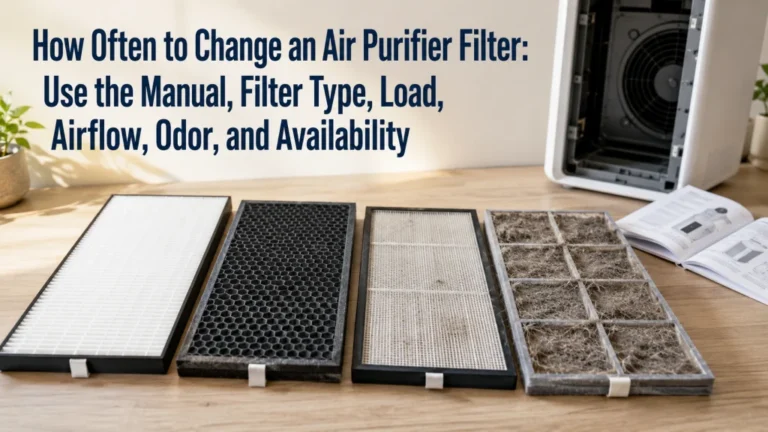
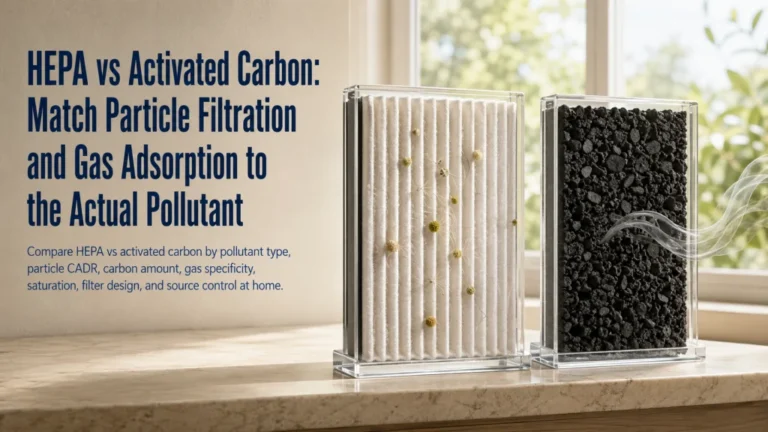
Add Filtration Only After Defining the Particle, Space, Compatibility, and Ongoing Cost
Filtration becomes a useful question when the concern involves airborne particles and the affected air can pass through a suitable filter. It is a poor match for a water leak, an active combustion concern, a gas source, or moisture that is being generated faster than the home can remove it.
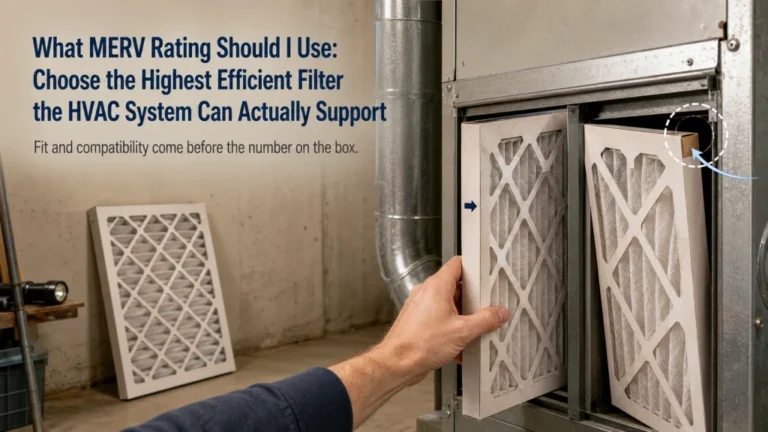
Before adding or changing filtration, define the target and the space. Decide whether the goal concerns one room, several connected rooms, or a central HVAC system. Consider whether affected air will reach the filter, whether the system can use it appropriately, and whether the noise level is acceptable enough for consistent operation.
Maintenance and cost belong in the same decision. A filter that is difficult to replace, frequently ignored, or expensive to operate may not fit the household routine even when its intended function matches the particle concern.
Filtration boundary: Filtration captures selected material carried through the filter. It does not repair a leak, correct combustion, identify the cause of symptoms, or remove material that never reaches the airflow path.
Product sizing, exact filter selection, performance claims, and equipment compatibility belong to dedicated air-cleaning guidance and exact system documentation.
Reject Ozone Generation, Fragrance Masking, and Unsupported Cleansing Claims
An approach can make the room smell different without reducing the source. Fragrance sprays, scented candles, and odor-masking products may add another airborne material while making the original event harder to track.
Do not use ozone-generating devices in occupied household spaces as an ordinary air-improvement strategy. Do not rely on vague cleansing or detox claims that fail to identify the source, pollutant class, pathway, or verified control mechanism.
Houseplants can be part of a home for many reasons, but they should not replace source control, suitable ventilation, local exhaust, or appropriate filtration. A plant display is not a household air-management plan.
Record the Event, Action, and Result Without Turning a Monitor Into a Diagnosis
A short record is more useful than a long list of impressions. It helps the household see whether the same event produces the same pattern and whether one specific change affects the result.
| Event | Action | Observed result | What remains unknown |
|---|---|---|---|
| Bathroom walls and towels remain damp after showers | Use the outdoor exhaust from the start and keep the room pathway arranged for the installed system | Surfaces dry more promptly on repeated days | Hidden moisture, duct condition, and building defects |
| Craft odor spreads from a work area | Move the activity to a better-controlled location and close the pathway to occupied rooms | The odor remains more localized during similar sessions | The exact vapor, concentration, and long-term suitability of the space |
| Particle monitor rises during cleaning | Change one cleaning step and repeat under similar conditions | The selected reading follows or no longer follows the activity | Every pollutant, medical meaning, and conditions in other rooms |
A consumer monitor reports only the variables its sensors address at its location. Use the display beside timing, activity, room conditions, and airflow. It can support an observation without naming the source or diagnosing the home.
Change one clear factor at a time when safety allows. When several controls begin together, improvement may be welcome, but the household learns less about which action actually matched the problem.
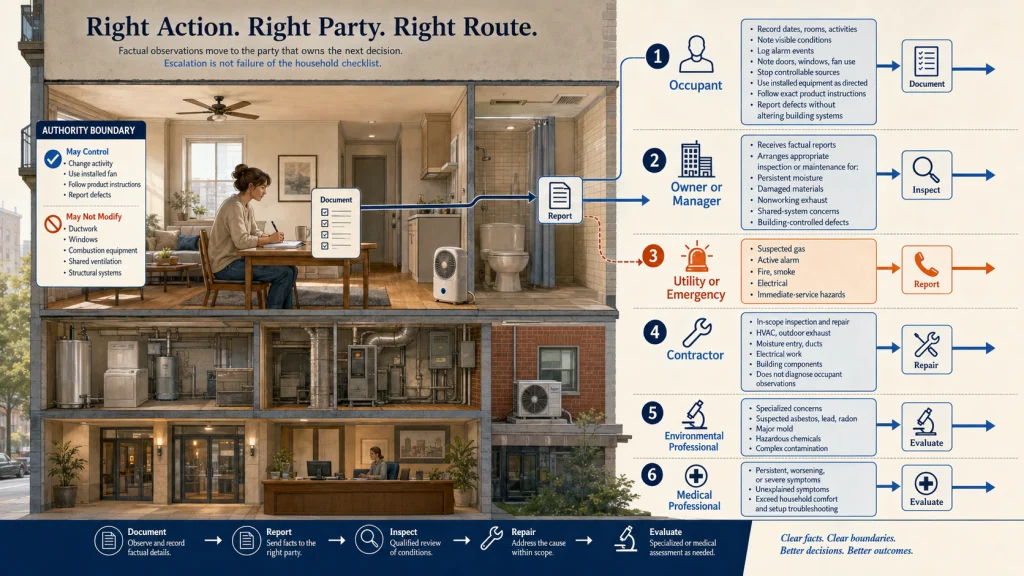
Separate Renter Actions From Owner, Manager, Utility, Contractor, and Professional Responsibilities
The right next step depends on who controls the source, equipment, structure, and building system. A renter may be able to change an activity or use an existing exhaust fan, but may not have authority to alter ductwork, windows, combustion equipment, or shared ventilation.
| Responsible party | Typical first-pass actions | Examples that require escalation |
|---|---|---|
| Renter or occupant | Document timing, stop controllable sources, use installed exhaust, follow product instructions, report defects | Nonworking exhaust, leaks, repeated alarms, suspected shared-system or structural issues |
| Owner or property manager | Respond to reported defects, arrange inspection, maintain building-controlled systems | Persistent moisture, damaged materials, ventilation defects, shared-system concerns |
| Utility or emergency service | Respond to suspected gas, electrical, fire, or urgent service conditions | Gas leak, active alarm, fire, smoke, or immediate hazard |
| Qualified contractor | Inspect and repair HVAC, exhaust, moisture entry, ducts, electrical work, or building components within scope | System modification, installation defects, pressure or venting concerns |
| Environmental professional | Assess specialized material or exposure concerns using an appropriate method | Suspected asbestos, lead, radon, major mold, hazardous chemicals, or complex contamination |
| Medical professional | Evaluate persistent, worsening, or unexplained symptoms | Symptoms that exceed household comfort or setup troubleshooting |
Keep records factual: dates, rooms, activities, visible conditions, alarm events, maintenance requests, and responses. Avoid claiming a medical or environmental diagnosis that has not been established.
The guide to indoor air quality in apartments addresses the boundary between occupant-controlled actions and building-controlled systems in greater depth.
Let the First Successful Change Tell You What to Do Next
The point of a source-first workflow is not to create another long checklist. It is to make the next decision smaller. When stopping one activity changes the room, the source becomes clearer. When local exhaust helps but the condition still spreads, the pathway or system may need attention. When a particle problem remains after source reduction, filtration becomes a more focused question.
Some results should end household troubleshooting rather than extend it. Alarms, gas, smoke, combustion concerns, severe or persistent symptoms, hazardous materials, major moisture damage, and building defects belong with the appropriate emergency service, utility, property manager, contractor, environmental professional, or medical professional.
The indoor air quality guide provides the broader route for ventilation, moisture, cleaning, chemicals, monitoring, and pollutant-specific decisions. A useful improvement is not the action that appears on the most tip lists. It is the one that matches the source, stays within the available evidence, and makes the next step clearer.
FAQs
🏠 What is the first step to improve indoor air quality at home?
Handle alarms, smoke, suspected gas, combustion concerns, and severe symptoms first. After urgent conditions are ruled out, identify the room, activity, material, and timing connected to the air change before choosing a product.
🍳 Is opening a window enough after cooking?
Not always. Local outdoor exhaust near the cooking source can act before the condition spreads, while a window depends on outdoor air and the direction of airflow. Source reduction, exhaust, and suitable outdoor ventilation may each play a different role.
🌬️ Does a fan ventilate a room?
A fan may only circulate air within the room. Ventilation requires outdoor air to enter and indoor air to leave through a pathway, while exhaust specifically removes air to outdoors.
🪟 Should I open windows every day?
Only when outdoor air, smoke, pollen, humidity, temperature, weather, and safety conditions are suitable. During poor outdoor conditions, keeping windows closed may be the better choice.
🧹 Can cleaning solve every indoor air problem?
No. Cleaning may remove settled material and reduce some sources, but it does not repair moisture entry, correct combustion, exhaust cooking, or address every gas and vapor. The action should match the source class.
🌀 Do I need an air cleaner before trying other steps?
Usually the source and pathway should be identified first. Filtration may help with selected airborne particles, but the room, airflow, compatibility, noise, maintenance, and recurring cost still need to fit the goal.
🚩 When should I stop troubleshooting the home myself?
Stop for alarms, suspected gas, fire, smoke, severe symptoms, combustion concerns, hazardous chemicals, major mold, asbestos, lead, radon, or building-system defects. Use the appropriate emergency, utility, medical, property-management, contractor, or environmental-professional route.