A useful personal hygiene checklist does not place every task into one daily column. It separates regular baseline care from event-triggered actions, periodic maintenance, optional grooming, and concerns that need support beyond a checklist. Build the list by domain, define what completion means, place supplies where the task happens, and record barriers that make the task harder. The result should be a practical inventory that can shrink on difficult days without turning preference, appearance, or symptoms into another box to check.
A Useful Checklist Does Not Pretend Everything Happens Every Day
Imagine opening a checklist with twenty-five boxes under one heading: daily hygiene. Bathing, handwashing, oral care, hair care, nail care, shaving, towel laundering, clothing changes, menstrual supplies, product replacement, and several grooming steps all appear to carry the same urgency. The list looks complete, but it gives the reader no way to tell what belongs to a regular routine, what happens after a specific event, what needs occasional attention, and what is simply a personal preference.
Reorganizing the list changes the workload without deleting important tasks. Handwashing after toilet use moves into an event-triggered category. Towel laundering belongs with periodic maintenance. Shaving becomes optional grooming. Persistent odor does not become an instruction to wash more often. It moves outside the checklist so the reader can consider appropriate guidance instead of using repetition as a substitute for evaluation.
| Item on an overloaded daily list | Better timing type | What the checklist should do |
|---|---|---|
| Handwashing after toilet use | Event-triggered | Attach the action to the event rather than one time of day. |
| Towel laundering | Periodic | Record the maintenance task without pretending it happens every morning. |
| Shaving | Optional grooming | Keep preference separate from basic care. |
| Persistent odor | Route outside the checklist | Do not respond by adding repeated washing boxes or treating the list as an evaluation tool. |
The purpose of a personal hygiene checklist is to make responsibilities visible and usable, not to create a universal standard for every adult. The broader personal hygiene overview explains how the different areas of care fit together, while personal hygiene basics provides the starting framework for selecting appropriate tasks.
Define Each Checklist Field Before Adding Tasks
A checklist becomes easier to use when every column answers a different question. Without clear fields, a task name such as “hair care” can hide several decisions about timing, products, location, access, and what counts as done.
| Checklist field | Question it answers | Example wording |
|---|---|---|
| Task | What action belongs on the list? | Clean the selected personal item. |
| Completion standard | What observable action means the task is finished? | Item cleaned, dried, and returned to its storage place. |
| Trigger | What event starts the task? | After use, after contamination, or when the current item is replaced. |
| Timing type | Does it belong to a regular baseline, an event, periodic maintenance, or preference? | Event-triggered. |
| Optional grooming | Is this an appearance or preference choice rather than a universal requirement? | Selected by the person, not required by the checklist. |
| Escalation | When should the checklist stop and another form of support begin? | New, persistent, worsening, or significant symptoms. |
These fields prevent the checklist from quietly making unsupported decisions. A task can be included without assigning an exact frequency, and a symptom can be acknowledged without converting it into a self-care instruction.
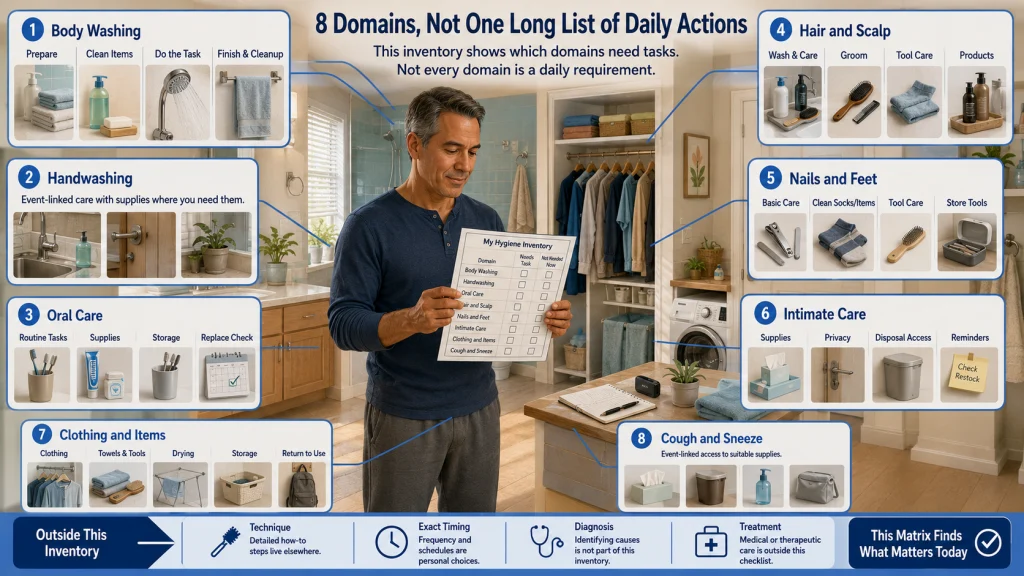
Start With Eight Broad Hygiene Domains
Begin with categories rather than a long list of isolated actions. This makes gaps easier to see and reduces duplicate boxes created by different wording for the same task.
| Domain | What belongs in the inventory | What stays outside this checklist |
|---|---|---|
| Body washing | Selected body-care tasks, preparation, clean items, and cleanup. | Exact body-area technique or a universal washing schedule. |
| Handwashing | Events that require hand care and supplies at the point of use. | Detailed infection-control instructions beyond the task inventory. |
| Oral care | Routine tasks, required supplies, storage, and replacement checks. | Dental diagnosis, symptom interpretation, or individualized treatment. |
| Hair and scalp | Washing, grooming, tool care, and product access as personally applicable. | A single schedule for every hair type, scalp condition, or hairstyle. |
| Nails and feet | Basic care tasks, tool maintenance, clean socks or footwear-related items. | Treatment of pain, wounds, infection, or other symptoms. |
| Intimate and menstrual care | Personally relevant supplies, privacy needs, disposal access, and task reminders. | Clinical guidance, symptom interpretation, or universal product instructions. |
| Clean clothing and personal items | Clothing, towels, bedding-related personal items, tools, and storage routines. | A complete household cleaning schedule. |
| Cough and sneeze etiquette | Event-linked actions and supplies that need to be available. | Diagnosis or treatment of respiratory symptoms. |
The matrix is an inventory boundary, not a set of instructions. When a task requires detailed body-area guidance, record the destination topic rather than trying to compress the full technique into one checkbox.
Create a Regular Baseline Without Assigning Universal Frequencies
A baseline contains the selected tasks that help the person maintain ordinary care. It may include body washing, oral care, clean clothing, hair or scalp care, and other personally relevant items. The checklist should name the task and its place in the routine without claiming that every body area or care practice belongs on the same schedule.
Use wording that leaves room for individual instructions and circumstances. “Complete planned oral care” is a checklist item. “Every adult must perform every listed oral-care step at this exact time” is an unsupported rule. “Use the selected hair-care task when scheduled” is flexible. A fixed universal hair-washing frequency is not.
A regular baseline can also change with work, climate, activity, menstruation, disability, caregiving, access, and personal preference. The list should make the current plan visible while allowing detailed timing to remain with the guidance that owns that topic.
Once the inventory is complete, the guide to building a personal hygiene routine can help place selected tasks into realistic parts of the day. This checklist decides what belongs. The routine decides when the chosen tasks can actually happen.
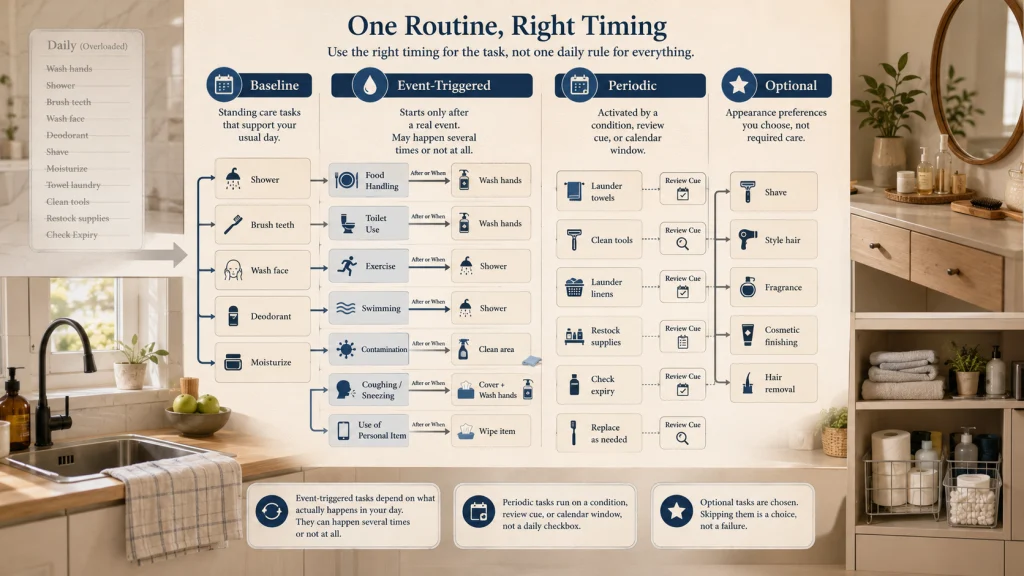
Move Event-Triggered Tasks Out of the Daily Column
Some hygiene actions are connected to an event rather than a morning or evening slot. Placing them in a generic daily list can make the checkbox meaningless because the action may need to happen more than once, not happen at all on a particular day, or depend on where the event occurs.
| Timing type | Examples of what activates the task | How to write the checklist item |
|---|---|---|
| Regular baseline | A selected routine or standing care plan. | Name the task without assigning an unsupported universal frequency. |
| Event-triggered | Toilet use, food handling, exercise, contamination, swimming, coughing or sneezing, or use of a personal item. | Write “after” or “when” and name the event. |
| Periodic | Tool care, laundering, inspection, restocking, or replacement. | Use a review cue, calendar window, or condition rather than a daily box. |
| Optional | Appearance, styling, hair removal, fragrance, or another preference. | Label it as chosen, not required. |
An event-triggered item should include the location and required supply when that prevents friction. “Hand care after food handling, kitchen sink, supplies available” gives the task a real home. The checklist does not need to reproduce the complete technique or make infection-prevention claims beyond its scope.
Give Maintenance Tasks Their Own Periodic List
Periodic hygiene work keeps tools, fabrics, clothing, and supplies usable, but it does not belong in a row of daily body-care boxes. Separating maintenance reduces clutter and prevents a missed laundry or replacement task from making the entire routine appear incomplete.
Possible categories include nail-tool care, grooming-tool cleaning, towel and clothing laundering, supply checks, storage cleanup, and replacement review. The checklist should use the product instructions or the relevant detailed guidance when exact timing matters. It should not invent one replacement schedule for every tool, fabric, or personal-care item.
A periodic item works best when it has a visible condition:
- The item has been used and needs cleaning before storage.
- The available supply has reached the chosen restock point.
- A clean replacement is no longer available at the point of use.
- The item shows wear, damage, contamination, or another reason to review its use.
The condition gives the task a purpose. It is more useful than adding “check products” to every day without defining what the person is checking.
Separate Optional Grooming From Basic Care
Shaving, hair removal, fragrance, styling, cosmetic steps, and appearance-focused routines may matter to a person, but they should not be presented as universal hygiene requirements. Labeling them separately protects choice and makes the baseline list easier to complete.
Optional does not mean unimportant. It means the task is selected because of preference, comfort, identity, culture, occasion, or presentation rather than being imposed on every reader. A person may choose to give an optional task a regular place in the week. The checklist should still preserve its status so skipping it is not confused with neglecting basic care.
This distinction also helps expose duplicate or marketing-created tasks. If two boxes use different product language but aim at the same outcome, keep one understandable task and remove the duplicate.
Mark the Required Supply and Point of Use
A task can be reasonable and still fail because the needed item is empty, stored elsewhere, difficult to open, shared with another person, or unavailable when the event occurs. Add two practical columns: supply and location.
| Task | Required supply | Point of use | Restock or return cue |
|---|---|---|---|
| Selected body-care task | Personally appropriate basic supplies | Bathroom or other accessible private space | Return items after use and note when a replacement is needed. |
| Event-triggered hand care | Required hand-care supplies | Where the triggering event occurs | Check availability before the supply runs out. |
| Clean clothing task | Clean item and a place for used clothing | Dressing or changing area | Move unavailable clean items to the periodic laundry list. |
| Personal-tool maintenance | Permitted cleaning and storage supplies | Safe cleaning and drying location | Return the tool only after the defined maintenance step is complete. |
Keep the supply description generic until the task and user need are clear. The guide to choosing personal hygiene supplies can support that decision without turning this article into a shopping list.
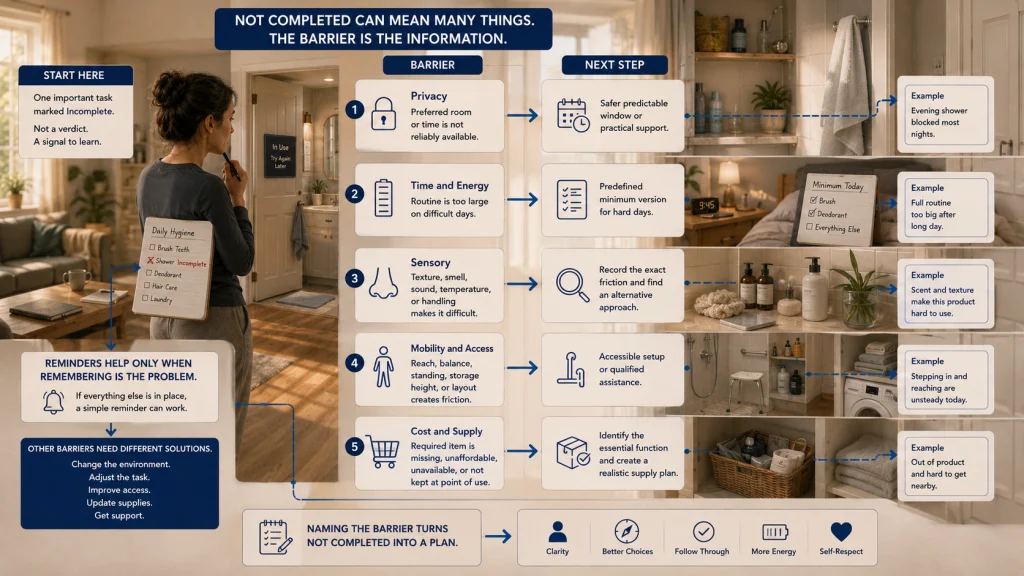
Record the Barrier Instead of Blaming the Person
When an important task is repeatedly missed, the list should reveal the obstacle. Adding reminders alone may not help when the real problem is privacy, time, sensory discomfort, mobility, cost, supply access, water access, storage, or the physical layout of the space.
| Task | Barrier | What the barrier changes | Next planning step |
|---|---|---|---|
| Private body-care task | Limited privacy | The preferred time or location is not reliably available. | Identify a safer, more predictable window or ask for practical support. |
| Multi-step routine | Limited time or energy | The standard version is too large for difficult days. | Create a minimum version that preserves the most important action. |
| Product-based task | Sensory discomfort | Texture, smell, sound, temperature, or handling makes the task difficult. | Record the exact friction and look for an appropriate alternative approach. |
| Sink, shower, dressing, or laundry task | Mobility or access limitation | The location, reach, balance demand, or setup is not workable. | Seek an accessible setup or qualified assistance rather than forcing the task. |
| Supply-dependent task | Cost or availability | The planned item cannot be replaced or kept at the point of use. | Identify the essential function and a realistic supply plan. |
A barrier column turns “not completed” into useful planning information. Significant difficulty maintaining essential care may require help from a trusted person, an accessible-care professional, or another appropriate service. The checklist should make that need visible rather than adding shame or more boxes.
Describe Completion as an Action, Not Perfection
Vague items such as “be clean,” “look presentable,” or “do hygiene” are difficult to complete because they do not name an observable action. They can also encourage excessive self-judgment about appearance and repeated checking.
Write completion criteria around the task itself:
- Selected task completed using the planned supplies.
- Used item placed in the correct laundry, disposal, cleaning, or storage location.
- Supply returned to the point of use or added to the restock list.
- Optional grooming marked separately from the baseline.
- Symptom concern moved to the appropriate support route rather than treated with extra repetition.
The standard should be clear enough to end the task. A checklist that encourages endless checking, repeated washing, or an appearance-based judgment is no longer serving as a simple planning tool.
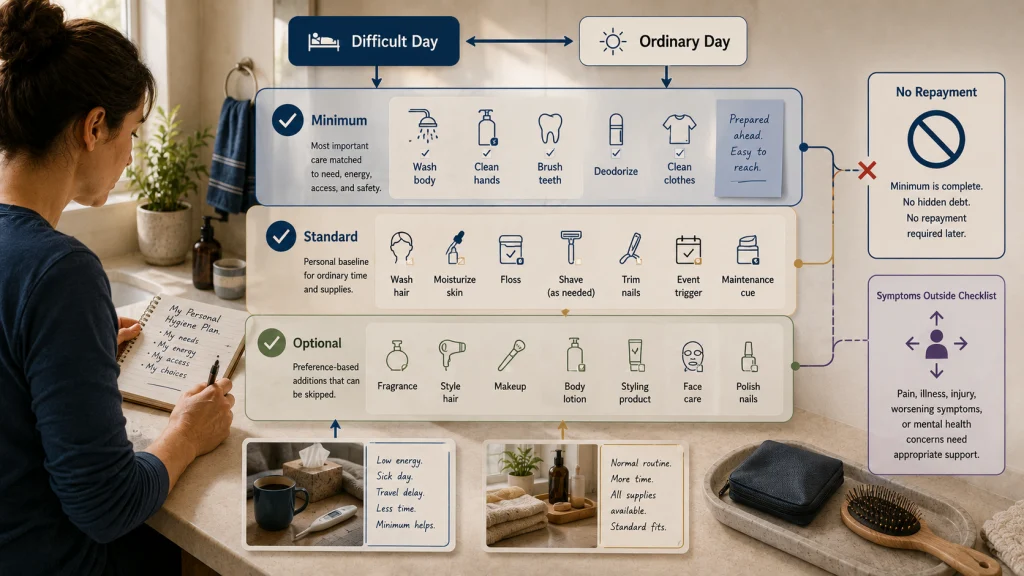
Build Minimum, Standard, and Optional Layers
One fixed list can become unusable during illness, fatigue, travel, schedule disruption, limited access, or a difficult day. Layers preserve the difference between the essential next action, the usual routine, and preference-based additions.
| Layer | Purpose | What belongs here | What does not belong here |
|---|---|---|---|
| Minimum | Keep the most important selected care actions visible when capacity is limited. | A short list matched to immediate needs, access, and safety. | A hidden requirement to complete the full routine later as repayment. |
| Standard | Show the personally selected baseline when ordinary time and supplies are available. | Regular tasks, event triggers, and the most relevant maintenance cues. | Every possible grooming or household-cleaning task. |
| Optional | Hold appearance, styling, comfort, or preference-based additions. | Chosen grooming steps and extras that can be skipped without changing baseline completion. | Symptoms that need evaluation or essential tasks disguised as extras. |
The minimum layer should be created before it is needed. It is easier to choose a clear smaller version during planning than to negotiate with a long list when time, energy, or access has already dropped.
Review the Checklist After One Week
A one-week review is a workflow check, not a judgment of the person. Look for boxes that were never relevant, tasks that appeared twice, supplies that were missing, event triggers that had no usable location, and standard tasks that were too large for the available time.
- Remove any box that duplicates another task under different wording.
- Move tasks that did not occur every day into event-triggered or periodic timing.
- Relabel grooming choices that were incorrectly presented as required care.
- Shorten any completion standard that encouraged repeated checking or unnecessary steps.
- Add one barrier note where a task failed because of access, cost, privacy, mobility, time, or sensory friction.
- Keep symptom concerns outside the completion score.
Change one structural problem at a time. If reminders are the main issue after the list itself fits, the guide to building repeatable hygiene habits can help connect selected tasks to cues and restart after interruptions.
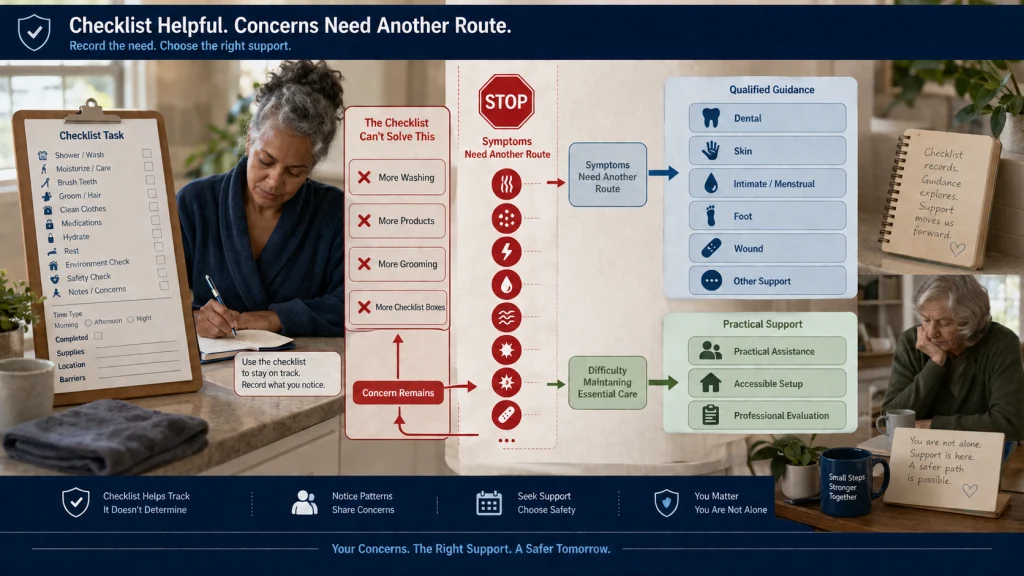
Route Symptoms Away From the Checklist
When a checklist is not the next step: Persistent odor, rash, pain, bleeding, unusual discharge, sores, swelling, wounds, or other significant, worsening, or unexplained symptoms should not be managed by adding more washing, grooming, product use, or repeated checklist boxes. Seek appropriate qualified guidance for the symptom and its context.
A checklist cannot diagnose the cause of a symptom or determine whether a dental, intimate, menstrual, skin, foot, wound, or infection-related concern is minor. It should record that another route is needed, then stop trying to solve the concern through task completion.
Difficulty maintaining essential personal care may also require support, especially when access, mobility, cognition, severe fatigue, mental distress, caregiving conditions, or the home setup makes the task unsafe or unmanageable. The appropriate next action may be practical assistance, accessible equipment guidance, or professional evaluation rather than a longer list.
Keep One List With Four Useful Decisions
For each selected task, record the task name, timing type, point of use, and destination for detailed guidance. Add a completion standard, required supply, and barrier note only when those fields make the task easier to carry out.
Keep regular care, event-triggered actions, periodic maintenance, and optional grooming visibly separate. Review the list after one week, remove duplicate or unused boxes, and route symptoms or significant access problems away from the checklist. A good hygiene checklist for adults should reduce confusion and workload, not turn every preference or difficulty into a daily requirement.
FAQs
📋 Should every hygiene task appear on a daily list?
No. Some tasks belong to a regular baseline, while others are activated by an event, handled periodically, or chosen as optional grooming. Keeping those timing types separate makes the list more accurate and less overwhelming.
🧼 How do I decide what belongs in my baseline?
Start with the broad care domains that apply to you, then record the selected task without inventing an exact universal frequency. Detailed timing and technique should come from the guidance appropriate to that body area or care need.
⏰ What is an event-triggered hygiene task?
It is an action connected to something that happens rather than a fixed time of day. The checklist should name the event, the task, and the point of use without repeating the full technique.
✂️ Is shaving required for good hygiene?
No. Shaving and other hair-removal practices are optional grooming choices. They can be included when personally relevant, but they should not be presented as universal requirements.
🧺 Where should towel and clothing tasks go?
Place laundering, restocking, and replacement checks in the periodic maintenance section unless a specific event activates them. Keep personal-item care separate from a full household cleaning schedule.
🧩 What should I do when a task is repeatedly missed?
Look for the barrier before adding more reminders. Privacy, time, energy, sensory discomfort, mobility, cost, supplies, and location can all change whether the task is workable.
🚩 Should persistent odor or a rash become another checklist item?
No. Persistent odor, rash, pain, bleeding, discharge, sores, swelling, or other significant concerns should be routed to appropriate qualified guidance. Do not respond by adding repeated washing or product-use boxes.