Common myths about aging often turn a birthday into a rule about memory, movement, sleep, learning, driving, or independence. Age can provide context, but it cannot show what one person can do, what has recently changed, or what support would help. Replace age-based assumptions with questions about function, change over time, environment, and safety. New, persistent, worsening, unexplained, or safety-relevant changes deserve appropriate professional assessment rather than being dismissed as normal aging.

Two People Can Share an Age Without Sharing a Life
Imagine two fictional calendar pages for adults who are both 75.
| Calendar A | Calendar B |
|---|---|
| A beginner language class on Tuesday, a bus trip on Thursday, grocery shopping on Friday, and a video call with family on Sunday. | A home-support visit on Monday, a follow-up appointment after a recent change, a quiet afternoon for recovery, and help preparing meals for the week. |
Age alone cannot tell whether either person is independent, healthy, lonely, active, safe to drive, comfortable with technology, or in need of more support. The first calendar does not prove that the person has no limitations. The second does not prove that the person has lost control of daily life. Each calendar shows a different mix of abilities, needs, choices, and circumstances.
Key decision: Replace the age label with a question about function, change, and context.
That shift matters because an age-based rule can restrict someone unnecessarily, while the opposite assumption can dismiss a real change that needs attention. The goal is not to deny aging. It is to observe what is actually happening before deciding what a person can do, what support fits, or whether professional input is needed.
Why Age Is a Weak Shortcut for Individual Function
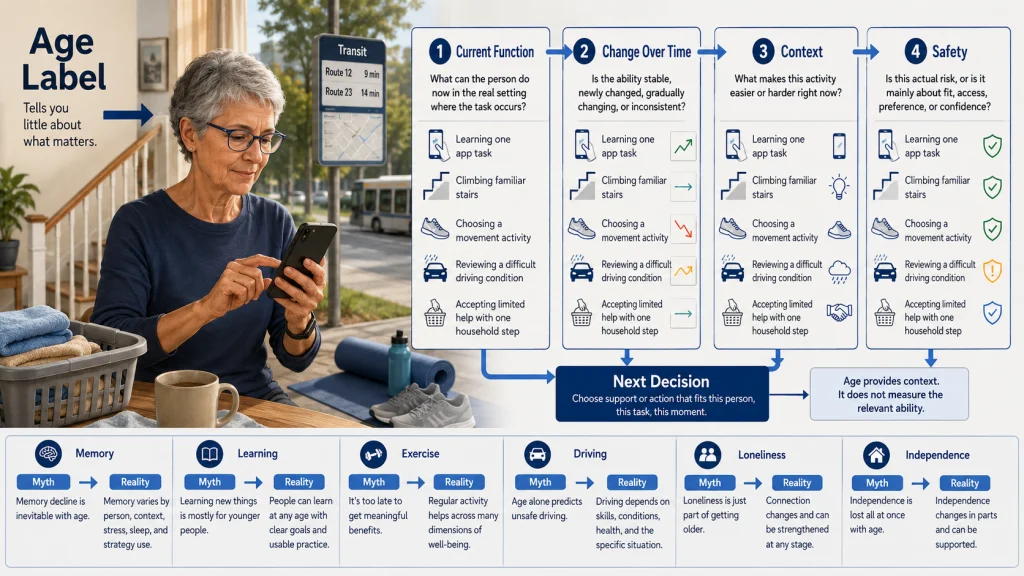
Chronological age is easy to see, so it often becomes a substitute for more useful information. A person may be described as too old to learn an app, too old to exercise, old enough to stop driving, or expected to become forgetful. None of those statements measures the relevant function.
A better decision begins with four questions:
- What can the person do now in the real setting where the task occurs?
- Has that ability changed recently or gradually?
- What conditions make the task easier or harder?
- Is there a safety concern, or is the issue mainly fit, access, confidence, or preference?
The table below converts repeated assumptions into observable questions.
| Repeated assumption | Reality to check | Practical decision |
|---|---|---|
| Everyone declines in the same way. | Abilities, health, environment, and support needs vary widely. | Track the person’s own function and changes over time. |
| Major memory loss is inevitable. | Occasional lapses and concerning change are not the same thing. | Look for persistence, worsening, safety effects, and loss of familiar abilities. |
| Loneliness is simply part of getting older. | Social circumstances and emotional health differ between people. | Ask about connection, mood, access, and recent losses rather than assuming. |
| Learning becomes impossible. | Design, instruction, practice, vision, hearing, and confidence affect learning. | Change the teaching method or setup before blaming age. |
| Exercise becomes too dangerous. | Appropriate activity depends on ability, health context, and task demands. | Match movement to the person and seek guidance when risk or symptoms are present. |
| Driving should end at a certain birthday. | Driving safety depends on functional abilities and real driving demands. | Review performance, safety events, routes, and alternatives. |
| Accepting help means losing independence. | Support can preserve choice, safety, and energy for valued activities. | Choose the smallest useful support and keep the person involved in decisions. |
Use the table as a starting point, not as a way to label another person. The most useful question is usually specific: What changed, where does it happen, and what would make the task safer or more manageable?
Myth: Everyone Declines in the Same Way
Later life does not follow one fixed sequence. One person may notice reduced grip strength but continue managing complex travel. Another may walk comfortably yet need help organizing medications or appointments. A third may use substantial support while remaining the main decision-maker in the household.
The useful comparison is not between one older adult and another. It is between the person’s current function and their own earlier pattern, while considering illness, injury, medication changes, environment, stress, sleep, access, and support.
Note: Variation is expected, but a new or worsening change should not be explained away by saying that everyone slows down with age.
For day-to-day planning, record concrete observations such as taking longer to climb the usual stairs, needing larger text on a familiar device, avoiding a route after a near miss, or needing help with a task that was previously routine. A clear observation gives the person and any professional something useful to discuss.
The broader healthy aging guide can help place changes into the right life domain without treating age as a single explanation.
Myth: Dementia and Major Memory Loss Are Inevitable
Dementia is not an unavoidable result of reaching a certain age. At the same time, this does not mean every memory concern can be judged at home. Forgetting a name and recalling it later is different from repeatedly getting lost on a familiar route, losing the ability to complete a known task, or showing a clear decline that affects safety or daily function.
Do not try to diagnose the cause from a single incident. Instead, record what happened in plain language:
- What task or information was affected?
- Was this new for the person?
- Has it happened more than once?
- Is it becoming more frequent or more disruptive?
- Did it affect safety, finances, medication use, travel, cooking, or another important activity?
Safety warning: New, persistent, worsening, unexplained, or function-limiting changes in memory, thinking, judgment, language, or behavior should be discussed with an appropriate health professional. Sudden or severe changes require prompt help, and an emergency requires immediate assistance.
The practical rule is to describe the change without naming the diagnosis. That protects against two mistakes: dismissing a concerning pattern as age, or frightening someone by assigning a condition without an assessment.
Myth: Loneliness and Depression Are Normal Aging
Older adults may face losses, reduced mobility, caregiving strain, changes in work, transportation barriers, or fewer nearby relationships. Those circumstances can increase risk, but they do not make loneliness or depression inevitable, harmless, or something a person should simply accept.
Ask about the actual experience rather than counting social events. A person can spend many hours alone and feel content, or be surrounded by people and still feel disconnected. Useful questions include whether the person has someone they trust, whether transportation or hearing limits participation, whether a recent loss changed their routine, and whether low mood is affecting sleep, eating, self-care, interest, or daily function.
Support may involve practical access, regular contact, a meaningful role, help with hearing or transportation, or professional care. The right response depends on the person’s preferences and the severity of the change.
Safety warning: Persistent low mood, major withdrawal, loss of function, expressions of hopelessness, or any concern about immediate safety require appropriate professional help. An emergency requires immediate assistance.
Myth: Older Adults Cannot Learn Technology or New Skills
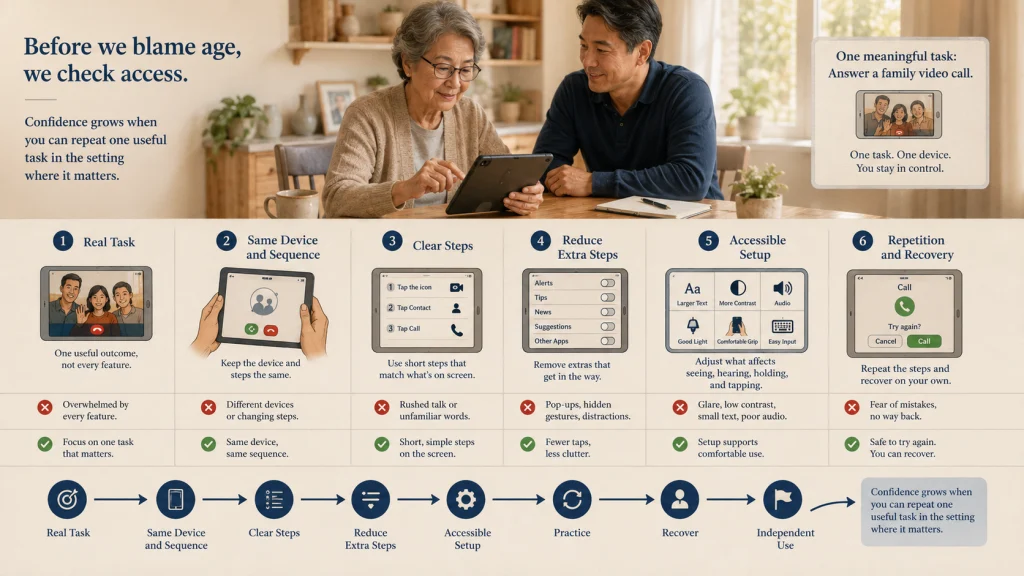
Learning difficulty is often blamed on age before anyone checks the instructions, interface, lighting, hearing, hand comfort, internet access, previous experience, or the pace of teaching. A small screen, low contrast, hidden gesture, rushed explanation, or fear of making an irreversible mistake can make a simple task feel impossible.
A better setup separates the skill from the barrier:
- Teach one real task at a time, such as answering a video call or checking a bus time.
- Use the same device and sequence during practice.
- Write short instructions that match the labels visible on the screen.
- Reduce unnecessary alerts and extra steps.
- Allow repetition without taking the device away and completing the task for the learner.
- Adjust text, contrast, audio, grip, or input method when those features affect access.
Confidence grows when the person can repeat the task independently in the setting where it matters. The goal is not to master every feature. It is to make a useful function understandable and recoverable after a mistake.
For setup choices, accessibility features, and practical household use, see the guide to choosing and using technology in later life.
Myth: Exercise Is Too Dangerous After a Certain Age
Age alone does not decide whether movement is appropriate. The relevant factors include current ability, balance, symptoms, recent changes, medical context, the environment, and the demands of the activity. For one person, a short walk may be a manageable starting point. For another, standing practice, seated movement, or supervised activity may fit better.
The opposite extreme is also unhelpful. Saying that anyone can do anything with enough motivation ignores real limitations and can create pressure or risk. Movement should be matched to the person, not to an age stereotype or an inspirational example.
Key decision: Choose an activity by asking what movement the person can perform safely and repeatably now, what support is needed, and what symptoms or risks require professional input.
Do not prescribe a program from this article. The guide to maintaining mobility as abilities change provides the next decision path for movement, home setup, and support.
Safety warning: New symptoms, unexplained falls, worsening balance, severe pain, chest symptoms, dangerous shortness of breath, or a major change in function require appropriate professional guidance. An emergency requires immediate help.
Myth: Older Adults Need Less Sleep
A person’s schedule and sleep pattern may change with age, but the need for restorative sleep does not simply disappear. Spending more time awake at night, waking earlier, or napping more does not automatically prove that less sleep is needed.
Start with the effect on daily life. Is the person rested enough to think clearly, move safely, drive or travel safely, and manage ordinary responsibilities? Has sleep changed recently? Are pain, breathing symptoms, medication timing, caregiving, noise, light, or frequent bathroom trips affecting the night?
Do not label persistent sleep difficulty as normal based on age. Also avoid turning one poor night into a diagnosis. Sleep-specific questions require their own assessment and guidance because routine, environment, schedule, symptoms, and health context can point in different directions.
Safety warning: Persistent sleep difficulty, severe daytime impairment, breathing-related symptoms during sleep, or dangerous sleepiness should be discussed with an appropriate professional. Do not rely on age or a consumer device score to explain the problem.
Myth: Giving Up Driving Is Determined by Age
A birthday does not measure vision, attention, reaction, judgment, physical control, route complexity, medication effects, or actual driving performance. Driving decisions should focus on ability and safety in the conditions the person faces.
Useful observations include new dents, near misses, confusion on familiar routes, difficulty turning to check traffic, trouble reading signs, avoiding certain conditions, or repeated concern from people who regularly ride with the driver. One observation is not a complete assessment, but a pattern should not be dismissed.
The conversation should also include what driving makes possible. Giving up a car without a transportation plan can affect food access, appointments, social connection, work, caregiving, and control over daily life. Safety and mobility both matter.
Practical tip: Discuss the hardest route or condition first rather than framing the choice as unrestricted driving versus no driving at all. Daylight, familiar routes, shorter trips, ride support, delivery, transit, and professional assessment may belong in the decision.
Use the guide to building transportation options before a driving change to compare realistic alternatives without treating age as the deciding factor.
Myth: Accepting Help Means Losing Independence
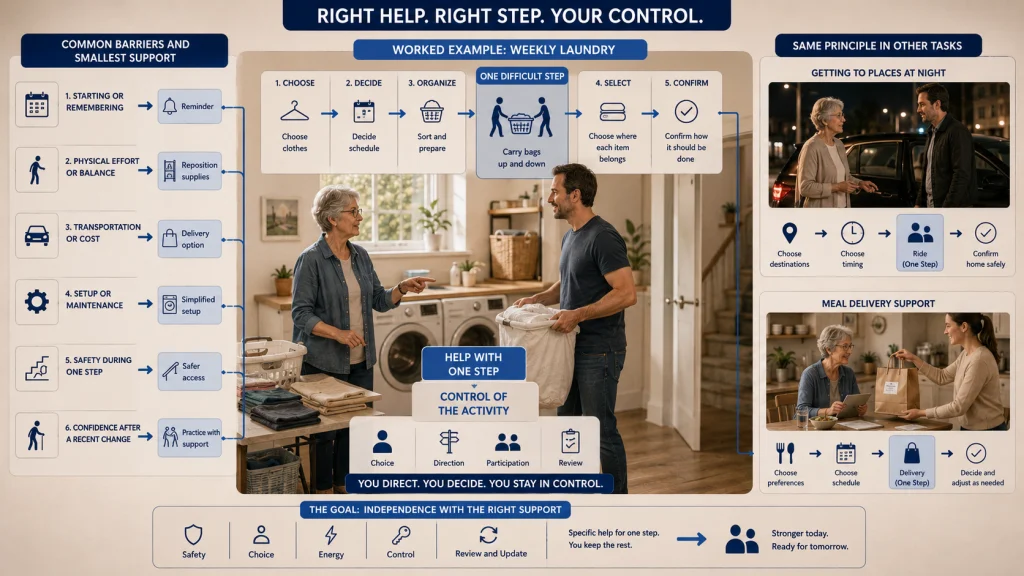
Independence does not require doing every task alone. It can mean deciding what matters, choosing how a task is completed, directing support, and preserving energy for the parts of life the person values most.
A person who accepts help carrying laundry may still choose their clothes, manage the schedule, and decide how the home is organized. Someone who stops driving at night may remain fully involved in planning trips and choosing destinations. A meal-delivery arrangement can reduce strain without taking away control over preferences or timing.
The best support is specific. Instead of asking whether someone is independent, ask which part of the task is difficult:
- Starting or remembering the task.
- Physical effort, balance, reach, grip, or endurance.
- Transportation, cost, or access.
- Setup, cleanup, charging, or maintenance.
- Safety during one step.
- Confidence after a recent change.
Then choose the smallest useful support that addresses the barrier while keeping the person involved. The guide to accepting help without surrendering choice develops this decision in more detail.
Myth: One Product for Older Adults Fits Everyone
A label aimed at older buyers does not prove that a product fits a particular body, home, routine, or ability. A large handle may help one person and strain another. A louder alert may improve access in one room and become overwhelming in a shared home. A simplified interface may remove clutter, or it may hide a function the user needs.
Editorial observation: Age-based merchandising often groups products by the buyer’s age when fit, grip, vision, hearing, setup, storage, charging, cleaning, household layout, and return friction are more useful selection criteria.
Match features to the actual constraint:
| Constraint to observe | Feature question | Household check |
|---|---|---|
| Grip or hand comfort | Can the control be held, pressed, turned, or released without strain? | Can the person test it in the position where it will be used? |
| Vision or contrast | Are labels, indicators, and settings readable under home lighting? | Does glare or low light change usability? |
| Hearing or alert recognition | Can volume, tone, vibration, or visual alerts be adjusted? | Will the alert be noticed without disturbing everyone else? |
| Setup and maintenance | How many steps, parts, cables, apps, or cleaning tasks are required? | Who will perform those tasks after the first week? |
| Space and storage | Does the item fit where it must be used and stored? | Can it remain accessible without becoming a trip or clutter hazard? |
Do not buy by age category alone. Define the constraint, test the feature that addresses it, and consider the ordinary work required to keep the item usable.
Use a Function-Not-Age Worksheet for New Decisions
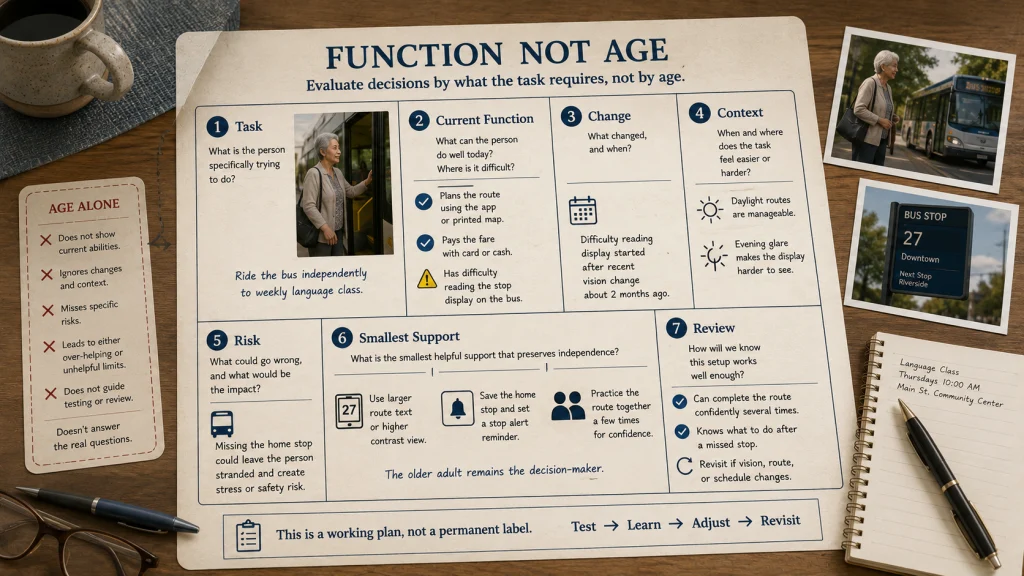
Use this worksheet before deciding that an activity, device, responsibility, or form of support is suitable or unsuitable because of age.
| Write down | Question to answer | Example of a useful observation |
|---|---|---|
| The task | What exactly is the person trying to do? | Ride the bus to a weekly class, not simply use transportation. |
| Current function | Which steps can the person complete now? | Plans the route and pays the fare, but struggles to read the stop display. |
| Change over time | Is this stable, new, worsening, or inconsistent? | The display became difficult after a recent vision change. |
| Context | What makes the task easier or harder? | Daylight routes are manageable, but glare makes the evening route difficult. |
| Risk | Could an error cause harm or leave the person stranded? | Missing the home stop would create a safety problem. |
| Smallest useful support | What change preserves the most choice? | Larger route text, a saved stop alert, and practice with a trusted person. |
| Review point | What result would show that the plan works or needs reassessment? | The person completes the route confidently three times and knows what to do after a missed stop. |
For the two fictional adults from the opening, this worksheet could lead to different answers. The person attending a language class may need transit practice but no help with learning. The person receiving home support may need temporary assistance after a recent change while retaining control over schedules, meals, and household decisions.
Related guidance: Use the practical independence guide to connect function with daily routines, planning for later-life changes to prepare before a crisis, the mobility decision guide for movement-related barriers, the transportation planning guide for driving alternatives, and the technology access guide for device setup and usability.
The worksheet does not decide for the person. It makes the decision visible enough to discuss, test, and revise.
Do Not Dismiss Red Flags as Normal Aging
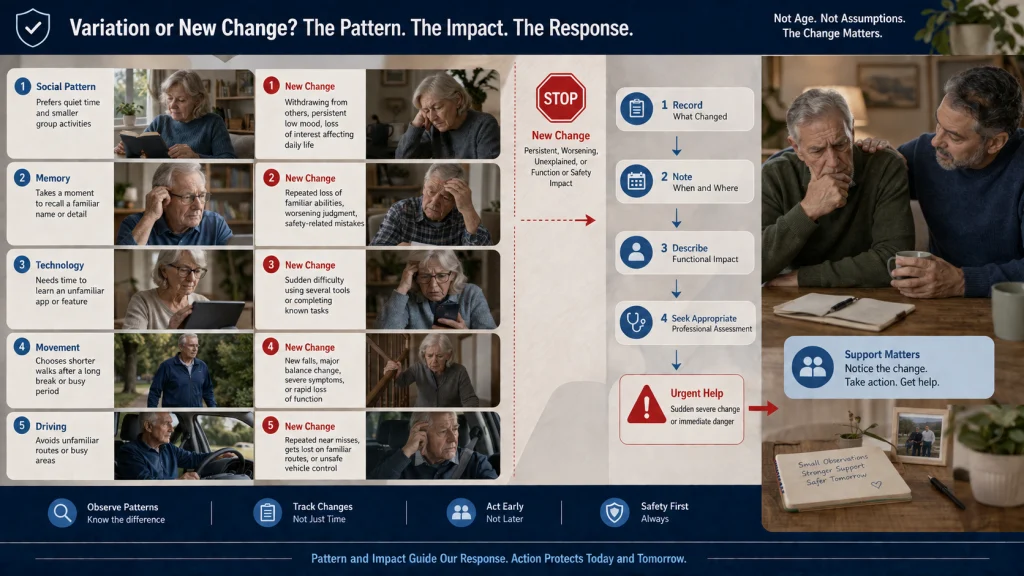
Variation means that people of the same age can have different abilities, routines, and support needs. A red flag is a new, persistent, worsening, unexplained, function-limiting, or safety-relevant change. The distinction depends on the pattern and impact, not on the person’s birthday.
| Variation to describe | Change that deserves attention | Next action |
|---|---|---|
| A person prefers a quieter social routine than a relative does. | Marked withdrawal, persistent low mood, or loss of interest that affects daily life. | Discuss the change with an appropriate professional. |
| A familiar name takes a moment to recall. | Repeated loss of familiar abilities, worsening judgment, or a pattern that affects safety. | Arrange professional assessment rather than assigning a cause at home. |
| An unfamiliar app takes time to learn. | A sudden inability to use several familiar tools or complete known tasks. | Record the change and seek appropriate evaluation. |
| A person chooses shorter walks after a long break. | New falls, major balance change, severe symptoms, or rapid loss of function. | Pause risky activity and obtain appropriate guidance. |
| A driver avoids an unfamiliar route. | Repeated near misses, getting lost on familiar routes, or unsafe control of the vehicle. | Address immediate safety and seek an ability-based review. |
Safety warning: Do not diagnose dementia, depression, a sleep disorder, frailty, osteoporosis, or driving impairment from an observation, checklist, or age. New, persistent, worsening, unexplained, or safety-relevant changes should be discussed with the appropriate professional. Sudden severe change or immediate danger requires prompt emergency help.
Place the action beside the observation. Writing down what changed, when it started, where it occurs, and how it affects function is more useful than saying that someone is declining because of age.
Replace One Assumption With One Observable Question
Choose one age-based statement you have heard or used. Then rewrite it as a question that can be answered from function, change, context, and safety.
Instead of saying, “She is too old to learn that,” ask, “Which step is difficult, and would clearer instructions or a different setup help?” Instead of saying, “Memory loss is normal at that age,” ask, “What changed, how often is it happening, and is daily function or safety affected?” Instead of saying, “Accepting help means giving up independence,” ask, “Which part of the task needs support, and which decisions can remain with the person?”
Aging is real, but age alone is an incomplete decision tool. Observe the person, name the actual change or constraint, preserve choice where possible, and seek appropriate assessment when the pattern is new, worsening, unexplained, or unsafe.
FAQs
🧭 Is memory loss always a normal part of aging?
No. Occasional lapses and a persistent decline that affects familiar tasks or safety are not the same. Describe the specific change and seek appropriate professional assessment when it is new, worsening, unexplained, or function-limiting.
💬 Is loneliness inevitable in later life?
No. Risk can increase when health, loss, transportation, hearing, or access changes, but loneliness is not an unavoidable result of age. Ask about the person’s actual sense of connection and the barrier affecting it.
📱 Can older adults learn new technology?
Yes, but the learning setup matters. Clear instructions, accessible design, practice with one real task, and permission to make mistakes are often more useful than adding more features or taking over the device.
🚶 Is exercise unsafe after a certain age?
Age alone does not determine whether an activity is safe or suitable. Current ability, symptoms, balance, medical context, environment, and the demands of the activity should guide the decision.
🌙 Do older adults naturally need very little sleep?
The need for restorative sleep does not simply disappear. Sleep timing and patterns may change, but persistent difficulty, severe daytime effects, breathing-related symptoms, or dangerous sleepiness should not be dismissed as age.
🚗 Should driving stop at a specific birthday?
A birthday does not measure driving ability. Decisions should consider vision, attention, physical control, judgment, actual driving events, route demands, and realistic transportation alternatives.
🤝 Does accepting help reduce independence?
Not necessarily. Well-matched support can preserve safety, energy, choice, and participation. Focus on the difficult part of the task and keep the person involved in decisions.
🛠️ Are products labeled for older adults automatically easier to use?
No. Fit depends on grip, vision, hearing, setup, cleaning, charging, storage, household layout, and the exact task. Evaluate the relevant feature instead of relying on the age label.