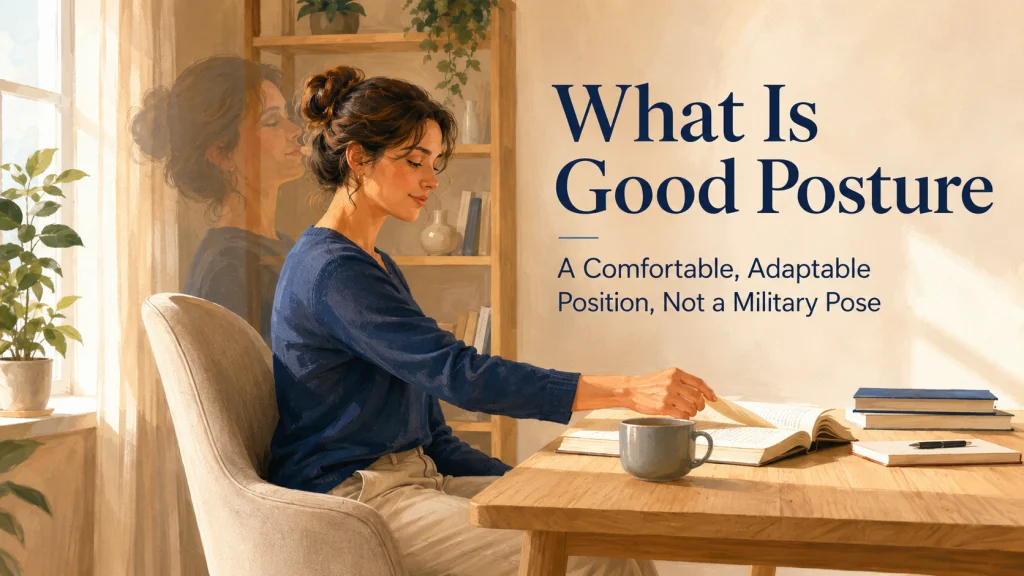
Good posture is not a rigid shape that everyone should hold from morning to night. It is a position that fits the task, feels manageable, uses support where it helps, and leaves room to move. Alignment can be a useful starting point, but a photograph cannot tell you how hard someone is working to hold a pose or whether that position suits their body and activity. The better question is not whether a person looks perfectly upright, but whether the position works without unnecessary strain or constant correction.
Four Upright Silhouettes, but No Automatic Winner
Many people have had the same small moment in front of a mirror: straighten the back, pull the shoulders behind the body, tuck the chin, and try to hold everything there. The result may look more upright for a few seconds. It may also feel like standing for a photograph rather than living through an ordinary day.
Now imagine four side-view outlines. Each person appears reasonably upright, so the cleanest silhouette seems like the obvious winner. The outline leaves out the part that matters most.
| Silhouette | What the outline shows | What is happening outside the outline |
|---|---|---|
| A | An upright seated position | The person is lifting the chest and holding the shoulders back with constant effort |
| B | An equally upright seated position | The chair supports the body, so the person can breathe and work without bracing |
| C | A small forward inclination | The person has moved closer for a detailed task and will move back when it ends |
| D | An upright standing position | The knees are locked and the person is avoiding every natural weight shift |
No outline tells you who feels steady, who can reach the task, who is tiring, or who can change position without losing control. It also hides chair dimensions, work height, footwear, body proportions, fatigue, and the amount of time already spent there.
Remove the visual winner and ask a more useful set of questions. Who can complete the task? Who can breathe normally? Who has enough support? Who can move when the current position stops being useful? Those answers provide more information than the straightest line.
Editorial observation: Chair, cushion, brace, and wearable marketing often presents one polished side-view silhouette as the desired result. Product fit still depends on body dimensions, contact points, adjustment range, task demands, and duration, so the diagram is better treated as a sales illustration than a medical standard.
Posture Is the Way the Body Organizes Itself for a Task
Posture is the way the body is positioned while sitting, standing, resting, moving, or carrying out an activity. It includes the relationship among body regions, but that is only one part of the picture. The surface under the body, the position of the task, the available support, and the time spent there all shape the final position.
A few terms are helpful when they remain descriptive rather than judgmental:
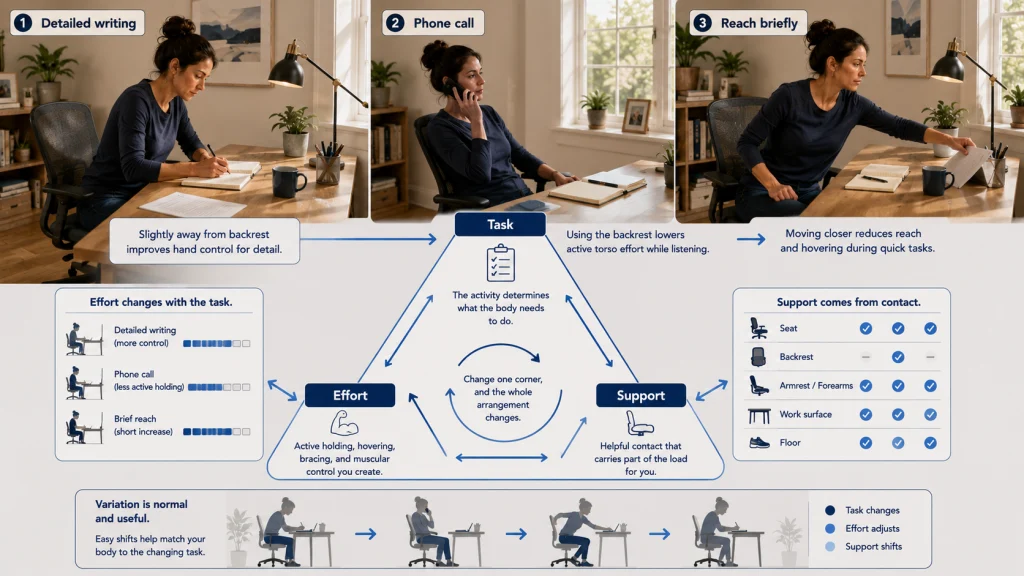
- Alignment describes how body regions relate to one another and to the work being done.
- Neutral describes a middle-range reference that avoids an unnecessary extreme for the current activity.
- Support comes from contact with a chair, floor, backrest, armrest, work surface, or another stable point.
- Effort is the work needed to hold and control the position.
- Variation is the freedom to shift, reposition, or use another workable posture over time.
These terms should help explain what is happening, not rank bodies from best to worst. A person can look neat while working too hard to stay there. Another person can appear less formal while using the chair well and completing the task comfortably.
| Task | |
|---|---|
| Effort How much active holding is required? | Support What can safely carry part of the load? |
This three-way relationship works like a simple decision triangle. The task sits at the top because it determines what the body needs to do. Effort and support form the base because they influence how sustainable that position feels. Change one corner and the whole arrangement may change.
For example, moving a document closer may reduce the need to hover forward. Using the backrest during a phone call may let the torso relax. Moving away from the backrest during detailed handwork may improve control for a short period. None of those choices has meaning without the task.
The Spine Is Not Meant to Look Straight From Every Angle
The word “straight” can make good posture sound like flattening the body against an invisible wall. From the side, the spine normally has curves. Trying to erase every curve often creates a stiff pose rather than an easier position.
Pulling the shoulders as far back as possible, forcing the chin downward, flattening the lower back, or tightening the abdomen continuously can create a military-looking outline. The body may appear more controlled while the person feels less able to breathe, reach, or relax.
A neutral reference is quieter than that. The head is not being pushed far forward or pulled sharply back. The torso and pelvis are organized well enough for the current activity. The spine keeps its natural curves, and the lower body provides a base without every joint being locked.
That reference will not look identical on everyone. Torso length, limb length, mobility, seating, footwear, and the height of the task all change the visible shape. The guide to a neutral spine position explains the positioning concept in more detail without turning it into one mandatory outline.
A Reference Position Should Help, Not Become Another Rule to Fail
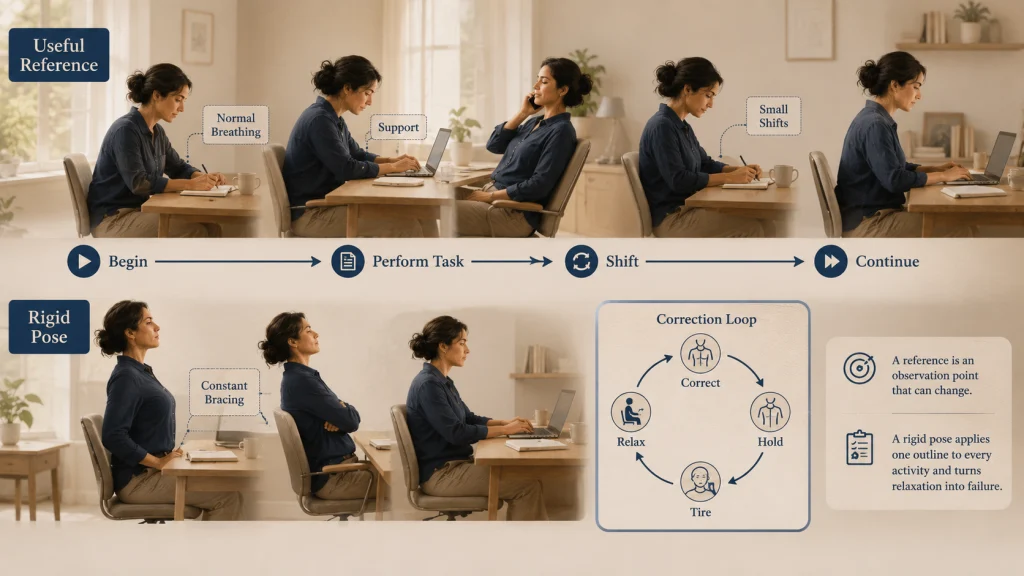
A reference position gives you somewhere to begin. It can help you notice that the screen is pulling the head forward, that the chair is too deep to use the backrest, or that the work is placed outside comfortable reach. Trouble begins when the reference becomes a pose that must be maintained without interruption.
That rigid interpretation often creates a familiar cycle. The person corrects the body, holds the new shape for as long as possible, becomes tired, relaxes, and then treats the relaxation as failure. The cycle produces more monitoring without necessarily improving the task.
| Useful reference position | Rigid pose |
|---|---|
| Uses only the effort the task requires | Depends on constant bracing |
| Allows normal breathing | Encourages holding the chest or abdomen tightly |
| Accepts small shifts | Treats movement as failure |
| Changes when the activity changes | Applies the same outline to every activity |
| Uses contact and support when useful | Assumes support means poor form |
| Provides one observation point | Becomes a verdict about health or discipline |
You may sit farther forward while writing, rest against the backrest during a call, lean closer for careful handwork, and shift again before standing. A workable posture can include all of those moments.
Use Practical Checks Without Turning Them Into Medical Tests
Ordinary posture awareness does not require measuring every angle. It can begin with a few simple observations about how the current position behaves during the activity.
- Breathing: Can you breathe without holding the chest, abdomen, jaw, or shoulders in place?
- Stability: Do the feet, seat, work surface, or other contact points create a dependable base?
- Reach: Can you reach what you need without repeatedly stretching, twisting, or hovering?
- Viewing: Can you see the work without continually moving the head closer?
- Control: Can you type, read, prepare food, lift, or use a tool with reasonable precision?
- Change: Can you shift or adopt another workable position when the current one becomes tiring?
These observations point toward friction rather than a diagnosis. Raised shoulders during keyboard work may suggest a poor match between the hands and the work surface. Sliding forward to read may point toward viewing distance, glare, or text size. A chair that feels relaxing during a call may be too deep for close desk work.
Note: Comfort matters, but it is not a pass-or-fail test. A position may feel pleasant for resting and still be awkward for reaching. Another position may feel unfamiliar simply because the setup has changed. Combine comfort with what the activity requires.
Body Proportions and Task Demands Change the Visible Shape
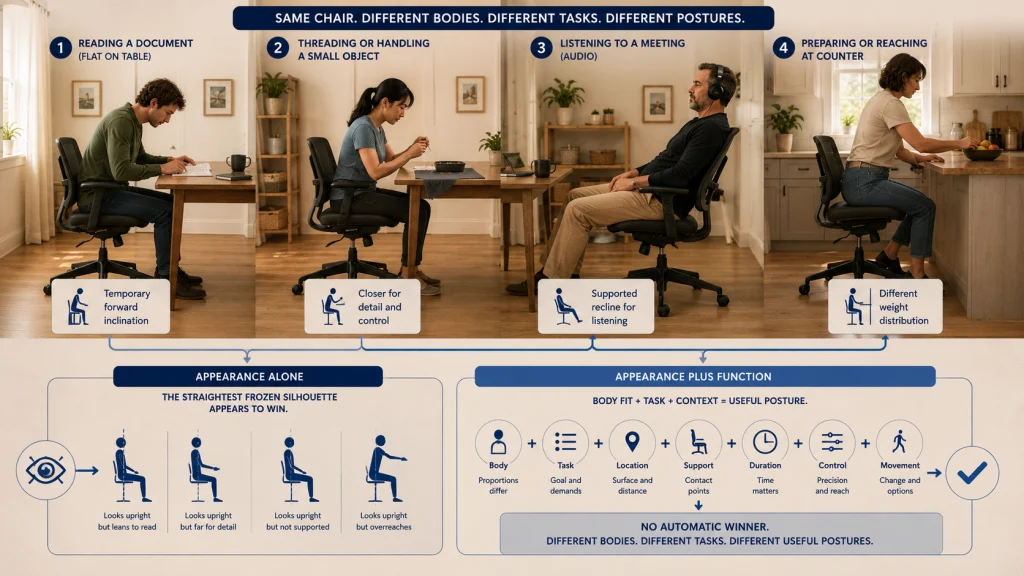
Two people can use the same chair and look different while both are working effectively. One may have a longer torso, another may have shorter lower legs, and another may need to sit closer because of viewing distance. The chair does not meet each body at the same points.
The activity can change the outline even more. Reading something flat on a table naturally brings the head and torso forward. Threading a needle or trimming a small object requires a different relationship to the work than listening to a meeting. Preparing food at a counter, folding laundry, and reaching into a cabinet each create their own useful range of positions.
This is why a side-view image can be visually persuasive while still being incomplete. It freezes a person but removes the reason for the position.
Ordinary body variation should not be treated as damage, failure, or poor discipline. A visible difference may matter for fit, but the outline cannot explain the entire experience.
Sitting and Standing Need Different Reference Points
Sitting and standing share broad goals, but they do not use the same base. In sitting, the chair and floor help organize the body. In standing, the feet and the surface below them carry that role. Copying one checklist across both positions can hide the difference.
During sitting, the seat should support the body without forcing a constant slide. The feet may rest on the floor or another stable surface. A backrest can carry part of the load when the activity allows it, while the hands or forearms may need their own contact during desk work.
During standing, small weight shifts are normal. A useful stance does not require freezing both feet in one position or locking the knees. The work should be near enough that the person does not need to hover, overreach, or keep the shoulders raised.
These are only reference ideas. The broader guide to improving posture connects positioning with awareness, movement, and the surrounding environment. Detailed decisions about chairs, screens, work surfaces, and tools belong to more specific ergonomics guidance.
A Comfortable Position Still Has an Expiration Point
A position can feel excellent at first and less useful later. That does not mean it was wrong from the beginning. Contact pressure builds, attention changes, muscles tire, and the activity moves into a new phase.
This is easy to recognize in daily life. A person may begin a call sitting forward with notes, settle against the backrest while listening, stand to find a document, and return in a different position. The useful posture changed because the activity changed.
Small shifts count. Moving one foot, changing the angle of the chair, resting the forearms, standing for part of a task, or walking to another surface can alter the experience without creating a formal routine.
The distinction between stillness and movement is explored further in the guide to static and dynamic posture. Neither staying still nor moving constantly is always better. The question is whether the current pattern fits what you are doing and how long you have been doing it.
Practical tip: Instead of asking whether you are still holding the right pose, ask whether the position still helps with the task.
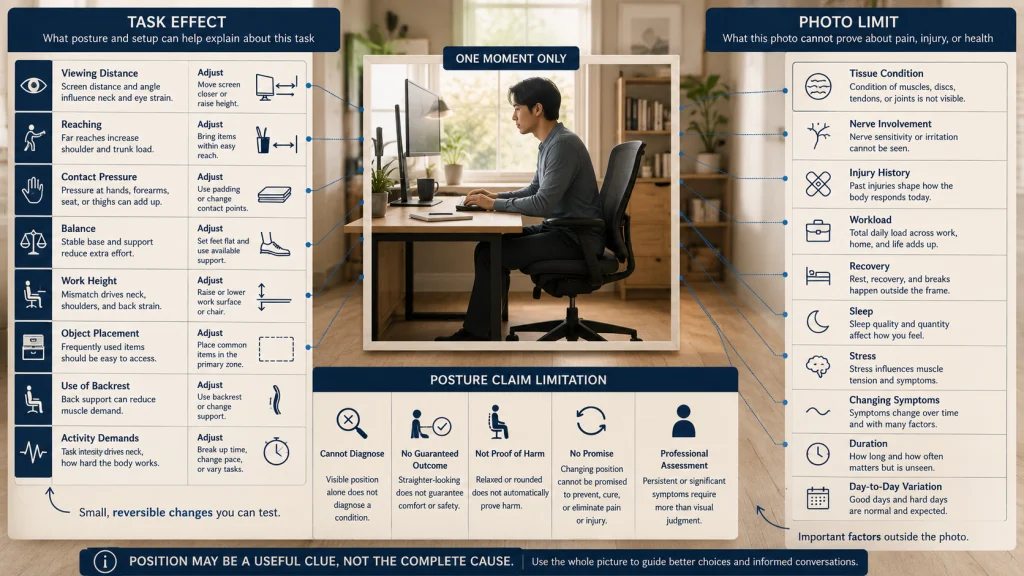
Posture Can Affect a Task Without Explaining Every Symptom
Position can influence reach, visibility, contact pressure, balance, and how demanding an activity feels. Moving a screen, changing work height, using a backrest, or bringing a frequently used object closer can make an ordinary task easier.
That practical effect should not be stretched into a diagnosis. A photograph cannot show tissue condition, nerve involvement, recovery, workload, sleep, stress, injury history, or the many other factors that may shape how someone feels. Two similar-looking people can have very different symptoms, and the same person can feel different on two days while appearing almost unchanged.
- A visible body position alone does not diagnose a condition.
- A straighter-looking position does not guarantee comfort or safety.
- A relaxed or rounded position does not automatically prove harm.
- A positioning change should not be promised to prevent, cure, or eliminate pain or injury.
- Persistent or significant symptoms require more than a visual judgment.
It is understandable to want one clear explanation when something hurts. A posture photo can feel reassuring because it offers something visible to correct. The limit is that the body is not a before-and-after diagram. Position may be one useful part of the situation without being the whole cause.
The guide to common posture myths examines claims that ask one body shape to explain more than appearance can support.
Choose the Next Question Instead of Correcting Everything at Once
Once posture is understood as a working relationship between the body and the activity, the next step becomes easier to choose. You do not need to solve alignment, movement, chair fit, symptoms, and every daily habit in one attempt.
- Use the neutral spine guide when the question is how to understand a middle-range spinal position.
- Use the posture self-check guide when you want to observe your current setup without treating a mirror check as a diagnosis.
- Use the static and dynamic comparison when the problem is staying in one position too long or misunderstanding the role of movement.
- Use the posture claims guide when a strong statement links one visible shape to pain, injury, or health.
Questions about slouching also need context. A brief relaxed position, a forward position used for detailed work, and a posture accompanied by persistent symptoms are not the same situation. Questions about chair fit, screen placement, repeated reaching, or work height belong to the wider posture and ergonomics framework.
Key decision: Name the problem before choosing the solution. Decide whether the next question concerns alignment, observation, movement, a health claim, or the surrounding setup.
When Visible Change or Symptoms Need Professional Assessment
Self-guided positioning advice is appropriate only while the problem remains an ordinary comfort or setup question. A visible change deserves more attention when it is new, progressive, linked to an injury, accompanied by symptoms, or limiting normal activities.
Seek appropriate professional evaluation: New, severe, persistent, worsening, or unexplained pain; numbness; weakness; tingling; balance changes; symptoms after a fall or injury; or a change that limits daily function should be assessed by a qualified professional. Loss of bowel or bladder control, chest pain, severe shortness of breath, or fainting requires immediate appropriate help.
Do not use a side-view photograph, posture app, brace advertisement, or online checklist to diagnose a spinal, joint, nerve, balance, connective-tissue, or musculoskeletal condition. Those tools may help organize observations, but they cannot replace an examination when symptoms or functional limits suggest that positioning advice is not enough.
Use Alignment as a Reference, Not a Verdict
Good posture should make daily life feel more workable, not turn every relaxed moment into something to correct. Use alignment to notice avoidable extremes and poor matches between the body and the environment. Then let the activity, the available support, and the need to move shape the final position.
A useful posture is not the one that looks most disciplined in a frozen image. It is the one that helps you do what you need to do, allows you to breathe and shift, and does not demand constant attention just to maintain its appearance.
FAQs
🧭 What is good posture in simple terms?
Good posture is a position that fits the activity, feels manageable, uses helpful support, and can change when needed. It is not one fixed outline that every person must copy.
🌿 Should my back look completely straight?
No. From the side, the spine normally has curves. A neutral reference respects those curves rather than forcing the back into an artificial line.
🪑 Is leaning back in a chair bad posture?
Not automatically. Leaning back may reduce effort when the chair supports the body and the activity does not require close reach. The position should still allow comfortable viewing, breathing, and an easy change when the task changes.
🔄 Do I need to hold one position all day?
No. Even a comfortable, well-supported position should change over time. Small shifts, different contact points, standing, or moving to another task position can all provide useful variation.
📷 Can a photo tell me whether my posture is healthy?
A photo can show one moment and may help you notice a position or setup detail. It cannot diagnose a condition, prove the cause of symptoms, or show how much effort, comfort, support, or movement was present.
🚩 When should I stop adjusting posture on my own?
Stop self-guided troubleshooting when symptoms are new, severe, persistent, worsening, unexplained, or limiting function, or when numbness, weakness, tingling, balance changes, or injury-related symptoms are present. Emergency signs such as chest pain, severe shortness of breath, fainting, or loss of bowel or bladder control require immediate appropriate help.