Deodorant and antiperspirant may come in similar packages, but they solve different problems. Deodorant is mainly for odor control, while antiperspirant is intended to reduce underarm perspiration; combination products do both. Choose by naming the problem first, then confirm the category, active claim, intended body area, directions, and warnings on the label. A product comparison is no longer enough when odor or sweating changes suddenly, disrupts daily life, or comes with skin symptoms.
Two Similar Sticks Can Have Different Jobs
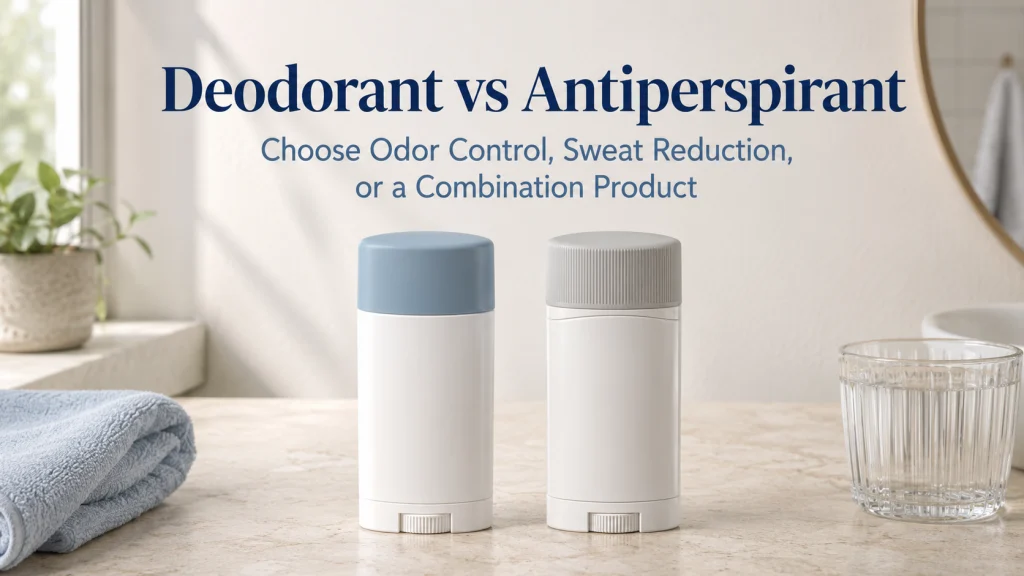
Place two nearly identical underarm sticks side by side and the packaging may suggest that they are interchangeable. One may say deodorant and focus on odor or fragrance. The other may say antiperspirant, list an active ingredient, and include a Drug Facts panel because it makes a perspiration-reduction claim.
| What you notice | Stick labeled deodorant | Stick labeled antiperspirant |
|---|---|---|
| Main front-label promise | Odor control, freshness, or fragrance | Perspiration or wetness reduction |
| Regulatory clue | Cosmetic claims may appear without a Drug Facts panel | An active ingredient and Drug Facts panel identify the drug function |
| What the package does not prove | A deodorant claim alone does not promise less sweat | An antiperspirant claim alone does not cover every odor concern or body area |
The practical difference starts with intended use, not with the shape of the package. This article helps you make that function decision within a broader bathing and body odor routine, without turning the comparison into a brand ranking or a universal safety claim.
Define the Problem Before Comparing the Products
Underarm odor and underarm wetness can occur together, but they are not the same target. Sweat itself is a fluid produced by sweat glands. Body odor develops when sweat, skin oils, bacteria, clothing, and time interact. A product can address one part of that situation without fully changing the other.
- Deodorant: A product intended mainly to control, reduce, or mask odor.
- Antiperspirant: A product intended to reduce perspiration in the labeled area.
- Combination product: A package that makes both deodorant and antiperspirant claims.
- Cosmetic: A product category based on cosmetic intended use, such as cleansing, beautifying, or changing appearance.
- Drug: A category based on a drug intended use, such as reducing perspiration.
- Active ingredient: The ingredient identified as providing the drug function listed in the Drug Facts panel.
A single package may be a cosmetic, a drug, or a cosmetic-drug combination depending on the claims it makes. That is why a quick glance at the word fresh, the scent name, or the applicator format does not tell you the full category.
Decide Whether You Want Odor Control, Sweat Reduction, Both, or Evaluation
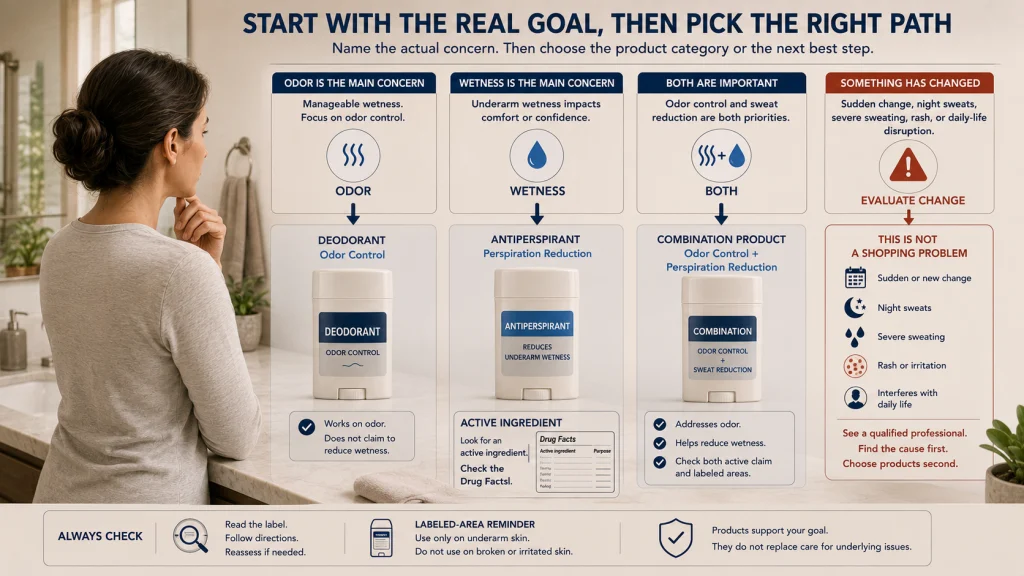
Start with what is actually bothering you. This keeps you from asking a deodorant to reduce wetness or repeatedly adding fragrance when the larger issue is a new or persistent change.
| Main concern | Category to examine | Important limit |
|---|---|---|
| Ordinary underarm odor with manageable perspiration | Deodorant | Odor control does not automatically mean sweat reduction |
| Underarm wetness is the main concern | Antiperspirant | Use only as directed for the labeled area |
| Both odor and wetness matter | Combination product | Confirm that both functions are stated on the package |
| Sudden change, severe sweating, night sweats, rash, or daily-life disruption | Qualified evaluation | Do not keep treating a changing symptom as a shopping problem |
Key decision: Name the goal before choosing the format. A clear goal makes the front label and Drug Facts panel easier to interpret.
What Deodorant Does and Where Its Limits Begin
Deodorant is chosen for odor control. Depending on the formula and its claims, it may mask odor with fragrance, reduce odor through cosmetic ingredients, or combine several cosmetic approaches. It should not be treated as a perspiration-reduction product unless the package also makes an antiperspirant claim.
This distinction matters when a reader asks, “Does deodorant stop sweat?” A deodorant-only label may leave normal underarm wetness unchanged even when the odor result is acceptable. Applying more fragrance cannot convert that product into an antiperspirant.
Deodorant also has practical limits. It cannot explain a sudden odor change, guarantee the same result through every activity, or replace a complete routine that includes clean skin and clean clothing. When odor returns soon after washing, use the broader post-shower odor troubleshooting process rather than treating a stronger scent as the only answer.
What Antiperspirant Does and Why the Drug Label Matters
Antiperspirant is intended to reduce perspiration in the body area named on the label. Because that is a drug function, the package should identify the active ingredient and provide Drug Facts, directions, warnings, and other required information.
That drug labeling does not make one format automatically stronger, gentler, or more suitable for you. It tells you what function the product claims and how it is meant to be used. The exact active claim, directions, and warnings matter more than the package color, fragrance name, or words such as sport and fresh.
Antiperspirant also should not be described as eliminating all odor. Reducing underarm wetness may change the conditions that contribute to odor, and many packages combine antiperspirant and deodorant functions, but the exact claim should come from the label rather than package appearance or expectation.
Read the Label in Six Passes
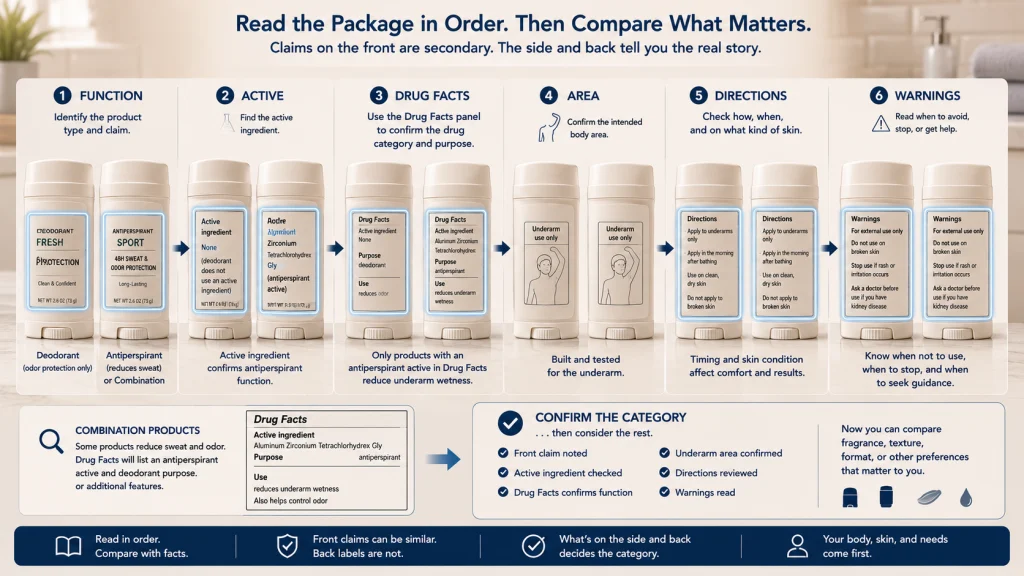
A quick label-reading sequence prevents many product mismatches. Read the package in this order before comparing scent, texture, or price.
| Label pass | What to find | Question it answers |
|---|---|---|
| 1. Front claim | Deodorant, antiperspirant, or both | Which function is being promised? |
| 2. Active ingredient | An identified antiperspirant active ingredient | Is there a perspiration-reduction drug function? |
| 3. Drug Facts | Purpose, directions, and warnings | How is the drug function defined and limited? |
| 4. Intended area | The body area named on the package | Where is the product meant to be used? |
| 5. Directions | Timing, frequency, skin condition, and preparation | What use method does this exact package require? |
| 6. Warnings | When to avoid, stop, or seek guidance | What conditions change the decision? |
Practical tip: Read the side or back panel before treating a front-label phrase as a function. Two products with nearly identical packaging may belong to different categories.
When the product is an antiperspirant, follow the labeled directions rather than copying a routine from another format. Application timing and technique are a separate decision from choosing the correct product function.
Separate Product Function From Product Format
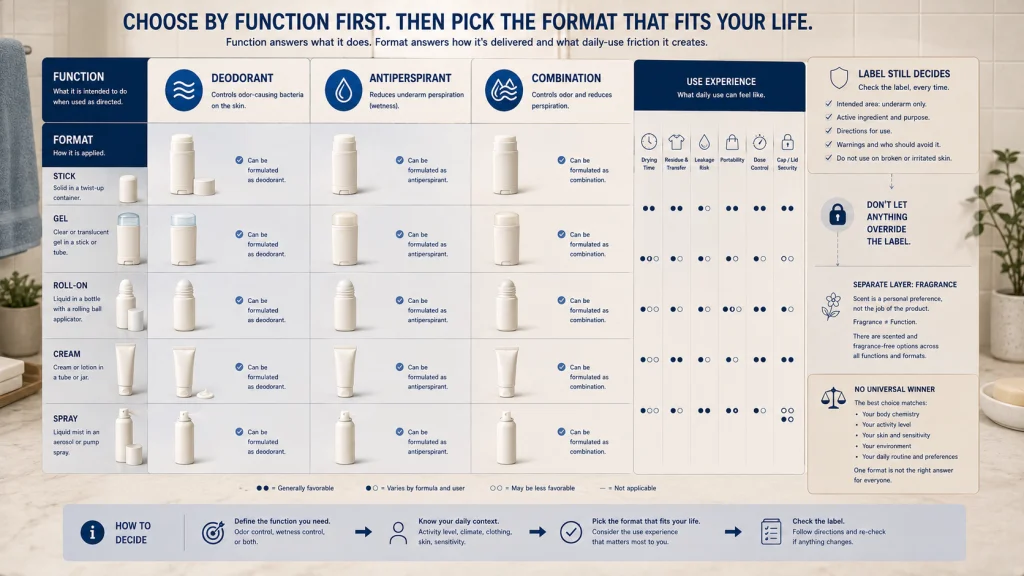
Function answers what the product is supposed to do. Format answers how the product is delivered and how it feels to use. Keeping those questions separate avoids conclusions such as “sprays are deodorants” or “sticks are antiperspirants.” Either function may appear in more than one format.
| Decision layer | Questions to ask | What it should not decide |
|---|---|---|
| Function | Odor control, sweat reduction, or both? | It does not tell you which texture you will prefer |
| Format | Stick, gel, roll-on, cream, or spray? | It does not prove the product reduces sweat |
| Fragrance | Scented, fragrance-free, or another labeled option? | It does not establish drug strength or safety superiority |
| Use experience | Drying time, residue, portability, leakage, and skin feel? | It does not override the labeled area or warnings |
| Package | Cap security, dose control, storage, and remaining-product visibility? | It does not change the category printed on the label |
Editorial observation: Package friction often becomes visible after purchase. A loose cap, slow-drying applicator, hard-to-control spray, or residue-prone formula may affect daily use even when the function is correct. Those are usability questions, not evidence that one format is medically better.
Compare Stick, Gel, Roll-On, Cream, and Spray Without Naming a Universal Winner
Formats create different tradeoffs, and the same person may prefer different formats for home, travel, or shared-space use. Compare how the package behaves rather than treating the applicator as proof of performance.
- Stick: Compact and familiar, with direct application and straightforward dose control. Check residue, clothing transfer, cap buildup, and product left below the mechanism.
- Gel: Often applies clearly and may offer adjustable dispensing. Drying time, sticky feel, over-dispensing, and cap mess can become the main friction points.
- Roll-on: Provides even liquid contact, but may feel wet and require more drying time. Leakage and keeping the roller ball clean also matter in storage.
- Cream: Allows manual placement and flexible amount control. Consider finger contact, cleanup, container hygiene, and portability.
- Spray: Can cover quickly with less direct applicator contact. Check overspray, ventilation, noise, shared-space use, and whether the package makes dose control easy.
Editorial observation: Format preferences often change with context. A roll-on that feels manageable at home may be inconvenient when dressing quickly, while a spray that seems fast may create noise or overspray in a shared bathroom. These tradeoffs affect whether the product fits the routine, not whether its labeled function is stronger.
The useful question is not “Which format is best?” It is “Which correctly labeled function can I use consistently without creating avoidable residue, drying, storage, or application problems?”
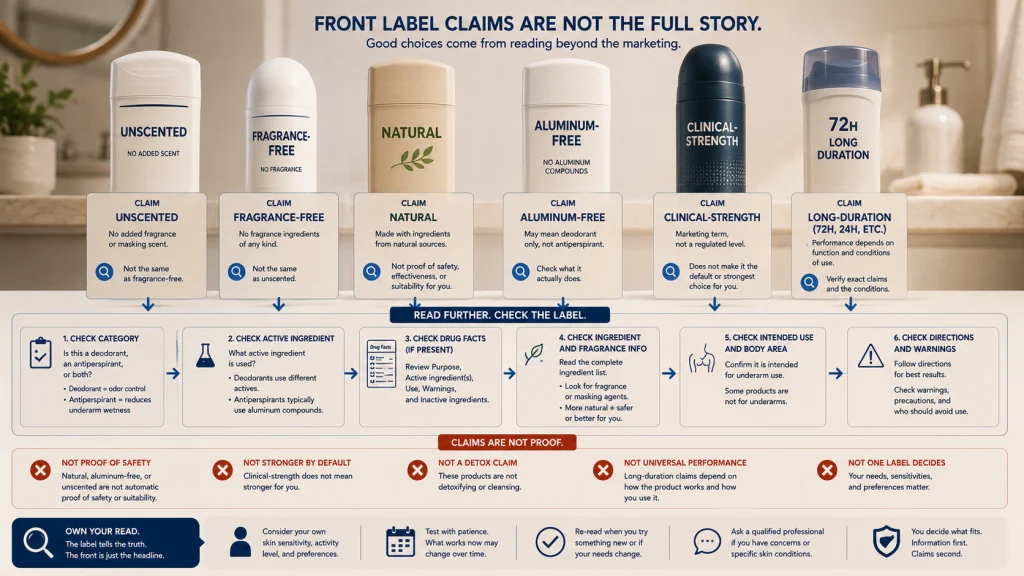
Treat Marketing Terms as Prompts to Read More Carefully
Note: A front-label term may describe fragrance, positioning, duration, or product category, but it should not replace the ingredient list, Drug Facts, directions, and warnings.
- Unscented: This term is not necessarily identical to fragrance-free. Read the exact wording and ingredient information.
- Fragrance-free: Treat it as a fragrance claim, not proof that the whole formula will suit every person.
- Natural: The word alone is not evidence that a product is safer or more effective.
- Aluminum-free: This usually signals that the product is not using an aluminum-based antiperspirant active ingredient. Confirm whether it is deodorant-only, and do not treat the phrase as proof of greater safety.
- Clinical-strength: The phrase is not automatically the best default and does not justify self-treating severe sweating.
- Long-duration claims: Confirm the exact function, directions, and conditions because the same result is not guaranteed for every person or activity.
Unsupported claims about aluminum, detoxification, or natural superiority can distract from the actual decision. The label should answer what the product does, where it is meant to be used, and how it should be applied.
Move From Product Choice to Correct Application
Once you have confirmed that perspiration reduction is the goal and that the package is an antiperspirant, the next question is application. Timing, skin condition, amount, and the product’s own directions can matter more than switching formats repeatedly.
Use the full guide on antiperspirant application for that next step. Keep the roles separate: this comparison chooses the function, while the application guide explains how to use the chosen category according to its label.
Treat Expanded-Area Claims as a Separate Decision
An underarm product is not automatically suitable for hands, feet, groin, face, or any other area. Skin characteristics, product directions, warnings, inhalation concerns, and mucosal exposure can differ by location.
When a package makes broader deodorant claims, use the separate guide to whole-body deodorant claims and limits. Do not extend an underarm antiperspirant routine to another body area unless the exact product labeling supports that use and the directions are appropriate.
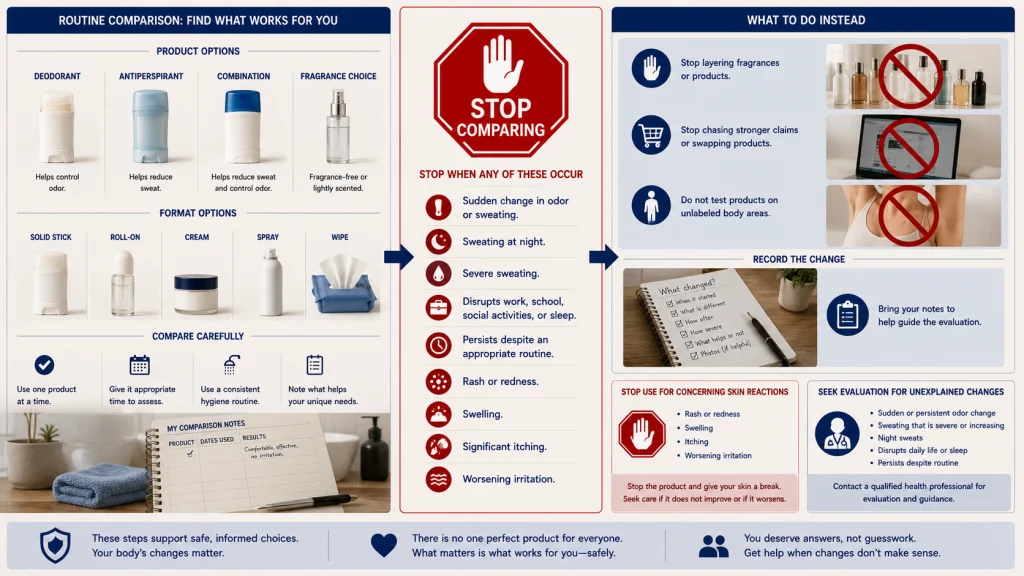
Know When Product Comparison Is No Longer Enough
A deodorant-versus-antiperspirant decision is designed for ordinary underarm odor and perspiration. It cannot determine the cause of a sudden change, diagnose excessive sweating, or explain a persistent skin reaction.
Safety warning: Seek qualified evaluation for sudden or unexplained odor changes, night sweats, severe sweating, symptoms that disrupt work or daily activities, or persistent failure despite an appropriate routine. Stop using the product and seek guidance for rash, swelling, significant itching, worsening irritation, or other concerning skin symptoms.
Do not use a stronger marketing claim, repeated fragrance, or an unlabeled body-area experiment as a substitute for evaluation. Broader personal hygiene guidance can help organize ordinary routines, but changing or severe symptoms need a different level of attention.
Choose by Goal, Category, Label, Area, and Stop Condition
Begin by naming the main goal: odor control, sweat reduction, or both. Then verify the product category from the front claim, active ingredient, Drug Facts, directions, intended area, and warnings before comparing format or fragrance.
Choose the format that creates the least daily friction without confusing convenience with function. Stop self-selection when sweating or odor changes suddenly, becomes severe, disrupts daily life, or appears with persistent skin symptoms.
FAQs
🧴 Does deodorant stop sweat?
Deodorant-only products are intended mainly for odor control, not perspiration reduction. Look for an antiperspirant claim, active ingredient, and Drug Facts panel when reducing underarm wetness is the goal.
💧 Does antiperspirant also control odor?
Some antiperspirants are combination products that make both perspiration and odor claims. Check whether the front label also states a deodorant function, then confirm the Drug Facts.
🏷️ How can I tell whether a product is a combination?
The package should make both deodorant and antiperspirant claims. An antiperspirant function should also be supported by an active ingredient and Drug Facts panel.
🌿 Is natural deodorant automatically safer?
No broad term such as natural proves that a formula is safer for every user. Compare the actual function, ingredients, directions, warnings, and your own skin response rather than relying on the marketing category alone.
🔍 Does aluminum-free mean antiperspirant-free?
Aluminum-free usually signals that the product does not use an aluminum-based antiperspirant active ingredient. Confirm the category on the label because the product may be deodorant-only.
👕 Which format leaves the least residue?
Residue depends on the formula, amount, drying, and clothing contact, not only the applicator type. Compare those practical factors separately from whether the product is deodorant, antiperspirant, or a combination.
🧭 Can I use an underarm product elsewhere?
Underarm directions do not automatically apply to another body area. Use only the areas listed on the exact package and review expanded-area products as a separate decision.
🚩 When should I stop comparing products and seek help?
Seek evaluation for sudden odor or sweating changes, night sweats, severe sweating, daily-life disruption, persistent failure, or concerning skin symptoms. A product label cannot diagnose the cause of those changes.