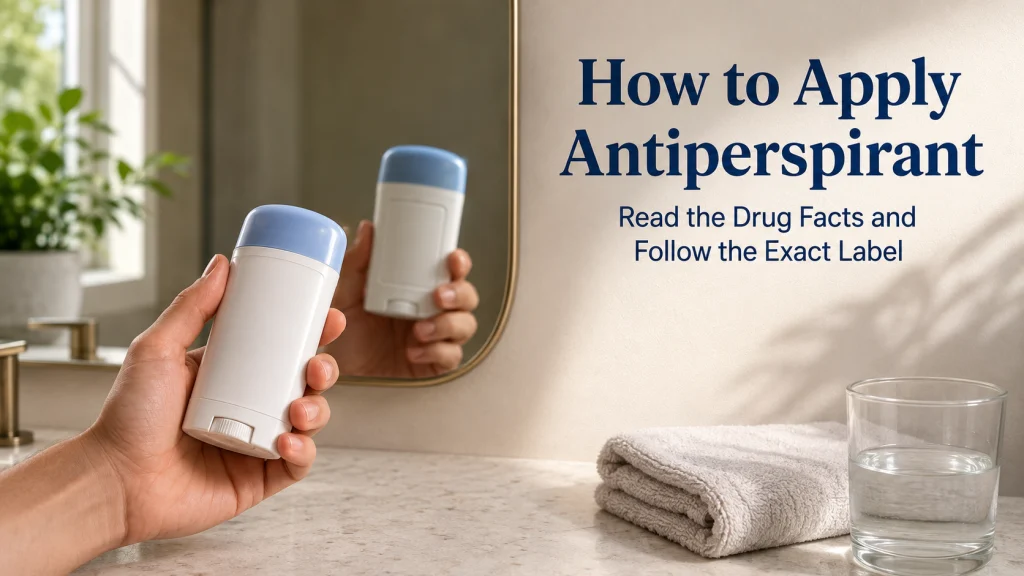
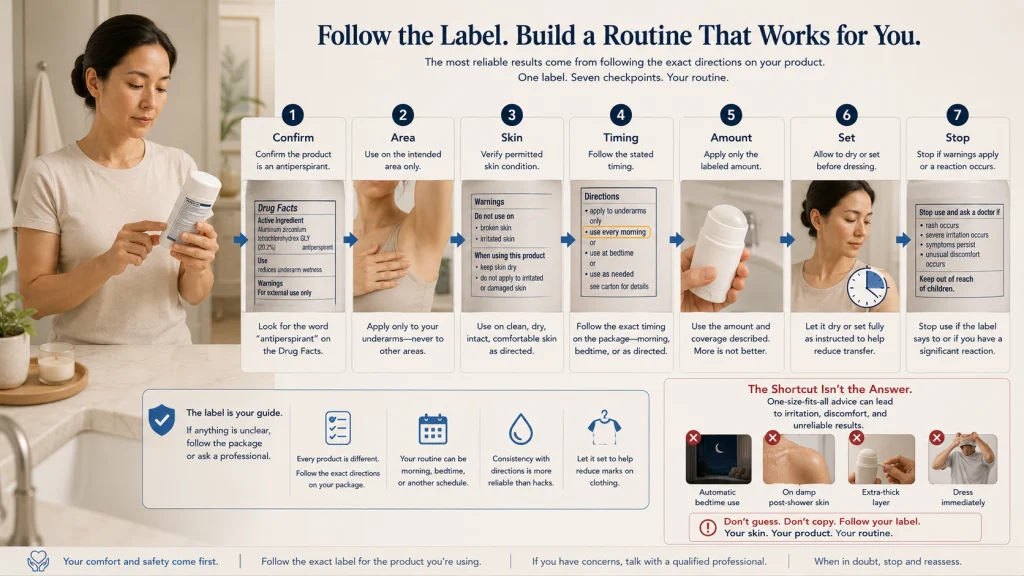
A reliable antiperspirant routine starts with the exact product label rather than a one-size-fits-all online rule. Confirm that the package is an antiperspirant, locate its Drug Facts, and follow the labeled area, timing, amount, skin condition, and warnings. Dry, intact underarm skin may fit many products, but bedtime use, post-shower timing, and reapplication instructions can differ. Stop using the product if significant irritation develops, and seek qualified evaluation when sweating changes suddenly, occurs at night, becomes severe, or disrupts daily life.
The Same Product Can Meet Four Different Skin States
Picture one antiperspirant beside four underarm situations: skin still wet after a shower, skin that is fully dry, skin that feels irritated after shaving, and skin that is already heavily sweating. The package has not changed, but the condition of the skin has. That difference can affect whether the product is appropriate to apply at that moment.
| Skin state | What to check before applying |
|---|---|
| Wet after a shower | Check whether the directions call for dry skin and allow enough time for the area to dry fully. |
| Fully dry and comfortable | Confirm the labeled timing, amount, and underarm-only directions. |
| Irritated, recently shaved, or broken | Read the warnings and avoid applying when the label excludes irritated or damaged skin. |
| Already heavily sweating | Check the directions instead of assuming an extra-thick layer or repeated application is appropriate. |
Begin by matching four details: product category, skin condition, application area, and the exact directions. That small check is more useful than copying an “always apply at night” routine from another package.
Confirm the Package Says Antiperspirant and Locate Drug Facts
Deodorant and antiperspirant can look nearly identical on a shelf. A stick, gel, roll-on, cream, or spray format does not tell you which function the product provides. The front label should identify whether the product is an antiperspirant, a deodorant, or a combination of both.
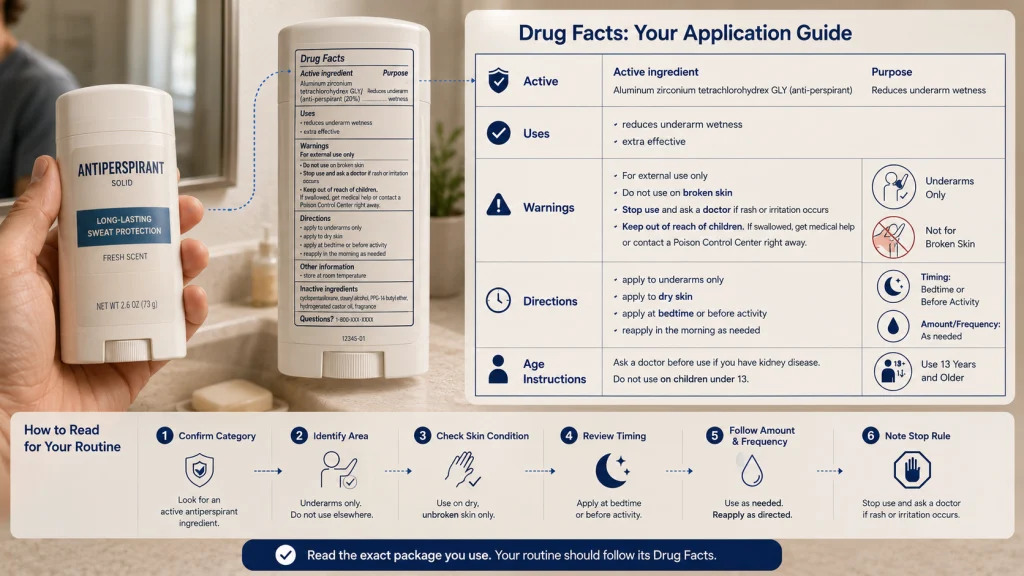
An antiperspirant should also provide Drug Facts information. That panel is more important than the package color, fragrance name, or broad front-label wording because it identifies the active ingredient, intended use, warnings, and directions.
Key decision: If the package does not identify an antiperspirant function and does not provide the relevant Drug Facts, do not treat it as a sweat-reduction product.
For help separating the two functions before choosing a product, review the comparison between odor control and sweat reduction.
Read the Active Ingredient, Purpose, Uses, Warnings, and Directions
Drug Facts turns the package into a practical application guide. Read the entire panel before deciding when or how much to apply, especially when switching formats or buying a product whose front label looks familiar.
| Label element | Question it answers |
|---|---|
| Active ingredient | Which antiperspirant ingredient the product uses. |
| Purpose | Whether the active ingredient is identified for antiperspirant use. |
| Uses | What the product is intended to do. |
| Warnings | Which skin conditions, reactions, or situations require avoiding or stopping use. |
| Directions | Where, when, and how often the product should be applied. |
| Age instructions | Whether the package gives a specific age-related direction or says to ask a professional. |
Use this sequence before application: identify the category, confirm the intended area, check the allowed skin condition, read the timing, follow the amount or application wording, and note the stop rule. When a direction is missing, advice from a different package is not a reliable substitute.
Apply Only to the Labeled Underarm Area
This article covers ordinary over-the-counter underarm antiperspirant use. Underarm directions do not automatically authorize use on the hands, feet, face, groin, back, or other areas. A product that works in one location may have different labeling, contact risks, and practical limitations elsewhere.
Safety warning: Do not extend underarm directions to another body area unless that use is stated on the exact product or a qualified professional has directed it.
Expanded-area odor products are a separate decision. Review the limits of whole-body deodorant claims rather than treating them as permission for whole-body antiperspirant use.
Use Only on the Skin Condition Allowed by the Label
Application advice often focuses on timing while skipping the condition of the skin. That omission matters. Dry, intact, comfortable skin is different from skin that is broken, infected, swollen, burning, or significantly irritated.
Read the warnings before applying after shaving, scratching, friction, or a previous reaction. A recent shower may leave the area damp, while shaving can make it feel sensitive even when no cut is obvious.
Note: “Clean” and “ready for application” are not the same decision. The label still controls whether the skin should be dry, intact, and free from irritation.
Follow the Exact Timing Instead of Treating Bedtime as Universal
Bedtime can suit some antiperspirant routines because the underarms may be drier and less active then. Other products use different directions, so the package still determines whether that timing fits.
Start with the directions on the package. Follow any stated time, frequency, or application condition, and keep to that schedule unless the label gives a reason to change it.
A useful schedule should feel easy to repeat and simple to verify on the package.
Do Not Treat Wet Post-Shower Skin as Automatically Ideal
A shower may fit neatly into a morning or evening routine, but the underarms can remain damp after the rest of the body feels dry. Applying immediately can make a stick drag, a gel smear, a roll-on stay wet, or a spray collect unevenly.
Pat the area gently and allow it to become fully dry when the label calls for dry skin. Avoid hard rubbing that creates more irritation. If shaving has left the skin tender, read the warning instead of assuming the next routine step must continue.
When odor returns soon after washing, antiperspirant timing may be only one part of the issue. The broader troubleshooting guide for odor after a shower covers routine and source questions without turning this page into a medical diagnosis.
Apply the Labeled Amount Rather Than Building a Thick Layer
A heavy coating often creates more residue, drying time, fabric transfer, or discomfort. It also cannot correct a mismatch in timing, skin condition, or product category.
Match the amount to both the wording and the delivery mechanism. A solid stick, gel dispenser, roll-on, cream, and aerosol release product differently, so a swipe count from one format may be meaningless for another.
Editorial observation: Package mechanisms can make amount control easier or harder. A dial-up stick may expose more product than expected, a gel may continue dispensing after the first turn, and a roll-on may feel wet even after the directed coverage is complete. Watching the mechanism is usually more informative than judging the routine by how heavily coated the skin feels.
Allow the Format to Dry or Set Before Dressing When Required
Some formats need a brief pause before clothing touches the underarm. Follow the package direction and give a wet or unset layer enough time to settle before fabric presses against it.
Loose arm positioning for a short period may reduce transfer while the product sets. Tight clothing applied immediately can move product onto fabric, leave visible marks, or create a sticky feeling that encourages unnecessary reapplication.
Practical tip: Put on the product at a point in the routine when you can leave the underarms uncovered long enough to follow the package instruction without rushing.
Separate Deodorant Use From Antiperspirant Function
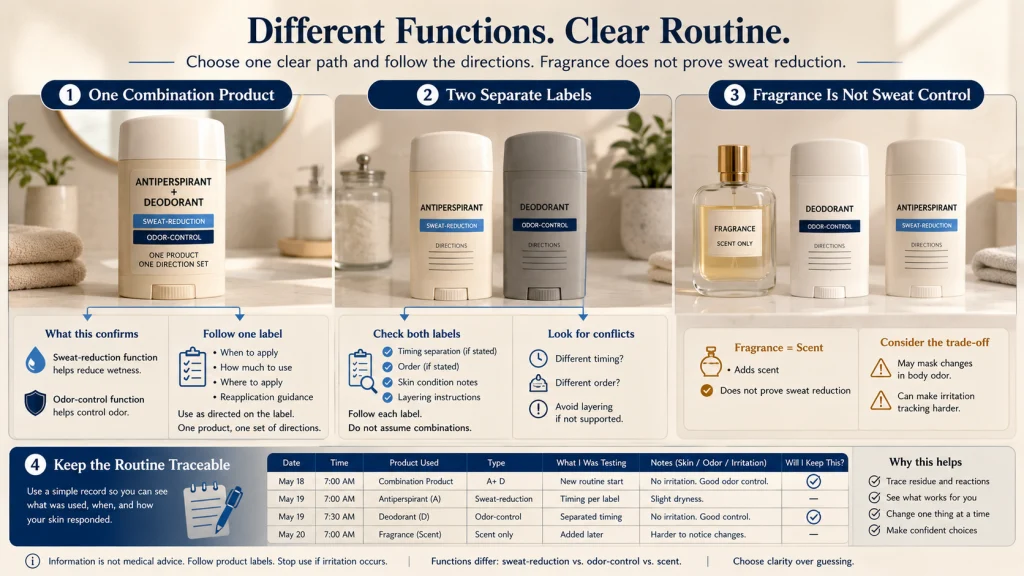
Antiperspirant and deodorant answer different primary questions. Antiperspirant is selected for sweat reduction. Deodorant is selected for odor control. A combination product may provide both functions, but the label should confirm that rather than leaving the reader to infer it from fragrance.
| Routine example | What to verify |
|---|---|
| One combination product | Confirm both functions on the package, then follow its single set of directions. |
| Separate antiperspirant and deodorant | Read both labels, avoid conflicting layering instructions, and do not assume the deodorant changes the antiperspirant timing. |
| Fragrance added later | Remember that scent does not prove sweat reduction and can complicate irritation tracking. |
A simple routine is easier to assess than several overlapping products. When irritation or residue appears, knowing which product was used and when makes the next decision clearer.
Handle Missed Applications and Reapplication According to the Label
After a missed application, doubling up later can create a mess without restoring the intended schedule. Daytime sweat also has several possible explanations, so another layer may not address the actual mismatch.
Check the directions for frequency and any reapplication wording. When missed-use instructions are absent, resume at the next labeled application instead of creating a catch-up dose.
Key decision: Treat reapplication as a directions question. Extra layers can obscure whether the real issue is timing, skin condition, product category, or a sweating concern that needs evaluation.
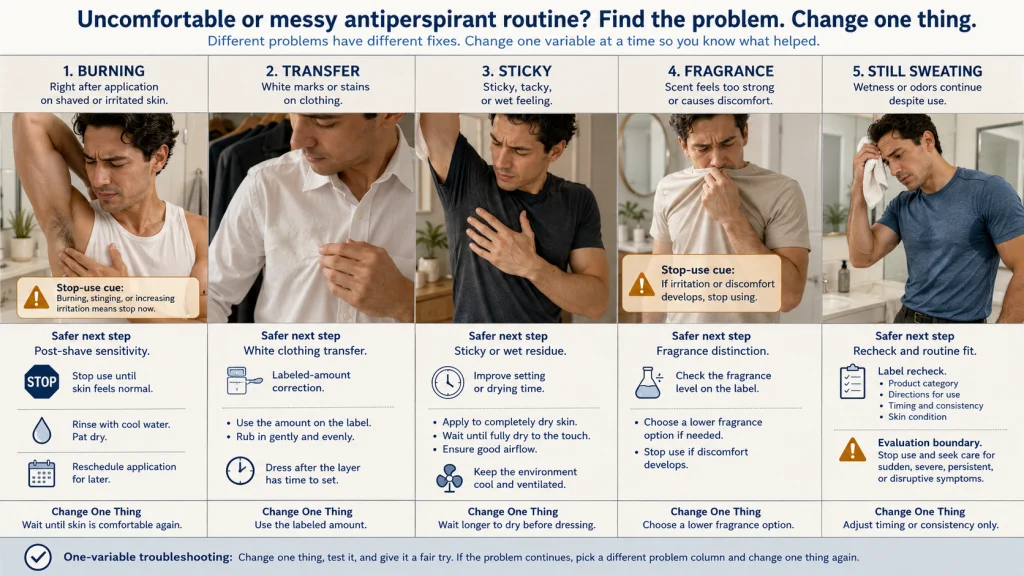
Review Shaving, Fragrance, Transfer, Residue, and Irritation Separately
When a routine is uncomfortable or messy, it helps to identify the exact friction point instead of treating every problem as product failure.
| Problem | Possible routine mismatch to check | Safer next step |
|---|---|---|
| Burning after application | Recently shaved, irritated, or damaged skin | Stop applying and follow the warning guidance on the package. |
| Heavy white transfer | Too much product or dressing before it sets | Return to the labeled amount and drying instruction. |
| Sticky or wet feeling | Format has not dried, or too much was applied | Allow the required setting time and avoid another layer. |
| Fragrance discomfort | Fragrance exposure rather than antiperspirant function itself | Stop use if irritation develops and compare labels carefully before choosing another format. |
| Sweating continues | Wrong category, incorrect timing, or a concern beyond routine selection | Verify the label first, then seek evaluation when symptoms are severe, sudden, persistent, or disruptive. |
Changing one part of the routine at a time makes it easier to tell whether amount, timing, format, fragrance, or skin condition caused the problem.
Store the Product According to Package and Aerosol Warnings
Storage affects package function as well as safety. Replace the cap, keep the mechanism clean enough to close normally, and follow any temperature, pressure, flame, or ventilation warning printed on the package.
Aerosol instructions deserve particular attention because the container and spray delivery create different handling concerns from a solid stick or roll-on. Do not leave any format where heat, direct sunlight, or household access conflicts with its warning.
Editorial observation: Routine friction often begins with storage. A cap that cannot close because product has collected around the rim, a gel stored where it leaks, or an aerosol kept too close to heat can turn an otherwise simple routine into a mess or a safety concern.
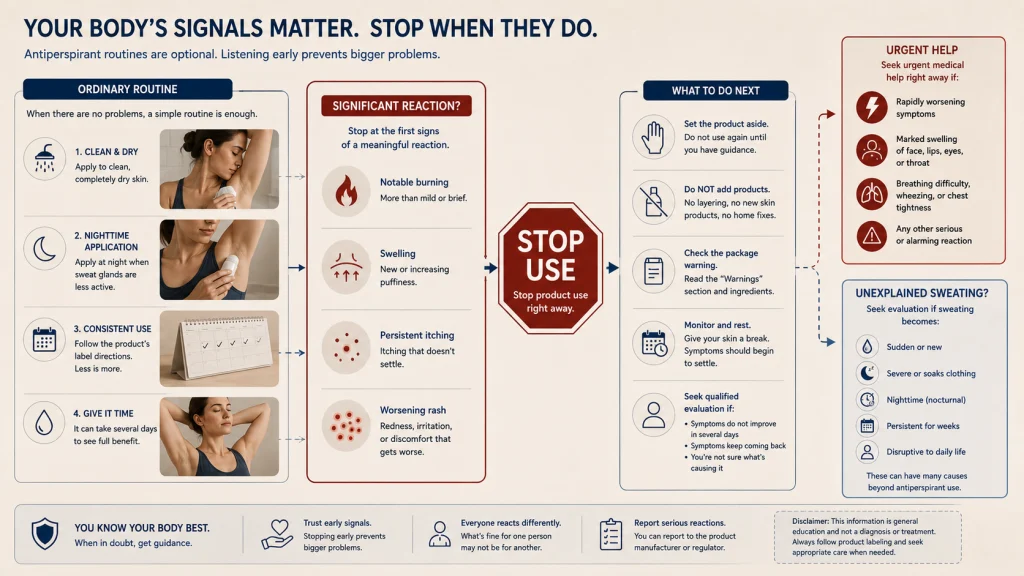
Stop for Significant Rash, Swelling, Burning, or Itching
Mild residue and a significant skin reaction are not the same issue. Stop using the product when the underarm develops notable burning, swelling, persistent itching, or a worsening rash. Do not cover the reaction with more antiperspirant or add several new products at once.
Safety warning: Follow the package warning and seek appropriate help for a serious reaction, rapidly worsening symptoms, marked swelling, breathing difficulty, or other signs that need urgent attention.
This article does not diagnose dermatitis, infection, or another cause of irritation. A qualified professional can evaluate symptoms that do not settle after the product is stopped.
Seek Evaluation When Sweating Is Sudden, Severe, Nocturnal, or Disruptive
Product comparison and application technique have limits. Sweating that changes suddenly, occurs during sleep, becomes unusually severe, interferes with work or daily activities, or persists despite correct labeled use may need qualified evaluation.
Escalating on your own to concentrated, prescription, or “clinical-strength” routines can move the decision beyond ordinary label-led care. This page does not choose treatment, prescribe active-ingredient concentration, or manage sweating on body areas beyond the labeled underarms.
Note: Unexplained sweating can be a symptom rather than a package problem. Evaluation becomes more important when it is accompanied by other new, severe, persistent, or worsening symptoms.
Let the Label Set the Routine
Before the next application, identify the product category, confirm the underarm area, check that the skin condition is allowed, and read the exact timing and amount. Give the format enough time to set when required, and keep deodorant use separate unless the package clearly combines both functions.
A dependable routine should feel almost uneventful: the product matches the goal, the application fits intact skin, and you know when to stop. Irritation or sweating that no longer looks like an ordinary product-selection issue deserves a different kind of attention, not a more complicated layer of products.
For the larger hygiene decision path, use the bathing and body odor guide and the broader personal hygiene guide.
FAQs
🌙 Should every antiperspirant be applied at night?
No. Bedtime is common advice, but the exact package directions control the timing. Use night application only when it matches the label and the underarm skin is in the allowed condition.
🚿 Can I apply antiperspirant immediately after a shower?
Check whether the label calls for dry skin. If the underarms are still damp, allow them to dry fully rather than applying automatically. Recently shaved or irritated skin also requires checking the warning before use.
🧴 How much antiperspirant should I use?
Use the amount or application method stated on the package. Once the area has the directed coverage, adding more may only increase residue, transfer, drying time, or irritation.
👕 Why does antiperspirant transfer onto clothing?
Transfer can happen when too much product is applied or clothing touches the area before the format has set. Return to the labeled amount and follow any drying instruction instead of adding another layer.
🪒 Can I apply it right after shaving?
Immediate post-shave use varies by product and skin condition. Read the warning and avoid application when the skin is broken, significantly irritated, or otherwise excluded by the label.
🔁 Should I reapply whenever I notice sweat?
Only when the exact directions support it. Repeated layers may add residue or irritation without correcting a timing, category, or medical issue.
🚩 When should I stop choosing products on my own?
Seek qualified evaluation when sweating is sudden, severe, occurs at night, disrupts daily life, or remains persistent despite correct use. Stop the product and seek appropriate help for significant rash, swelling, burning, itching, or a serious reaction.