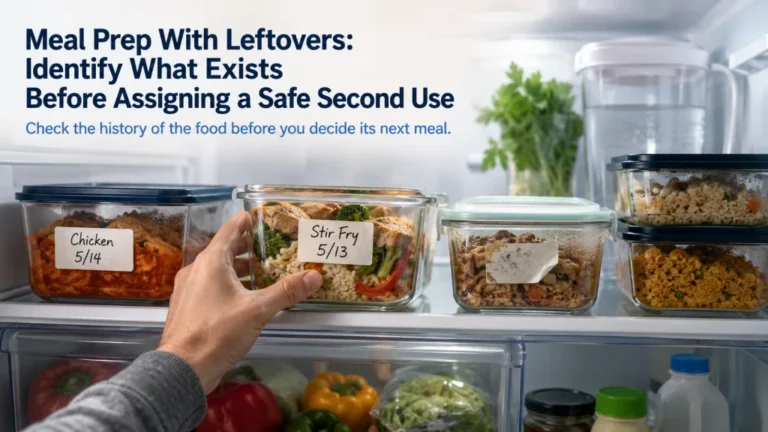
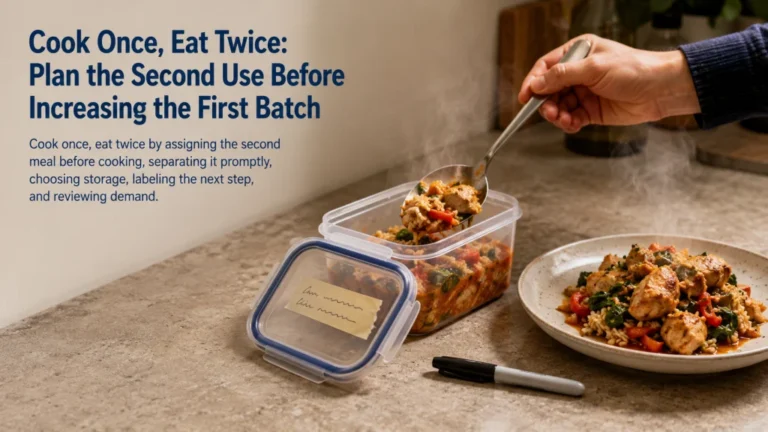
How much food to meal prep depends on how many eating occasions actually need advance work, not on the number of days in the week. Count meals and snacks expected at home, subtract meals away, takeout, current leftovers, frozen backups, and flexible slots, then decide whether you are preparing complete meals, components, or partial assemblies. Check refrigerator and freezer space before cooking, avoid using an entire package only because it is open, and add a buffer only when the household reliably uses it. Record what was actually eaten, frozen, carried forward, or discarded, then change one quantity the following week.
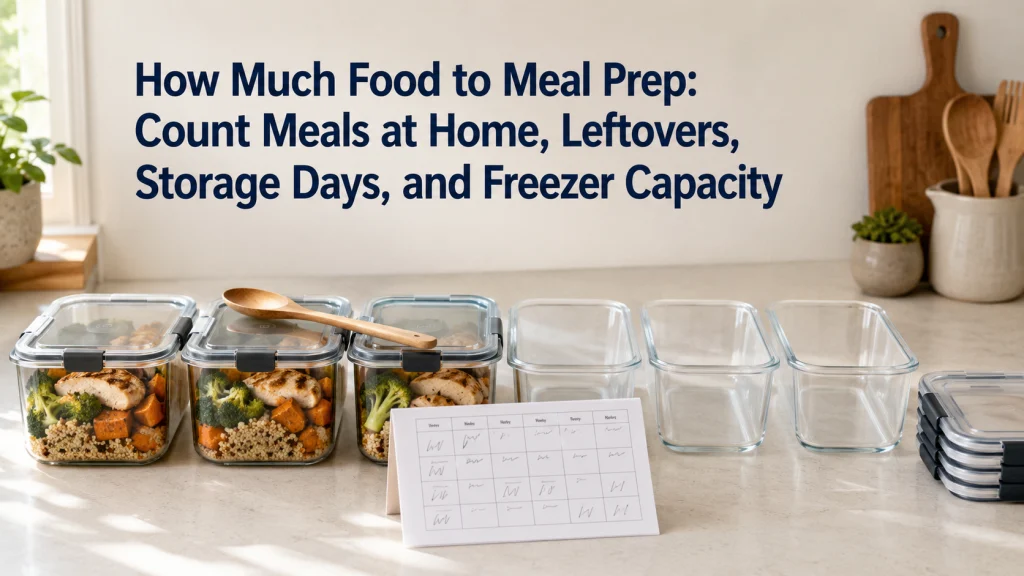
Seven Days Can Become Four Prepared Lunches
A weekly calendar may show seven lunches, but that does not mean seven lunches need to be prepared. One may happen at the office, one may be a restaurant meal, one may already exist in the freezer, and one may need to stay flexible because the schedule often changes.
7 possible lunches
− 1 office meal
− 1 restaurant meal
− 1 existing frozen meal
− 1 flexible slot
= 3 fully prepared lunches + 1 component-based backup
The result is not a smaller commitment because the person failed to prepare enough. It is a better match for the week that is likely to happen.
Nora’s practical observation is that container sets and appliance capacities encourage round-number batches. Owning ten matching containers can quietly make ten portions feel like the target even when the calendar only needs six.
The broader meal prep process helps connect this quantity decision with preparation, cooling, storage, and later use.
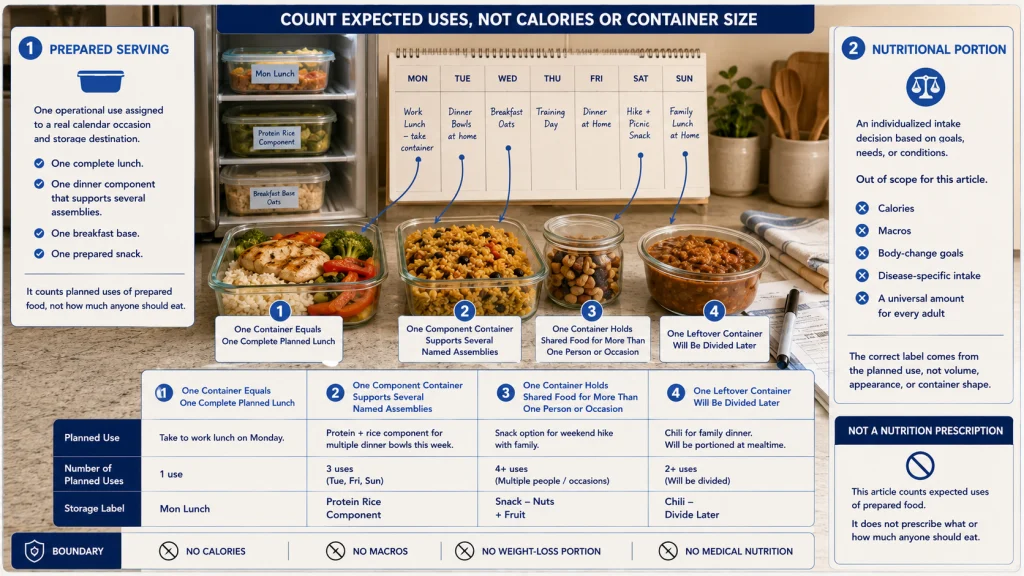
Separate Prepared Servings From Nutritional Portion Size
In this article, a prepared serving means one planned use of prepared food. It might be one complete lunch, one dinner component, one breakfast base, or one snack that needs advance work.
A prepared serving is an operational unit for planning and storage. It does not prescribe how much any person should eat, how many calories a meal should contain, or how food should be divided for weight change or a medical goal.
That distinction keeps the quantity calculation practical. You are counting how many times the prepared food is expected to be used, not deciding a universal amount for every adult.
One container may hold a complete meal for one person, a shared component for several meals, or leftovers that will be divided later. The correct label depends on the intended use, not the size or shape of the container.
Count Meals and Snacks That Actually Need Advance Work
Begin with the calendar. Mark only the eating occasions that are expected to happen at home or need prepared food carried elsewhere.
For each day, ask:
- Will breakfast need advance preparation, or is the usual option already available?
- Will lunch happen at home, at work, while traveling, or somewhere else?
- Will dinner be cooked that evening, assembled from components, reheated, or eaten away?
- Does a snack genuinely need preparation, or is it already handled by ordinary pantry or refrigerator food?
Do not turn every possible eating moment into another container. A meal that will be cooked fresh, purchased outside, or assembled from existing food does not need to be counted again.
The weekly meal-planning workflow helps place these occasions on the calendar before they become preparation quantities.
Subtract Meals Away, Takeout, Leftovers, Frozen Backups, and Flexible Slots
The first count is usually too high because it assumes every calendar space needs new food. Subtraction is where the plan becomes realistic.
Remove:
- Meals already planned away from home.
- Takeout or restaurant meals that are likely to happen.
- Current leftovers with an assigned use.
- Frozen meals or components already available.
- Meals that will be cooked fresh.
- Flexible slots reserved for schedule changes, invitations, or appetite differences.
Leaving one slot open can feel less tidy than filling every day. It may also prevent a prepared meal from becoming unwanted food when the week changes.
If leftovers repeatedly disappear behind new food, use a use-first meal-planning process before adding another batch.
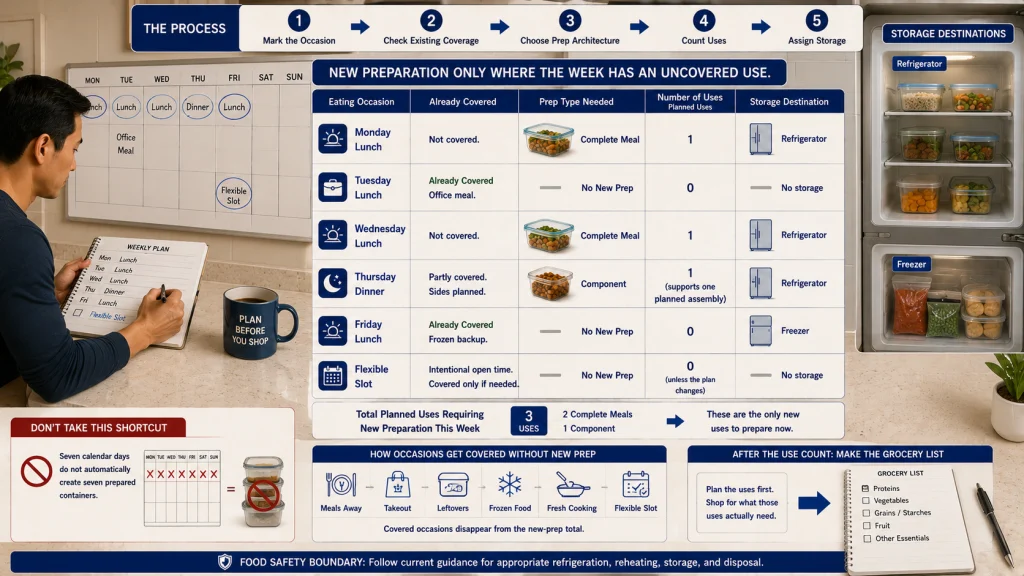
Convert the Calendar Into a Quantity Worksheet
After subtraction, convert each remaining occasion into the type of food that needs to exist.
| Eating occasion | Already covered? | Prep type needed | Number of uses | Storage destination |
|---|---|---|---|---|
| Monday lunch | No | Complete meal | 1 | Refrigerator |
| Tuesday lunch | Office meal | None | 0 | None |
| Wednesday lunch | No | Complete meal | 1 | Refrigerator |
| Thursday dinner | Partly | Prepared component | 1 planned assembly | Refrigerator |
| Friday lunch | Frozen backup available | None | 0 new uses | Freezer |
| Flexible slot | Intentionally open | No new preparation | 0 | Use leftovers or backup if needed |
The worksheet does not need a perfect forecast. Its purpose is to show where new preparation is actually required and where existing food already covers the week.
A meal prep grocery list should be built after this step so purchases reflect planned uses rather than an assumed full week.
Decide Complete-Meal, Component, or Partial-Assembly Quantities
The same calendar can produce different quantities depending on how much of each meal is committed in advance.
Complete-meal quantities count finished meals. Four prepared lunches usually mean four complete uses.
Component quantities count how many planned assemblies one base, filling, or side is expected to support. One container of a prepared component may serve several different meals.
Partial-assembly quantities count stable elements prepared early while selected wet, crisp, fresh, or fragile parts remain separate.
Choose one architecture before multiplying recipes. Otherwise, it is easy to prepare four finished lunches and enough components for four more without noticing that both sets serve the same calendar spaces.
For a first attempt, beginner meal prep works best when the method and number of intended uses are written down before cooking starts.
Check Package Yield Without Automatically Using the Whole Package
A package is a purchasing unit, not a preparation target. Opening it does not require cooking or portioning all of it immediately.
Before using the full package, ask:
- How many planned uses does the worksheet actually show?
- Can part of the package remain safely stored in its original form?
- Can the ingredient be divided before cooking?
- Will preparing the entire package create more refrigerated food than the week can use?
- Is there a named freezer use for the excess?
Round numbers can be comforting. A full tray, full pot, or full appliance basket looks efficient, but the unused remainder still needs a storage path and a future occasion.
Nora’s retail-side observation is that product capacity often becomes an invisible instruction. A six-cup vessel or ten-piece container set can make a larger batch feel correct even when the household schedule points elsewhere.
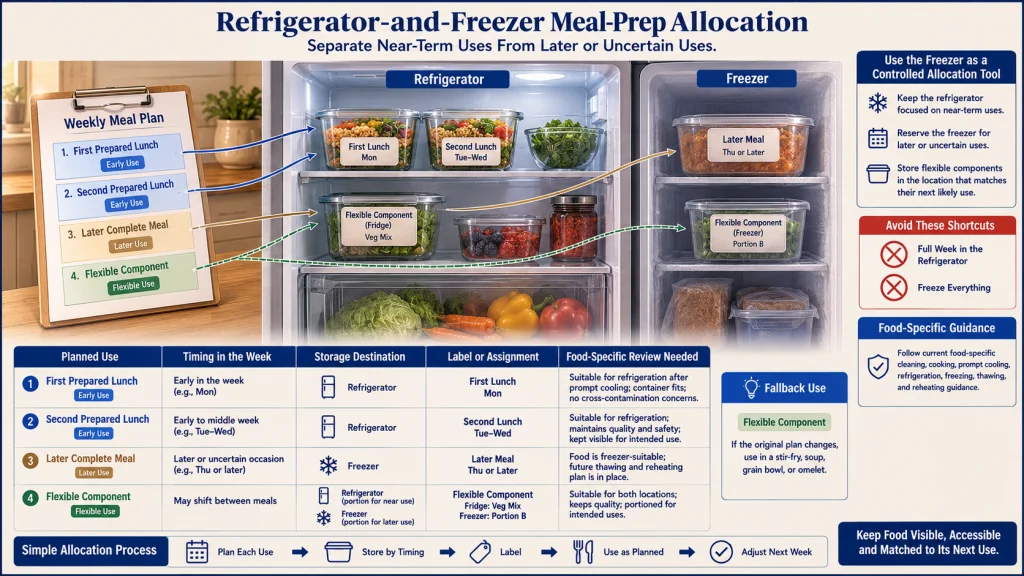
Check the Refrigerator Window and Move Later Uses to the Freezer When Suitable
Do not treat the refrigerator as a full-week holding area without reviewing the specific food, cooling method, storage guidance, and expected use date.
| Planned use | Timing in the week | Allocation example | Review needed |
|---|---|---|---|
| First prepared lunch | Early | Refrigerator | Confirm prompt cooling and food-specific storage guidance |
| Second prepared lunch | Early to middle | Refrigerator | Label intended use and date |
| Later complete meal | Later or uncertain | Freezer when suitable | Confirm freezing, thawing, and reheating method |
| Flexible component | May shift | Divide between refrigerator and freezer when appropriate | Label both portions and assign a fallback use |
The freezer is not an excuse to prepare unlimited food. It is a way to separate near-term uses from later or less certain ones when the food is suitable for freezing.
Follow current food-specific guidance for cleaning, separation, cooking, prompt refrigeration, cooling, storage, freezing, thawing, and reheating. People at higher risk of foodborne illness may need stricter guidance from a qualified professional.
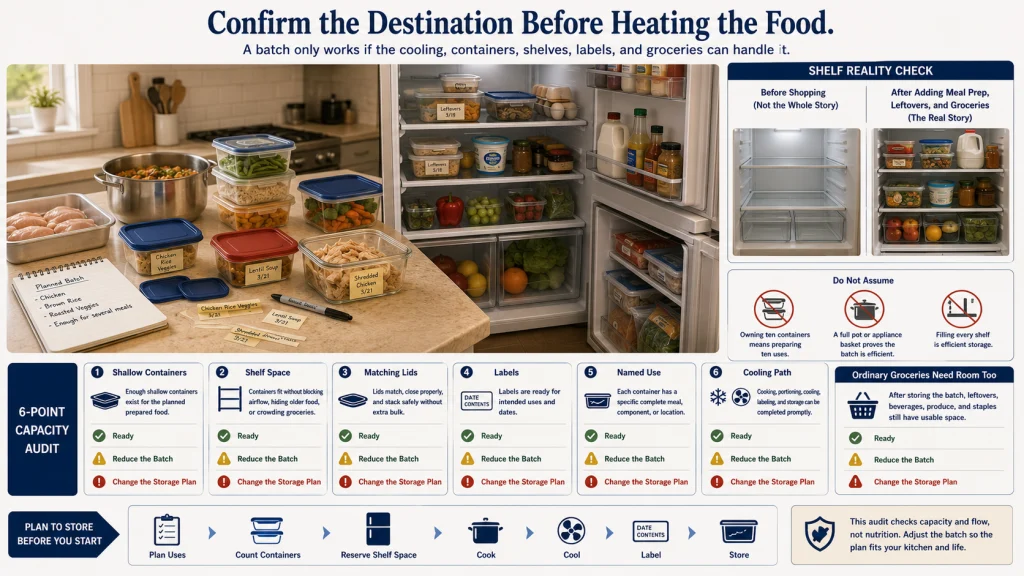
Check Cooling, Shelf Space, and Container Capacity Before Cooking
Quantity is limited by more than appetite and calendar space. Prepared food must also cool, fit, remain visible, and have a clear destination.
- Are enough suitable shallow containers available for the prepared food?
- Do the containers fit on the refrigerator or freezer shelf without blocking airflow or hiding older food?
- Do the lids match, close correctly, and leave room for labels?
- Can each container be assigned to a named meal, component, or freezer backup?
- Will cooling and transfer be completed promptly according to food-safety guidance?
- Is there room for ordinary groceries and current leftovers after prep is stored?
A shelf that looks open before prep can fill quickly once leftovers, ordinary groceries, and shallow cooling containers compete for the same space. Shelf depth, container shape, cooling needs, and visibility all matter.
A meal prep schedule can help sequence cooking, cooling, labeling, and storage so the kitchen is not left with more hot food than the available containers and shelves can handle.
Add a Small Buffer Only When the Household Reliably Uses It
A buffer is one extra prepared use or flexible component kept for a schedule change. It is not permission to double the batch.
Add one only when the household regularly uses leftovers, freezer backups, or last-minute meals. The buffer should have:
- A named storage destination.
- A realistic fallback occasion.
- A food-safety plan.
- A clear label.
- A review point if it remains unused.
First-week under-prep is acceptable. Discovering that one more lunch would have helped gives a clean signal for the next week. Repeatedly discarding two extra portions gives a different signal.
It can feel safer to prepare more “just in case,” especially after a busy week. A smaller test protects the household from turning uncertainty into a refrigerator full of obligations.
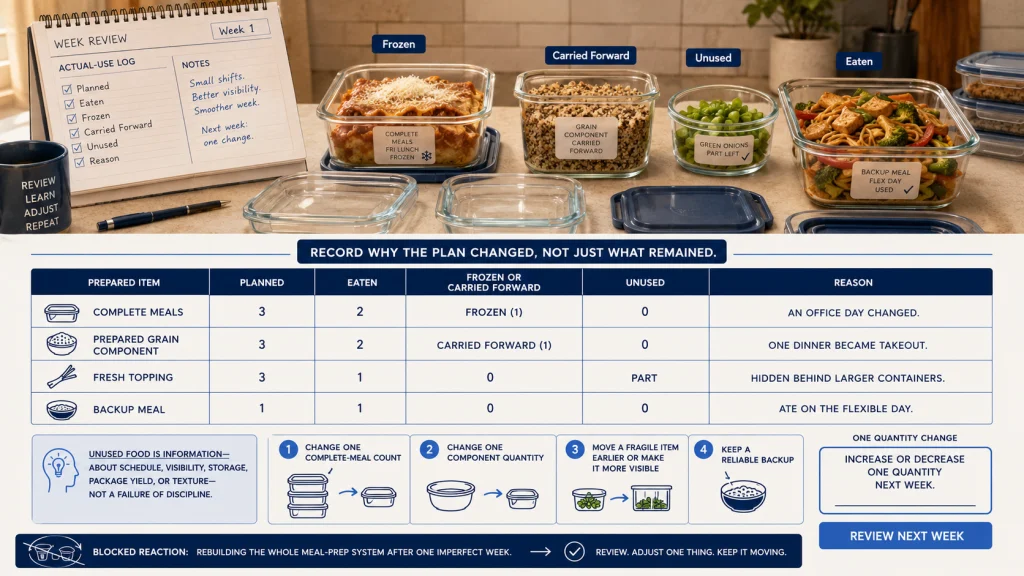
Run a One-Week Actual-Use Count
The calendar predicts. The actual-use log shows what happened.
| Prepared item | Planned uses | Eaten as planned | Frozen or carried forward | Unused or discarded | Reason |
|---|---|---|---|---|---|
| Complete lunches | 3 | 2 | 1 frozen | 0 | One office day changed |
| Prepared grain component | 3 assemblies | 2 | 1 carried forward | 0 | One dinner became takeout |
| Fresh topping | 3 uses | 1 | 0 | Part remained | Hidden behind larger containers |
| Backup meal | 1 | 1 | 0 | 0 | Used on the flexible day |
Record the reason, not just the leftover amount. A changed meeting, unexpected takeout, hidden container, disliked texture, or oversized package points to a different adjustment.
Do not read unused food as a failure of discipline. It is information about the calendar, storage, visibility, or quantity decision.
Increase or Decrease One Quantity the Following Week
Use the log to change one number, not the entire system.
If all three lunches were used and another meal was repeatedly purchased, add one prepared use. If one complete meal remained but the components were used, reduce the finished-meal count and keep the flexible element. If a topping repeatedly spoiled, prepare less or move it earlier.
Changing one quantity makes the result easier to interpret. Preparing fewer lunches, more components, a smaller package amount, or one freezer backup are four different experiments.
The next grocery list should reflect that revised number. The next schedule should reflect the storage and cooling work that number creates.
Count Occasions, Choose the Prep Type, Confirm Storage, and Adjust
Begin with eating occasions that actually need advance work. Subtract meals away, takeout, current leftovers, frozen backups, fresh-cooked meals, and flexible slots before deciding how much food to prepare.
Then choose what the number represents. Complete meals, components, and partial assemblies create different quantities even when they cover the same week.
Check package yield, refrigerator and freezer allocation, cooling space, container capacity, and whether a buffer has a believable use. A clean row of filled containers is not the goal if several of them have no place in the calendar.
At the end of the week, count what was used and change one quantity. The most useful number is not seven, ten, or the capacity of the largest appliance. It is the amount the household can store safely and actually use.
FAQs
📅 How many meals should I prep for one week?
Count only the meals that actually need advance work. Subtract meals away, takeout, leftovers, frozen backups, fresh-cooked meals, and flexible slots before choosing a quantity.
🍱 Is one prepared serving the same as a nutritional portion?
No. A prepared serving is one planned use of prepared food for operational planning. It does not prescribe calories, macros, weight-change portions, or individualized intake.
🧩 Should I count components differently from complete meals?
Yes. Complete meals are counted as finished uses, while components are counted by the number of planned assemblies they support. Write the intended uses before cooking so the same calendar space is not counted twice.
📦 Should I cook the whole package once it is opened?
Not automatically. Compare the package yield with the planned uses, storage space, and freezer plan. A package is a purchasing unit, not a preparation target.
🧊 Can I refrigerate an entire week of meal prep?
Do not assume every prepared food can remain refrigerated for a full week. Review food-specific cooling and storage guidance, then move later uses to the freezer when suitable.
➕ Should I prepare an extra meal just in case?
Add a small buffer only when the household reliably uses it and the food has a clear storage destination and fallback occasion. Under-preparing during a first test is acceptable and easier to correct the following week.
📝 What should I track after meal prep?
Track planned uses, meals eaten as planned, food frozen or carried forward, unused food, and the reason the plan changed. Adjust one quantity rather than rebuilding the entire system.