Rest is relative to the work that came before it. A beginner may keep a daily movement habit while giving demanding strength, cardio, or unfamiliar sessions more recovery time. Use activity type, intensity, duration, soreness, energy, sleep, performance, and joint comfort to decide whether the next day calls for full rest, light activity, or another training session. Persistent pain, swelling, weakness, severe fatigue, chest symptoms, or repeated decline requires appropriate evaluation rather than another self-directed recovery experiment.
Daily Movement and Daily Hard Training Are Not the Same
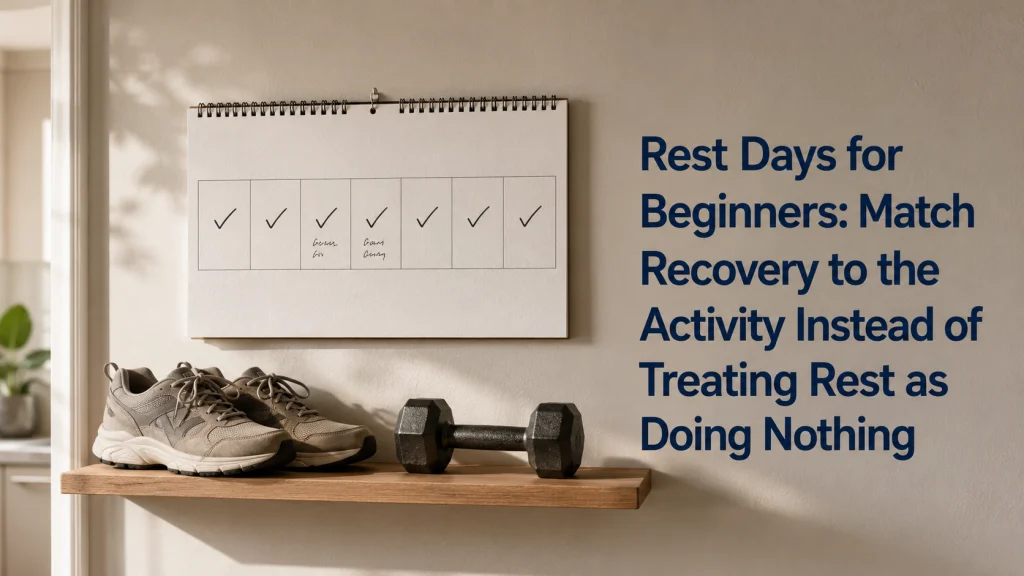
Two calendars can both contain a checkmark on every day. On the first calendar, demanding sessions alternate with walking, ordinary household activity, and easier movement. On the second, the same challenging dumbbell workout appears seven days in a row.
| Calendar A: Daily Movement | Calendar B: Daily Hard Training |
|---|---|
| Strength work is followed by walking or ordinary activity. | The same demanding muscle groups are loaded again the next day. |
| Movement intensity changes across the week. | Effort, duration, and resistance remain high every day. |
| Easy days support the habit without copying the hardest workload. | The streak counts completion but does not show whether recovery demand has changed. |
A movement streak and a hard-training streak are different. On a screen, both days may look equally complete. In the body, a recovery walk and a repeated heavy dumbbell session ask for very different kinds of readiness the next morning.
For the larger setup process, use the beginner home-workout guide. The complete home exercise guide can help place rest days for beginners within a broader activity plan.
Define Full Rest, Light Activity, Active Recovery, and Training Days
Rest does not have one appearance. For a beginner, that can be a relief: choosing an easier day does not mean the week has gone off track. The useful category depends on what the previous session demanded and what the next session is meant to accomplish.
| Day Type | Main Purpose | What It May Include | What It Does Not Need to Prove |
|---|---|---|---|
| Full rest | Remove planned exercise demand for the day. | Ordinary daily activity, comfortable routines, and no scheduled workout. | That complete stillness is required or that movement is forbidden. |
| Light activity | Keep the day gently active without repeating the demanding workload. | Easy walking, household movement, or another familiar low-demand activity. | That the activity must raise performance or count as a hard session. |
| Active recovery | Use intentionally easy movement that feels compatible with recovery. | A brief easy walk, gentle cycling, or simple mobility that stays comfortable. | That a special routine is medically necessary or superior for every person. |
| Training day | Create a planned exercise stimulus through aerobic, strength, mobility, or mixed work. | The session scheduled for the current goal and ability. | That every session must be hard or longer than the last one. |
Key decision: Label the day by its demand, not by whether an app awarded a checkmark. Easy movement can coexist with recovery, while a demanding session remains training even when it is short.
Match Recovery Demand to Activity, Intensity, Duration, and Familiarity
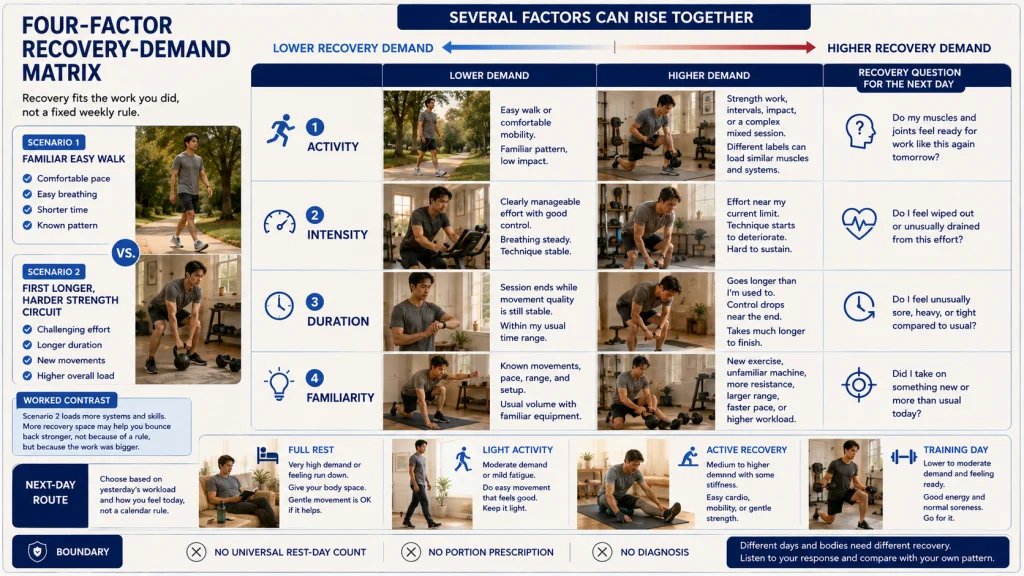
A fixed number of rest days cannot describe every beginner week because recovery demand changes with the work itself. A familiar easy walk may leave the day feeling ordinary, while a first strength session or a new mixed routine can make the following morning feel noticeably different. The plan needs room for that difference without treating it as failure.
| Workload Feature | Lower Recovery Demand May Look Like | Higher Recovery Demand May Look Like |
|---|---|---|
| Activity | Easy familiar movement using a comfortable pace and range | Demanding strength work, intervals, impact, or a complex mixed session |
| Intensity | Effort remains clearly manageable and movement stays controlled | The session approaches the person’s current limit or technique becomes harder to maintain |
| Duration | The session ends before fatigue changes movement quality | The workload lasts longer than the person is accustomed to managing |
| Familiarity | The body and routine already know the movement pattern | The activity, equipment, range, pace, or volume is new |
Several features can rise together. A new exercise performed longer and harder than usual creates a different recovery question from repeating a familiar easy session.
Use the guide on beginner workout frequency when deciding how many planned sessions belong in the week. This article focuses on what happens between them.
Leave Recovery Time Before Repeating Demanding Work for the Same Muscles
Demanding strength work creates a local recovery question. Tired legs do not mean the whole day must become motionless, and they do not automatically mean the same workout belongs on the schedule again. The practical question is whether comfort, control, and familiar performance have returned enough for that muscle group to handle the next planned demand.
Separate the muscle group from the entire day:
- A lower-body strength session may be followed by easy walking when that movement feels comfortable.
- An upper-body session may be followed by ordinary lower-body activity without repeating the same loaded patterns.
- A full-body session may call for a lighter day, a different emphasis, or full rest depending on the demand and response.
- Mobility or technique practice may fit when it remains easy and does not reproduce the workload that needs recovery.
Exercise labels can hide overlap. A circuit, cardio video, and strength workout may all load the same muscles even when the session names look different. Review the movements, resistance, pace, and fatigue rather than relying only on the category printed on the screen.
The home strength training guide can help organize muscle groups, exercise selection, and progression without turning a rest day into an injury-treatment plan.
Use Easy Movement Without Turning It Into Another Hard Cardio Session
After a harder cardio day, easy movement can feel reassuring because it keeps the routine familiar without asking for another performance. Whether it remains recovery depends on pace, duration, hills, resistance, impact, and breathing demand, not simply on whether movement continues.
A relaxed walk may support the daily routine after a harder cardio day. The same walk becomes a new training session if the pace rises, the route becomes demanding, or the duration expands far beyond what feels restorative. Easy cycling can follow the same pattern: low resistance and familiar movement may feel manageable, while intervals or heavy resistance create another workload.
Keep active recovery simple:
- choose a familiar movement;
- keep effort clearly below the previous hard session;
- avoid adding a performance target;
- stop or change the plan if pain, instability, unusual symptoms, or worsening fatigue appears;
- let the next training session remain the place for progression.
The immediate transition after exercise belongs in the guide to cooling down after a workout. A cool-down ends one session; a recovery day helps decide what demand belongs between sessions.
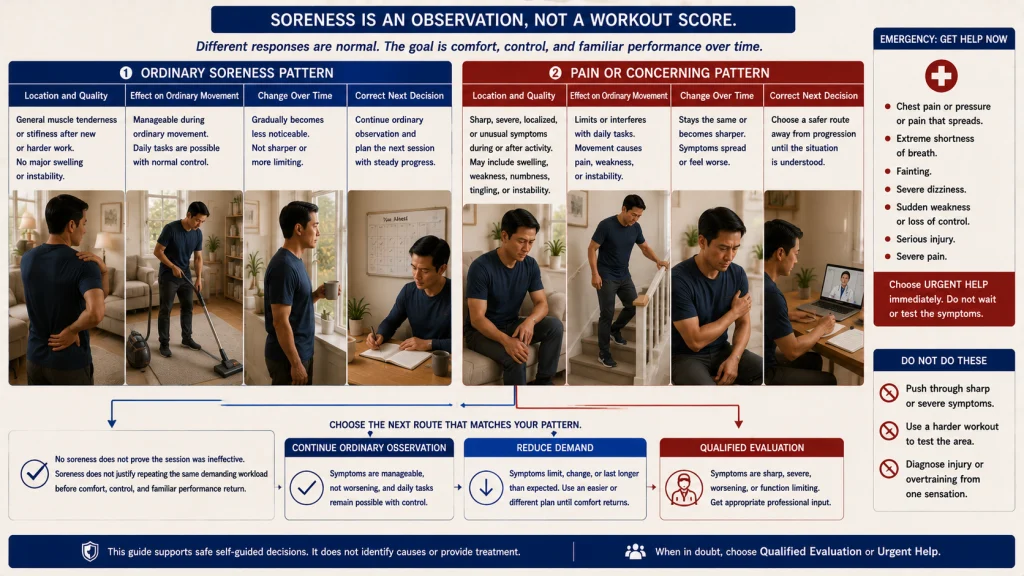
Separate Ordinary Soreness From Pain and Concerning Symptoms
Beginners often need language for what they feel after a new or harder session. A general article cannot diagnose the cause, but it can set a boundary between ordinary observation and signs that need a different response.
Do not use soreness as proof that a workout was effective, and do not use the absence of soreness as proof that nothing happened. The next decision depends on comfort, movement quality, performance, and whether symptoms are improving.
Safety boundary: Ordinary post-workout soreness should not become a reason to push through sharp, severe, worsening, swollen, weak, numb, unstable, or function-limiting symptoms. Stop progression and use the full warning guidance later in this article when the pattern is persistent, dangerous, or clearly outside ordinary recovery.
Review Performance, Energy, Sleep, Motivation, and Joint Comfort
Recovery is easier to judge when several ordinary signals are considered together. Everyone has a flat morning or a session that feels less inviting than expected. The useful information appears when performance, energy, sleep, motivation, and joint comfort begin telling the same story across more than one day.
| Signal | What to Notice | Possible Planning Question |
|---|---|---|
| Performance | Movement quality, pace, resistance, coordination, and whether familiar work feels unexpectedly harder | Is the next session repeating too much demand too soon? |
| Energy | Whether ordinary daily tasks and the planned workout both feel manageable | Did duration, intensity, sleep, or schedule load change? |
| Sleep | Repeated difficulty settling, waking, or feeling restored | Is the training time or total demand interfering with the broader routine? |
| Motivation | A temporary preference for rest versus repeated dread, irritability, or loss of interest | Is the plan too demanding, repetitive, or difficult to fit? |
| Joint comfort | Comfort during ordinary movement, warm-up, training, and the following day | Does pain or limitation require stopping progression and seeking guidance? |
Review trends rather than reacting to a single imperfect day. If several signals worsen together or the pattern continues despite reducing the workload, move from routine adjustment to qualified support.
Editorial observation: Apps and connected equipment often compress very different sessions into the same daily completion badge. That badge may record consistency, but it does not show muscle group, resistance, pace, fatigue, or whether the next day should be easier. The activity details still matter more than the visual reward.
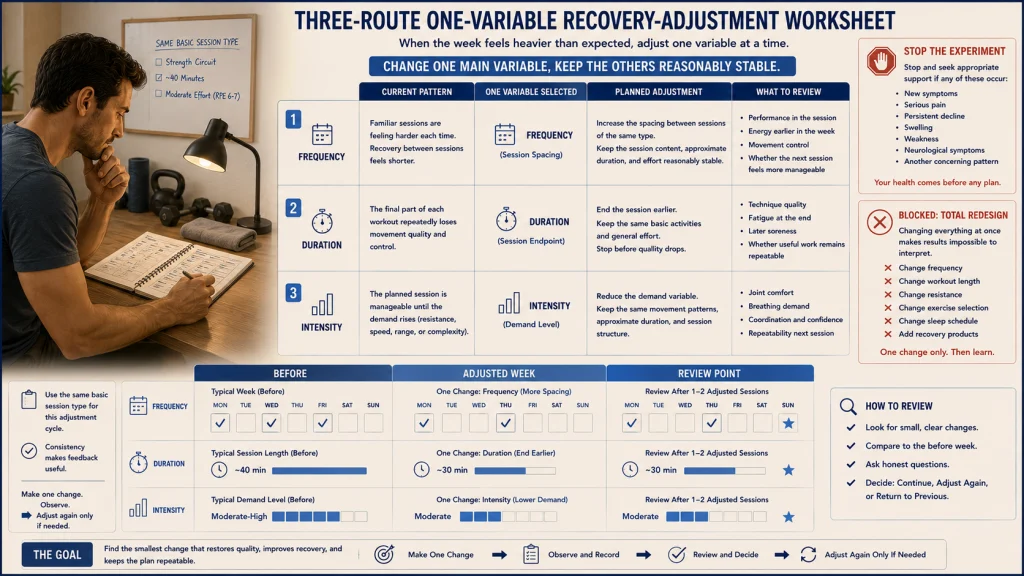
Adjust Frequency, Duration, or Intensity One Variable at a Time
When the week starts to feel heavier than expected, the instinct may be to rebuild everything. A smaller change is easier to learn from. Choose the one variable with the clearest connection to the recovery problem, then give the adjusted week a fair comparison.
| Current Pattern | Choose One Variable | Possible Adjustment | What to Review |
|---|---|---|---|
| Familiar sessions feel harder each time | Frequency | Add more recovery space before repeating the demanding session. | Performance, energy, and whether the next session feels more controlled |
| The final part of each workout loses quality | Duration | End the session earlier while keeping the same basic activity. | Movement quality, fatigue, and later soreness |
| The planned session is manageable until resistance or pace rises | Intensity | Lower resistance, speed, impact, range, or complexity. | Joint comfort, breathing demand, and repeatability |
Keep the other variables reasonably stable during the review. If the plan includes new symptoms, serious pain, or a repeated decline, do not continue experimenting simply to complete the worksheet.
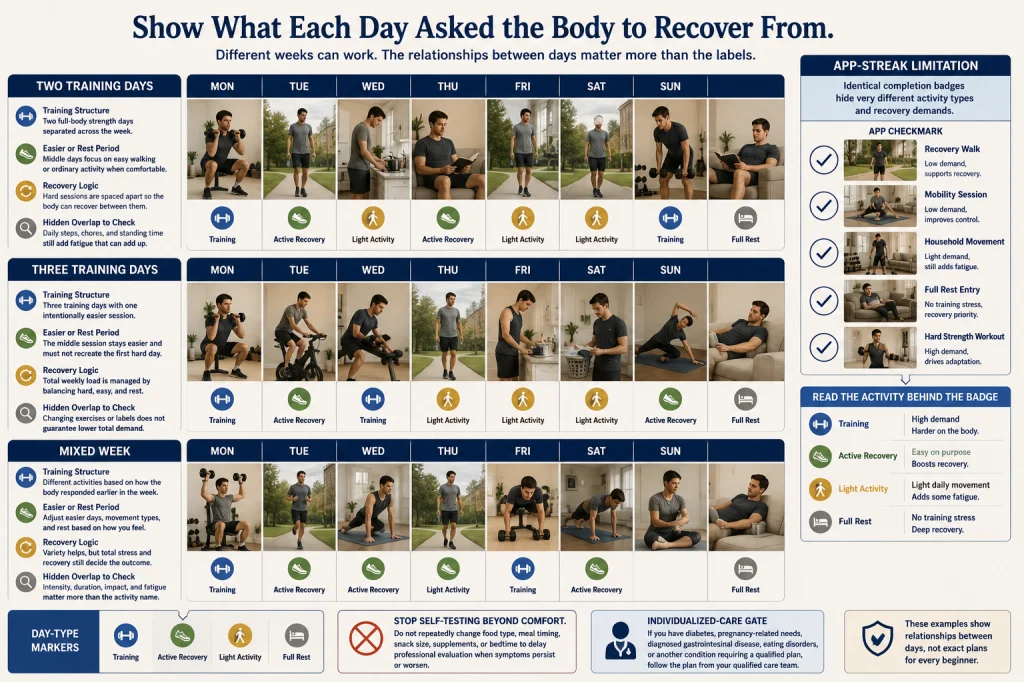
Place Recovery Inside Two-Day, Three-Day, and Mixed Weeks
Weekly examples are most useful when they show how one day leaves space for the next. They are not prescriptions for the exact number of days every beginner needs, and they do not turn recovery into empty gaps on a calendar.
| Week Type | Example Structure | Recovery Logic |
|---|---|---|
| Two training days | Day 1: full-body strength Middle days: ordinary activity or easy walking Day 2: full-body strength | The demanding full-body sessions are separated, while light movement can continue if it feels comfortable. |
| Three training days | Day 1: strength Day 2: easy cardio or ordinary movement Day 3: strength with adjusted muscle emphasis or demand | The middle session remains easier and does not quietly reproduce the same hard workload. |
| Mixed week | Strength, moderate cardio, mobility, easy walking, and full rest arranged around response | Different labels do not guarantee different recovery demands, so the actual muscles, intensity, duration, and impact still need review. |
The beginner workout schedule guide can help place sessions on specific days after the recovery relationships are clear.
App-streak limitation: A daily completion record may represent walking, mobility, household movement, a planned rest day, or demanding training. Read the activity history behind the badge so the schedule reflects what each day actually asked you to recover from.
Know What Recovery Products Cannot Replace
When the week feels difficult, a recovery product can seem easier to add than changing the schedule. Yet no device, routine, or service can repair a plan that repeatedly asks for more work than the person can currently recover from. It also cannot replace sleep opportunity, appropriate progression, hydration context, ordinary meals, or a needed medical evaluation.
Before adding a recovery product, ask whether the real issue is:
- the same demanding muscles are trained too soon;
- session intensity rose faster than planned;
- duration expanded because the workout felt incomplete;
- sleep or daily responsibilities leave little recovery time;
- pain or concerning symptoms require qualified evaluation;
- the product is being used to preserve a streak rather than change the workload.
This article does not recommend painkillers, supplements, ice, heat, massage, foam rolling, or another modality as a universal recovery treatment. The workout recovery guide can help separate longer-term recovery methods from the basic decision to reduce training demand.
Stop Self-Directed Progression for Persistent or Severe Warning Signs
A rest day can create space after ordinary fatigue, but it is not a treatment for a serious symptom. When the pattern becomes persistent, worsening, or dangerous, the next step changes from schedule adjustment to appropriate help.
Safety warning: Seek appropriate help for persistent pain, swelling, sudden weakness, severe fatigue, repeated performance decline, neurological symptoms, serious injury, or severe pain. Stop exercise and use urgent help for chest pain or pressure, extreme shortness of breath, fainting, severe dizziness, sudden weakness, or another immediate danger.
Pregnancy, recent surgery, chronic conditions, disability-related limitations, a long period of inactivity, or clinician-directed restrictions may require an individualized plan from a physician, physical therapist, or qualified exercise professional.
Do not diagnose overtraining syndrome from a checklist, an app score, or a difficult week. Record the pattern, reduce avoidable demand, and seek qualified guidance when ordinary recovery adjustments are not enough.
Name the Activity, Recovery Demand, Next Session, and Stop Rule
Start by naming the activity and the muscles or systems it challenged. Describe the demand using intensity, duration, familiarity, resistance, pace, and impact rather than relying only on the workout title.
Choose full rest, easy movement, active recovery, or another training day based on performance, energy, sleep, motivation, soreness, and joint comfort. When the week needs adjustment, change frequency, duration, or intensity one variable at a time.
Finish with a stop rule that is easy to recognize: routine adjustment ends when symptoms are persistent, worsening, dangerous, or repeatedly reduce normal function and performance. At that point, appropriate support matters more than preserving the schedule.
FAQs
🛌 How many rest days do beginners need?
There is no single number for every beginner. The useful amount depends on activity, muscle groups, intensity, duration, familiarity, sleep, soreness, performance, and health context. Plan recovery around the workload rather than copying a fixed weekly count.
🚶 Can I walk on a rest day?
Easy walking may fit when it feels comfortable and does not reproduce the demand of the session that needs recovery. Pace, hills, duration, and symptoms determine whether the walk stays light or becomes another workout.
🏋️ Can I train different muscle groups on consecutive days?
It may be possible when the sessions truly emphasize different muscles and the total workload remains manageable. Review overlap, fatigue, joint comfort, exercise technique, and whether the second session quietly repeats the first day’s demand.
😣 Is soreness required for progress?
No. Treat soreness as one possible response to unfamiliar or harder work, not as a score for workout quality. Review movement control, gradual progression, performance, comfort, and the broader response instead.
🔄 What is active recovery for a beginner?
Active recovery is intentionally easy movement that does not copy the previous demanding workload. It might include a comfortable walk, gentle cycling, or simple mobility, but it does not need to be a special routine.
📱 Should I protect a daily workout streak?
A daily completion goal can include easy activity, ordinary movement, or a planned recovery day. Check what the activity actually involved before repeating a demanding session simply to protect the count.
📉 What if my performance keeps getting worse?
Review frequency, duration, intensity, sleep, symptoms, and whether the same muscles are being challenged too soon. A repeated decline, especially with pain, weakness, severe fatigue, swelling, or other concerning signs, requires qualified evaluation.
🚩 When should I stop training and seek help?
Use the full warning section when symptoms are immediate, severe, persistent, worsening, or repeatedly limiting normal movement and performance. Chest symptoms, fainting, severe breathing difficulty, sudden weakness, serious injury, or severe pain require prompt appropriate help.