A meal prep grocery list should begin with a finished weekly plan and a quick check of what is already at home. Combine repeated ingredients across meals, subtract usable stock, and write the remaining amount in a form that makes sense at the store. Keep required items separate from optional extras and long-term stock purchases, then organize the final list around the store route or department. The goal is not a longer checklist, but a precise list that can be reviewed after the week.
Three Recipe Lists Are Not Yet One Grocery List
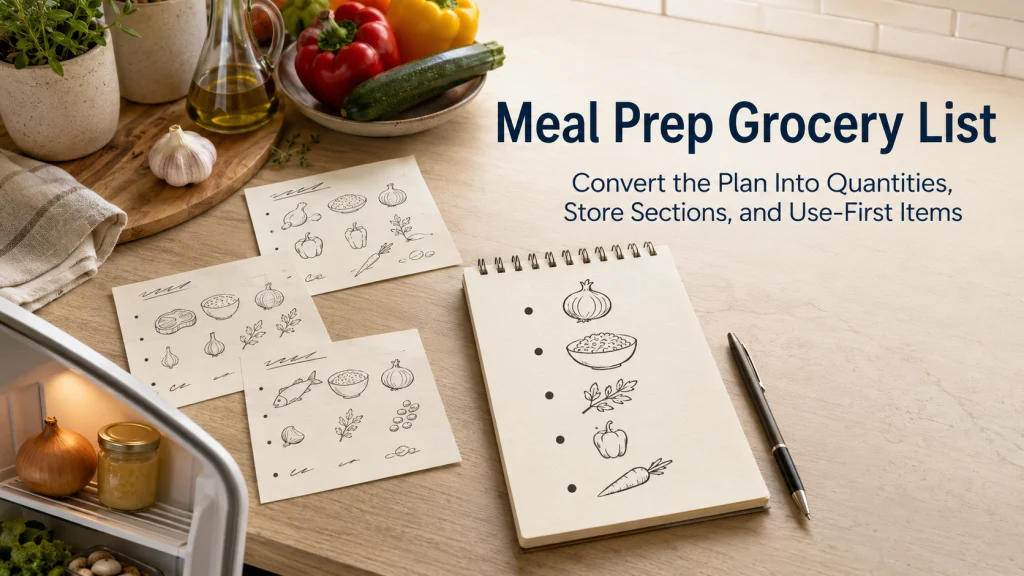
Imagine three planned meals written on separate cards. The first uses one onion, rice, and a small amount of herbs. The second uses two onions, more rice, and the same herbs. The third uses half an onion and another portion of herbs. Copying each card into a shopping app creates repeated lines, not a finished list.
| Ingredient | Meal one | Meal two | Meal three | Consolidated need |
|---|---|---|---|---|
| Onions | 1 | 2 | 1/2 | 3 1/2 onions before inventory subtraction |
| Rice | 1 cup dry | 1 1/2 cups dry | None | 2 1/2 cups dry before inventory subtraction |
| Fresh herbs | Small amount | Small amount | Small amount | One combined purchase amount based on the chosen package |
The final list should not repeat “onion” three times or ask the shopper to remember which recipe needs which amount. It should combine the demand, subtract what is already usable, and produce one practical purchase line.
This is the difference between recipe ingredients and a meal prep grocery list. Recipe cards describe what each meal uses. The shopping list translates the entire plan into the quantities that are still missing.
The earlier step of deciding which meals belong on the calendar is covered in the guide to planning meals for the week. This article begins after those choices are stable enough to shop from.
Confirm the Weekly Plan Is Final Enough to Shop
A grocery list built from a draft calendar often carries the mistakes of that draft into the cart. A meal may later be removed because someone will eat away from home, a busy night may switch to leftovers, or an uncertain dinner may become a flexible slot. Ingredients for those deleted meals can remain on the list unless the plan is checked first.
The plan does not need to be perfect. It does need to answer a few practical questions:
- Which meals will actually happen at home?
- Which meals depend on leftovers from an earlier day?
- Which slots are flexible rather than tied to a fixed recipe?
- Which ingredients are shared across more than one meal?
- Which backup meal is expected to remain available?
A flexible slot should not automatically create a second full set of purchases. Give it a clear boundary, such as using leftovers, using a freezer or pantry backup, or deciding later from food already available.
Key decision: Do not translate a meal into purchases until it has a real place in the week. A recipe idea is not yet a shopping requirement.
Readers who need the full sequence from planning through preparation can use the beginner meal-prep framework before building the list.
Subtract Food Already in the Refrigerator, Freezer, Pantry, and Leftovers
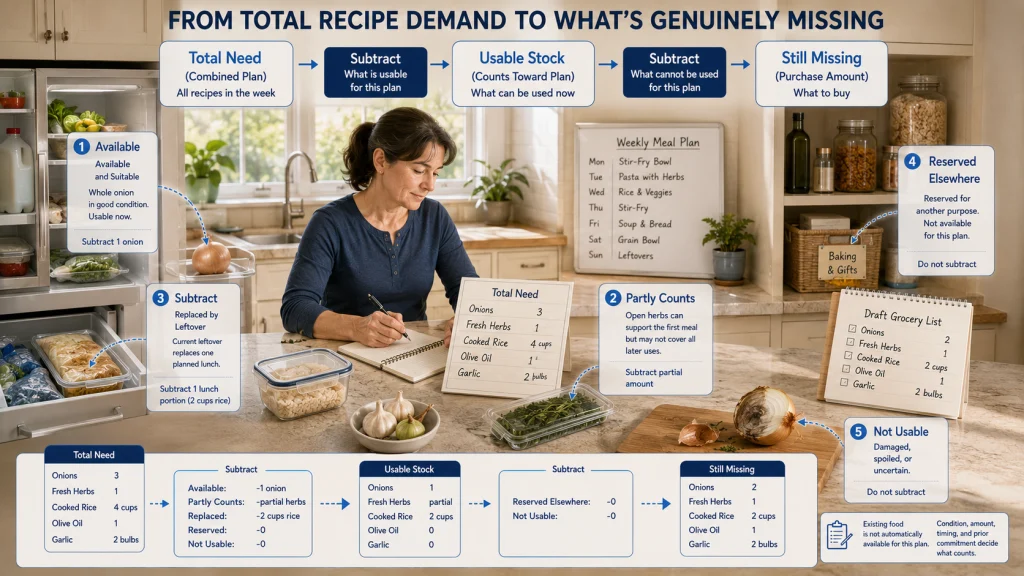
The fastest way to buy duplicates is to treat every recipe amount as a purchase amount. Before adding anything to the list, check the places where usable food may already be waiting.
This is a focused subtraction for the current plan, not a permanent inventory project. The question is whether a specific item at home can genuinely support one of the selected meals.
| Item found at home | Can it be counted? | Why or why not? | Effect on the list |
|---|---|---|---|
| One whole onion in good condition | Yes | It is available and suitable for the planned meals | Subtract one onion from the combined need |
| An open herb package suitable for the first meal | Partly | It can cover the early use but may not support the later meals | Reduce the purchase amount without deleting the line entirely |
| A leftover that can replace one planned lunch | Yes | It fills the meal slot rather than adding another meal | Remove the ingredients tied only to that lunch |
| A pantry item reserved for another household use | No | Physical presence does not make it available for this plan | Keep the ingredient on the list |
| A damaged, spoiled, or uncertain item | No | It should not be treated as usable stock | Do not subtract it from the planned need |
The useful distinction is between food that exists and food that is actually available. Condition, amount, timing, and whether the item is already committed elsewhere all affect that answer.
An open package that should be used soon deserves more attention than a sealed backup with a longer practical window. A current leftover can remove an entire purchase line when it replaces a meal, while a partial package may only reduce the amount.
Note: This check supports list construction only. A lasting pantry system, baseline stock rules, and restocking routines belong to the separate guide to pantry inventory for meal planning.
Combine Duplicate Ingredients Across Every Planned Meal
After subtracting current stock, scan the remaining recipe notes for repeated ingredients. The duplicate may be obvious, such as onions appearing on three cards, or hidden behind different wording, such as chopped tomatoes on one list and canned tomatoes on another.
Combine items only when they are genuinely interchangeable for the planned meals. Fresh herbs and dried herbs may serve different purposes. Cooked rice and dry rice are not the same shopping line. A specific ingredient needed for one recipe should not disappear into a broad category that becomes unclear in the store.
A useful consolidated line contains enough context to prevent confusion:
- The ingredient name in the form actually needed.
- The total missing amount across meals.
- A short use note when two similar items must remain separate.
- A substitution note when another form is acceptable.
Consolidation is where the list begins to look like one household plan instead of several recipe cards stapled together. Once the total need is visible, package choices and quantity notes become much easier to write without repeating the same calculation later.
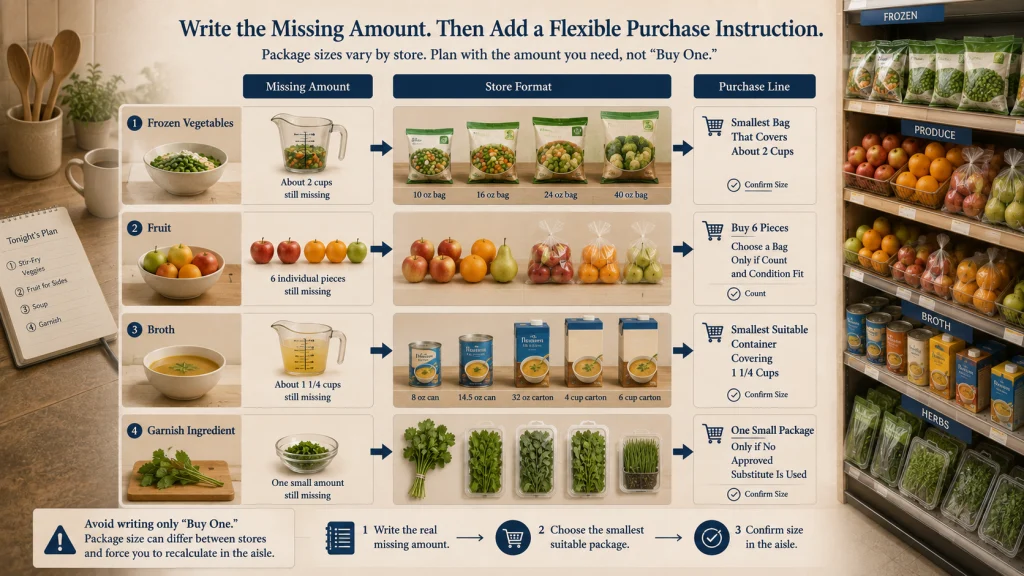
Convert Missing Amounts Into Usable Purchase Quantities
Inventory subtraction answers whether something must be bought. This step answers how the missing amount should be written for the shopper.
Recipe units and store units often do not match. A plan may call for cups, tablespoons, ounces, individual pieces, or part of a package, while the shelf offers bunches, bags, cartons, jars, or several package sizes. The list should preserve the real need without pretending that one package format is universal.
| Missing amount after inventory | How the store may sell it | Useful purchase line | Why this line works |
|---|---|---|---|
| About 2 cups of frozen vegetables | Bags of different weights | Frozen vegetables, smallest bag that covers about 2 cups | The line keeps the needed amount visible without assuming a standard bag |
| 6 individual pieces of fruit | Sold individually or in a multi-piece bag | Fruit, 6 pieces; choose a bag only if the count and condition fit | The shopper can compare the real count with the available format |
| About 1 1/4 cups of broth | Cartons or cans in several sizes | Broth, smallest suitable container covering 1 1/4 cups | The purchase rule follows the missing amount rather than rounding to a large package too early |
| One small amount of a garnish ingredient | Usually sold as a full bunch or package | Garnish ingredient, one small package only if no substitute is used | The line exposes the package mismatch before the item enters the cart |
For items sold individually, round only to a usable count. For packaged goods, write the missing amount first and then add a buying instruction such as “smallest suitable package,” “one container if it covers the need,” or “confirm package size before buying.”
This wording matters because “buy one” can hide a large difference between stores. The list should give the shopper enough information to make the package decision without recalculating the whole meal plan in the aisle.
The separate guide to meal-prep quantities addresses how much prepared food the household intends to make. Here, quantity means the remaining amount that must be translated into a practical purchase line.
Mark Use-First Fresh Food and Keep Backups Distinct
Fresh food that should be used early in the week deserves a visible mark on the list. Without that mark, a new purchase can be treated as interchangeable with a longer-lasting item even though the planned timing is different.
A simple label is enough:
- Use first: Intended for an early meal or chosen because a current item should be used soon.
- Later fresh item: Needed for a later meal and selected with that timing in mind.
- Freezer backup: Reserved for a flexible or disrupted meal.
- Pantry backup: Shelf-stable support that should remain available until needed.
The backup should not depend on the same fresh ingredient already committed to another meal. Otherwise, one change in the week can break two parts of the plan at once.
Use-first marking also helps prevent a common list mistake: buying a second version of an ingredient while an open or more time-sensitive version remains at home. The guide to meal planning that reduces unused food explores that priority in more depth.
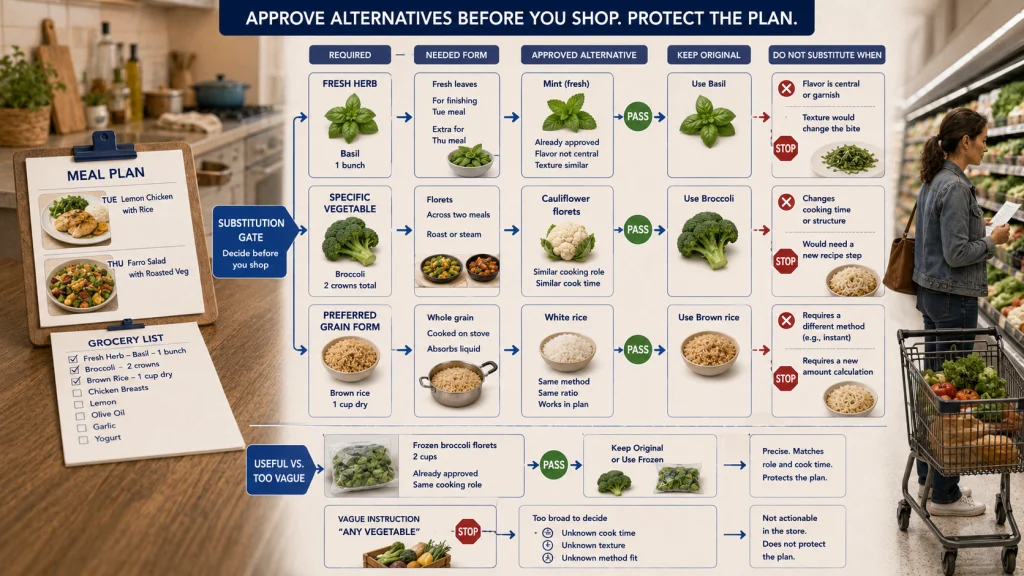
Write Acceptable Substitutions Before Entering the Store
A substitution is easiest to use when it is decided before the shopper is standing in front of an unavailable or unsuitable option. A short approved alternative protects the meal without inviting a rushed replacement that changes the recipe, cost, or quantity unexpectedly.
| Required item | Needed amount or form | Acceptable substitution | Do not substitute when |
|---|---|---|---|
| Fresh herb | Enough for finishing and one later meal | Another suitable fresh herb already approved for those meals | The flavor or texture is central to the recipe |
| Specific vegetable | Amount needed across two meals | A vegetable with a similar cooking role | The alternative changes cooking time or the meal structure |
| Preferred grain form | Enough to cover the missing amount | Another form only when the cooking method still works | The substitution would require a different recipe or quantity calculation |
Substitutions should be narrow and useful. “Any vegetable” is often too broad to guide a real decision. “Use the approved frozen version if the fresh one is unavailable” gives the shopper a clear boundary.
This article does not choose ingredient formats in depth or compare every fresh, frozen, canned, or shelf-stable option. It only records alternatives that the completed meal plan can already support.
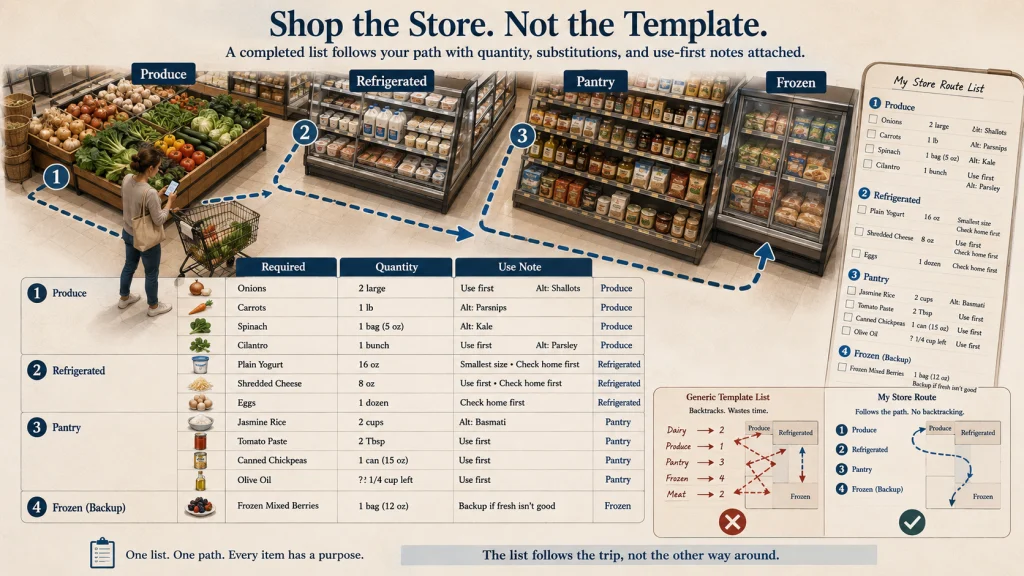
Organize the Final List by the Actual Store Route or Department
Once ingredients are consolidated and quantified, organize the final lines in the order they are likely to be encountered. This reduces backtracking and makes it easier to see duplicate entries before shopping begins.
| Store section | Required items | Quantity or package note | Substitution or use note |
|---|---|---|---|
| Produce | Onions; selected vegetables; fresh herbs | Write individual count or missing amount | Mark use-first items and approved alternatives |
| Refrigerated | Only items missing from the planned meals | Choose the smallest suitable package when practical | Check open packages at home before purchase |
| Frozen | Planned frozen component or one defined backup | Buy only the amount assigned to the plan | Keep the backup separate from fresh meal ingredients |
| Pantry | Rice and other missing shelf-stable ingredients | Record the missing amount before package selection | Do not add unrelated stock purchases here |
The exact departments and route differ by store. Someone who regularly starts in produce and ends near frozen foods should build the list in that order, even if a printable template uses a different sequence. The list should follow the real trip, not ask the shopper to follow the template.
Detailed shopping execution, store comparisons, ingredient-format choices, and online-versus-in-store decisions begin after the list is complete. Those questions belong to the broader grocery and pantry planning process.
Separate Required Items, Optional Upgrades, and Stock-Up Purchases
A list becomes harder to control when ingredients required for this week’s meals sit beside optional extras and long-term stock purchases with no distinction. The shopper may leave with everything except the item that one planned dinner actually needs.
Use three simple groups:
- Required: Missing items needed for meals already on the calendar.
- Optional: An upgrade or preference that can be skipped without breaking the plan.
- Stock-up: A separate purchase considered for future use rather than the current meal plan.
Required items should remain visible even if the optional and stock-up groups are removed. This makes it possible to adjust spending without rewriting the meal plan in the store.
The article on meal prep on a budget addresses spending limits and tradeoffs in greater depth. This section simply prevents optional or future purchases from being mistaken for current meal requirements.
Stop Once the Consolidated List Is Complete
The endpoint of this process is a list that states what is missing, how much is needed, where the item belongs, and which substitutions are acceptable. Once those decisions are present, list construction is finished.
Do not let the article expand into every decision that happens afterward. The actual store trip, order placement, route execution, comparison among shopping channels, shopping frequency, and long-term pantry rules require different information.
Use the guide to grocery shopping for meal prep when the question is how to carry out the trip or order. Use the broader meal-prep guide when the reader needs to place list construction within the full planning, preparation, and storage sequence.
Completion check: Every required meal ingredient has one consolidated line, current stock has been subtracted, missing amounts are stated, substitutions are bounded, and optional purchases are visibly separate.
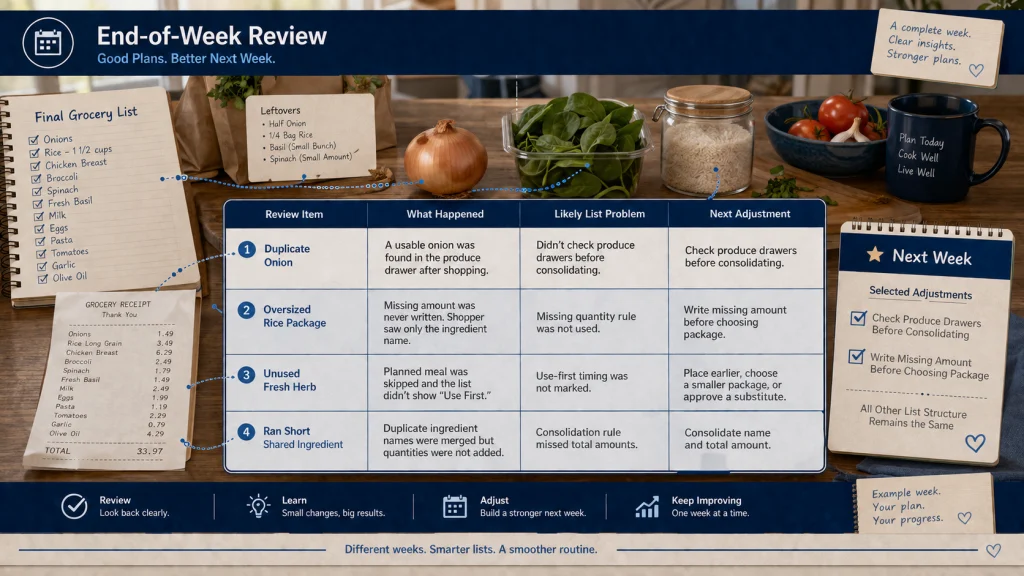
Review the Receipt, Unused Purchases, and Missed Quantities After the Week
The receipt shows what entered the home, but the useful review happens after the planned meals have had time to unfold. Compare the final list with what was purchased, what was used, and what remained.
| Review item | What happened | Likely list problem | Adjustment for next week |
|---|---|---|---|
| Duplicate onion purchase | An existing onion was found after shopping | The refrigerator check missed usable stock | Check produce drawers before consolidating quantities |
| Rice package much larger than needed | The missing amount was never written | The shopper saw only the ingredient name | Add the missing amount before choosing a package |
| Fresh herb remained unused | One planned meal was skipped | The list did not mark the item as use first | Place the ingredient earlier or approve a smaller package or substitute |
| One meal lacked enough of a shared ingredient | The item was listed once but quantities were not combined | Duplicate lines were removed without adding the amounts | Consolidate both the name and the total quantity |
Do not judge the list only by whether every item was purchased. A complete purchase can still be inaccurate if quantities were too large, ingredients were duplicated, or optional items displaced required ones.
Record one or two clear corrections for the next list. Repeating the same structure with a small adjustment makes it easier to see whether inventory subtraction, quantity writing, or use-first marking actually improved.
Build the List by Subtracting, Consolidating, Quantifying, and Organizing
Begin with meals that are final enough to shop. Subtract food already at home, combine repeated ingredients, and write the missing amounts before choosing package sizes. Mark use-first items and backups, add narrow substitutions, and place each line in the section where it will actually be found.
Keep required purchases separate from optional and future stock items. After the week, review what was duplicated, missed, or left unused. A reliable grocery list is not the longest list or the most detailed template. It is the shortest accurate translation of the plan into purchases.
FAQs
🛒 What should be on a meal prep grocery list?
Include only the ingredients still missing from the completed meal plan. Each line should show a usable amount, relevant package note, store section, and any approved substitution or use-first instruction.
🧅 Should I list the same ingredient more than once?
Usually no. Combine the amount needed across all planned meals, then subtract usable stock at home. Keep separate lines only when the ingredient forms or uses are not interchangeable.
📦 How do I handle unknown package sizes?
Write the missing amount first. Then add a practical note such as “smallest package that covers the need” rather than pretending every store sells one standard size.
🔁 Should substitutions go on the grocery list?
Yes, when an alternative has already been approved for the planned meal. Keep the substitution narrow enough that the shopper knows what will still work without changing the meal unexpectedly.
📱 Can an app create the entire list automatically?
An app can transfer ingredients and reduce typing, but someone still needs to subtract current stock, combine duplicates, confirm quantities, and resolve package or substitution notes. Automatic transfer is a starting draft, not the final list.
🧾 What should I review after shopping?
Check the receipt and the end of the week for duplicate purchases, unused fresh food, oversized packages, and ingredients that ran short. Use those results to change one or two list rules next time.