Hygiene habits become easier to repeat when the task has a stable cue, the supplies are ready at the point of use, and a minimum version is available for difficult days. Start with one task instead of rebuilding an entire routine at once. Use one reminder only when the cue is not yet reliable, track whether you started rather than whether everything looked perfect, and use a restart rule after interruptions. There is no universal number of days required for a habit to feel automatic.
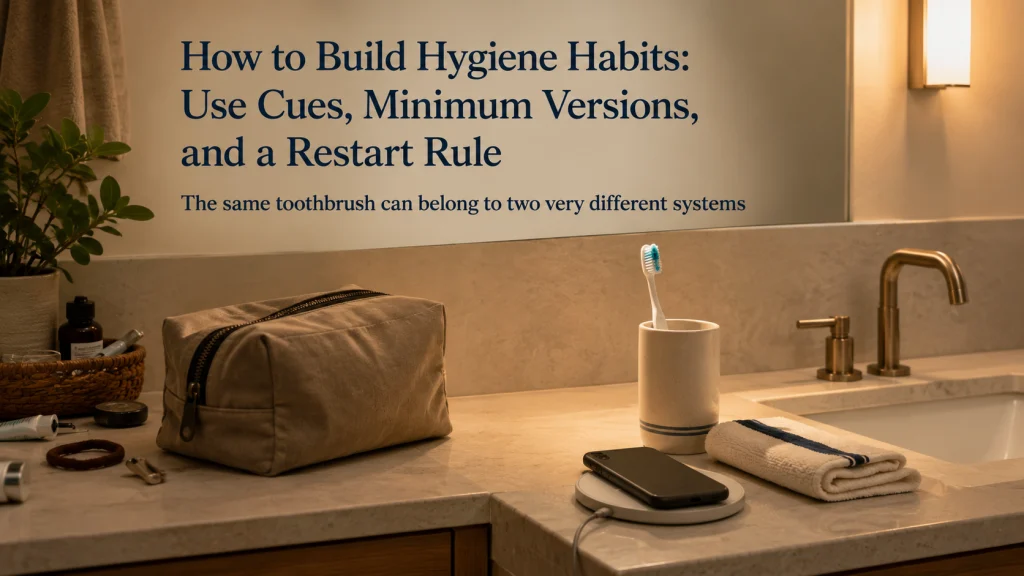
The Same Toothbrush Can Belong to Two Very Different Systems
In the first system, a toothbrush is stored inside a closed travel bag. Brushing depends on remembering that the bag exists, finding it, opening it, and putting everything away again. A missed evening feels like proof that the routine is failing.
In the second system, the same toothbrush is stored appropriately near the sink, follows an event that already happens, and has both a standard version and a minimum version. A written restart rule means an interrupted evening does not force the person to invent a new plan the next morning.
| System | Launch Conditions | What Happens After a Miss |
|---|---|---|
| Memory-dependent | Supplies are hidden, setup takes several steps, and there is no stable cue. | The miss is treated as failure, so restarting feels heavier. |
| Cue-supported | The task follows a familiar event, supplies are ready, and a minimum version is defined. | The existing system remains easy to re-enter after the interruption. |
The task did not change. The launch conditions did. Learning how to build hygiene habits is less about forcing motivation and more about making the next start easy to recognize and practical to complete.
Use the personal hygiene basics guide when you need the broader foundation, or review the personal hygiene guide for the wider set of everyday decisions.
Define the Parts of a Repeatable Hygiene Habit
A habit system is easier to adjust when each part has a clear job. These terms describe the workflow rather than judging the person using it.
- Cue: The event, location, or signal that tells you it is time to begin.
- Routine: The sequence you follow after the cue appears.
- Friction: Any extra step that makes starting, continuing, or cleaning up harder.
- Minimum version: The smallest safe, useful version you can complete when time, privacy, energy, or access is limited.
- Tracking: A simple record of starts or completed minimums, used to notice patterns rather than grade appearance.
- Restart: The rule for returning after travel, illness, a schedule change, or an ordinary missed task.
Key decision: When a hygiene task is inconsistent, inspect the cue, location, task size, and restart rule before assuming that motivation is the only problem.
Choose One Task Instead of Rebuilding Everything
An oversized reset can create a long list of supplies, times, and standards before any single behavior has a reliable starting point. Choosing one task keeps the experiment small enough to understand.
Start with a task that is important, clearly defined, and possible in your current setting. Examples might include brushing teeth in the evening, washing your face after removing contact lenses, changing into clean sleepwear, or preparing tomorrow’s basic hygiene supplies.
Use a personal hygiene checklist to decide which task needs attention, but do not turn the full checklist into one new habit project. Select one action and write it as a visible behavior.
The narrower statement gives you something to attach to a cue, place in a location, and revise when friction appears.
Attach the Task to an Existing Event or Location
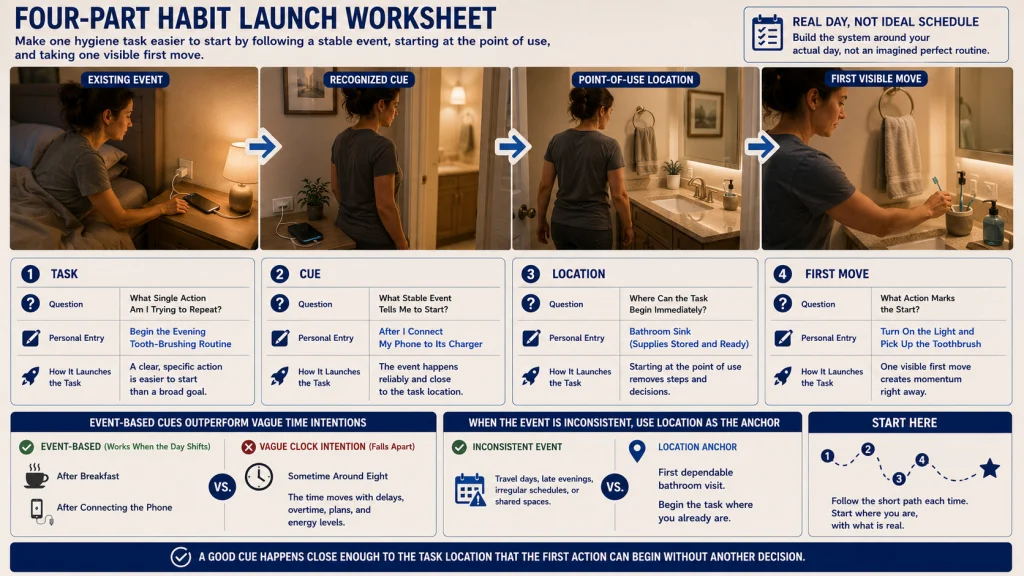
A useful cue is already part of ordinary life and occurs near the place where the task can begin. It should be specific enough that you can tell whether it happened.
Events often work better than vague clock times when schedules change. “After I finish breakfast” may be easier to recognize than “sometime around 8 a.m.” A location can also support the cue when the task always begins in the same place.
| Worksheet Part | Question | Example |
|---|---|---|
| Task | What single action am I trying to repeat? | Begin the evening tooth-brushing routine. |
| Cue | What stable event tells me to start? | After I connect my phone to its charger. |
| Location | Where can the task begin immediately? | At the bathroom sink. |
| First visible move | What action marks the start? | Turn on the light and pick up the toothbrush. |
Choose a cue that belongs to your real day, not an ideal schedule. If breakfast varies but the first bathroom visit is dependable, the location may be the stronger anchor.
Keep Supplies at the Point of Use
Point of use means the task can begin where the supplies are stored. It does not mean every item must stay visible or uncovered. Storage instructions, household safety, cleanliness, privacy, and shared-space needs still apply.
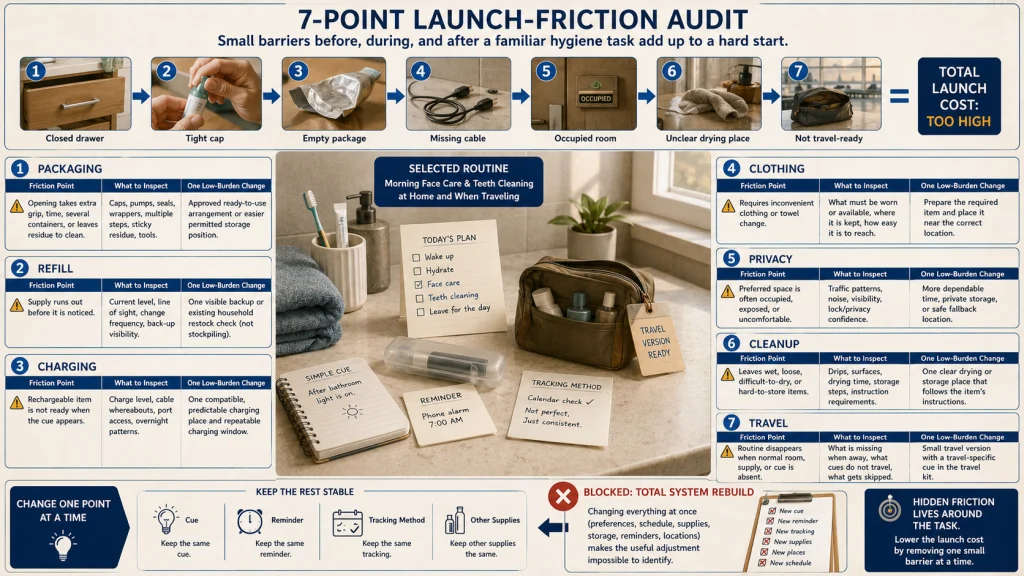
Place the required item where it can be reached without opening several unrelated containers or walking to another room. Keep refills close enough that an empty container does not end the routine for several days. For rechargeable items, make the charging location predictable and compatible with the product instructions.
Editorial observation: Caps, drawers, charging cables, refill packages, and cleanup steps can each add only a few seconds, yet several small barriers in sequence can make a familiar task feel surprisingly difficult to launch. Good placement reduces unnecessary steps without ignoring safe storage.
The guide to setting up hygiene supplies can help when the physical arrangement, replacement cycle, or cleanup burden is the main obstacle.
Define Minimum, Standard, and Expanded Versions
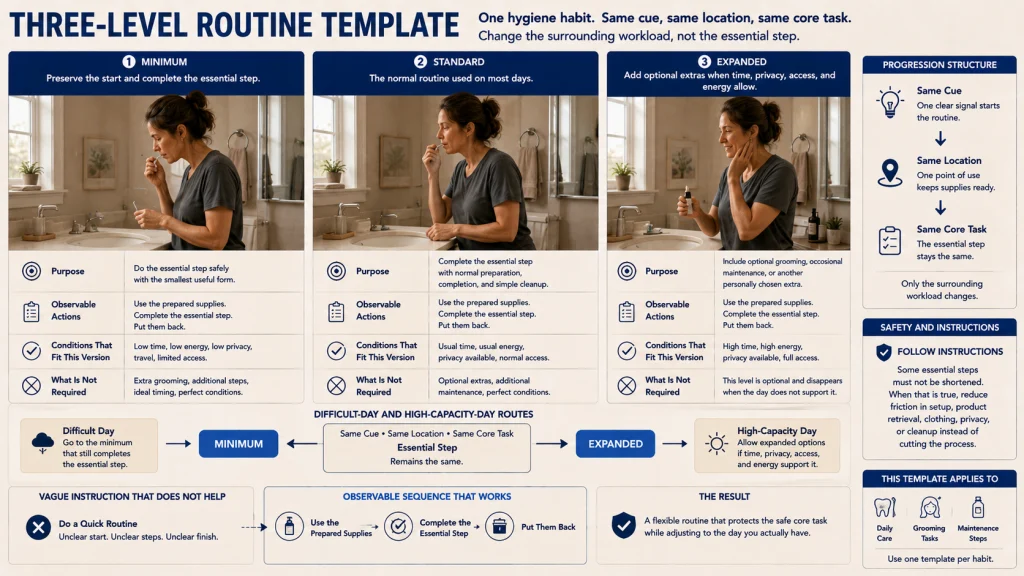
A single oversized version makes the routine fragile. When every step is required every time, a busy evening, limited privacy, travel disruption, or low-energy day can turn one incomplete session into no start at all.
Three versions protect the core task while allowing the routine to match the day. The minimum version must still follow basic safety and product instructions. It is not a careless substitute or a reason to skip necessary care indefinitely.
| Version | Purpose | Example Structure |
|---|---|---|
| Minimum | Preserve the start and complete the smallest safe, useful form. | Complete the essential step with supplies already at the point of use. |
| Standard | Complete the normal routine used on most days. | Perform the essential step plus the usual preparation and cleanup. |
| Expanded | Add optional care when time, access, and energy allow. | Include occasional maintenance or an optional extra that is not required for every start. |
Write each version in observable actions. “Do a quick routine” is open to interpretation. “Use the prepared supplies, complete the essential step, and put them back” creates a clear finish.
Note: Some hygiene tasks should not be shortened beyond their safe or effective instructions. In those cases, reduce setup and cleanup friction instead of cutting the essential process.
Use One Reminder When the Cue Is Not Reliable Yet
A reminder can support a new cue, but several alerts can become background noise. Start with one reminder that appears close to the actual opportunity to complete the task.
The reminder should name the first action, not deliver a lecture. “Supplies are ready at the sink” is easier to act on than a long message about what you should have done.
- Use an event-based cue as the main trigger when possible.
- Add one reminder if the event is easy to miss or the schedule changes.
- Place the reminder near the point of use or the transition into the task.
- Remove or revise it if you dismiss it automatically without starting.
A reminder that repeatedly arrives when the task is impossible needs a better time or location. More reminders will not fix a launch window that does not fit your day.
Track Starts and Completed Minimums, Not Perfection
Tracking should feel like a small note to your future self, not a scorecard. A mark beside the date can show whether the cue was visible, whether the start happened, and where friction entered the routine. That is enough information to improve the setup without turning one difficult day into a judgment.
Use one of three simple outcomes:
- Started and completed: The cue and setup worked well enough.
- Started but stopped: The launch worked, but a later step needs attention.
- Did not start: Check whether the cue was noticed, the location was available, or supplies were ready.
Do not use appearance, smell, comparison with another person, or an idealized routine as the score. The purpose is to improve repetition without turning ordinary variation into a moral judgment.
Practical tip: Keep tracking smaller than the task. One mark beside the date is often enough to reveal whether the problem is starting, completing, or recovering after a miss.
Reject Fixed Habit Timelines
There is no universal point when a hygiene behavior becomes automatic. The timing can vary with the task, cue stability, repetition opportunities, environment, travel, illness, schedule changes, and individual circumstances.
A routine that becomes easy to start at home may still need active attention in a hotel, shared bathroom, or new work schedule. That does not erase the earlier progress. It shows that habits depend partly on context.
Review function instead of counting toward a promised day:
- Do you notice the cue more often?
- Can you begin with fewer setup steps?
- Is the minimum version clear on difficult days?
- Can you resume after disruption without redesigning everything?
Progress may be uneven. A task can feel natural for several days, require more attention during a busy period, and become easier again when the environment stabilizes.
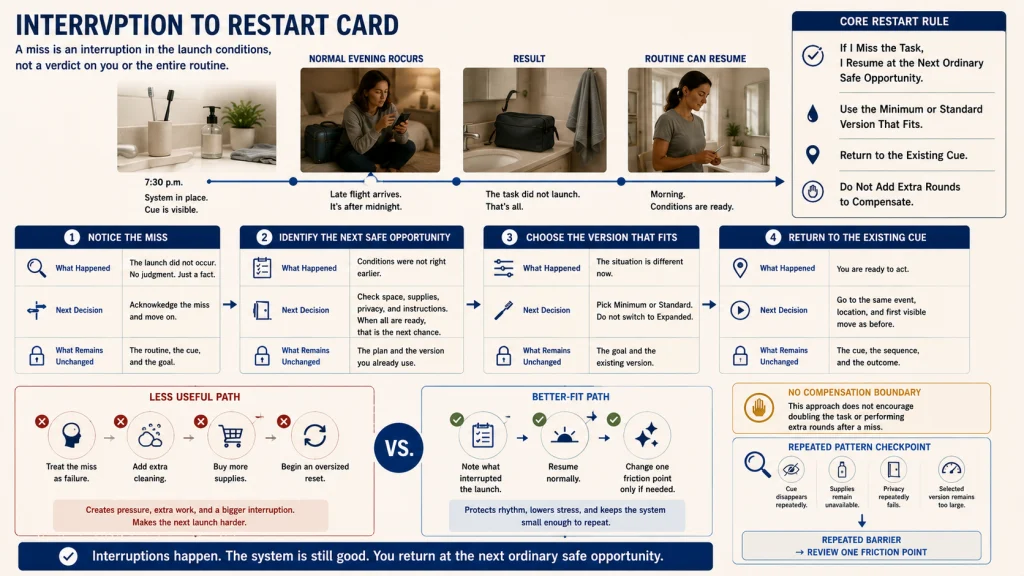
Create a Restart Rule for Missed Tasks
A restart rule decides what happens before a miss occurs. It prevents one disruption from becoming a debate about whether the entire system still counts.
Restart rule: If I miss the task, I will resume at the next ordinary safe opportunity, use the minimum or standard version that fits, and return to the existing cue. I will not add extra rounds to compensate.
The next safe opportunity depends on the task and its instructions. It may be the next scheduled routine, the next time the correct space is available, or the next point when supplies can be used safely.
Missing once does not require punishment, shame, or a more aggressive routine. The useful information is whether the cue disappeared, the supplies were unavailable, or the task version was too large for that situation.
Review the System After Several Weeks
Give the setup enough ordinary repetitions to reveal a pattern, then look back with curiosity rather than using the review as a grade. A routine can work well on calm days and still expose one awkward step during travel, illness, a late night, or a schedule change. The useful question is not whether every day went well, but which part of the system deserves one practical adjustment.
- Cue: Notice which event led naturally into the task and which one was easy to overlook.
- Location: Check whether the point of use was actually available when the cue appeared.
- Task size: Confirm that the minimum version remained safe, clear, and realistic.
- Reminder: Notice whether it supported the start or became another alert to dismiss.
- Disruption: Look at what changed during travel, illness, a late night, or a different schedule.
- Repeated friction: Choose the one barrier that appeared often enough to justify a change.
Then change one variable. Move the supplies, revise the cue, simplify preparation, change the reminder time, or clarify the restart rule. Keep the rest stable long enough to see whether the adjustment improves starts.
When timing and fallback structure are the main issue, the guide to building an adult hygiene routine can help organize the task within the rest of the day.
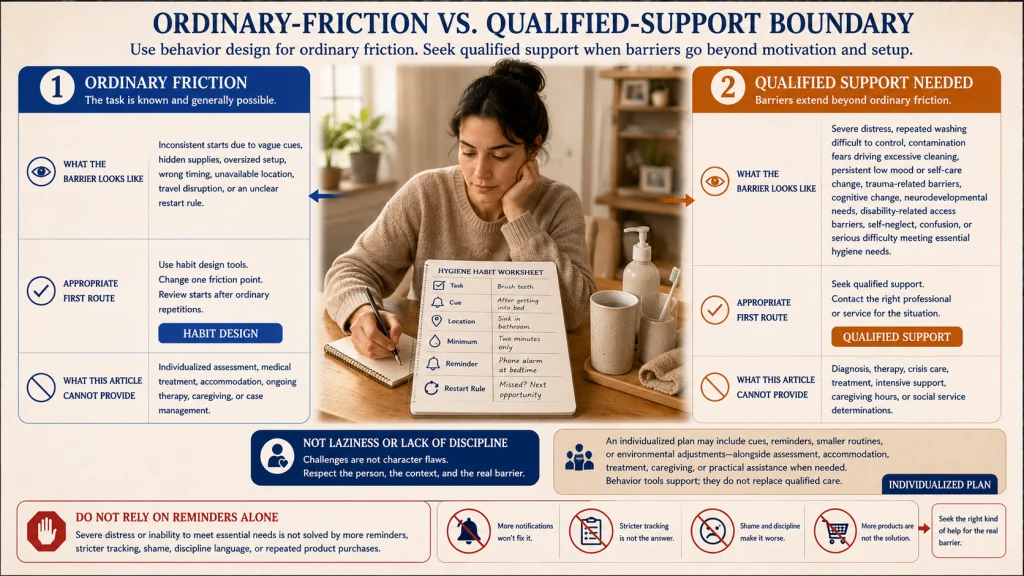
Know When Habit Design Is Not the Main Issue
This article covers ordinary repetition and setup friction. It does not treat severe distress, compulsive washing, contamination fears, persistent low mood, trauma-related barriers, cognitive change, neurodevelopmental needs, disability-related access, self-neglect, or serious difficulty meeting essential needs.
Safety warning: Do not frame these barriers as laziness or a simple failure of motivation. Significant distress, repeated washing that feels difficult to control, fear that drives excessive cleaning, a marked change in self-care, confusion, or inability to meet essential hygiene needs requires qualified support appropriate to the situation.
Support may involve a health professional, mental-health professional, occupational therapist, disability service, caregiver, social service, or another qualified resource. The appropriate route depends on the barrier and the person’s circumstances.
A cue, reminder, or smaller routine may still be part of a supported plan, but it should not replace individualized assessment, accommodations, treatment, or practical assistance when those are needed.
Write the Six Parts of Your Habit System
Choose one hygiene task and write down its cue, point-of-use location, and first visible action. Define the minimum version that remains safe, then note the standard version you expect to use most often.
Add one reminder only if the cue is not reliable yet. Finish with a restart rule that tells you how to re-enter the same system after an interruption, without redesigning the whole routine.
Your final line can be simple: “After [cue], at [location], I will start [task]. My minimum is [minimum version]. I will use [reminder] if needed, and after a miss I will [restart rule].”
FAQs
🪥 Should I build several hygiene habits at once?
Start with one task when several parts of the routine are inconsistent. A smaller project makes it easier to identify whether the cue, location, task size, or restart rule is helping. Add another task after the first system is understandable, not only after it feels perfect.
🔔 Are reminders enough to make hygiene a habit?
A reminder can support a cue, but it cannot remove every setup barrier. If the alert arrives when supplies are unavailable, privacy is limited, or the task is too large, adjust those conditions instead of adding more notifications.
📍 What is the best cue for a hygiene task?
The best cue is a stable event or location that occurs close to the real opportunity to begin. Choose something specific, such as finishing breakfast or connecting your phone to its charger, rather than a vague intention such as “later tonight.”
🧩 What counts as a minimum version?
It is the smallest safe, useful form of the task that preserves the start on a difficult day. It still needs to follow essential instructions. When the core process should not be shortened, reduce preparation and cleanup instead.
📅 How many days does it take to build a hygiene habit?
There is no fixed number that applies to every person, task, or setting. Look for practical changes such as noticing the cue, beginning with fewer steps, using the minimum version when needed, and restarting more easily after disruption.
🔄 What should I do after missing a day?
Return to the established cue and use the version that fits the situation. Treat the miss as information only when the same barrier keeps returning; otherwise, let the routine continue normally rather than turning one day into a larger reset.
🧳 How can I keep the routine while traveling?
Prepare a travel version with only the necessary supplies, follow storage instructions, and choose a cue that exists in the travel setting. Keep the restart rule available in case transport, shared spaces, or schedule changes interrupt the routine.
🚩 When is this more than an ordinary habit problem?
Seek qualified support when hygiene is connected with severe distress, compulsive behavior, contamination fears, persistent low mood, cognitive change, disability-related barriers, or inability to meet essential needs. These situations should not be reduced to motivation or discipline.