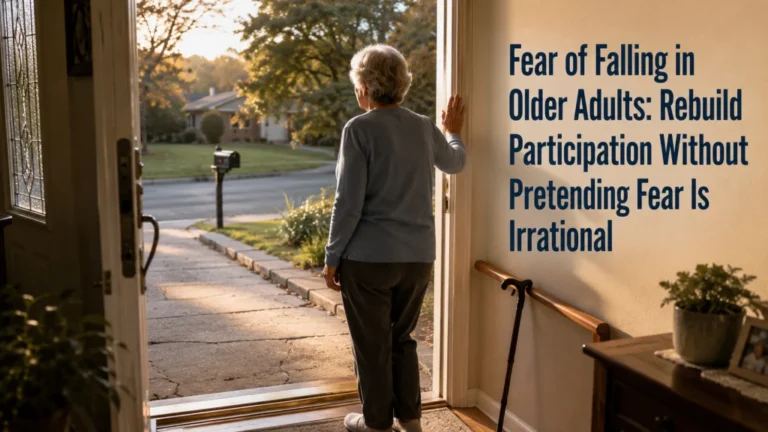
A refusal of help may be protecting control, privacy, identity, trust, reciprocity, routine, or the right to choose how a problem is solved. Before repeating the same offer more forcefully, ask what the offer changes besides the workload. Separate a preference conflict from an unmet essential need or immediate danger, then redesign the support around the outcome the older adult wants. Keep the person in the conversation and use qualified local help when safety, abuse, exploitation, severe confusion, or essential needs require more than a family negotiation.

The Same Grocery Problem Can Produce Three Different Offers
Consider three ways to respond when carrying groceries has become difficult:
| Offer | What it solves | What else it may communicate |
|---|---|---|
| “I will take over your groceries.” | Shopping and carrying | The current routine and decisions are being transferred. |
| “Do you want me to order everything?” | Travel, shopping, and carrying | The proposed solution is already chosen before preferences are discussed. |
| “Would delivery on heavy-item weeks make shopping easier?” | The physically demanding part on selected weeks | The older adult still chooses the list, store, timing, substitutions, and whether to use the option. |
The task is the same, but the amount of control is not. A no may be directed at the loss of choice built into the offer rather than at groceries, transportation, reminders, equipment, or support itself.
Before pushing harder: Identify what your offer changes besides the workload.
That question can lower the emotional temperature. Repeated refusals can leave a caregiver worried, tired, and unsure whether backing off is respectful or irresponsible. Moving away from judgment does not minimize that concern. It creates a better way to examine task scope, timing, privacy, identity, trust, and decision rights.
The healthy aging guide provides the broader context for later-life choices. The guide to staying independent as you age explains how support can preserve choice without treating doing everything alone as the goal.
Replace a Character Judgment With a Testable Question
When the same offer has been declined several times, it is easy to turn the refusal into a personality label. That label feels explanatory, but it gives you nothing useful to test.
Ask whether the person is protecting a decision they still want to make, objecting to the helper or schedule, limiting access to private space, or resisting an offer that removes more of the task than necessary. A previous agreement may also have expanded beyond its original scope, making the next offer harder to trust.
Possible motives must remain hypotheses. A caregiver cannot know from one refusal whether the concern is identity, trust, cost, privacy, past experience, or something else. Ask, listen, and compare the answer with the design of the offer. Also ask whether the situation is urgent or mainly a disagreement about method, because those paths require different responses.
Understand Why Taking Over Can Feel More Threatening Than the Difficult Task
Once the refusal is treated as information rather than a character flaw, the next question is what control the current task still provides. A difficult task may be tiring, slow, or inconvenient while still carrying familiar choices. The person decides when it happens, how it is done, which compromises are acceptable, and who sees the process.
An offer to take over can remove the physical difficulty and also remove those decisions. That trade may feel too large when the current problem affects only one step.
Break the task into parts. Grocery shopping includes planning meals, choosing a store, creating a list, traveling, selecting items, approving substitutions, paying, carrying bags, and putting food away. The difficult step may be carrying, while the offer transfers all ten decisions.
Better question: “Which part would you like to make easier, and which parts do you want to keep?”
This approach does not guarantee agreement. It does make the offer more accurate and preserves the possibility that support can be limited to the step that is actually creating difficulty.
Notice When Help Also Carries an Age or Ability Label
A service, device, or household change can communicate more than its practical function. Its design, name, sales language, or the way family members introduce it may suggest that the person is now being placed in a category they do not recognize or accept.
Consumer-culture research on later-life identity has examined how marketplace offerings can become tied to unwanted age identities. A product may be rejected not because its function is useless, but because accepting it appears to confirm a label the person is resisting. The identity research supports treating that reaction as meaningful rather than dismissing it as irrational.
Editorial observation: A device can provide a useful function while its packaging, oversized controls, constant alerts, or monitoring-focused sales language communicates “old,” “incapable,” or “watched.” Changing the framing or choosing a less intrusive setup may matter as much as adding the feature.
Describe the function in ordinary adult language. Instead of presenting an item as proof that the person can no longer manage, explain the specific friction it removes and ask whether that result is useful.
Explore Worry About Imposing on Others and Losing Reciprocity
Some people may decline when the offer feels one-sided. They may worry that the helper is already busy, that every ride creates a debt, or that accepting repeated support changes a relationship from mutual to unequal. Even a generous offer can feel uncomfortable when the person cannot see how the relationship will remain balanced.
Do not answer only with, “It is no trouble.” The person may still see time, travel, scheduling, money, or emotional effort that the helper is not naming.
Make the request finite:
- Define one task, date, and end time.
- Say what you can genuinely provide without resentment.
- Offer an exchange when the older adult wants one and it remains realistic.
- Separate appreciation from obligation.
- Allow the person to decline without punishing the relationship.
Reciprocity can take many forms: preparing a list, making a call, sharing knowledge, choosing the route, hosting a meal, checking on a pet, or contributing to a family decision. It does not need to match the physical effort or financial value of the assistance.
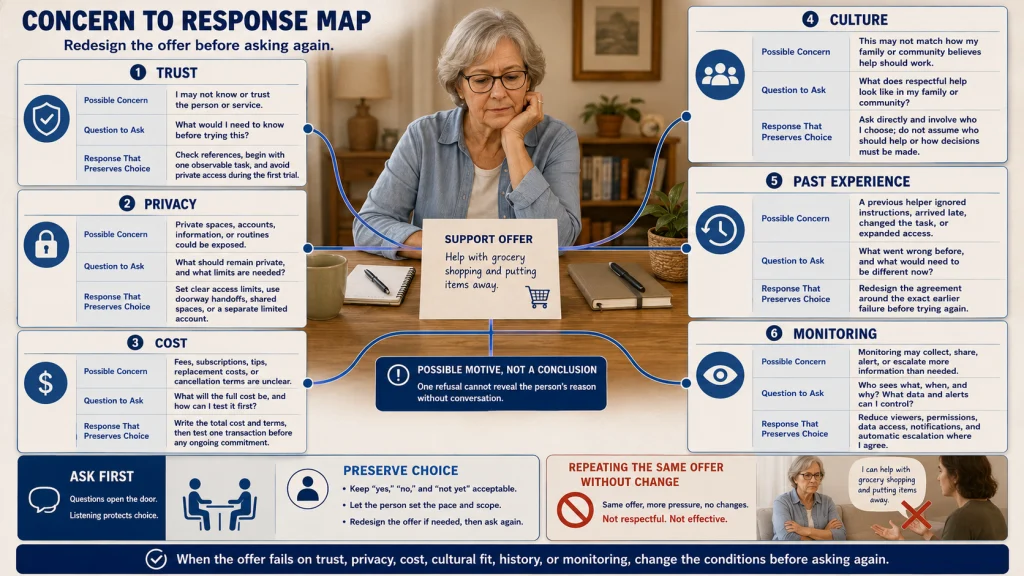
Check Trust, Privacy, Cost, Culture, and Past Experience
Reciprocity is only one possible concern. The next layer is whether the person trusts the helper, the process, and the terms being offered. A refusal may be a reasonable response to those conditions. Family familiarity does not automatically create trust, and a paid service is not automatically neutral.
| Possible concern | What to ask | Response that preserves choice |
|---|---|---|
| Trust | “What would you need to know before trying this person or service?” | Check references, begin with an observable task, and avoid private access at first. |
| Privacy | “Which rooms, accounts, information, or routines should stay private?” | Set access limits and move the task to a doorway, shared area, or separate account. |
| Cost | “Which fees, subscriptions, tips, or cancellation terms are unclear?” | Write the full cost and test one transaction before creating an ongoing commitment. |
| Cultural expectations | “What would respectful help look like in this family or community?” | Ask rather than assuming who should provide care or how decisions should be made. |
| Past experience | “Has a previous helper ignored instructions, arrived late, or expanded the task?” | Build new boundaries around the exact failure rather than repeating the same format. |
| Monitoring | “Does this tool collect or share more information than the task requires?” | Reduce data access, alerts, viewers, and automatic escalation where the person agrees. |
When an offer fails on trust, privacy, cost, or cultural fit, a more forceful version of the same offer usually preserves the same problem. Change the conditions before asking again.
Notice How the Parent and Adult Child Relationship Is Changing
An adult child may feel responsible for preventing every foreseeable problem. That pressure can make each refusal feel like a warning that time is running out. A parent may hear the same concern as a reversal of authority, especially when the conversation includes instructions, inspections, deadlines, or decisions made with other relatives first.
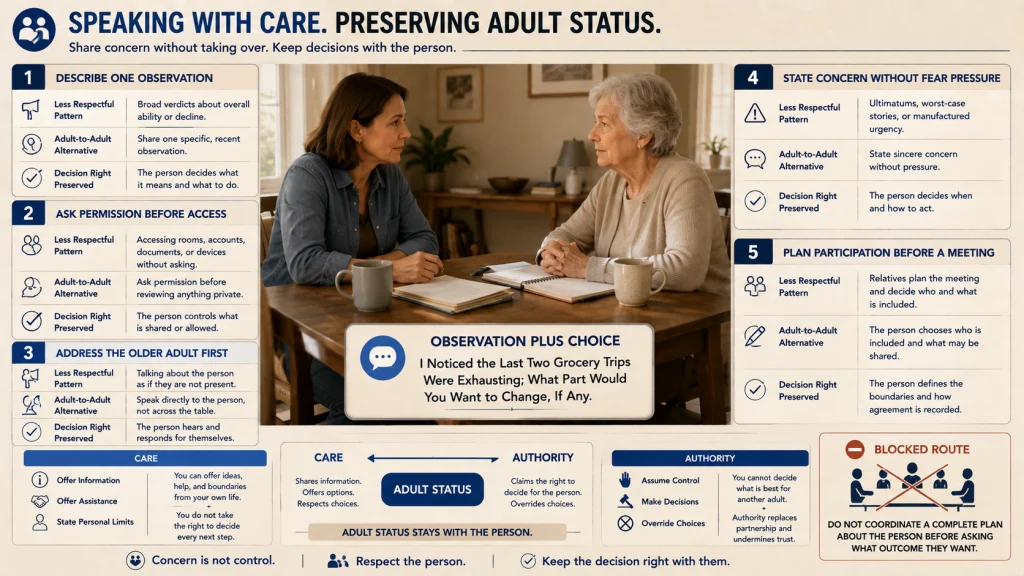
Care and authority are not the same. You can bring information, describe what you observed, state what help you can offer, and explain your own limits without claiming the right to decide every next step.
Use adult-to-adult language:
- Describe one observation instead of presenting a verdict about the person’s overall ability.
- Ask permission before reviewing private spaces, accounts, medicines, or documents.
- Speak directly to the older adult when other relatives or professionals are present.
- State your concern without using fear to force immediate agreement when no emergency exists.
- Do not hold a family meeting about the person without planning how they will participate.
Language that preserves adult status: “I noticed the last two grocery trips were exhausting. What part would you want to change, if any?”
Look for the Wrong Person, Timing, Scope, or Amount of Monitoring
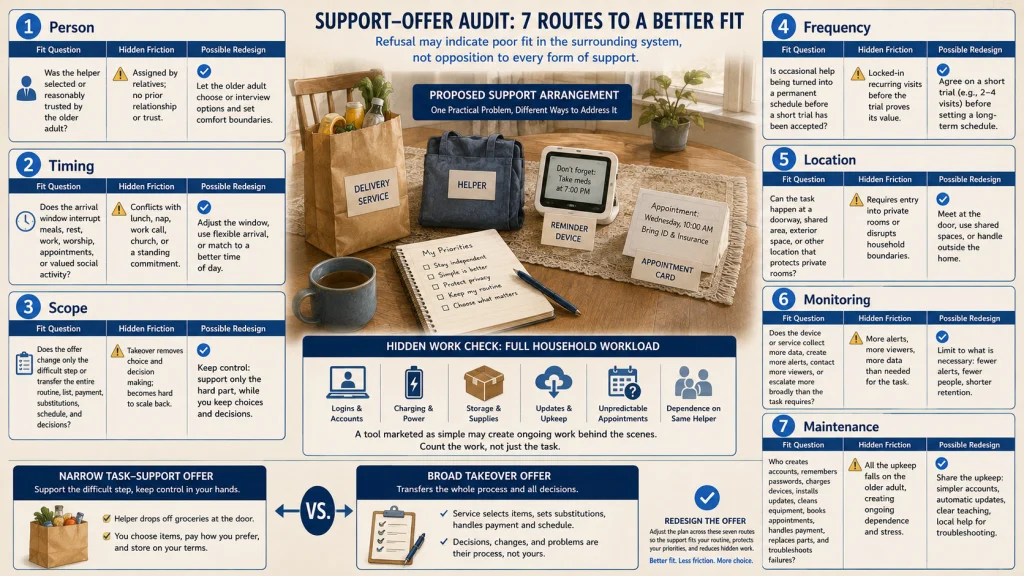
Useful support can be rejected because it is badly matched. The offer may arrive during an argument, use a helper the person does not trust, require a four-hour arrival window, or include monitoring that is much broader than the task.
Audit the offer:
- Person: Is this someone the older adult chose or would reasonably trust?
- Timing: Does the support interrupt meals, rest, appointments, work, worship, or social activity?
- Scope: Does it solve one step or take over the entire routine?
- Frequency: Is occasional support being presented as a permanent schedule?
- Location: Can the task happen outside private rooms?
- Monitoring: Does the solution collect more data or send more alerts than necessary?
- Maintenance: Who charges, updates, cleans, books, pays for, or troubleshoots the solution?
A tool or service that creates logins, charging duties, unpredictable appointments, and repeated alerts may add more dependence on the helper than the original task did. Count the maintenance burden before calling the offer simple.
Ask What Outcome They Want Before Naming a Solution
Begin with the life result, not the product, service, or family plan. The desired outcome may be keeping a weekly class, shopping at a preferred store, preparing familiar meals, staying in the current home, seeing friends, or reducing exhaustion after one task.
Ask what part of the routine matters most, what has become harder, what is still working well, and what kind of support would feel too intrusive. Then ask what result would make a short trial worth continuing.
The answer may reveal that the family is solving the wrong problem. A caregiver may focus on the effort required to cook while the older adult cares most about choosing meals and eating at a familiar time. Support with carrying, preparation, or cleanup may fit better than replacing the whole routine.
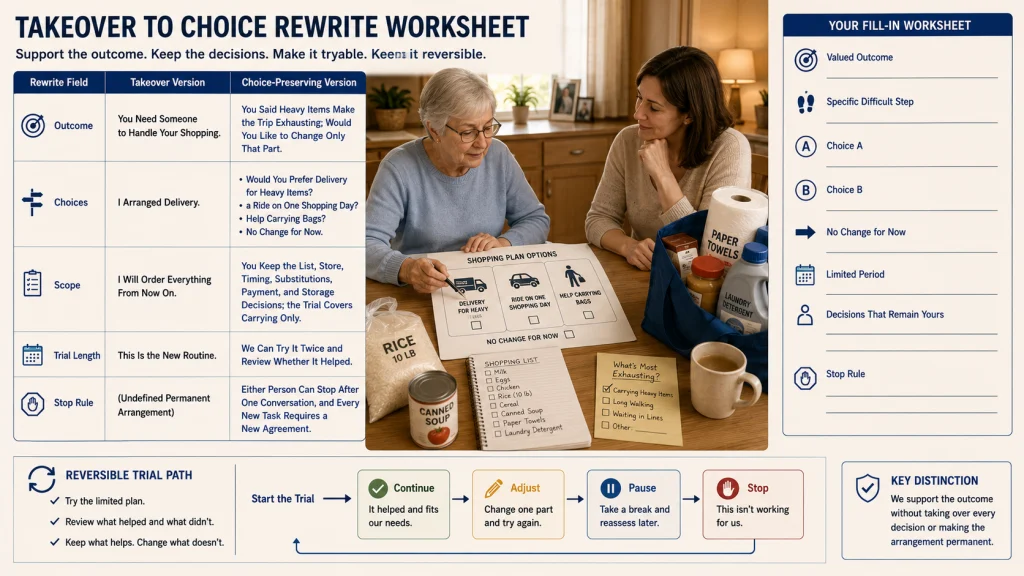
Offer Choices and a Small Reversible Trial
Once the desired outcome is clear, the offer can become smaller and more precise. A trial should be narrow enough that saying yes does not feel permanent. Offer two or three realistic choices, including the choice to pause and revisit the discussion when no immediate danger is present.
| Rewrite field | Takeover version | Choice-preserving version |
|---|---|---|
| Outcome | “You need someone to handle your shopping.” | “You said heavy items make the trip exhausting. Would you like to change only that part?” |
| Choices | “I arranged delivery.” | “Would you prefer delivery for heavy items, a ride on one shopping day, or help carrying bags?” |
| Scope | “I will order everything from now on.” | “You keep the list, store, substitutions, and payment. The trial covers carrying only.” |
| Length | “This is the new routine.” | “We can try it twice and review whether it helped.” |
| Stop rule | No clear way to end the arrangement | “Either of us can stop after one conversation. A new task requires a new agreement.” |
Write the revised offer in one sentence:
Offer-rewrite worksheet: “You want to keep [valued outcome]. The difficult step appears to be [specific step]. Would you prefer [choice A], [choice B], or no change for now? We can try it for [limited period], keep [decisions] under your control, and stop if [stop rule].”
The guide to designing acceptable support speaks directly to the older adult and can be shared without turning the article into another persuasion tool.
Keep the Older Adult in the Conversation
A better offer still fails if the person is excluded from the discussion around it. Concern can lead families to talk around the person. Relatives compare notes, contact services, or ask a professional what should happen before asking what the older adult wants. That may be necessary in an emergency, but it should not become the default for ordinary support decisions.
During a meeting or appointment:
- Address the older adult first.
- Ask who they want included.
- Separate observations from conclusions.
- Pause after questions instead of answering for them immediately.
- Confirm what information may be shared afterward.
- Record disagreement without pretending everyone consented.
If communication is difficult, use a quieter room, shorter questions, written choices, hearing or language access, and more time. Do not treat a rushed or inaccessible conversation as proof that the person cannot participate.
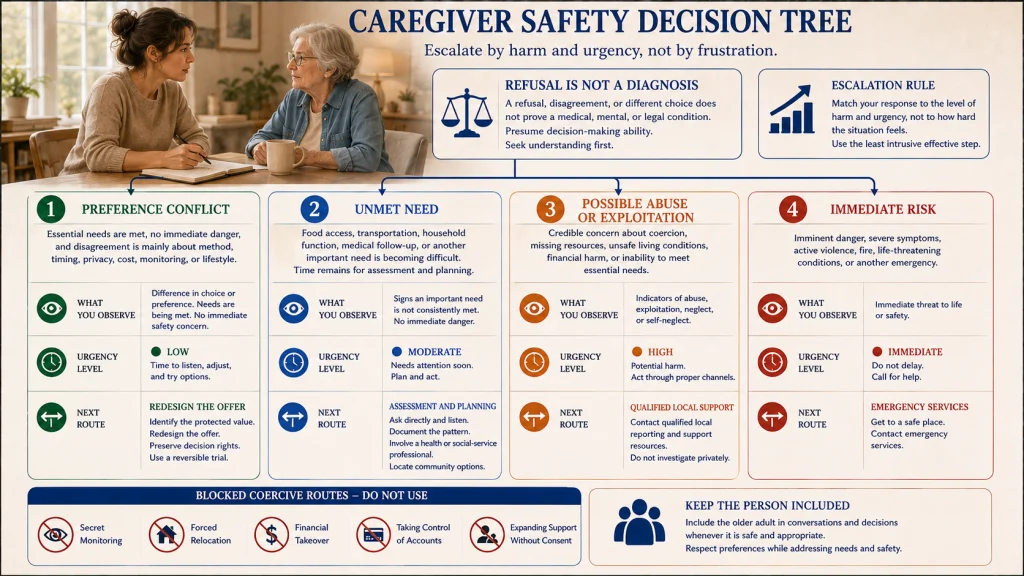
Distinguish Preference Conflict, Unmet Need, and Immediate Risk
Respectful offer design matters, but it is not the only responsibility. Not every disagreement is a safety crisis, and not every refusal can wait for another family conversation. Use the level of harm and urgency to choose the next step.
| Decision point | What you observe | Next route |
|---|---|---|
| Preference conflict | Essential needs are being met, no immediate danger is present, and the disagreement is mainly about method, timing, privacy, cost, or lifestyle. | Clarify the protected value, redesign the offer, and use a reversible trial. |
| Unmet need without immediate danger | Food, transportation, household function, medical follow-up, or another important need is becoming difficult, but there is time for assessment and planning. | Ask directly, document the pattern, involve an appropriate health or social-service professional, and locate community options. |
| Possible abuse, exploitation, neglect, or self-neglect | There are credible concerns about harm, coercion, missing resources, unsafe living conditions, or inability to meet essential needs. | Use qualified local reporting and support resources rather than investigating alone. |
| Immediate risk | There is imminent danger, severe symptoms, active violence, fire, life-threatening conditions, or another emergency. | Contact emergency services immediately. |
Safety boundary: A refusal by itself does not diagnose cognitive impairment, depression, paranoia, or lack of decision-making capacity. Do not use this decision tree to justify secret monitoring, forced relocation, financial takeover, or another coercive action.
Choose the Next Resource Based on the Problem
Different questions need different workflows:
- Use the support-design process when the older adult wants a more acceptable arrangement.
- Use the guide to talking with an aging parent about help when the main difficulty is how to begin and structure the conversation.
- Use the guide to recognizing patterns that may need attention when the family is unsure whether one incident or a broader change is present.
- Return to the independence framework when several domains, routines, and backup plans need to be considered together.
Do not send a stack of articles as proof that the person must agree. Choose the one that matches the next decision and invite them to review it with you.
Know When to Involve Qualified Outside Support
A family conversation may not be enough when the situation involves health changes, essential needs, abuse, exploitation, unsafe conditions, or a conflict that the family cannot assess fairly.
Possible routes include:
- Health professional: for sudden confusion, severe symptoms, medication questions, functional changes, or a health concern that needs individualized evaluation.
- Social worker: for care coordination, family communication, service options, discharge planning, or complex practical needs.
- Area Agency on Aging: for local information about transportation, meals, household support, caregiver resources, and community services. The federal Eldercare Locator connects U.S. families with local aging resources.
- Adult Protective Services: for suspected abuse, neglect, self-neglect, or financial exploitation when the danger is not immediate.
- Emergency services: for imminent danger, severe medical symptoms, active violence, fire, or another immediate threat.
The Administration for Community Living’s official reporting guidance directs people to emergency services for immediate danger and to the relevant state Adult Protective Services agency for non-immediate suspected abuse, neglect, or exploitation.
Important: This article does not determine legal capacity, authorize intervention, or provide a legal conclusion. Local laws, reporting duties, service eligibility, and agency procedures vary. Use qualified local guidance for the exact situation.
Identify the Protected Value and Rewrite the Offer
Write the declined offer in one sentence. Then ask what it changed besides the workload. Did it transfer decisions, enter private space, add monitoring, create a cost, change a family role, attach an unwanted label, or expand beyond the difficult step?
Rewrite the offer around the person’s desired outcome. Keep the task narrow, provide choices, state what remains under their control, set a short trial, and make the stop rule visible.
You may still hear no. That can be difficult when your concern is sincere and the consequences feel close. When there is no immediate danger, the answer is information about the fit of the offer and the person’s priorities. When essential needs or safety are at risk, move from repeated persuasion to appropriate professional, protective, or emergency support.
FAQs
🧭 Why does my aging parent reject useful help?
The offer may affect control, privacy, identity, trust, cost, routine, reciprocity, or family roles in addition to solving the task. Treat these as possibilities to ask about, not motives you can assume.
🗣️ How should I respond to another no?
Do not repeat the identical offer more forcefully. Ask which part feels unacceptable, what outcome the person wants, and whether a smaller or reversible option would fit better.
🔒 What if privacy is the main concern?
Limit rooms, accounts, information, monitoring, and people involved. Move the task to a doorway or shared area when possible, and require separate consent before expanding access.
🤝 How can I offer help without taking over?
Separate the task into steps, ask which step is difficult, offer two or three choices, and state which decisions remain with the older adult. Use a short trial with a stop rule.
🏷️ Can the way a product is marketed affect acceptance?
Yes. A useful function may still be rejected when the design or sales framing communicates incapacity, surveillance, or an unwanted age identity. Describe the specific function and reduce unnecessary monitoring.
👥 Should relatives discuss the situation without the older adult?
Ordinary planning should keep the person involved and addressed directly. Private coordination may be necessary during an emergency, but it should not become the default method for routine support decisions.
⚖️ Does refusing help prove a person lacks capacity?
No. A refusal alone does not establish cognitive impairment, a mental-health condition, or lack of legal capacity. Those questions require appropriate individualized and, where relevant, legal assessment.
🚨 When should I seek outside help immediately?
Contact emergency services for imminent danger, active violence, severe symptoms, fire, or another immediate threat. Use qualified local resources for suspected abuse, exploitation, neglect, self-neglect, or inability to meet essential needs.