A useful posture check is a repeatable observation, not a verdict from one mirror glance, wall reference, photograph, or app overlay. Choose one ordinary task, keep the time, surface, footwear, camera position, and recent activity as consistent as practical, then record appearance alongside comfort, effort, breathing, contact, and symptoms. Compare ordinary posture with a deliberately changed pose, repeat under similar conditions before claiming a pattern, and use professional assessment when symptoms, instability, injury, or functional limits make home observation insufficient.
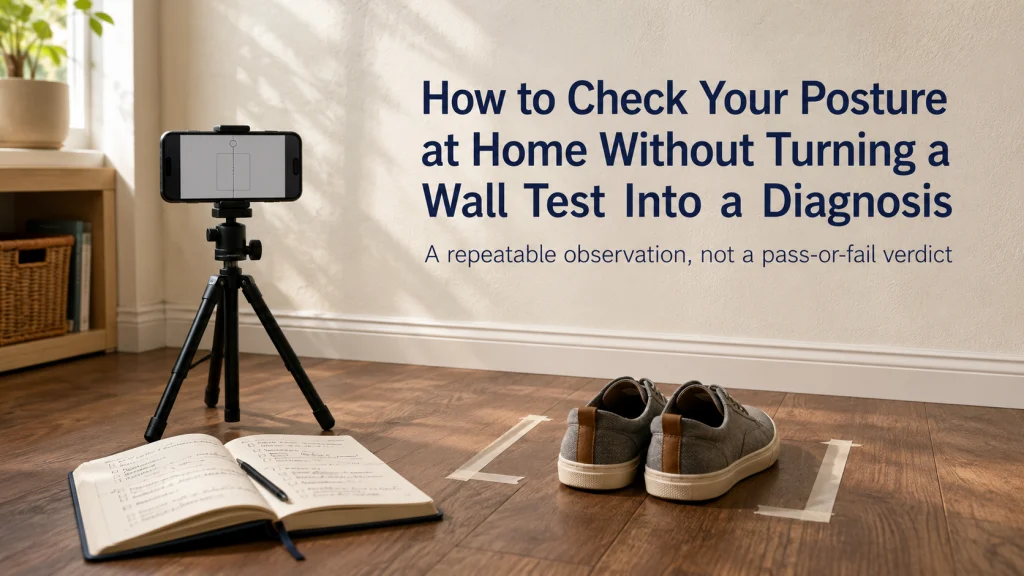
Three Photos of the Same Person Can Show Three Different Silhouettes
Imagine taking three side-view photos on the same day. The first is taken in the morning before much activity. The second comes after several hours at a laptop. The third is taken after someone says, “Stand with better posture,” and the person deliberately lifts the chest, pulls the shoulders back, and holds still for the camera.
All three images belong to the same person. None automatically represents a single true posture.
| Photo condition | What may change the silhouette | What the image cannot settle |
|---|---|---|
| Morning snapshot | Recent rest, footwear, room setup, and the chosen task | How the body responds later in the day |
| After laptop work | Task duration, screen position, fatigue, attention, and support | Whether the visible change is persistent or context-specific |
| Deliberately posed image | Conscious effort, breath holding, shoulder tension, and camera awareness | How the person stands or moves when not posing |
A useful self-check therefore records conditions, not only angles. The photograph becomes more informative when it is attached to a task, a time, a level of effort, and a note about whether the person was posing.
The guide to what good posture means explains why appearance alone cannot define whether a position is workable for a particular task.
Define Observation, Reference, Repeatability, Asymmetry, and Diagnosis
People often begin a posture check because one image has made them uneasy. Keeping the language precise can prevent that concern from turning into a conclusion the image cannot support.
| Term | Meaning in a home check | Limit |
|---|---|---|
| Observation | A description of what is visible or felt under stated conditions | It does not identify a medical cause |
| Reference | A consistent point of comparison, such as the same wall, task, or camera position | It is not a universal standard for every body |
| Repeatability | The ability to repeat the check under similar conditions | A repeated image can still be affected by setup error |
| Asymmetry | A visible difference between sides or contact points | A home image cannot determine whether the difference is structural, temporary, functional, or clinically important |
| Diagnosis | A clinical determination based on appropriate history, examination, and evidence | It cannot be produced from a wall gap, mirror check, app overlay, or single photograph |
The safest wording stays descriptive: “My head appears farther forward after laptop work,” or “One shoulder looks higher in this setup.” That language preserves the observation without pretending to explain it.
The broader posture and ergonomics overview can help route ordinary setup questions while keeping clinical interpretation outside household observation.
Choose One Ordinary Task and Record the Conditions
Checking posture without a task often creates an artificial pose. The moment a mirror or camera appears, many people pull the shoulders back, lift the chin, or try to “stand correctly.” The resulting image may show effort more clearly than ordinary behavior.
Choose one familiar situation instead. It might be standing while reading a recipe, sitting during a short email, waiting for water to boil, or holding a phone near the end of a normal conversation. Keep the task simple enough that the setup can be repeated.
- Time of day.
- Task being performed.
- Surface, chair, or work area used.
- Footwear or bare feet.
- Recent activity, such as walking, driving, exercise, or prolonged computer work.
- Whether the person knew the image was being taken at that exact moment.
- Any symptom, fatigue, or unusual condition already present.
Nora’s practical preference is to start with the lowest-friction method that can still be repeated. A mirror is quick but invites immediate correction. A phone photo takes more setup, yet it creates a record that can be compared later. The right method is the one the person can use consistently without turning the check into constant self-inspection.
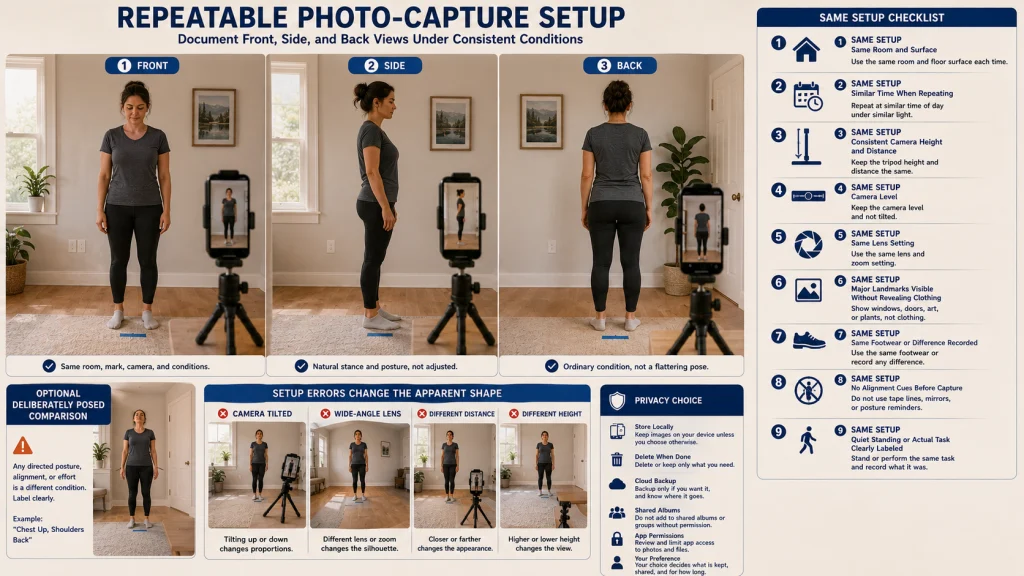
Take Front, Side, and Back Views Without Forcing a Pose
A set of views can show more context than one angle, but only when the capture method stays reasonably consistent. The goal is not to create a flattering image or an inspection stance. It is to document how the person normally organizes the body during the chosen task or quiet standing reference.
- Use the same room, surface, and approximate time when repeating the check.
- Place the camera at a consistent height and distance.
- Keep the camera level rather than tilting it upward or downward.
- Use the same lens setting and avoid switching between wide and zoomed views.
- Wear clothing that allows major body landmarks to remain visible without requiring revealing clothing.
- Keep footwear consistent or note the difference.
- Take front, side, and back views without asking the person to “correct” the pose first.
- Record whether the image shows quiet standing or an actual task.
- Store or delete images according to the person’s privacy preference.
If someone else takes the photo, ask them not to direct the shoulders, chin, pelvis, or feet unless the goal is a separate deliberately posed comparison. Direction changes the observation before it is recorded.
This is also where privacy becomes practical rather than abstract. Nora treats storage, deletion, cloud backup, shared albums, and app permissions as part of the setup, not as an afterthought once body images already exist.
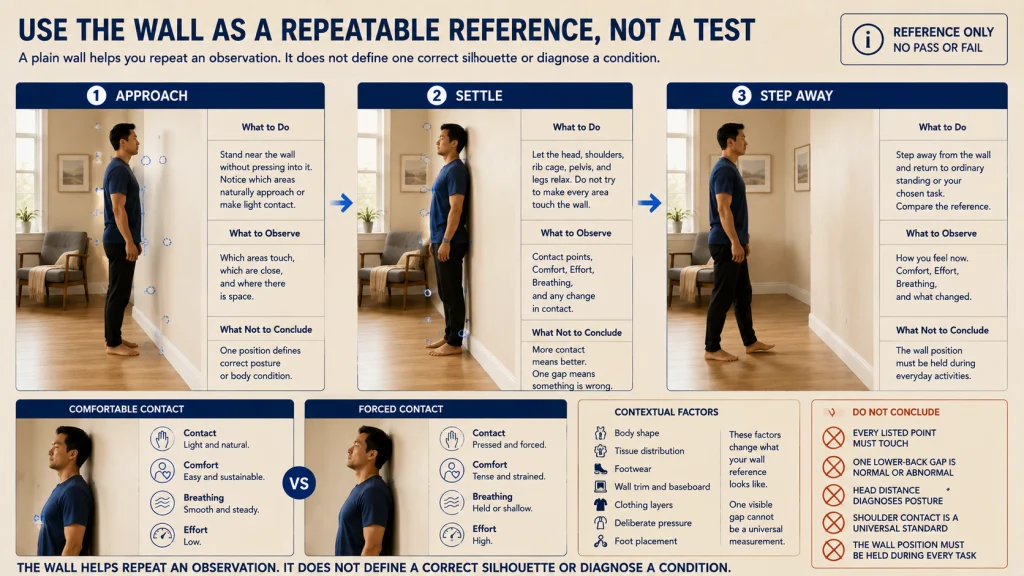
Use a Wall as a Positioning Reference, Not a Pass-or-Fail Test
A wall can provide a consistent vertical surface and clear contact points. Its value is repeatability: the same person can return to the same surface and notice how effort, contact, and comfort change.
| Wall reference sequence | Observation | What not to conclude |
|---|---|---|
| Stand with a comfortable foot position near the wall ↓ | Notice which body areas approach or contact the surface without forcing them | Every listed point must touch |
| Allow the head, shoulders, rib cage, pelvis, and legs to settle ↓ | Notice effort, breath, and whether contact changes when the pose is relaxed | A particular silhouette is a universal target |
| Step away and return to ordinary standing ↓ | Compare the wall reference with the usual position and comfort | The wall position must be maintained during every task |
Do not use one lower-back gap, head distance, shoulder contact, or heel position as a universal standard. Body shape, tissue distribution, footwear, wall trim, and how deliberately the person presses into the surface can all change the result.
The guide to finding a neutral spine reference explains how to explore a comfortable starting position without reducing the body to one wall measurement.
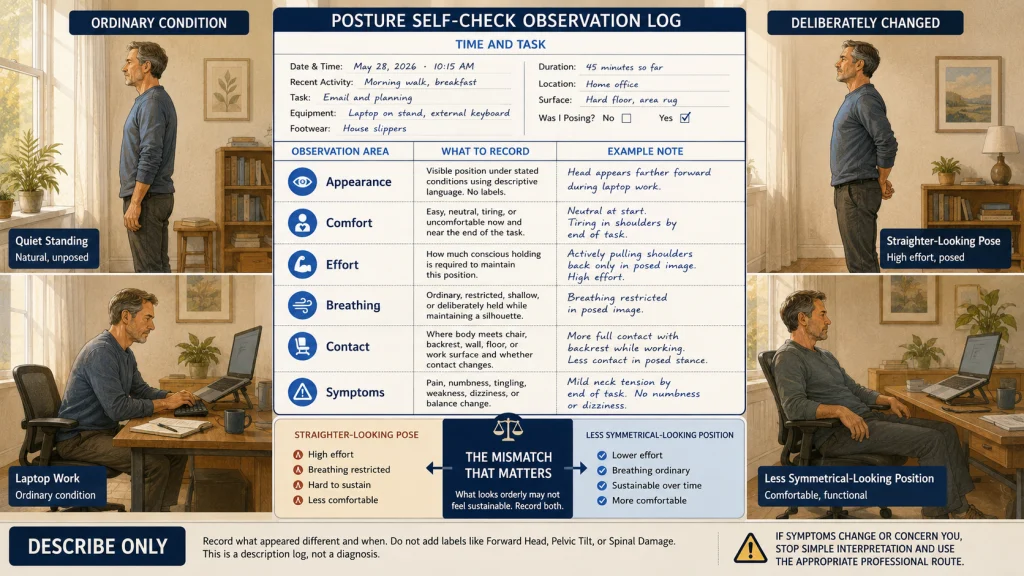
Record Comfort, Effort, Breathing, Contact, and Symptoms Alongside Appearance
A picture can look orderly while the pose feels strained. Another can look less symmetrical while the person feels relaxed and capable of finishing the task. That mismatch is often the most useful part of the check.
| Observation area | What to record | Example note |
|---|---|---|
| Appearance | Visible position without assigning a diagnosis | Head sits farther forward during laptop work than during quiet standing |
| Comfort | Whether the position feels easy, neutral, tiring, or uncomfortable | Comfortable at first, then less comfortable near the end of the task |
| Effort | How much conscious holding seems necessary | Shoulders feel held back only in the posed photo |
| Breathing | Whether breathing remains ordinary or becomes restricted during the pose | Breath becomes shallow when trying to stay upright |
| Contact | Where the body meets the chair, floor, wall, backrest, or work surface | Feet lose full contact when the chair is raised |
| Symptoms | Any pain, numbness, tingling, weakness, dizziness, or balance change | New tingling appears during the task and continues afterward |
This log creates an appearance-plus-context record. It can show that a position changes with duration, equipment, deliberate effort, or symptoms instead of assuming the image explains itself.
If an attempted change looks more upright but feels unusually effortful, the guide to why a posture change can feel uncomfortable helps separate unfamiliar effort from signs that self-guided troubleshooting should stop.
Repeat the Check Under Similar Conditions Before Claiming Change
One photo can be influenced by fatigue, mood, footwear, a recent workout, camera placement, or the simple fact that someone was watching. A second photo taken under completely different conditions may look different for reasons unrelated to any habit or setup change.
Repeat the check only after defining what should stay similar:
- The same ordinary task.
- A similar time of day when practical.
- The same chair, counter, wall, or work surface.
- The same footwear condition.
- The same camera height, distance, and lens setting.
- The same instruction about posing or not posing.
- A note about any recent activity that differs.
Look for a pattern across several comparable observations rather than a dramatic difference between two unrelated snapshots. Even then, describe what changed instead of naming a cause.
A repeatable method may show that the position shifts after laptop work, varies with a chair, or changes when someone consciously poses. It does not explain spinal structure, muscle function, or a medical condition.
Compare Ordinary Posture With Deliberately Corrected Posture
Taking one ordinary image and one deliberately changed image can reveal how much effort is being added when someone tries to look more upright. The comparison is useful only when both conditions are labeled clearly.
You may notice that the corrected pose looks cleaner in a side photo but requires pulling the shoulders, lifting the chest, tightening the jaw, or holding the breath. That observation does not prove the pose is harmful. It shows that appearance and effort moved in different directions.
The goal is not to choose a winner from two photos. It is to understand which changes are voluntary, which ones occur during the real task, and whether the altered position remains workable without excessive holding.
The guide to common posture myths explains why a straighter-looking silhouette should not automatically be treated as a better functional result.
Understand Camera, Clothing, Lens, Wearable, and App-Overlay Limitations
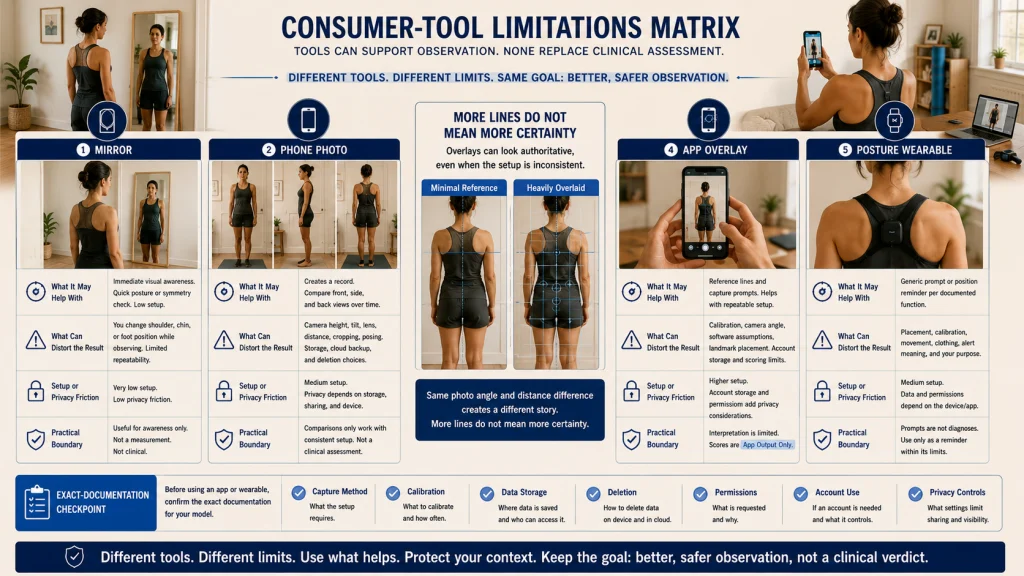
Consumer tools can make a check easier to repeat, but each one adds its own friction and blind spots. More lines, scores, and prompts can make the result look more certain without making the underlying capture more reliable.
| Tool or setup factor | What it may help with | What can distort the result | Practical boundary |
|---|---|---|---|
| Mirror | Immediate visual awareness | The person changes position while looking | Low setup, low repeatability |
| Phone photo | Repeatable records from several views | Camera height, tilt, lens choice, distance, and deliberate posing | Requires consistent setup and privacy decisions |
| Loose or uneven clothing | Comfort and privacy | Fabric folds can hide or create apparent differences | Visible shape may not represent the body beneath it |
| App overlay | Reference lines or capture prompts when documented | Calibration, landmark placement, camera angle, and software assumptions | A score should remain an app output, not a body verdict |
| Posture wearable | Prompts or position reminders according to the device’s documented function | Placement, calibration, movement, clothing, and the meaning assigned to alerts | Useful only when the prompt matches the person’s actual purpose |
Nora compares these tools by setup friction, repeatability, privacy, calibration, and what they ask the person to do next. A mirror is immediate. A phone creates a record. A wearable adds ongoing prompts. An overlay adds visual structure. None of those features removes the need to control the conditions and interpret the result modestly.
Before using an app or wearable, check the exact documentation for capture method, calibration, storage, deletion, account use, and privacy controls. Do not assume what happens to images or body data.
Do Not Label Forward Head, Pelvic Tilt, Scoliosis, or Spinal Damage From a Home Image
A home photograph can show that the head appears farther forward in one condition, one shoulder sits higher in one image, or the pelvis seems positioned differently when the feet move. It cannot determine the medical meaning of those observations.
Avoid turning descriptive notes into labels such as:
- “I have forward head posture.”
- “My pelvis is tilted and needs correction.”
- “This photo proves scoliosis.”
- “My spine is damaged.”
- “One side is abnormal.”
Instead, write what changed and under which conditions: “The head appears farther forward after laptop work,” or “One shoulder looks higher in this camera setup.” Then compare the observation with comfort, effort, function, and symptoms.
This is the one place where the distinction needs to remain explicit. A descriptive record can support a better next question. A diagnostic label created from a home image can narrow the question too early and send the person toward a correction that may not fit the actual issue.
Route Workstation-Specific Checks to the Work Setup
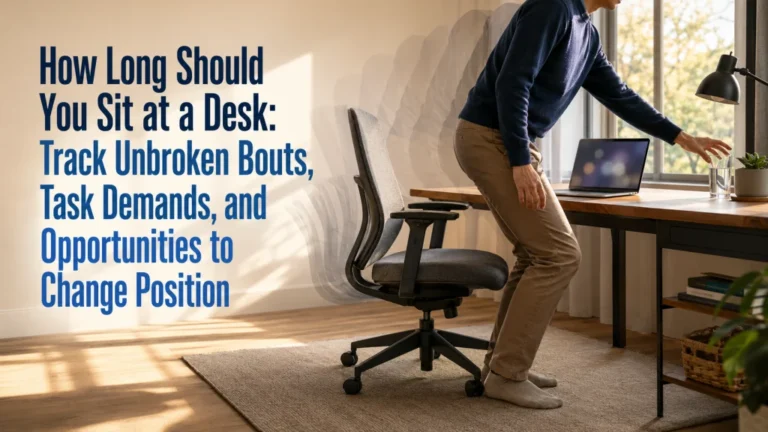
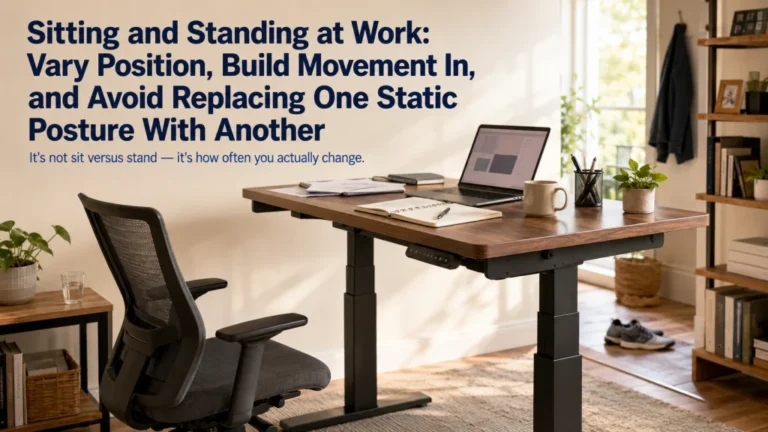
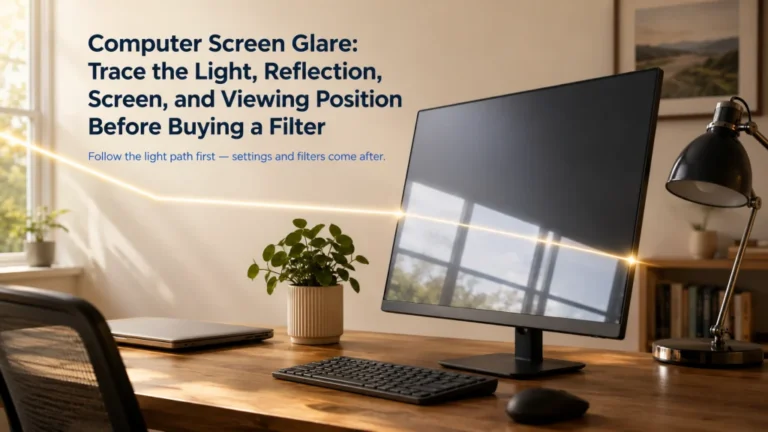
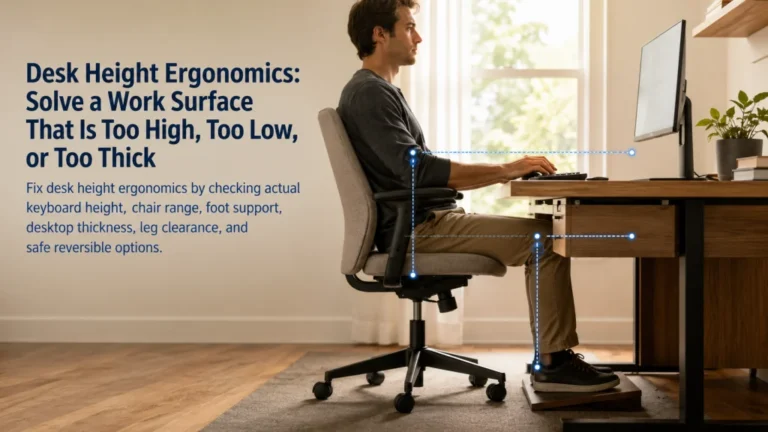
If the posture difference appears mainly during computer work, the next useful check is the workstation rather than another general body photo. Screen position, chair height, desk reach, keyboard and mouse placement, foot support, and task duration can all shape the observed position.
A workstation check asks whether the environment makes the ordinary task easier to perform. It does not attempt to diagnose the person’s spine from the resulting silhouette.
Use the guide to home office ergonomics when the concern is tied to a desk, laptop, screen, chair, keyboard, or repeated computer task.
The broader posture improvement process helps separate observation, environmental changes, movement variation, and habits without converting one image into a correction plan.
Persistent Asymmetry, Symptoms, Instability, or Post-Injury Findings Need a Different Route
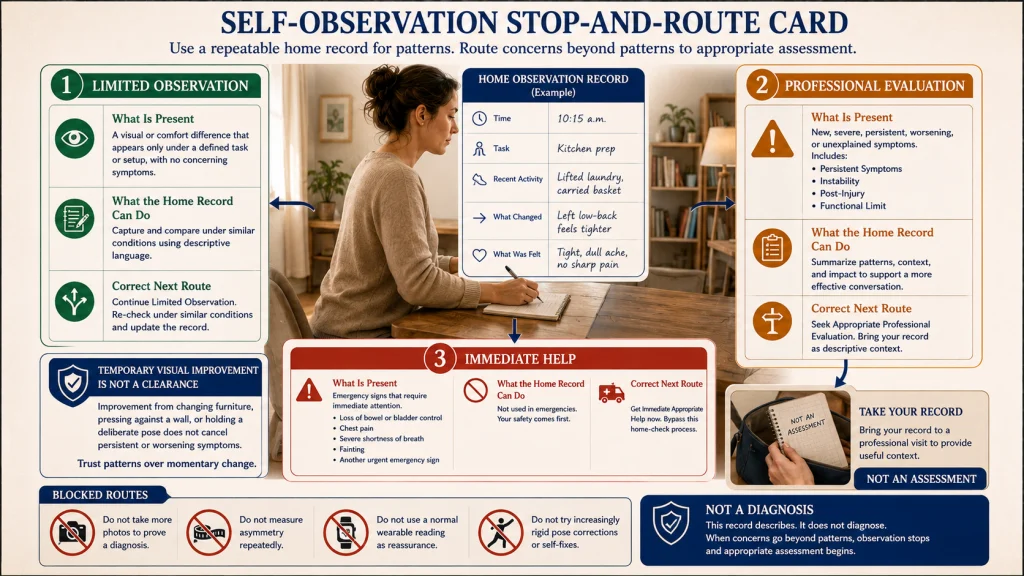
Self-observation should stop when the concern is no longer limited to a repeatable visual or comfort pattern.
Professional-assessment boundary: Seek appropriate professional evaluation for new, severe, persistent, worsening, or unexplained pain; numbness; weakness; tingling; balance changes; symptoms after a fall or injury; a new functional limit; or an asymmetry that is persistent and concerning. Loss of bowel or bladder control, chest pain, severe shortness of breath, or fainting requires immediate appropriate help.
A household record can still be useful here. Time, task, recent activity, what changed, and what the person felt may help describe the situation clearly. The record supports the conversation, but it does not replace the assessment.
Persistent or worsening symptoms deserve medical guidance even when a furniture change or deliberate pose seems to alter the image temporarily.
Observe Consistently, Document the Context, and Avoid Self-Diagnosis
Choose one ordinary task, keep the capture conditions reasonably consistent, and record more than appearance. Time, recent activity, footwear, surface, camera setup, effort, breathing, contact, comfort, and symptoms all shape the observation.
The goal is not to watch yourself more often. It is to make each check quieter and more useful. One well-documented comparison can reveal whether the task, equipment, deliberate posing, or time of day is changing what you see.
From there, the next step may be a workstation adjustment, a different support, more variation during the task, or professional assessment. A good home check does not produce a label. It reduces guesswork.
FAQs
📷 Can I check my posture with a phone photo?
A phone photo can document one visible position when the camera setup and context are recorded. It cannot diagnose posture types, measure spinal curvature, or determine the cause of symptoms.
🪞 Is a mirror better than a photograph?
A mirror gives immediate feedback, but people often change position while looking. A photograph is easier to compare later, though camera angle, lens, distance, clothing, and posing can still distort the result.
🧱 Does the wall test show whether my posture is good?
No. A wall provides a repeatable vertical reference and contact surface. It should not be used as a universal pass-or-fail test or as proof that a particular body area is normal or abnormal.
📐 Can an app measure my spinal alignment?
Do not assume that an app overlay or score measures spinal alignment accurately. Camera setup, calibration, landmark placement, software assumptions, and the app’s documented function all limit what the result means.
🔁 How often should I repeat a posture self-check?
Repeat only when the task and capture conditions can be kept reasonably similar. The goal is to compare a pattern after a meaningful setup or habit change, not to inspect the body repeatedly throughout the day.
🧍 Should I correct my pose before taking the photo?
Take an ordinary-condition image first without alignment cues. A separate deliberately changed image can be useful when it is clearly labeled and accompanied by notes about comfort, effort, breathing, and contact.
🚩 When should I seek a professional posture assessment?
Seek appropriate evaluation for persistent or worsening symptoms, neurological changes, balance problems, post-injury findings, functional limits, or a concerning persistent asymmetry. Emergency signs require immediate appropriate help.