Problem-focused coping changes the part of a stressful situation that can be changed, while emotion-focused coping helps you handle the reaction happening inside you. The better choice depends on three questions: what is controllable, what must happen now, and whether you are ready to think and act. Many situations need both approaches in sequence rather than one approach alone. Start by naming the first job, then decide whether a second coping job is still needed.
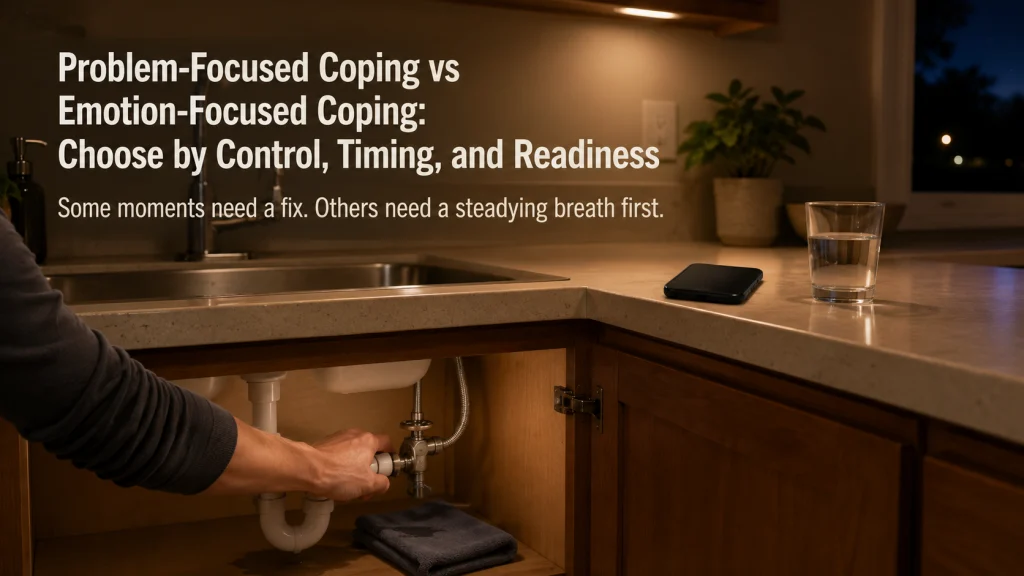
A Leaking Pipe Can Require More Than One Kind of Coping
Imagine discovering a leaking kitchen pipe at 10 p.m. One response is to turn off the water, move anything that could be damaged, and contact the landlord. Another response is to steady your breathing for a moment so you can make that call clearly. A third response is to watch videos for an hour while the water keeps spreading.
| Response | Immediate job | What it means in practice |
|---|---|---|
| Turn off the water and call for help | Change the situation | It acts on the controllable source of damage. |
| Pause long enough to speak and think clearly | Manage the reaction | It lowers the immediate barrier to useful action. |
| Keep distracting yourself while the leak continues | Avoid the next needed step | It provides temporary distance but leaves active damage unaddressed. |
Changing the problem and managing the reaction are different jobs. The best sequence may use both. The question is not which coping style wins; it is which job must happen first.
This article focuses on choosing a coping category. For a broader starting point, use the coping skills guide, and review the home stress management framework when several parts of daily life are contributing at once.
Define Problem-Focused and Emotion-Focused Coping Without Ranking Them
Problem-focused coping aims to change a stressor or your practical relationship to it. It may involve gathering information, making a decision, setting a limit, requesting assistance, changing an environment, or creating a workable plan.
Emotion-focused coping aims to help you handle the emotional or physical response connected to the situation. It may involve accepting a feeling, seeking emotional support, taking a restorative pause, creating temporary distance, or viewing the situation from a steadier perspective.
Neither category is automatically healthy or unhealthy. A strategy can be useful in one situation and unhelpful in another. Taking a short pause before a difficult call may support action. Taking the same pause repeatedly for several weeks may become a way to avoid the call.
Key decision: Judge a coping response by the job it performs, the timing, and the later cost, not by its category name alone.
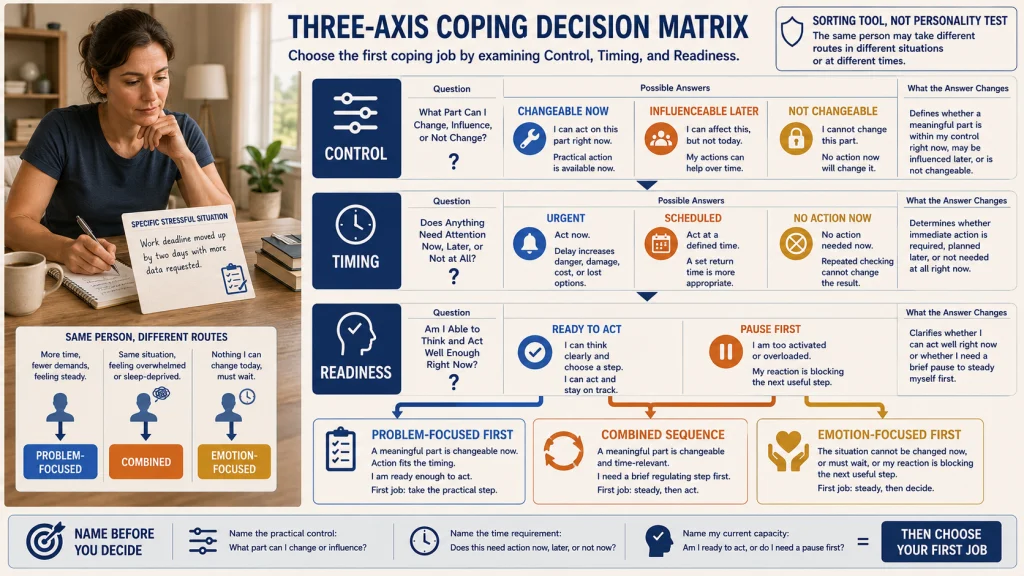
Add Readiness to Control and Timing
A solvable problem does not always mean you can solve it effectively this minute. You may know exactly what needs to happen and still be too angry, frightened, tired, or overloaded to choose words, compare options, or complete the next step safely.
This is why a useful decision needs three questions instead of one:
| Decision axis | Question to ask | What the answer changes |
|---|---|---|
| Control | What part can I change, influence, or not change? | It identifies whether practical action is available. |
| Timing | Does anything need attention now, later, or not at all? | It separates urgent steps from scheduled steps and unnecessary action. |
| Readiness | Am I able to think and act well enough right now? | It shows whether a short regulating step should come before problem-solving. |
Use the matrix as a sorting tool, not a personality test. It helps you choose the next job for one situation at one point in time.
Control Axis: Changeable Now, Influenceable Later, or Not Changeable
Control is rarely all or nothing. A stressful situation often contains several parts with different levels of control.
- Changeable now: You can take a direct step, such as closing a valve, moving a deadline request into writing, or turning down disruptive noise in your own room.
- Influenceable later: You cannot guarantee the result, but you can prepare, ask, document, negotiate, schedule, or follow up.
- Not changeable: The event has happened, the decision belongs to someone else, or the condition cannot be altered by your effort.
The goal is to locate the smallest controllable part. During a delayed flight, you cannot move the aircraft, but you may be able to check a connection, notify someone expecting you, find a quieter waiting area, or decide when to stop refreshing the same screen.
When the situation feels vague, mapping the specific stress trigger can help separate the part you can address from the part you are only reacting to.
Timing Axis: Urgent Action, Scheduled Action, or No Immediate Action
Even a controllable issue may not require immediate action. Treating every stressor as urgent can create a second layer of pressure, especially when several unfinished tasks are competing for attention.
- Urgent action: Delay could increase danger, damage, cost, or loss of options.
- Scheduled action: The issue matters, but a defined later time is more appropriate than acting while rushed or unprepared.
- No immediate action: There is no useful step available right now, or repeated checking will not change the outcome.
A deadline due in two hours may call for direct action. A difficult conversation may be better scheduled for a time when both people can participate. A delayed decision from another organization may leave no useful action beyond noting when you will follow up.
Note: Scheduling is still action when it includes a real time, place, or trigger. Saying “later” without a defined return point can quietly turn a reasonable pause into avoidance.
Readiness Axis: Able to Act or Too Activated to Think Clearly
Readiness is about current capacity, not character. A person can be capable, responsible, and fully aware of the solution while still needing a short pause before acting.
Signs that problem-solving may be available include being able to identify the issue, compare two or three realistic options, follow a short sequence, and communicate without escalating the situation. Signs that a pause may be useful include rereading the same information without absorbing it, jumping between tasks, speaking more sharply than intended, or feeling unable to choose even a small next step.
The pause should have a purpose: regain enough steadiness to complete the next safe action. It does not need to remove every uncomfortable feeling first.
When cognitive load is the main barrier, a smaller first step from the guide on reducing overwhelm may be more useful than trying to solve the entire situation at once.
Problem-Focused Coping Examples
Problem-focused coping is useful when a practical change is available and you are ready enough to make it. The action does not need to solve everything. It only needs to change a meaningful part of the situation.
Clarify Information
Ask what is due, what is optional, who decides, what information is missing, and what happens if the timing changes. Uncertainty can make a task feel larger than it is, while one clear answer may reveal the real next step.
Set a Boundary
A boundary can define when you are available, what you can take on, or what condition must be met before you continue. It does not control another person’s response, but it can clarify your own action.
A useful action can feel almost too small when the whole situation is still uncomfortable. That does not make it trivial. The next workable step is often more valuable than a complete plan you cannot begin.
Break Down a Task
Replace a broad instruction such as “deal with the paperwork” with a visible first action such as finding the account number, opening the form, or listing the missing documents.
Request Practical Help
Ask for a specific contribution rather than general rescue. Examples include requesting a missing file, asking someone to handle one errand, or confirming who is responsible for the next decision.
Not every practical change depends on finding the perfect words or persuading another person. Sometimes the kindest way to make action easier is to change what is immediately around you.
Change the Environment
Move to a quieter area, reduce an avoidable interruption, prepare the tools needed for the task, or remove a physical obstacle that keeps delaying the first step.
Make a Schedule
Assign a realistic time to the action, including a stopping point. A schedule is especially useful when the task matters but should not consume the entire evening.
After choosing one action, ask whether the stressor has changed enough to reassess. Continuing to add steps after the useful part is complete can turn problem-solving into another source of strain.
Emotion-Focused Coping Examples
Emotion-focused coping is useful when the situation cannot be changed, action must wait, or your current reaction is blocking a needed step. Its job is not to prove that the situation is acceptable. Its job is to help you carry the response more safely and deliberately.
Acknowledge the Feeling
Naming disappointment, anger, fear, or grief can reduce the pressure to pretend you are unaffected. Acceptance in this context means recognizing what is present, not approving of what happened.
Seek Emotional Support
Talk with someone who can listen without immediately taking over the decision. Emotional support and practical help are different, so it may help to say which one you need.
Being heard does not erase the situation, but it can make the reaction feel less isolating. From there, a quieter physical transition may help you decide whether action is possible now or should wait.
Use a Brief Relaxation Step
A comfortable position, slower transition, quiet room, or simple settling routine may create enough space to think. Detailed physical relaxation methods belong in separate guidance and are not taught here.
Create Temporary Distance
Step away from a message, conversation, or task when immediate engagement is likely to make the situation worse. Set a return point so the distance remains temporary when action is still required.
Distance is most useful when it gives you a steadier place to return from. Once the first surge has passed, the next question is whether the moment has become larger in your mind than the evidence supports.
Widen the Perspective
Ask whether this moment represents the entire situation, whether more information is coming, or whether one difficult outcome removes every available option. This is not clinical cognitive restructuring and should not be used to dismiss valid concerns.
Emotion-focused coping can be active. Choosing support, making room for grief, or regulating enough to speak clearly may require more intention than rushing into a solution.
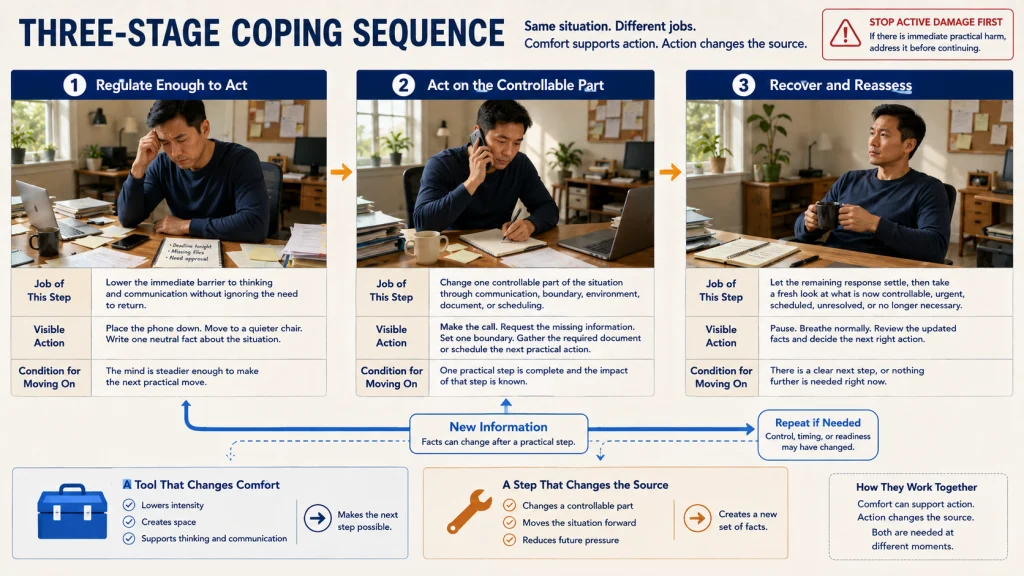
Use a Combined Sequence When Both Jobs Matter
Many everyday situations are not solved by choosing one category and rejecting the other. A combined sequence helps when emotional activation and a practical problem are both present.
Read the sequence from left to right. Each step has a different job, and the next step begins only when it fits the situation.
| 1. Regulate Enough to Act | 2. Act on the Controllable Part | 3. Recover and Reassess |
|---|---|---|
| Lower the immediate barrier so you can think, communicate, or complete a safe next step. | Make the call, gather information, set the limit, change the environment, or schedule the next action. | Let the remaining response settle, then check whether control, timing, or readiness has changed. |
Editorial observation: Home troubleshooting often follows the same order: stop active damage, lower the barrier to action, then make a repair plan. A towel may improve comfort around a leak, but it does not replace turning off the water. In the same way, a coping tool that changes comfort may support action without changing the source.
The sequence can repeat. After taking one practical step, new information may change what is controllable, what is urgent, or how ready you feel for the next step.
When Problem-Solving Becomes Overcontrol or Endless Planning
Problem-solving can become unhelpful when it is applied to a part of the situation you do not control. The effort may look productive while keeping you trapped in repeated research, rehearsal, checking, or contingency planning.
Common signs include creating more plans after a reasonable plan already exists, repeatedly asking for reassurance without using the answer, trying to predict every reaction before a conversation, or treating another person’s decision as something you can guarantee through perfect preparation.
Use a stopping rule:
- Name the decision you actually control.
- Choose the information needed for that decision.
- Set a point when planning ends and action begins.
- Accept that some uncertainty remains after a responsible step.
Practical tip: Ask, “Will one more round of planning change my next action?” If the answer is no, the next job may be action, waiting, or managing the remaining uncertainty.
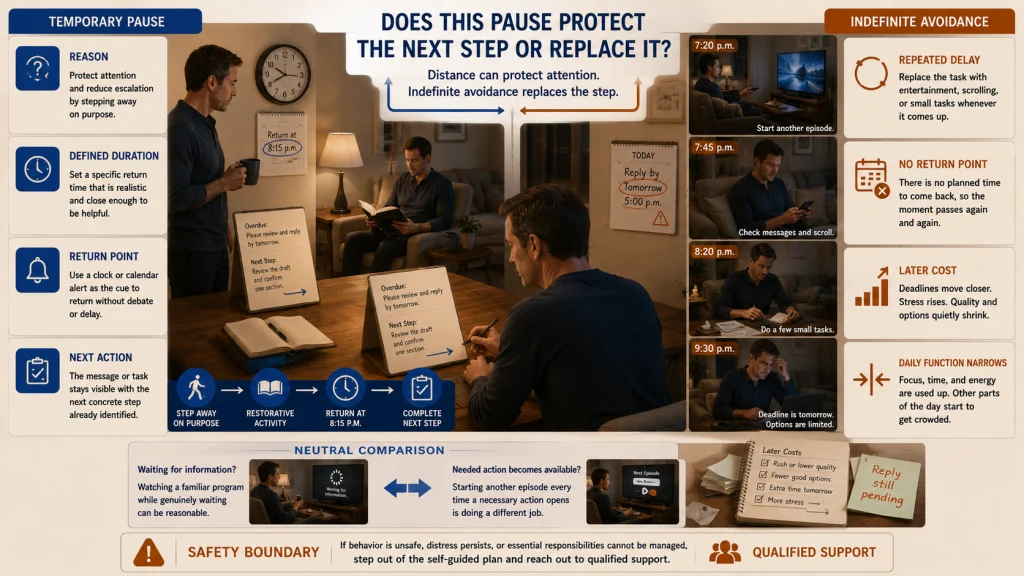
When Emotion-Focused Coping Becomes Avoidance
Temporary distance can protect attention, reduce escalation, and create a better time for action. It becomes a concern when the coping response repeatedly replaces a necessary step, increases later consequences, or narrows daily functioning.
Distraction is not automatically harmful. Watching a familiar show while waiting for information may be a reasonable way to spend an evening. Watching one more episode every time you approach an overdue task may be performing a different job.
Safety warning: A temporary pause has a reason and a return point. Indefinite avoidance repeatedly delays a needed action without a workable plan to revisit it. If avoidance is linked with unsafe behavior, persistent distress, or inability to manage essential daily responsibilities, seek qualified support rather than relying on self-guided coping alone.
To evaluate the cost of a repeated response across categories, use the guide to recognizing costly coping patterns.
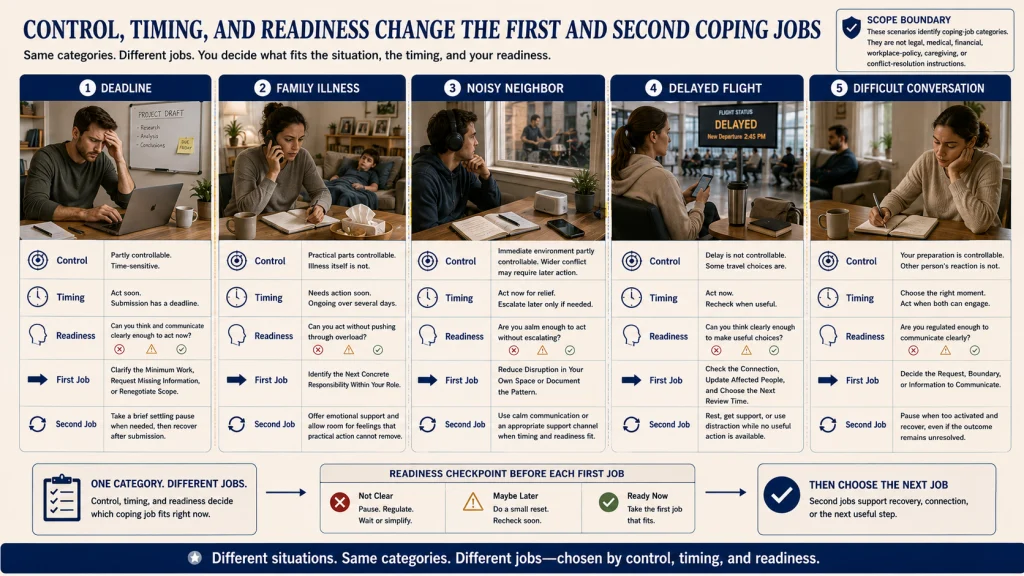
Five Scenarios Using Control, Timing, and Readiness
The same coping category can serve a different purpose depending on the situation. These examples show the first job and the possible second job without treating the sequence as a universal script.
| Situation | Control and timing | Possible first coping job | Possible second job |
|---|---|---|---|
| Deadline | Partly controllable and time-sensitive | Clarify the minimum required work, request missing information, or renegotiate scope. | Take a short settling pause, then recover after the submission. |
| Family illness | Some practical tasks are controllable, but the illness itself may not be | Identify the next concrete responsibility that is within your role. | Seek emotional support and make room for feelings that practical action cannot remove. |
| Noisy neighbor | Immediate environment may be partly controllable; the wider conflict may require later action | Reduce the immediate disruption in your own space or document the pattern. | Wait until you can communicate calmly, then use the appropriate support channel if needed. |
| Delayed flight | The delay is not controllable; travel choices may be influenceable | Check the connection, update anyone affected, and choose the next review time. | Use emotional support, rest, or distraction while no useful action is available. |
| Difficult conversation | Preparation is controllable; the other person’s response is not | Decide the request, boundary, or information you need to communicate. | Pause if too activated, then recover afterward even if the outcome remains unresolved. |
The table is not a set of instructions for legal, medical, financial, or workplace disputes. It shows how to identify the type and order of coping jobs while leaving specialized decisions to the appropriate qualified support.
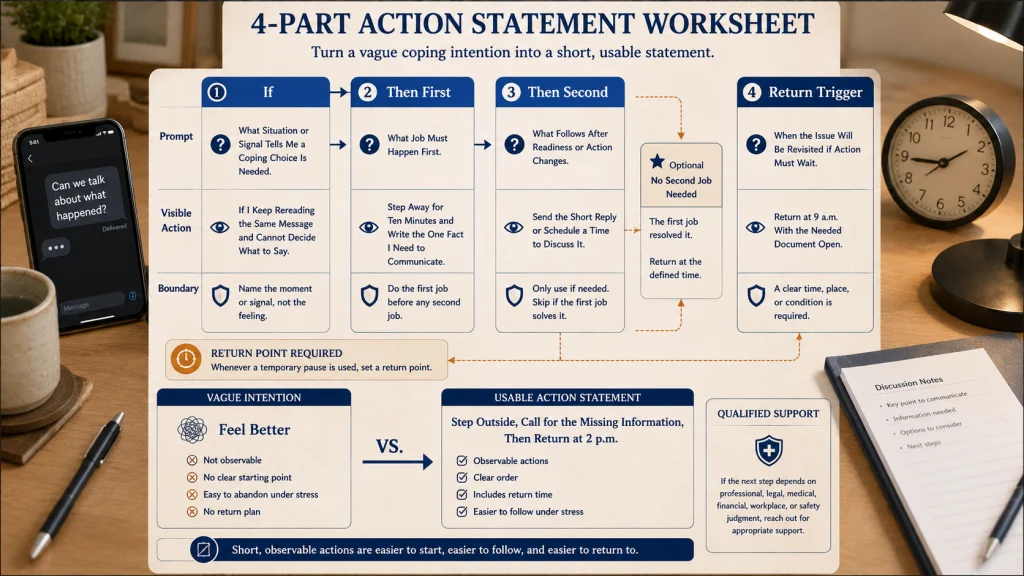
Build an If-Then Coping Statement
An if-then statement turns a vague intention into a recognizable trigger and a small next action. It works best when it names the situation, the first coping job, and the second job only when one is needed.
| Statement part | Prompt | Example |
|---|---|---|
| If | What situation or signal tells me the coping choice is needed? | If I keep rereading the same message and cannot decide what to say… |
| Then, first | What job must happen first? | …then I will step away for ten minutes and write the one fact I need to communicate. |
| Then, second | What follows after readiness or action changes? | After that, I will send the short reply or schedule a time to discuss it. |
| Return trigger | When will I revisit the issue if action must wait? | If I cannot act tonight, I will return to it at 9 a.m. with the needed document open. |
Keep the statement short enough to use under stress. A detailed routine for repeated situations belongs in a broader stress management plan.
Key decision: Write the first coping job as a visible action. “Feel better” is difficult to follow. “Step outside, call for the missing information, then return at 2 p.m.” gives the pause and the practical step clear boundaries.
Know When the Problem Needs Support Outside This Article
A coping framework can help you sort the next job, but it cannot provide specialized advice for problems that require professional judgment, formal authority, or individualized care.
- Professional or workplace support: Use the appropriate manager, human resources process, union representative, mediator, or qualified adviser when the issue involves formal responsibilities, harassment, discrimination, safety, or policy.
- Legal support: Seek qualified legal guidance for rights, contracts, housing disputes, deadlines, or legal consequences.
- Financial support: Use a qualified financial or debt professional when decisions involve serious debt, insolvency, taxes, or risks you do not understand.
- Medical support: Seek qualified medical guidance for symptoms, medication questions, health changes, or decisions that depend on a diagnosis or treatment plan.
- Mental-health support: Persistent distress, unsafe behavior, inability to function, or coping patterns that are causing serious harm require qualified support.
Safety warning: If there is immediate danger, a risk of harm, or an urgent medical or safety concern, use the appropriate emergency service or local crisis resource now. Do not delay urgent help to complete a coping exercise.
Choose the First Job, Then Reassess
Start by naming the controllable part of the situation. Then decide whether the first coping job is practical action, emotional regulation, or a short sequence that uses both.
Choose a second job only when it is still needed. You may regulate enough to act, act on the controllable part, and then recover. You may also discover that no immediate action is available, which makes support, acceptance, rest, or a defined waiting plan the better fit.
The useful question is not whether you are a problem-focused or emotion-focused person. It is what this situation requires from you now, what can wait, and what belongs with qualified support.
FAQs
🧭 Is problem-focused coping always better?
No. It is useful when a meaningful part of the stressor can be changed and you are ready to act. When the situation cannot be changed, action must wait, or activation is blocking clear thinking, emotion-focused coping may be the more useful first job.
🌿 Is emotion-focused coping just avoiding the problem?
No. Emotional support, acceptance, a restorative pause, and temporary distance can help a person handle a difficult response or prepare for action. It becomes avoidance when it repeatedly replaces a needed step and creates growing later costs.
⏱️ How long should a coping pause last?
There is no universal duration. A useful pause is long enough to improve readiness and short enough to protect the next needed action. When action must wait, set a clear return time or trigger instead of leaving the issue open-ended.
🔄 Can I use both coping approaches for one problem?
Yes. A common sequence is to regulate enough to think, act on the controllable part, and then recover from the remaining stress response. The order may change as the situation changes.
🧩 What if I cannot tell what is controllable?
Separate the situation into smaller parts and ask who decides each part, what action is available, and whether action would change the outcome. When the answer depends on legal, medical, financial, workplace, or safety expertise, use qualified support rather than guessing.
🚩 When should I get professional help?
Seek qualified support when distress persists, functioning is impaired, behavior becomes unsafe, or the problem exceeds your knowledge or authority. Use urgent help immediately when there is immediate danger, risk of harm, or an urgent medical or safety concern.