Feeling uncomfortable after trying to sit or stand more upright does not prove that the old position was correct or that the new one is helping. First classify the sensation, notice when it begins, and check whether the shoulders, ribs, pelvis, jaw, or abdomen are being forced. Move away from extremes toward a lower-effort range, then review support, task reach, and how long the position is held. Use short observation windows and regular position changes instead of endurance tests. Stop self-correction when symptoms are sharp, worsening, neurological, breathing-related, linked to balance, or connected to a recent injury.
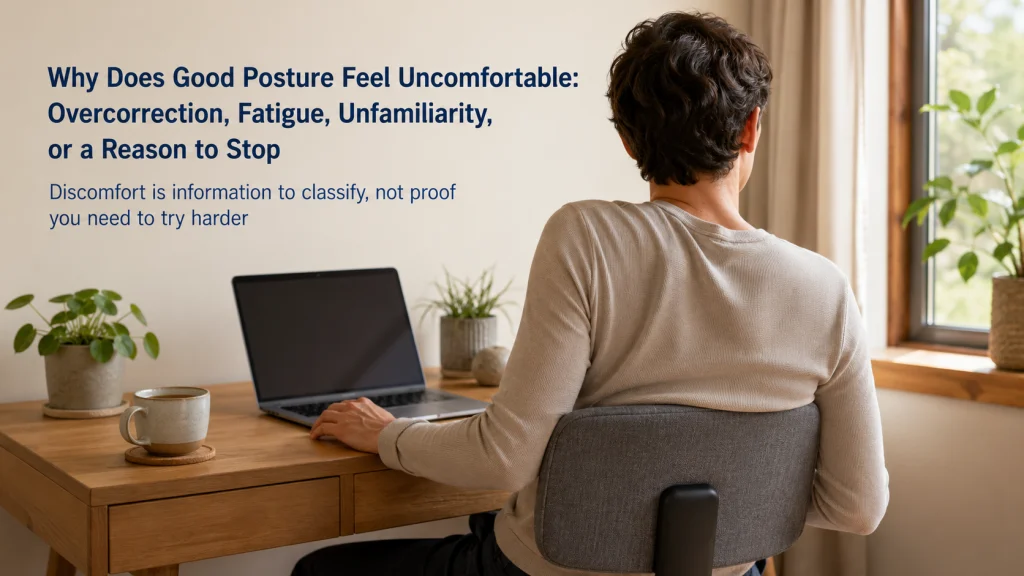
One “Shoulders Back” Cue Can Produce Four Very Different Sensations
You sit taller, draw the shoulders back, and try to hold the position. A few moments later, something feels wrong. That can be unsettling, especially when the change was supposed to help.
The difficulty is that “uncomfortable” can describe several different experiences that should not be treated as one problem.
| Sensation after the same cue | What the person notices | First response |
|---|---|---|
| Upper-back fatigue | A tired, effortful feeling that builds while holding the pose | Reduce the holding effort and change position |
| Pinching | A localized compressed or caught feeling near a joint or body area | Leave the forced position rather than pressing farther into it |
| Restricted breathing | The chest, ribs, or abdomen feel held and breathing becomes less natural | Release the bracing and return to ordinary breathing |
| Sharp pain | A sudden or clearly painful signal rather than mild effort | Stop the experiment and use the appropriate evaluation route |
You are not failing because one cue feels wrong. Discomfort is information, not proof that the old or new posture is correct. The first useful question is not “Should I push through?” It is “What am I actually feeling, and what was I forcing when it began?”
The article on checking posture at home explains how to record position, effort, and context without turning one observation into a diagnosis.
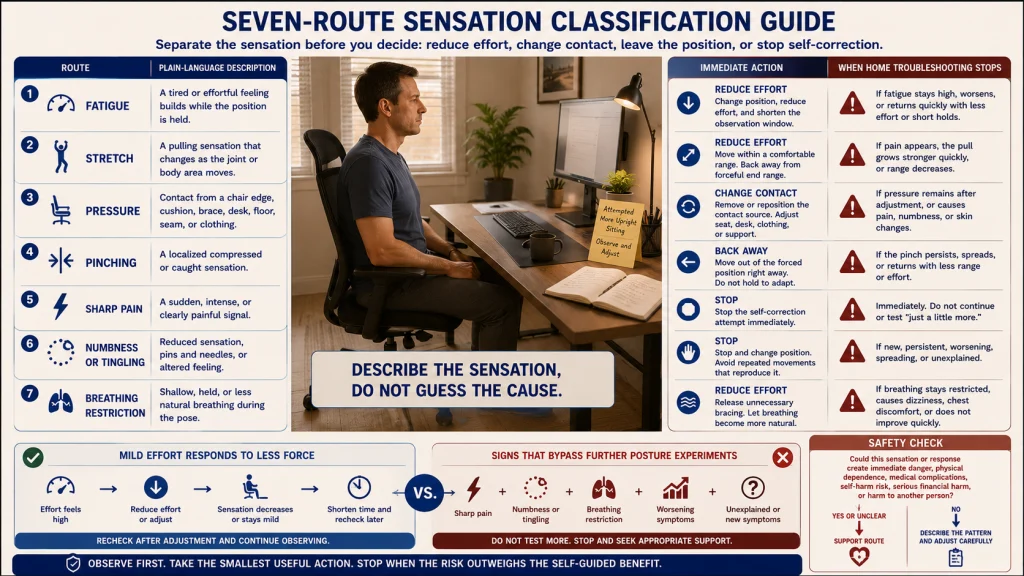
Separate Fatigue, Stretch, Pressure, Pinching, Sharp Pain, Numbness, and Breathing Restriction
People often use one word, “pain,” for every unpleasant sensation. A safer troubleshooting process starts by describing the sensation without guessing its cause.
| Sensation | Plain-language description | Immediate action |
|---|---|---|
| Fatigue | A tired or effortful feeling that builds while holding a position | Change position, reduce effort, and shorten the observation window |
| Stretch | A pulling sensation that may change when the joint or body area moves | Stay away from forceful end ranges and do not assume more stretch is better |
| Pressure | Contact from a chair edge, cushion, brace, desk, floor, or clothing | Remove or reposition the contact source |
| Pinching | A localized compressed or caught sensation | Back away from the position instead of holding it |
| Sharp pain | A sudden, intense, or clearly painful sensation | Stop the self-correction attempt |
| Numbness or tingling | Reduced sensation, pins and needles, or altered feeling | Stop and seek appropriate evaluation when new, persistent, worsening, or unexplained |
| Breathing restriction | Breathing becomes shallow, held, or less natural during the pose | Release unnecessary bracing and stop if the problem persists or is severe |
The table does not identify a medical cause. It helps choose a safer next step. Mild effort calls for less force or a shorter trial. Sharp, neurological, breathing-related, or worsening symptoms require a different response.
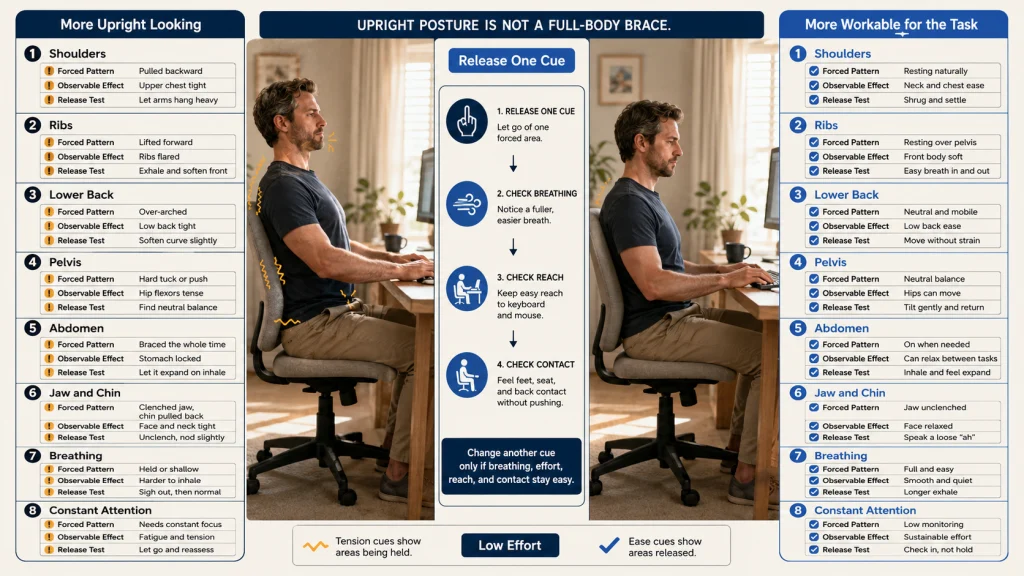
Check Whether You Are Forcing the Shoulders, Ribs, Pelvis, Jaw, or Abdomen
Many posture cues are interpreted as instructions to hold several body areas at once. The result can look upright while feeling rigid.
- Are the shoulders being pulled backward instead of resting naturally?
- Is the chest being lifted so far that the lower ribs flare forward?
- Is the lower back being arched to create a taller silhouette?
- Is the pelvis being tucked or pushed forward and held there?
- Are the abdominal muscles braced continuously?
- Is the jaw clenched or the chin pulled hard backward?
- Has breathing become shallower since the correction began?
- Does the position require constant concentration to maintain?
If several answers are yes, the problem may be the amount of force being added rather than a lack of discipline. Release one cue at a time and notice whether breathing, effort, and task access improve.
The goal is not to collapse into the previous position. It is to stop treating upright posture as a full-body brace.
Move From an Extreme Toward a Low-Effort Neutral Range
When a correction feels strained, the answer is rarely to push farther. Move away from the extreme until the position feels less forced and breathing becomes ordinary again.
A low-effort range is not one fixed shape. It is a workable area where the body is not being pulled to either end of the available position. You may notice:
- The shoulders can rest without being dragged backward.
- The ribs settle without being pushed forward or compressed downward.
- The pelvis is not held in a hard tuck or exaggerated arch.
- The feet, seat, or backrest provide clear support.
- The task remains reachable without leaning or bracing.
- Breathing continues without conscious control.
The guide to a neutral spine reference describes this as a range for orientation, not a position that must be frozen during every activity.
Use the reference briefly, then return attention to the task. A useful position should support the activity rather than become a second activity that must be managed continuously.
Check Whether the Position Is Unsupported or Changes Your Reach to the Task
An upright position can become tiring when the chair, floor, backrest, desk, or work surface does not support it. The body may end up holding a shape while also reaching toward the task.
Start with the environment rather than adding another body cue. Check whether the feet have stable contact, whether the backrest is close enough to use, and whether the screen, keyboard, steering wheel, counter, or reading material can be reached without leaning forward again.
A support can also solve one problem and create another. A firm cushion may fill a gap behind the back but push the person too far from the keyboard. A higher seat may improve one viewing angle while leaving the feet unsupported. A thicker backrest may feel comfortable until the arms must reach farther for the task.
Nora’s practical comparison is to test the task both with and without the added support, then note reach, contact, breathing, and effort. The useful question is not whether the support makes the silhouette look more upright. It is whether the person can perform the real task with less strain and without losing normal movement.
Computer-specific reach, chair, and screen questions belong in the home office ergonomics workflow.
Notice Whether Discomfort Appears Immediately or Only After Holding Still
Timing can separate a force or contact problem from a duration problem without assigning a diagnosis.
When discomfort begins immediately, return to the exact moment of correction. Did the shoulders pinch as soon as they were pulled back? Did a cushion create pressure as soon as it was added? Did the new position move the task farther away? There is little value in proving that an immediately uncomfortable setup can be endured.
When discomfort builds gradually, the position may have remained unchanged for too long. A pose can begin comfortably and still become tiring when the person is trying not to move.
When discomfort appears only during one task, the task may be demanding a different reach, viewing angle, support, or movement pattern. Change the environment before forcing the same pose into every activity.
When the sensation continues after the task ends, or becomes persistent, worsening, neurological, or unexplained, stop the self-guided correction and use the appropriate evaluation route.
The timing record is more useful than deciding that discomfort is “normal.” It shows when the experiment stopped being low effort.
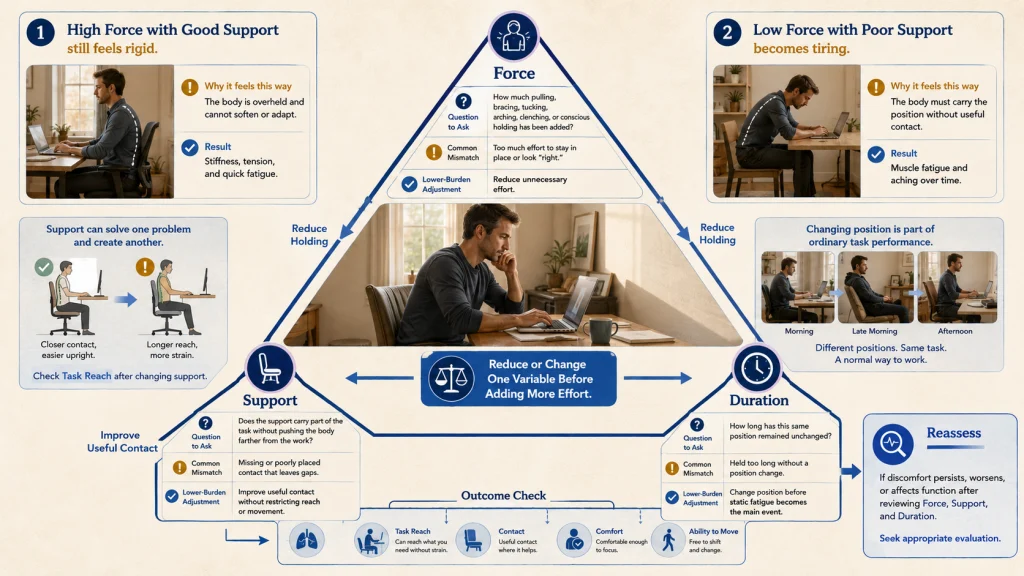
Use the Force, Support, and Duration Triangle
After checking the environment and the timing, bring the three main variables together. The triangle is a summary tool, not another list of corrections.
| Force | Support | Duration |
|---|---|---|
| How much pulling, bracing, tucking, arching, or holding is being added? | Does the setup carry part of the task without pushing the body into another problem? | How long has the same position remained unchanged? |
| Reduce unnecessary effort | Use contact that helps without restricting reach or movement | Change position before static fatigue becomes the main event |
The triangle prevents a common mistake: treating every uncomfortable attempt as evidence that more strengthening, stretching, or discipline is required. This article does not prescribe exercise. It asks which variable can be reduced or changed before more effort is added.
If all three variables look reasonable and the discomfort still persists, worsens, or affects function, the next step is not a harder experiment.
Use Short Observation Windows and Position Changes Instead of Endurance Tests
Trying to hold an unfamiliar position for as long as possible turns a posture check into an endurance test. It also makes the person watch the body so closely that the task itself disappears.
Use a shorter sequence:
- Choose one ordinary task.
- Reduce the correction to a low-effort change.
- Notice breathing, contact, reach, comfort, and effort.
- Change position before fatigue becomes the main event.
- Record what changed rather than how long you endured it.
You do not need to win against the chair or prove that you can sit upright without moving. Movement and position changes are part of ordinary task performance.
Nora’s practical preference is to judge a setup by whether it is easy to return to, not by how long someone can hold it once. That keeps the experiment connected to real life rather than turning it into a test of willpower.
The broader posture improvement process can help place these small experiments inside a routine without turning one position into a permanent rule.
Treat Unfamiliar Effort as an Observation, Not a Promise of Adaptation
A low-effort position can still feel unfamiliar. The body and attention may be used to a different chair contact, screen distance, standing habit, or movement pattern.
Unfamiliarity does not prove that the new position is better. It also does not prove that the old position must be preserved. Record what is different:
- Does the pose require constant conscious correction?
- Does effort decrease when support improves?
- Does breathing remain natural?
- Does the position work only briefly?
- Does the sensation settle after changing position, or persist?
Avoid promising that discomfort will disappear after a specific number of days or weeks. There is no safe household timeline that can explain every cause of discomfort.
If the experiment remains low effort and symptom-free, it can be repeated briefly under similar conditions. If it repeatedly creates pain, neurological symptoms, breathing restriction, or functional difficulty, stop self-correction and seek the appropriate guidance.
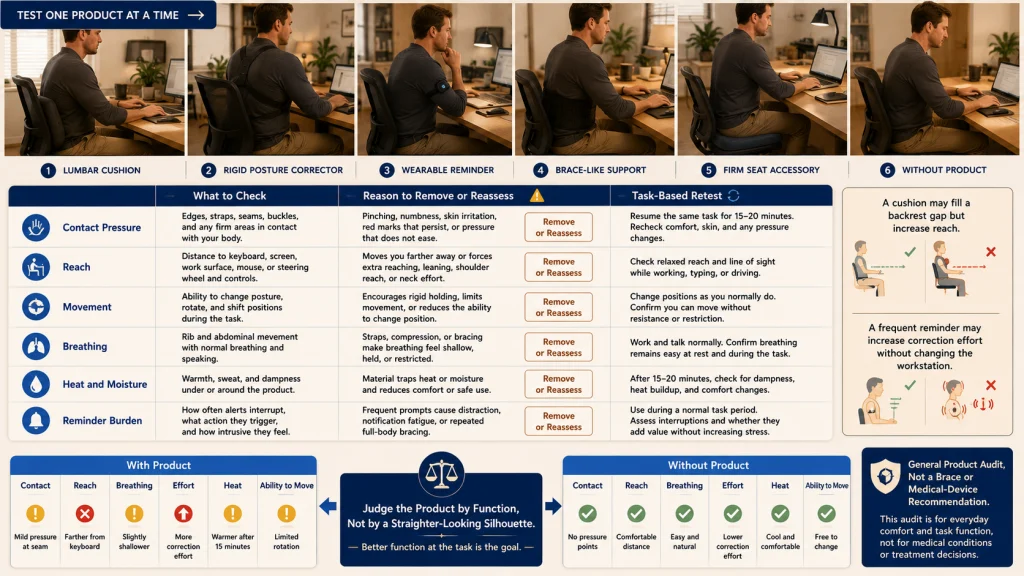
Audit Cushions, Braces, Correctors, and Reminder Devices for Fit and Restriction
A support or reminder can change the experience without proving that it has corrected the body. The practical question is what the product does to contact, reach, movement, heat, pressure, and attention.
| Audit area | What to check | Reason to remove or reassess |
|---|---|---|
| Contact pressure | Edges, straps, seams, or firm areas pressing into the body | Pinching, numbness, skin irritation, or persistent pressure |
| Reach | Whether the product moves the body farther from the task | More leaning, shoulder reach, or neck effort |
| Movement | Whether ordinary position changes remain possible | The product encourages rigid holding or restricts needed motion |
| Breathing | Whether straps or bracing affect rib or abdominal movement | Breathing feels held, shallow, or restricted |
| Heat and moisture | Whether the product traps heat or stays damp | Skin discomfort or reduced willingness to use it safely |
| Reminder burden | How often alerts interrupt work and what action they trigger | Notification fatigue, repeated bracing, or distraction |
Nora’s practical observation is that rigid correctors, firm lumbar shapes, and aggressive reminder devices can create contact pressure, altered reach, heat, restricted movement, or notification fatigue even when marketed around correction. Those effects should be reviewed before assuming the discomfort means the person needs more force.
This article does not recommend a brace or medical device. General support and equipment questions belong in the ergonomic equipment guide.
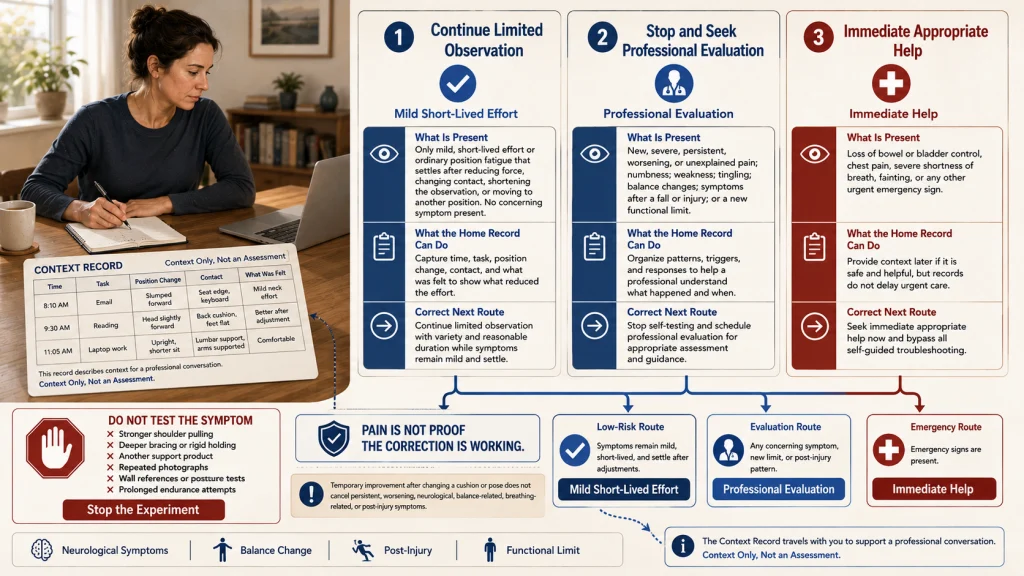
Do Not Push Through Sharp, Worsening, Neurological, Breathing, Balance, or Post-Injury Symptoms
Self-guided troubleshooting must stop when the experience moves beyond mild, short-lived effort or ordinary position fatigue.
Stop-now boundary: Stop the posture experiment and seek appropriate professional evaluation for new, severe, persistent, worsening, or unexplained pain; numbness; weakness; tingling; balance changes; symptoms after a fall or injury; or a new functional limit. Loss of bowel or bladder control, chest pain, severe shortness of breath, or fainting requires immediate appropriate help.
Do not use a cushion, brace, reminder device, wall reference, photograph, or stronger correction cue to test whether these symptoms can be overcome. Do not assume that pain is proof that a correction is working or that the body only needs to become stronger.
A symptom log may help describe when the problem appears, what task was occurring, and what changed. It does not replace an appropriate assessment.
Route Workspace, Habit, and Support Questions to the Right Next Step
Once severe or concerning symptoms are ruled out, the next route depends on what changed the discomfort.
| Observed pattern | Next route |
|---|---|
| The discomfort appears mainly at a computer or desk | Review home office ergonomics |
| The concern began after a visual posture check | Return to a repeatable posture observation |
| The same slouched position returns during one repeated task | Review the task and habit triggers behind slouching |
| The discomfort comes from a cushion, corrector, or support | Use the equipment-fit and purpose workflow |
| The person is chasing a rigid visual ideal | Revisit common posture myths |
The broader posture and ergonomics overview can help connect these routes without reducing every discomfort to the same correction.
Classify the Sensation, Reduce Force, Change Support or Duration, and Stop When Required
Begin with the moment the discomfort appears. What changed first: the cue, the contact surface, the distance to the task, or the length of time spent holding still?
Then make the experiment smaller. Release unnecessary bracing, return from the extreme, use support that does not interfere with reach, and allow the body to change position. A useful adjustment should make the task easier to perform, not create another task that must be maintained through constant attention.
Unfamiliar effort can be recorded without promising that it will disappear. Supports and reminder devices can be audited without assuming that more restriction produces a better result.
The clearest outcome is not a straighter-looking pose. It is knowing when to reduce force, change the setup, shorten the observation, or stop. Concerning symptoms are not a cue to become more disciplined. They are a reason to use the appropriate professional route.
FAQs
😣 Why does sitting up straight feel uncomfortable?
The position may be overcorrected, unsupported, held too long, unfamiliar, or poorly matched to the task. Classify the sensation and reduce unnecessary force before assuming more effort is needed.
🫁 Is restricted breathing a normal part of better posture?
No. Release chest lifting, rib holding, abdominal bracing, or restrictive equipment. Persistent or severe breathing difficulty requires appropriate professional evaluation, and severe shortness of breath requires immediate help.
💪 Does discomfort mean my muscles are weak?
A home posture experiment cannot establish that conclusion. Discomfort may relate to force, support, duration, task reach, contact pressure, unfamiliarity, or a condition that needs assessment.
⏱️ How long should I hold corrected posture?
Do not use a universal endurance target. Use a short observation window, keep effort low, change position before fatigue dominates, and stop when symptoms become concerning.
🪑 Can a lumbar cushion make posture feel worse?
Yes. A firm shape can create pressure or move the body farther from the task. Recheck contact, reach, movement, breathing, heat, and whether the support fits the chair and activity.
📳 Can posture reminders become unhelpful?
Frequent alerts can create interruption or repeated bracing without solving the task setup. Judge the reminder by the action it triggers and whether that action remains low effort.
🚩 When should I stop correcting my posture myself?
Stop for sharp, severe, persistent, worsening, or unexplained pain; numbness; weakness; tingling; balance changes; post-injury symptoms; breathing restriction; or functional loss. Emergency signs require immediate appropriate help.