An exercise habit becomes easier to repeat when the launch conditions are stable. Choose one cue, one location, and a minimum version that can survive busy, noisy, low-energy, or interrupted days. Reduce the hidden setup burden, track starts before outcomes, and return at the next planned cue after a missed session. Significant distress, compulsive exercise, severe mood symptoms, eating-disorder concerns, or other clinical barriers require qualified support rather than a stricter habit system.
The Workout Stayed the Same, but the Launch Conditions Changed
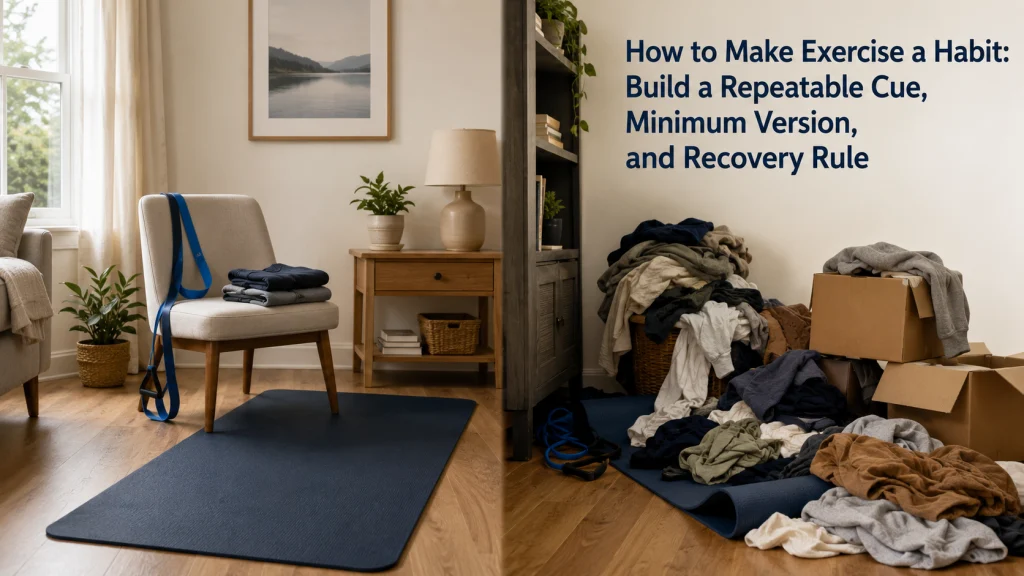
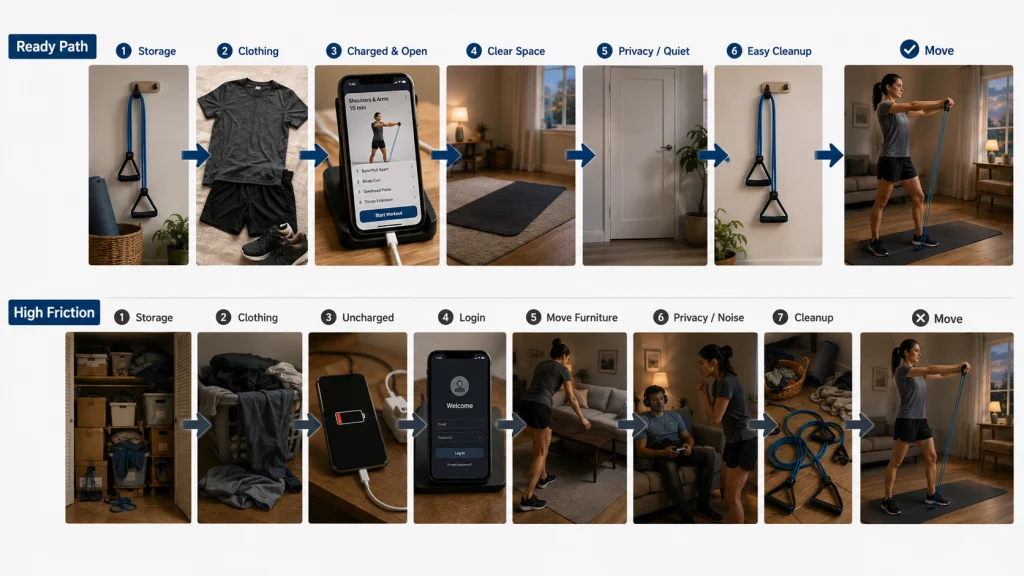
On Monday, a ten-minute workout begins easily. The mat is already in the chosen corner, the room is free, comfortable clothes are nearby, and the cue is clear: start after closing the work laptop.
On Wednesday, the same workout never begins. The mat is stored behind boxes, another person is using the room, the phone requires an app login, and “exercise sometime tonight” is the only cue. The workout did not become harder. The path into it did.
| Same Ten-Minute Workout | Easy Launch Day | High-Friction Day |
|---|---|---|
| Cue | Begins after one stable event. | Depends on remembering at an unspecified time. |
| Location | The chosen space is open and ready. | The room is occupied or requires furniture changes. |
| Equipment | The needed item is visible and reachable. | It is stored behind other items or needs charging. |
| Minimum version | A shorter fallback is already defined. | The full session feels like the only version that counts. |
| Recovery rule | A missed session returns at the next cue. | One interruption becomes a reason to abandon the week. |
Consistency is not only a property of the person. It is also a property of the cue, room, equipment, timing, and fallback plan. The beginner home-workout guide can help choose a safe starting activity, while the home exercise overview places habit design inside a broader movement routine.
Define a Habit as Repeated Behavior, Not a Fixed-Day Achievement
An exercise habit is a behavior repeated in a recognizable context until starting requires less active negotiation. That shift can be gradual and uneven. A routine may feel automatic on quiet weekdays but still require planning during travel, family changes, illness, deadlines, or seasonal disruption.
The goal is not to reach a ceremonial day when effort disappears. The useful signs are practical:
- the cue is easy to recognize;
- the first action begins with less delay;
- the setup requires fewer choices;
- a smaller version remains available when conditions change;
- a missed session no longer turns into a long abandonment.
There is no dependable fixed-day deadline that applies to every person, activity, schedule, or environment. Habit timing varies, and a calendar milestone cannot prove that a behavior is automatic. Use time points to review the setup, not to judge whether the person succeeded on schedule.
A routine can be valuable before it feels automatic. Repetition, contextual fit, enjoyment, and a workable response to disruption matter more than reaching a universal day count.
Choose One Stable Cue and One Location
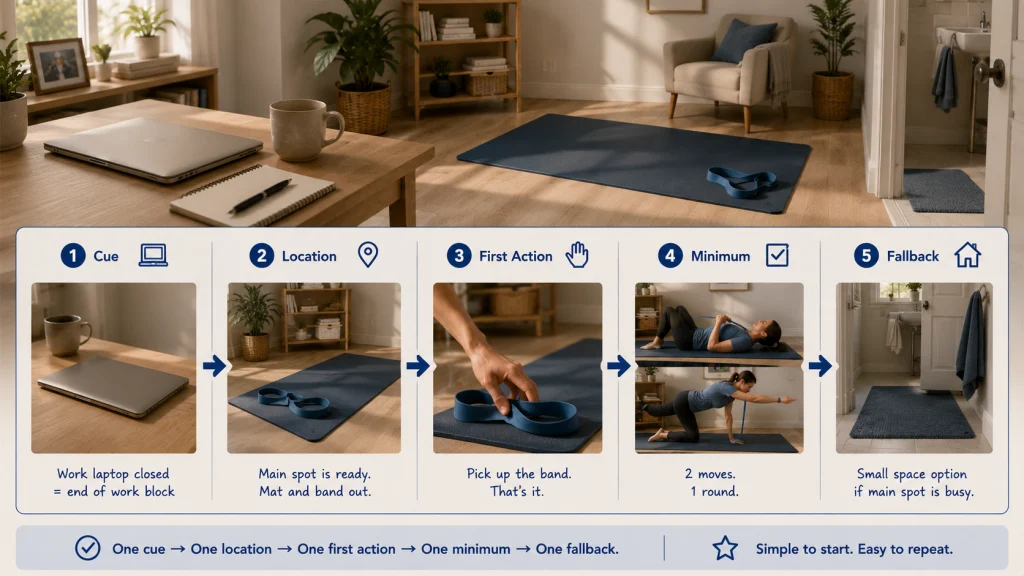
A cue works best when it is specific enough to notice and already connected to the day. “After I close the work laptop” is easier to act on than “later tonight.” “After the morning coffee is put away” is clearer than “when I feel motivated.”
The location should be realistic under ordinary home conditions. It does not need to be a dedicated gym. It needs enough safe space for the chosen movement, a predictable setup, and a fallback when the room is occupied.
| Cue-Location-Minimum Worksheet | Write the Decision | Check the Fit |
|---|---|---|
| Stable cue | After __________, I begin. | Does this event happen reliably enough to notice? |
| Primary location | I usually exercise in __________. | Is the space safe, available, and quick to prepare? |
| First visible action | The first action is __________. | Can it begin before another decision is required? |
| Minimum version | On a difficult day, I will do __________. | Is it clearly smaller than the standard session? |
| Fallback location | If the main space is unavailable, I use __________. | Does the fallback avoid unsafe crowding, noise, or furniture movement? |
Keep the first version narrow. One cue and one primary location reveal more about launch obstacles than several competing reminders and exercise spots.
Define a Minimum Version That Still Counts
The minimum version is the smallest safe form of the planned behavior that preserves the act of starting. It is not a punishment, a secret full workout, or a demand to exercise through illness, pain, or exhaustion.
A useful minimum version has four qualities:
- Specific: It names the actual movement or sequence.
- Short: It fits a genuinely limited window.
- Easy to launch: It uses little equipment or setup.
- Easy to stop: Completing it does not create pressure to continue.
Examples might include beginning the warm-up and one planned movement, taking a brief familiar walk, or completing a short mobility sequence that already belongs in the routine. The minimum should match the activity and the person’s current ability.
Minimum-version rule: Completion preserves the repetition. It does not create a debt that must be repaid with extra exercise later.
Choose an Activity You Are Willing to Repeat
A theoretically ideal activity has little practical value when the person dreads the setup, dislikes the movement, cannot perform it privately, or cannot fit it into the household. Enjoyment does not mean every session must feel exciting. It means the activity is acceptable enough to return to.
Review the fit across several dimensions:
- Does the activity match current ability and available space?
- Can it be modified without becoming unrecognizable?
- Does the sound level fit the home?
- Can the minimum version use the same basic movement?
- Does the person prefer instruction, music, silence, repetition, or variety?
- Does the activity leave room for appropriate recovery?
Willingness may grow after the launch becomes easier. Before replacing the activity, check whether the actual problem is storage, timing, complexity, discomfort, or an unrealistic standard for what counts.
The home workout planning guide can help match activities and session types after the repeatable launch sequence is clear.
Use Calendar Planning Without Requiring a Perfect Streak
A calendar gives the behavior a place to land. It should clarify the next opportunity, not turn every interruption into evidence that the routine has failed.
Schedule the standard session first, then add:
- the stable cue;
- the likely location;
- the minimum version;
- the fallback window or next cue;
- the recovery needs created by the activity.
Calendar flexibility is not vagueness. “Tuesday after work, with Wednesday morning as the fallback” is flexible and specific. “Whenever I have time” leaves the behavior competing with every other task.
Use the beginner workout schedule to arrange sessions across the week. Use the guide to beginner rest days when the next decision depends on recovery demand rather than habit consistency.
Track Starts and Completed Minimums Before Outcomes
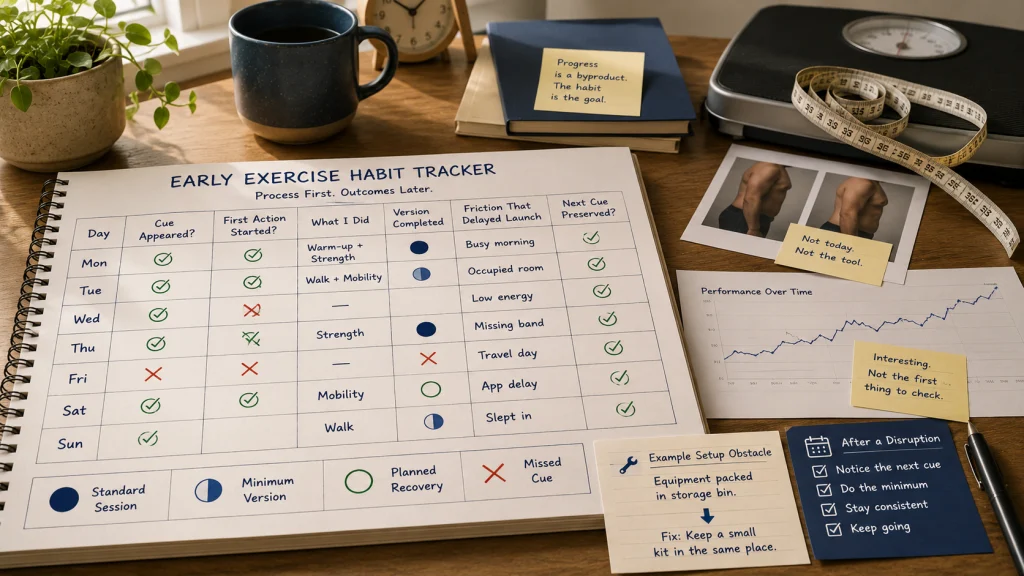
Early habit tracking should show whether the launch system works. The first useful win may simply be that starting no longer takes twenty minutes of bargaining. Weight, appearance, pace, strength, mood, or other outcomes can change for many reasons and may move too slowly or unevenly to guide the next setup decision.
Track a few behavior signals:
- Was the cue noticed?
- Did the first action begin?
- Was the standard or minimum version completed?
- Which setup obstacle delayed the start?
- Was the next cue preserved after disruption?
A simple mark can distinguish a standard session, minimum version, planned recovery day, and missed cue. This prevents one generic checkmark from hiding how the routine actually functioned.
Tracking boundary: The record should support review, not create pressure to exercise when rest, illness, pain, or qualified guidance calls for another choice.
Create If-Then Plans for Predictable Interruptions
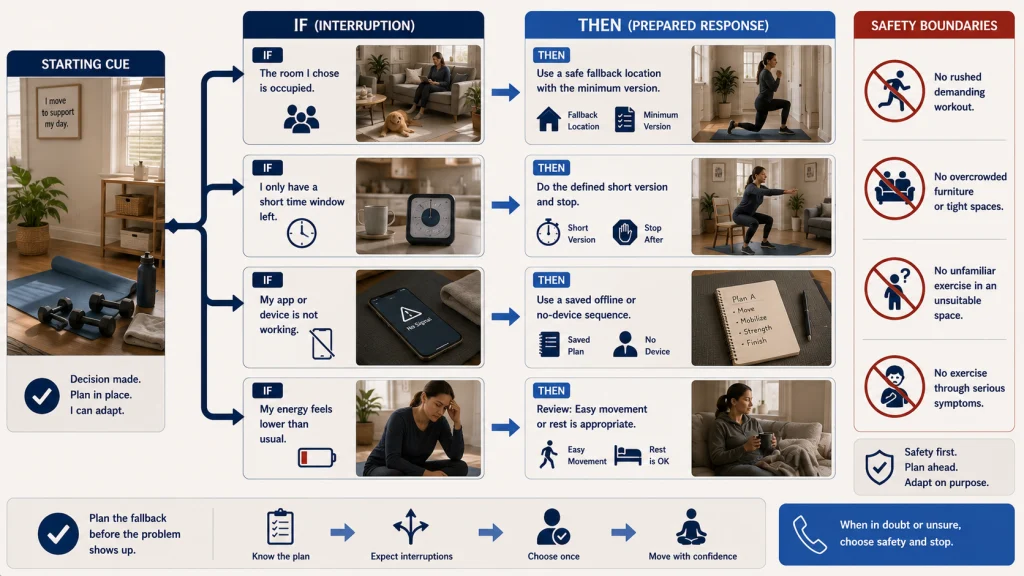
Home routines are interrupted by occupied rooms, late meetings, caregiving, travel, noise, low energy, and missing equipment. These disruptions are not proof that the habit is weak. An if-then plan makes the fallback decision before the interruption arrives.
| If This Happens | Then I Will | Boundary |
|---|---|---|
| The chosen room is occupied | Use the safe fallback location and minimum version. | Do not crowd furniture or create an unsafe movement area. |
| Only a short window remains | Complete the defined minimum and stop without adding debt. | Do not compress a demanding full session into an unsafe rush. |
| I am traveling | Use a familiar no-equipment option or resume at the first suitable cue. | Do not improvise unfamiliar exercise in an unsuitable space. |
| Energy is lower than usual | Review sleep, illness, soreness, and function, then choose the minimum, easy movement, or rest. | Persistent or severe symptoms require a different route. |
| The device is uncharged or the app fails | Use the saved offline sequence or no-device version. | The technology does not decide whether the behavior can begin. |
| Household noise limits the session | Switch to the prepared lower-noise option. | Respect shared-space and neighbor constraints. |
Fallbacks should preserve the cue without forcing exercise through a condition that needs rest, evaluation, or qualified guidance.
Resume at the Next Cue After a Missed Session
A missed session is information about the system, not a verdict on the person. The cue may have been unclear, the room unavailable, recovery incomplete, or the day legitimately too demanding.
- Do not add punishment, extra volume, or a makeup workout automatically.
- Name the reason in one short phrase.
- Restore one launch condition if needed.
- Return at the next planned cue with the standard or minimum version.
- Review the schedule only if the same interruption repeats.
The rule is deliberately calmer than an absolute two-miss limit. Sometimes the next cue also needs to be skipped because of illness, recovery, travel, caregiving, pain, or professional guidance. The habit is protected by a clear return path, not by ignoring context.
Review the Setup After Four Weeks and Change One Friction Point
Four weeks is a practical review window, not a deadline for automaticity. It is long enough to observe ordinary weekdays, some disruptions, and the difference between the standard and minimum versions. The review is meant to make the routine easier to live with, not to grade the person who tried to follow it.
Review five questions:
- Which cue produced the most reliable starts?
- Which location required the least conversion or negotiation?
- Was the minimum version small enough to use honestly?
- Which obstacle caused repeated delay?
- Did the recovery rule shorten the return after a missed session?
Change one repeated obstacle at a time. Move the equipment, simplify the login, change the cue, shorten the setup, prepare clothing, or revise the fallback. Keeping the rest stable makes the next review easier to interpret.
Progress can remain gradual. A better launch with the same modest workout may be more useful than a harder program that repeatedly fails to start.
Separate Habit Friction From Clinical Barriers and Compulsive Exercise
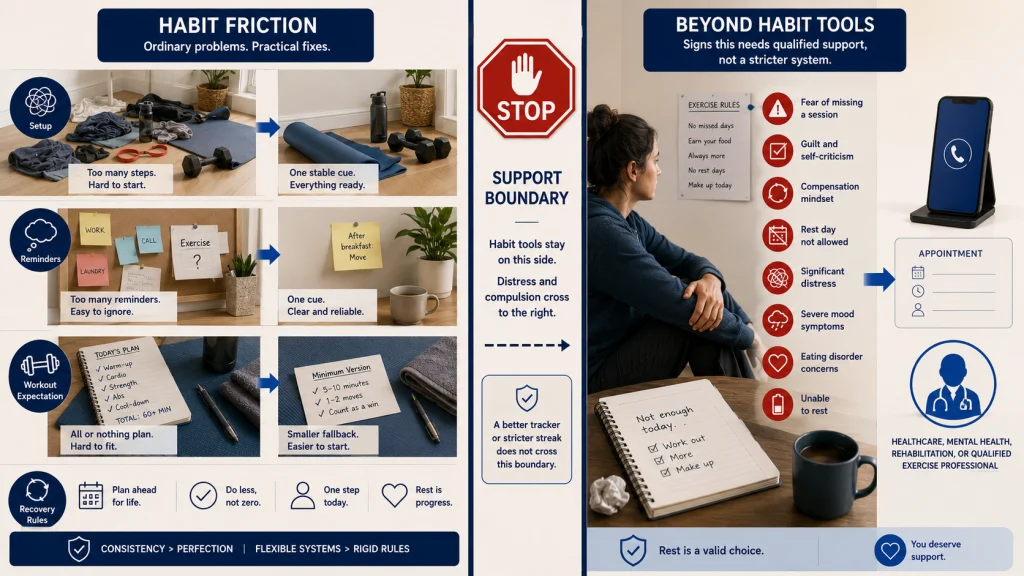
This framework addresses ordinary behavior design for generally healthy adults. It does not treat depression, anxiety, ADHD, eating disorders, compulsive exercise, executive-function disorders, or another clinical condition.
Support boundary: Seek qualified support when exercise is driven by fear, guilt, compensation, rigid rules, or an inability to rest; when missing a session causes significant distress; when severe mood symptoms or eating-disorder concerns are present; or when another clinical barrier is affecting daily life.
Stop exercise and use appropriate medical guidance for serious symptoms, injury, or another health concern. A cue, minimum version, or streak rule should never override rest, safety, clinician instructions, or a needed evaluation.
The appropriate next step may be a healthcare, mental-health, rehabilitation, or qualified exercise professional rather than a more elaborate habit tracker.
Write the Cue, Location, Minimum Version, Friction Fix, and Recovery Rule
Choose one cue connected to an event that already happens and one location that is safe, available, and quick to prepare. Define the first visible action and a minimum version that can be completed without turning into a hidden full session.
Audit storage, clothing, charging, login, furniture, privacy, noise, and cleanup. Prepare if-then plans for predictable disruptions, track starts before outcomes, and return at the next suitable cue after a missed session.
Review after four weeks, change one repeated obstacle, and keep the timeline flexible. The goal is not a perfect streak or a fixed-day achievement. It is a routine with a clear way to begin, shrink, recover, and continue.
FAQs
🔁 How long does it take to make exercise a habit?
There is no fixed duration that applies to every person or routine. Timing varies with the behavior, cue, environment, repetition, enjoyment, disruption, and individual circumstances. Use scheduled reviews to improve the setup rather than treating one day count as a pass or fail deadline.
⏰ What makes a good exercise cue?
A useful cue is specific, noticeable, and connected to an event that already happens, such as closing the work laptop or finishing a morning routine. It should point directly to the first action rather than relying on a vague intention.
🪶 How small can the minimum workout be?
It can be very small when it remains safe, specific, and connected to the chosen activity. The minimum should preserve starting without creating pressure to continue or repay the shortened session later.
🏠 What if someone else is using my workout space?
Prepare a safe fallback location or a lower-space minimum version before the conflict occurs. Do not move furniture hurriedly, crowd the room, or use an unsuitable area only to protect the schedule.
📱 Do I need an app to stay consistent?
No. A calendar, paper mark, phone note, or another simple record can track cues and starts. Keep a no-device version available when charging, updates, pairing, or login adds unnecessary steps.
📅 Should I make up a missed workout?
Do not add extra volume automatically. Note the reason, restore the needed launch condition, and return at the next suitable cue. The broader weekly schedule may need revision when the same interruption repeats.
🎯 What should I track first?
Track whether the cue was noticed, the first action began, the standard or minimum version was completed, and which setup obstacle delayed the start. These signals reveal whether the launch system is working.
🚩 When is habit advice not enough?
Habit advice is not enough when exercise involves significant distress, compulsive behavior, rigid compensation, severe mood symptoms, eating-disorder concerns, or another clinical barrier. Seek qualified support instead of tightening the routine.