A useful conversation begins with one neutral observation and one shared goal, not a verdict about whether an aging parent can still manage. Choose one topic, ask permission, learn what the parent wants to preserve, and offer two or three workable options rather than presenting a finished decision. Keep the first step small, reversible, and clear about cost, privacy, control, and follow-up. Move beyond a family conversation when immediate danger, abuse, exploitation, severe confusion, emergency symptoms, or inability to meet essential needs requires qualified local help.

Cross Out the Verdict and Keep the Observation
Write two possible first sentences on a notepad:
“You cannot keep doing this alone.”
“I noticed the stairs have been harder this month. What would make getting upstairs feel easier?”
The first sentence assigns a status. It turns one concern into a broad conclusion about the person’s independence. The second names an observable change and opens a decision about one task.
Conversation starting point: Begin with one observation and one goal, not a verdict about independence.
This distinction matters when you are worried. Concern can make a sweeping statement feel urgent and efficient, but it may force the parent to defend their adult status before the practical problem is even discussed.
The healthy aging guide provides the wider context for later-life decisions. The guide to staying independent as you age explains why support can preserve options without requiring a person to do every task alone.
Decide Whether This Is Planning, a Recurring Concern, or an Immediate Safety Issue
Before choosing your words, decide what kind of conversation you are preparing. A future planning discussion should not sound like an emergency. An immediate threat should not be handled as a routine family meeting.
| Situation | Typical pattern | Appropriate route |
|---|---|---|
| Proactive planning | No current crisis, but a future transportation, housing, household, or support question is foreseeable. | Schedule an unhurried discussion focused on preferences and backup options. |
| Recurring concern | The same concrete difficulty has happened more than once, but no immediate danger is present. | Bring specific observations, ask what has changed, and discuss a limited next step. |
| Unmet essential need | Food, hygiene, mobility, medical follow-up, housing conditions, or another important need is not being met reliably. | Include an appropriate professional or local service resource rather than relying only on repeated family persuasion. |
| Immediate risk | There is active danger, severe symptoms, fire, violence, serious confusion, or another emergency. | Contact emergency services or the appropriate urgent resource now. |
Do not use urgency as a communication tactic when the concern is not urgent. It can make future conversations harder to trust. If you are unsure whether one incident belongs to a broader pattern, use the guide to recognizing signs an aging parent may need help before deciding how narrowly or urgently to frame the discussion. When the risk is immediate, skip the script-building exercise and obtain qualified help.
Pick One Topic Instead of Reorganizing an Entire Life
Housing, driving, finances, medication, home maintenance, meals, technology, and personal care should not be introduced as one package. Combining them can make the conversation sound like a coordinated loss of control.
Choose the topic with the clearest observation and the most useful next decision. “The front steps have been difficult after grocery trips” is discussable. “We need to talk about everything” leaves the parent guessing how many decisions have already been made.
Use this filter:
- What exactly did I notice?
- How often has it happened?
- Which valued activity is affected?
- What decision needs to be made now?
- Which related topics can wait for another conversation?
A narrow topic also makes disagreement easier to survive. The family can pause one decision without treating the entire future as unresolved.
Choose the Setting, Participants, Access, and Time Deliberately
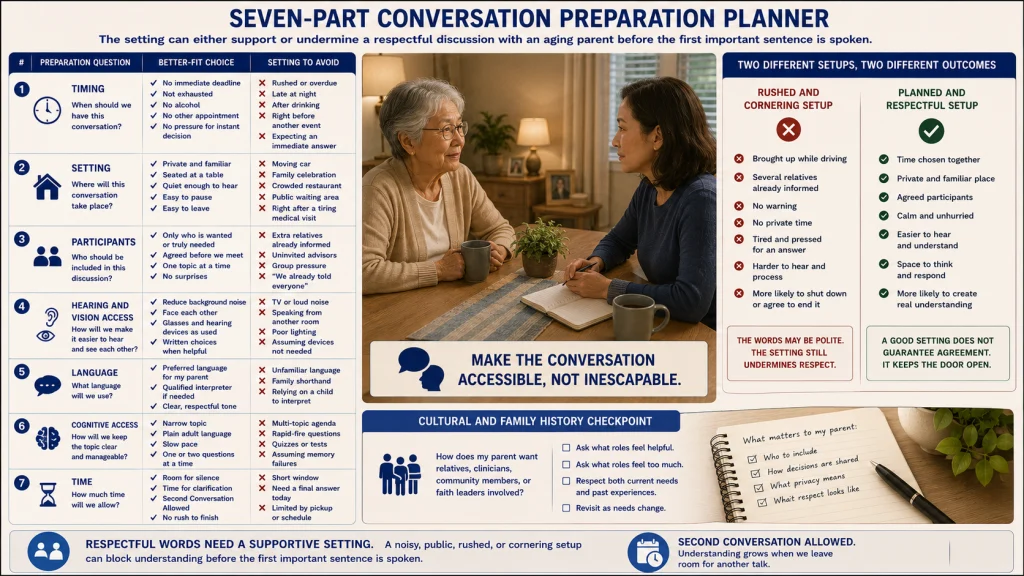
The right words can still fail in a rushed, noisy, inaccessible, or overly public setting. A parent who feels cornered may respond to the setting before they can respond to the concern itself. Avoid raising a major topic while driving, during a family celebration, at the end of an exhausting appointment, or in front of people the parent did not invite.
| Preparation field | Decision |
|---|---|
| Timing | Choose a period without an immediate deadline, fatigue, alcohol use, or competing appointment. |
| Setting | Use a private, familiar place where everyone can sit, hear, and leave without embarrassment. |
| Participants | Invite only people whose presence is wanted or necessary for the specific topic. |
| Hearing and vision access | Reduce background noise, face the person, use glasses or hearing devices, and provide written options when helpful. |
| Language access | Use the person’s preferred language and a qualified interpreter when important information could be misunderstood. |
| Cognitive access | Keep the topic narrow, use plain language, slow the pace, and avoid testing or quizzing the person. |
| Time | Leave room for pauses and a second conversation rather than demanding a final answer immediately. |
Cultural expectations and family history also shape what feels respectful. A format that feels caring to one family may feel exposing or controlling to another. Ask how the parent wants relatives, clinicians, community members, or faith leaders involved instead of assuming one family model applies.
Ask Permission and State the Shared Goal
Permission does not mean hiding a serious concern. It gives the parent a role in when and how the topic begins.
Try a short opening:
“Could we talk for ten minutes about the stairs? I want to understand what would help you keep using the upstairs rooms comfortably.”
The shared goal should describe something the parent values, not only what the family wants to prevent. It might be keeping a weekly activity, continuing to cook, getting outside, managing personal finances, staying connected with friends, or using the current home more easily.
If the parent says this is not a good time and there is no immediate danger, agree on another time. Repeated postponement can become its own topic, but forcing the discussion during a bad moment rarely improves the quality of the decision.
Describe Specific Observations Without Age Labels or Diagnosis
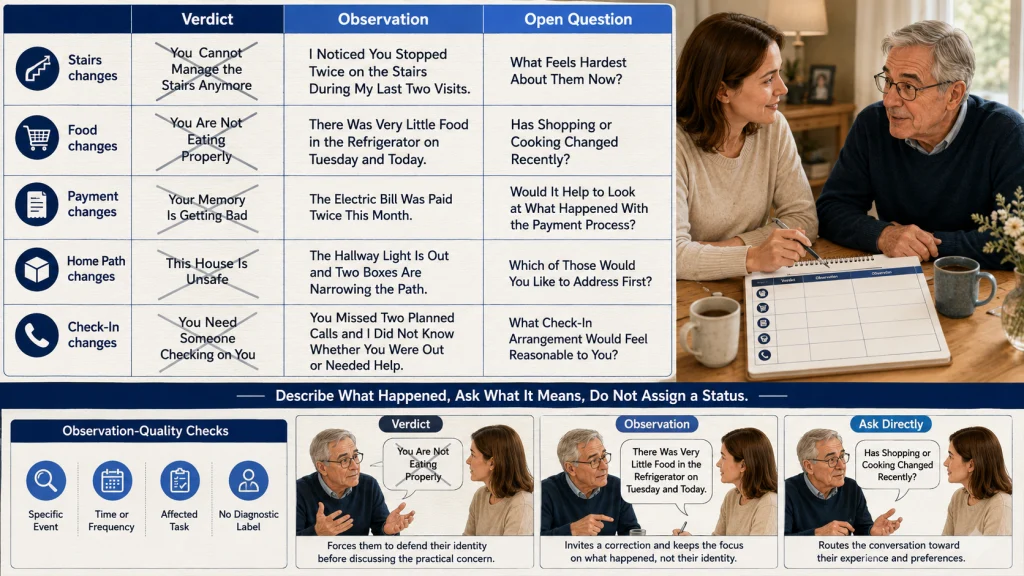
Observations can be checked, corrected, and discussed. Judgments require the parent to disprove a conclusion about their identity or ability.
| Judgment or verdict | Neutral observation | Open question |
|---|---|---|
| “You cannot manage the stairs anymore.” | “I noticed you stopped twice on the stairs during my last two visits.” | “What feels hardest about them now?” |
| “You are not eating properly.” | “There was very little food in the refrigerator on Tuesday and today.” | “Has shopping or cooking changed recently?” |
| “Your memory is getting bad.” | “The electric bill was paid twice this month.” | “Would it help to look at what happened with the payment process?” |
| “This house is unsafe.” | “The hallway light is out, and two boxes are narrowing the path.” | “Which of those would you like to address first?” |
| “You need someone checking on you.” | “You missed two planned calls, and I did not know whether you were out or needed help.” | “What check-in arrangement would feel reasonable to you?” |
The NIA recommends asking the older person directly and raising concerns with specific examples rather than beginning with a general conclusion. Its caregiving guidance also emphasizes trying to fulfill the person’s wishes where possible.
Keep adult status visible: Describe what happened, ask what it means to the parent, and do not turn one event into a diagnosis.
Ask What the Parent Wants to Keep Doing
A conversation about help should not begin and end with the difficult task. Behind the stairs, groceries, appointments, or household work is usually something the parent still wants to protect. Ask which part of life the task supports.
Useful questions include:
- “What part of this routine matters most to you?”
- “What has become frustrating or tiring?”
- “What is still working the way you want?”
- “Which decisions do you want to keep making yourself?”
- “What would make this easier without changing the parts you value?”
The parent may care less about preserving every step than about preserving a particular result. Grocery delivery may be acceptable if choosing food and approving substitutions remain under their control. A ride may be acceptable if the schedule and destination still belong to them.
Do not assume that the family’s preferred outcome is shared. The parent may place more weight on privacy, familiarity, cost, contribution, or flexibility than on maximum convenience.
Listen for Control, Reciprocity, Privacy, Trust, Cost, and Identity
After you ask what matters, the difficult part is listening without using every answer as an opening to persuade. A no can carry information about the design of the offer. It may concern the helper, timing, price, access to the home, amount of monitoring, or fear that a small agreement will expand.
Qualitative home-support research found concerns related to loss of control, trust, inability to complete tasks, and feeling like an imposition among older adults discussing assistance at home. Those findings describe possibilities to explore, not motives you can assign to one parent.
Listen for statements such as:
- “I do not want someone in the house.”
- “You already have too much to do.”
- “I do not want everyone knowing my business.”
- “Once this starts, it will never stop.”
- “That service costs more than it is worth.”
- “I can still decide how I want this done.”
Reflect the concern before offering a solution: “It sounds like privacy and not creating more work for us both are important. Let us keep those limits in the next option.”
Offer Two or Three Workable Options
Do not reveal a product, service, move, or family arrangement before understanding the goal. A finished solution can make the conversation feel like an announcement.
Offer a small choice set that includes a lower-cost or lower-support option when one exists:
| Concern | Smaller option | Moderate option | More support |
|---|---|---|---|
| Heavy groceries | Use a cart and make smaller trips. | Arrange help carrying only. | Use delivery for heavy-item weeks. |
| Stairs | Move frequently used items to one level. | Add a planned rest point and improve lighting. | Request an appropriate home or clinical assessment. |
| Appointments | Use a written calendar and one reminder. | Share selected appointments with one trusted person. | Arrange transportation and appointment support. |
| Household tasks | Reduce frequency or divide the task. | Accept help with the hardest step. | Use scheduled household support. |
Decision-design observation: A useful option includes setup, cost, maintenance, privacy, and who does what after the first day. Do not present a device or service as simple when the parent will need someone else to charge, update, book, troubleshoot, or supervise it.
Propose a Reversible Trial With a Review Date
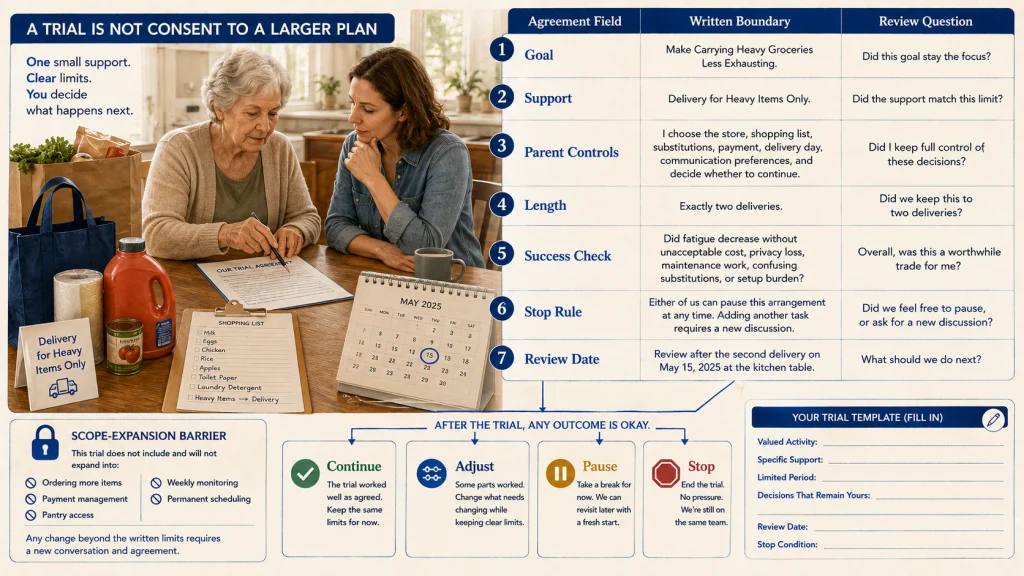
A permanent arrangement can be difficult to evaluate before it exists. A trial creates a limited experience that can be reviewed without pretending the first choice must be final.
| Trial field | Write the agreement |
|---|---|
| Goal | “Make carrying heavy groceries less exhausting.” |
| Support | “Delivery for heavy items only.” |
| What the parent controls | Store, list, substitutions, payment, delivery day, and whether to continue |
| Length | Two deliveries |
| Success check | Less fatigue without unacceptable cost, privacy loss, or setup work |
| Stop rule | Either person can pause the arrangement; adding another task requires a new discussion |
| Review date | A specific date after the second delivery |
Small-trial template: “You want to keep [valued activity]. Would you try [specific support] for [limited period]? You would keep control of [decisions]. We will review it on [date], and either of us can stop if [condition].”
A trial is not consent to a larger plan. Keep the boundary visible throughout the test.
Clarify What the Parent Controls and What the Help Does Not Include
Support becomes easier to evaluate when the edges are explicit. Without clear limits, even a small agreement can feel like the beginning of a much larger loss of privacy or control. Name the decisions that remain with the parent and the tasks the helper is not authorized to add.
Write down:
- Who enters the home and which rooms are included.
- What information can be seen or shared.
- Who chooses the schedule, provider, route, store, or appointment.
- Who pays and what the full cost includes.
- Whether reminders are requested or optional.
- Whether a relative receives updates and which updates are allowed.
- How the arrangement can be paused, changed, or ended.
Use the guide to understanding resistance to help when a repeated no may be protecting control, privacy, trust, reciprocity, or identity rather than rejecting the practical outcome itself.
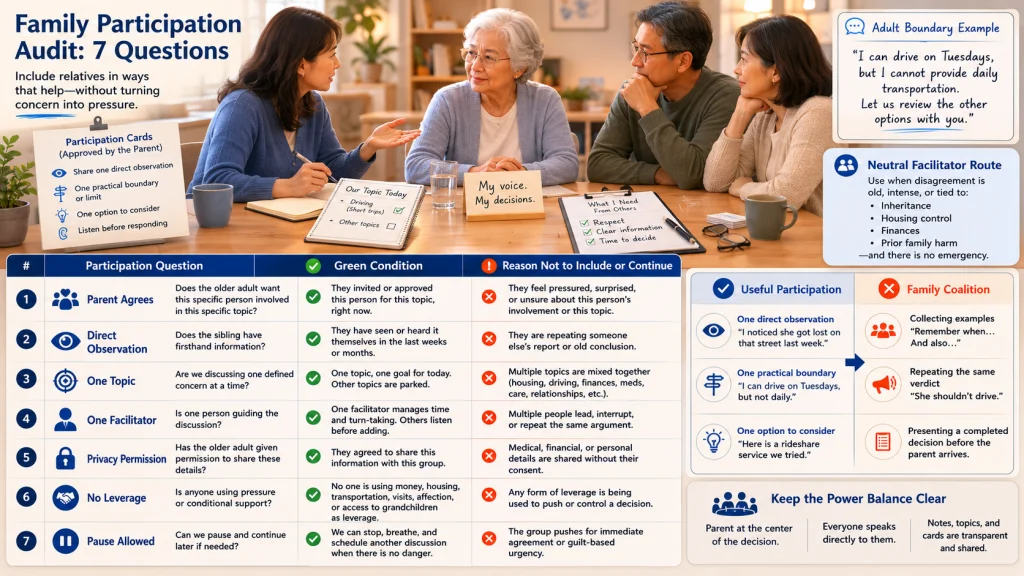
Handle Disagreement Without Building a Family Coalition
When one conversation goes badly, the impulse may be to call siblings, collect examples, and return with a united front. That can turn concern into a hearing in which the parent is outnumbered.
Use this sibling-participation checklist before involving others:
- Has the parent agreed that this person should participate?
- Does the sibling have a direct observation or only a secondhand opinion?
- Is everyone discussing the same single topic?
- Can one person facilitate while others avoid repeating the same argument?
- Have private medical, financial, or household details been shared without permission?
- Is anyone using money, housing, visits, or affection as leverage?
- Can the group accept a pause when there is no immediate danger?
Family members can state their own boundaries without claiming collective authority. For example: “I can drive on Tuesdays, but I cannot provide daily transportation. Let us look at the other options with you.”
If the disagreement is old, intense, or tied to inheritance, housing, control, or past harm, a neutral facilitator may be more useful than another family meeting.
Involve the Right Professional or Community Resource
Reaching the limit of a family conversation does not mean the conversation failed. Some concerns need clinical assessment, service coordination, neutral facilitation, or local resource knowledge that relatives cannot reasonably provide on their own.
- Clinician: for new physical symptoms, severe confusion, medication questions, functional changes, or concerns that require individualized evaluation.
- Social worker or care manager: for service coordination, discharge planning, household support, transportation, or complex practical needs.
- Mediator: for structured discussion when conflict prevents the family from making progress and no emergency is present.
- Area Agency on Aging: for local information about meals, transportation, caregiver support, household services, and community programs.
The federal Eldercare Locator connects U.S. older adults and families with local aging services. The parent should remain part of the contact and decision whenever the situation allows.
A professional should not be introduced as someone who will make the parent agree. Explain the purpose of the meeting, what information will be shared, and which decisions remain open.
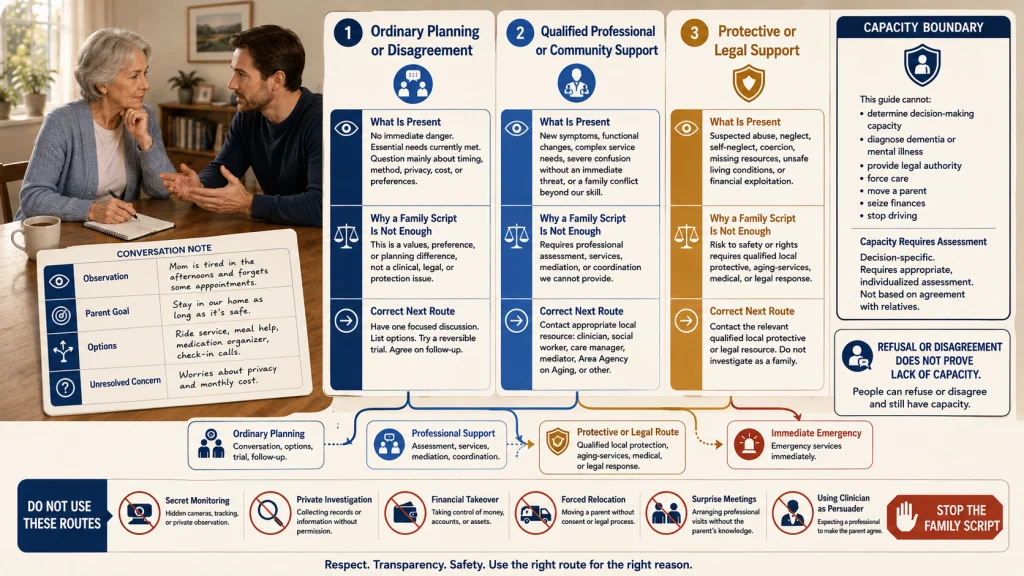
Recognize Emergency, Abuse, Exploitation, and Capacity Boundaries
A conversation guide cannot determine decision-making capacity, diagnose dementia or mental illness, provide legal authority, or authorize a family member to force care, move a parent, seize finances, or stop driving.
Escalation boundary: Immediate danger, emergency symptoms, active violence, fire, severe confusion, inability to meet essential needs, suspected abuse, neglect, self-neglect, or financial exploitation requires qualified local, protective, medical, legal, or emergency support. Do not investigate a potentially dangerous situation alone.
Call emergency services for an immediate threat. For non-immediate suspected abuse, exploitation, neglect, or self-neglect, contact the relevant local protective-services or aging-services resource. Laws, reporting duties, agency roles, and legal standards vary by location.
A refusal does not prove lack of capacity. Capacity questions require appropriate individualized assessment and may be decision-specific. Do not use disagreement with the family as the test.
Write the Next Step and Schedule the Follow-Up Conversation
End with a record of what was agreed, what remains undecided, and when the topic will return. This matters because both people may leave the same conversation remembering different promises, limits, or next steps. A vague promise to “talk later” can become permanent avoidance or repeated surprise conversations.
| Conversation planner | Your entry |
|---|---|
| One observation | What happened, when, and how often |
| One valued activity | What the parent wants to keep doing |
| One decision | The specific question being decided now |
| Options considered | Two or three choices, including smaller or lower-cost support |
| Trial or action | Who will do what, by which date |
| Parent’s control | Decisions, privacy, access, information, and stop rule |
| Unresolved concern | What needs more information or professional input |
| Review date | A specific date and preferred setting |
Send or leave a copy only when the parent wants one. The written plan should reflect the conversation, not become a document used to prove that consent was given to something broader.
For proactive decisions across housing, transportation, support, activity, and future contingencies, use the guide to planning for aging.
Use One Observation, One Value Question, One Trial, and One Review Date
Prepare one neutral observation. Ask which activity or decision the parent wants to preserve. Offer a small choice set and, when appropriate, a reversible trial with clear limits.
Then write the next step and a review date. One conversation may not resolve the concern, but it can protect the relationship while making the next decision more specific.
When the situation exceeds ordinary planning or disagreement, move to the qualified professional, protective, legal, or emergency route that matches the actual risk.
FAQs
🗒️ How should I start a conversation about help?
Begin with one recent, neutral observation and ask permission to discuss the specific task. State a goal the parent values rather than making a broad statement about independence.
🎯 Should I discuss every concern at once?
No. Choose one topic with a clear observation and one decision that needs attention. Housing, driving, finances, medication, and household support usually require separate conversations.
👂 What if my parent becomes defensive?
Pause the solution and ask what the offer changes besides the workload. Listen for concerns about control, privacy, cost, trust, reciprocity, identity, or an unwanted expansion of support.
🧩 How do I offer help without taking over?
Separate the task into steps, offer two or three workable choices, name which decisions remain with the parent, and use a short trial with a stop rule and review date.
👨👩👧 Should all siblings join the conversation?
Only when their participation is useful and wanted. Avoid surprising the parent with a family coalition, repeating the same argument through several people, or sharing private information without permission.
🩺 When should a clinician or social worker be involved?
Use a clinician for symptoms or functional changes needing assessment. A social worker or care manager can help with coordination, services, transportation, discharge planning, and complex practical needs.
⚖️ Does refusing help mean my parent lacks capacity?
No. Refusal or disagreement alone does not establish lack of decision-making capacity. Capacity questions require appropriate individualized assessment and may depend on the specific decision.
🚨 When is a family conversation not enough?
Seek qualified help for immediate danger, emergency symptoms, severe confusion, inability to meet essential needs, suspected abuse, neglect, self-neglect, exploitation, or another situation beyond ordinary planning.