Signs that an aging parent may need help are most useful when they are compared with the person’s own baseline and tracked as repeated, meaningful changes. One cluttered room, missed meal, forgotten appointment, or unexplained bruise should not be turned into a diagnosis or a verdict about living alone. Record frequency, severity, context, and consequences, then ask the person directly using one neutral observation and one open question. Route the pattern to a simple fix, a planned check-in, the right professional, a local aging resource, or emergency help based on the actual level of risk.

Four Observations Do Not All Carry the Same Weight
A relative’s notes from several visits might look like this:
| Date | Observation | What is known so far |
|---|---|---|
| May 4 | Several unopened envelopes were on the table. | One incident. The mail may be recent, unimportant, or waiting for a planned time. |
| May 18 and June 1 | The refrigerator contained very little food on two separate visits. | A repeated change that deserves a direct question about shopping, appetite, cost, transportation, or meal preparation. |
| June 15 | The usual weekly outing had stopped. | A change from routine that could involve mobility, transportation, mood, weather, cost, or personal preference. |
| June 29 | A new bruise had no clear explanation. | A finding that should be asked about promptly, especially if injuries repeat or other safety concerns appear. |
One imperfect day is not the same as a pattern. Repeated change, a serious consequence, or a sudden difference from the person’s usual routine should not be dismissed simply because each event has a possible explanation.
Starting point: Compare the person with their own baseline, then ask directly.
The healthy aging guide provides the wider context for later-life changes. The guide to staying independent as you age explains why accepting targeted support does not mean giving up every decision or activity.
Start With the Person’s Baseline, Not an Age-Based Expectation
When you are worried, ordinary differences can begin to look like evidence that something is wrong. A quiet home, simple meals, an old car, a small social circle, or an unconventional routine may be normal for that person. The useful question is not whether their life matches someone else’s idea of later life. It is whether something meaningful has changed.
Build the baseline from what the person usually does:
- How the home normally looks and which repairs are already known.
- How meals, shopping, laundry, and bills are usually handled.
- Which routes, stairs, vehicles, and community activities are routine.
- How often the person calls, texts, attends events, or sees friends.
- What level of forgetfulness, mood variation, or physical discomfort is usual.
- Which tasks the person has intentionally delegated or stopped doing.
The National Institute on Aging advises asking the older adult directly and considering changes at home, mood, mobility, falls, isolation, hygiene, confusion, weight, and memory as prompts for further attention. Its official signs guidance does not turn any single item into a diagnosis.
Baseline rule: A change matters because it is new, repeated, severe, or consequential, not because the person has reached a certain age.
Record Frequency, Severity, Context, and Consequence
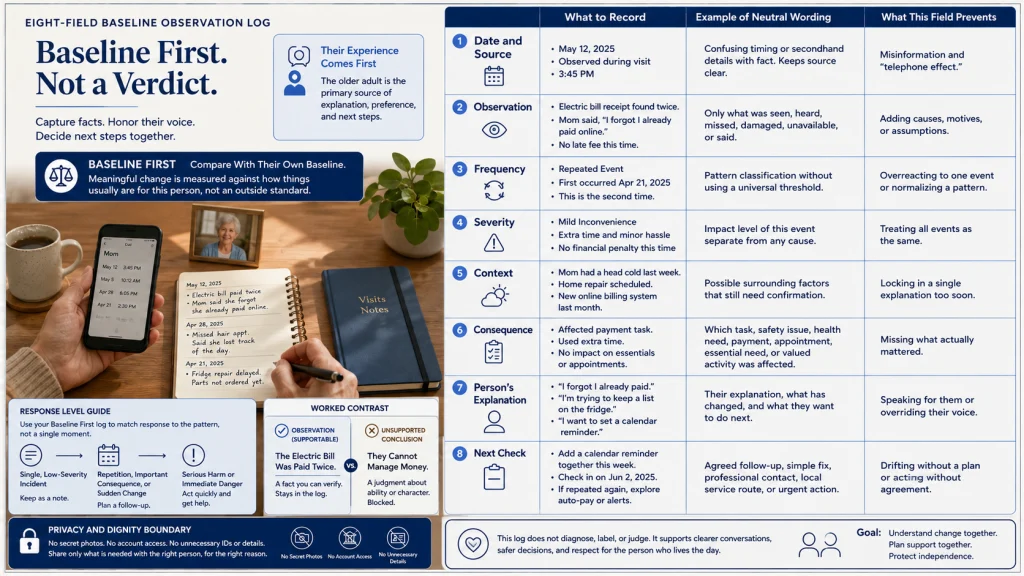
Once a change feels important, it can be hard to remember each event in proportion. Memory tends to compress several small events into one alarming impression or, in the opposite direction, explain each event away. A short factual log helps keep both reactions in check.
| Baseline Observation Log | What to Write |
|---|---|
| Date and source | When it happened and whether you saw it, heard it from the person, or received it from someone else |
| Neutral observation | What was visible or said without adding a diagnosis or motive |
| Frequency | First occurrence, repeated event, or continuing pattern |
| Severity | Mild inconvenience, important disruption, serious harm, or immediate danger |
| Context | Illness, travel, weather, grief, repair work, schedule change, cost, or another possible explanation |
| Consequence | What task, safety issue, health need, payment, appointment, or valued activity was affected |
| Person’s explanation | What the older adult says happened and what they want to do next |
| Next check | Simple fix, follow-up date, professional contact, or urgent action |
Keep observations separate from interpretations. “The electric bill was paid twice” is a fact to discuss. “They cannot manage money” is a conclusion that the log does not establish.
Look for Changes in the Home, Utilities, Maintenance, and Safety
A home can look different because of a temporary repair, a recent delivery, pain, fatigue, cost, grief, or a changed cleaning routine. Look for a pattern and ask what is making the task harder.
Changes worth documenting include:
- New clutter blocking stairs, hallways, doors, heat sources, or exits.
- Broken lighting, railings, steps, locks, plumbing, heating, or cooling that remain unresolved.
- Utilities being disconnected or notices accumulating despite available funds.
- Food waste, pests, strong odors, or sanitation changes that are new and persistent.
- Repeated stove, appliance, water, or electrical concerns.
- Needed mobility equipment being unavailable, damaged, or difficult to use in the space.
Start with the smallest environmental fix that addresses the observation. The guide to home safety for older adults explains how the environment can support independence, while the room-by-room safety checklist can organize a permission-based review.
Do not conduct an unannounced inspection or photograph private rooms without permission. A safer home plan still needs the resident’s participation whenever possible.
Notice Changes in Daily Tasks Without Performing an Informal Assessment
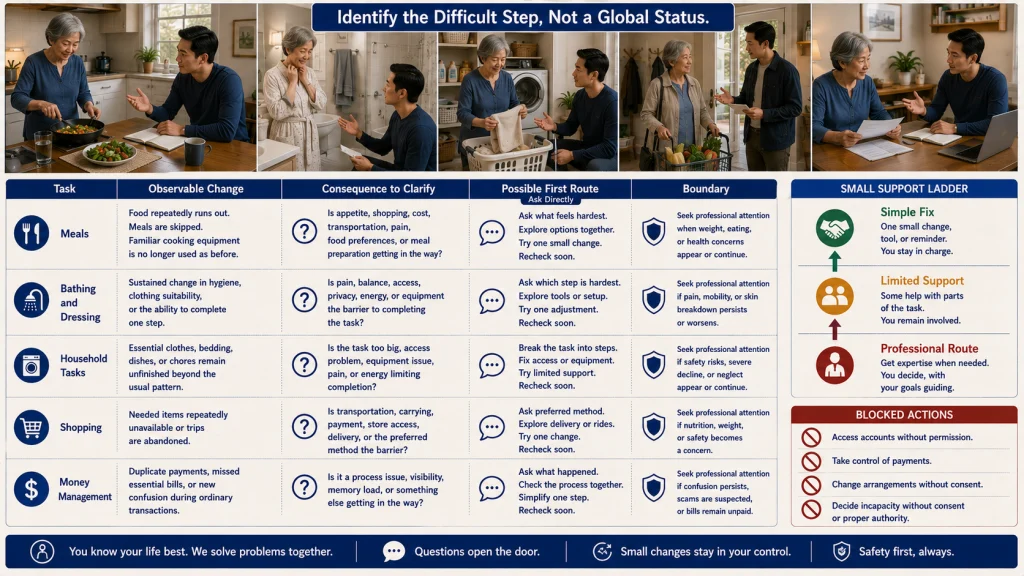
After the home itself, look at the routines that keep daily life moving. Bathing, dressing, meals, laundry, shopping, transportation, phone use, paperwork, and money management can become harder for many different reasons. The observation should identify the task and the consequence, not assign a cause.
| Task area | Observable change | Possible first route |
|---|---|---|
| Meals | Food repeatedly runs out, meals are skipped, or cooking equipment is no longer used as before. | Ask about appetite, shopping, cost, transport, pain, and meal preparation; involve a clinician when weight or health concerns are present. |
| Bathing and dressing | There is a sustained change in hygiene, clothing suitability, or ability to complete the routine. | Ask which step is difficult and whether pain, balance, access, privacy, or equipment is involved. |
| Laundry and household tasks | Essential clothes, bedding, dishes, or household chores remain unfinished beyond the person’s usual pattern. | Divide the task, address equipment or access, or explore household support. |
| Shopping | Needed items are repeatedly unavailable or trips are abandoned. | Check transportation, carrying, payment, store access, and delivery preferences. |
| Money management | Duplicate payments, missed essential bills, or new confusion around ordinary transactions appears. | Ask directly, rule out a simple process problem, and seek appropriate professional help when the pattern continues. |
The guide to activities of daily living explains how specific tasks can be separated without turning this article into a formal assessment. Do not access accounts, take control of payments, or change arrangements without appropriate consent or authority.
Track Changes in Walking, Transfers, Stairs, Falls, and Outings
Movement changes can be especially difficult to interpret because a person may quietly adapt before anyone else realizes what has changed. They may hold furniture, pause more often, avoid stairs, struggle to rise from a chair, stop carrying items, or reduce outings long before they describe the task as a problem.
Record what happened and what it changed. “Stopped twice while climbing the stairs and skipped the upstairs bedroom” is more useful than “mobility is getting worse.”
Ask about pain, dizziness, breathlessness, fear of falling, vision, footwear, the environment, and whether the person has already adapted the routine. A near-fall can matter even when no injury occurred, especially if it changes confidence or activity.
Use the guide to maintaining mobility with age for the broader movement framework. New falls, repeated near-falls, sudden weakness, severe pain, fainting, or injury requires appropriate professional evaluation rather than a home exercise guess.
Separate Transportation Changes From the Broader Question of Independence
Missing events, avoiding unfamiliar routes, new vehicle damage, getting lost, or no longer driving at night can affect community participation. These observations do not automatically answer whether a person should continue driving.
Ask which part changed:
- Is the concern vision, pain, reaction time, navigation, traffic, parking, weather, cost, or confidence?
- Are appointments missed because the trip is difficult or because the appointment itself was forgotten?
- Has the person stopped driving but lacks an acceptable replacement?
- Does avoiding one route preserve safety without preventing other travel?
The guide to transportation options for older adults can help separate the destination from the driving method. Use the driving-safety framework and the guide on when driving concerns need formal attention for the next decision.
Do not hide keys, remove a vehicle, or make a driving decision from this checklist alone. Immediate unsafe driving requires prompt local action, while non-urgent concerns may need a qualified driving or clinical assessment.
Notice Communication, Technology, and Missed-Contact Changes
A missed call may mean the phone was muted, charging, out of reach, unfamiliar after an update, or no longer easy to hear or see. Repeated communication changes deserve a practical review before a surveillance response.
Observe whether the person:
- Can hear the ringtone and understand voicemail.
- Can charge, unlock, and answer the device they use.
- Recognizes common contacts and suspicious messages.
- Can recover from a software update or changed screen layout.
- Misses planned calls because of schedule, sleep, outings, or technology friction.
- Wants a local contact involved when they cannot be reached.
The guide to technology for older adults covers setup and access. If remote support is being considered, review permission-based remote monitoring before adding cameras, location sharing, sensors, or automatic alerts.
Editorial observation: Buying a monitoring device before understanding the pattern can create surveillance without solving the cause. A missed call caused by an inaudible ringtone needs a different response from a missed call caused by an emergency.
Route Mood, Isolation, Weight, Confusion, Memory, and Personality Changes to Professional Attention
Changes in mood, memory, weight, or personality can feel frightening because they raise questions a family member cannot answer from a visit or phone call. A sustained change should not be explained as normal aging without assessment. The same observation can have many possible causes, including health changes, grief, pain, sleep problems, medication effects, sensory loss, stress, or environmental disruption.
Document the beginning, frequency, context, and consequence:
- Withdrawal from activities the person previously valued.
- New hopelessness, agitation, fear, unusual suspicion, or major personality change.
- Significant or unexplained weight change.
- Confusion that is new, worsening, or affecting essential tasks.
- Memory problems that interfere with payments, appointments, navigation, cooking, or communication.
- Dangerous sleepiness, repeated falls, or reduced ability to move around.
These signs are prompts for qualified evaluation, not diagnoses. Sudden confusion, stroke signs, chest pain, severe shortness of breath, serious injury, or another emergency symptom should bypass routine observation and lead to immediate emergency care.
Observe Medication and Health-Management Problems Without Changing Treatment
Medication bottles, refill notices, appointment cards, devices, and instructions may reveal a process problem, but they do not give a relative authority to diagnose the cause or rewrite the treatment plan.
Useful observations include:
- Needed medication is unavailable or refills are repeatedly missed.
- Doses appear duplicated, skipped, mixed, or stored in an unsafe way.
- The person cannot open, read, hear, or understand the instructions.
- Appointments, laboratory visits, or follow-up calls are repeatedly missed.
- Medical equipment is not functioning, charged, clean, or used as instructed.
- A new symptom appears after a treatment or routine change.
Ask what happened and contact the prescribing clinician, pharmacist, or relevant professional for guidance. Do not add, stop, split, combine, hide, or reorganize treatment based only on what you observed.
Medication boundary: A suspected overdose, severe reaction, breathing problem, loss of consciousness, extreme confusion, or another urgent symptom is not a wait-and-see situation. Contact emergency or poison-response services appropriate to the location.
Take Financial Irregularities, Exploitation, and Abuse Concerns Seriously
Financial or abuse concerns can place a family member in a painful position: asking too little may leave harm unseen, while accusing someone without enough information can increase danger or isolate the older adult. A new purchase, gift, withdrawal, or unpaid bill may have an ordinary explanation. Concern increases when changes are sudden, repeated, secretive, inconsistent with the person’s wishes, or connected to fear, pressure, injury, missing necessities, or another person’s control.
Possible warning signs include unexplained injuries, withdrawal or agitation, unsafe living conditions, missing personal or health items, unexpected financial losses, unpaid bills despite adequate funds, or a caregiver preventing private conversation. The NIA’s elder-abuse guidance presents these as signs that warrant attention and reporting, not proof that one specific person caused harm.
Abuse and emergency callout: If danger is happening now, move directly to emergency services. When suspected abuse, neglect, self-neglect, or exploitation is serious but not immediate, use the appropriate local protective-services, aging-services, medical, or legal route. Do not confront a potentially dangerous person or conduct your own investigation.
Do not access accounts, transfer money, seize cards, change beneficiaries, or take financial control without proper consent or legal authority. Preserve factual records and use qualified local guidance.
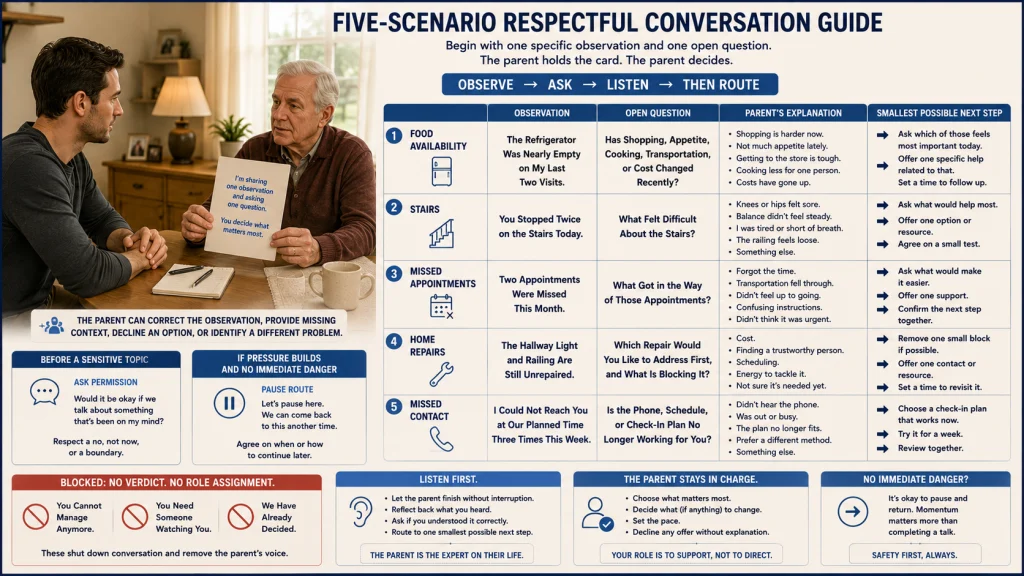
Ask Directly With One Observation and One Open Question
After observing a pattern, the next step is not to present a case against the person. A respectful question gives them a chance to explain the context, correct an assumption, and identify the part that feels difficult.
| Observation | Open question |
|---|---|
| “The refrigerator was nearly empty on my last two visits.” | “Has shopping, appetite, cooking, transportation, or cost changed recently?” |
| “You stopped twice on the stairs today.” | “What felt difficult about the stairs?” |
| “Two appointments were missed this month.” | “What got in the way of those appointments?” |
| “The hallway light and railing are still unrepaired.” | “Which repair would you like to address first, and what is blocking it?” |
| “I could not reach you at our planned time three times this week.” | “Is the phone, schedule, or check-in plan no longer working for you?” |
The guide to talking with aging parents about help provides the full conversation workflow. If the response is no, the article on what a refusal may be protecting can help you redesign the offer without turning the conversation into a verdict.
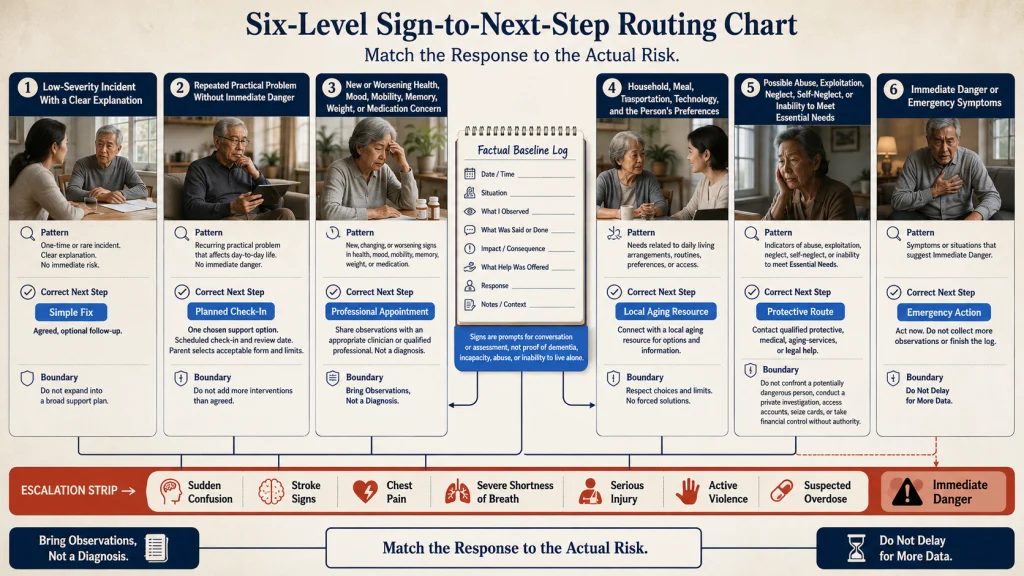
Choose the Next Step That Matches the Pattern
Not every observation needs the same response. Route the issue by severity, repetition, and the kind of problem involved.
| Pattern | Possible next step | Boundary |
|---|---|---|
| One low-severity incident with a clear explanation | Make the simple fix and agree on whether a follow-up is useful. | Do not expand one solved event into a broad care plan. |
| Repeated practical problem without immediate danger | Schedule a check-in, test one support option, and set a review date. | Keep the older adult involved in choosing the support. |
| New or worsening health, mood, mobility, memory, weight, or medication concern | Arrange an appropriate clinical or professional appointment. | Bring observations, not a diagnosis. |
| Household, meal, transport, or social-support gap | Contact a local aging resource, social worker, or service coordinator. | Confirm cost, eligibility, privacy, and the person’s preferences. |
| Possible abuse, exploitation, neglect, or inability to meet essential needs | Use qualified protective, medical, aging-services, or legal help. | Do not investigate or intervene beyond your role when danger may be present. |
| Immediate danger or emergency symptoms | Use emergency services immediately. | Do not delay action to collect more observations or finish the log. |
For U.S. local services, the federal Eldercare Locator connects older adults and families with Area Agencies on Aging and community resources.
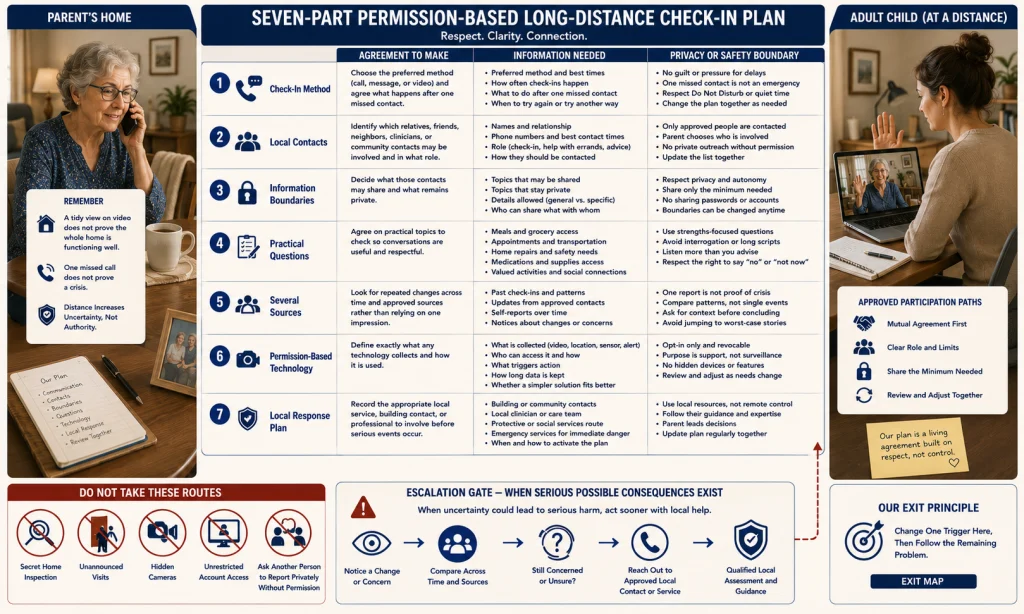
Respect the Limits of Long-Distance Observation
Distance can make every missed call feel larger and every reassuring answer feel incomplete. Phone and video calls still show only part of the day. A tidy camera angle does not prove the home is functioning well, and one missed call does not prove a crisis.
Use a permission-based long-distance checklist:
- Agree on a regular check-in method and what to do when a call is missed.
- Ask which local relatives, friends, neighbors, clinicians, or community contacts may be included.
- Confirm whether those contacts can share concerns and what information remains private.
- Ask about meals, appointments, transportation, home repairs, and valued activities instead of only asking, “Are you okay?”
- Compare changes across several calls and sources rather than relying on one person’s impression.
- Use monitoring technology only with clear permission, a defined purpose, limited access, and an agreed response plan.
- Know which local service or emergency number applies before a problem occurs.
Do not ask someone to inspect the home secretly or arrive unannounced unless a qualified emergency or protective process directs that action. Distance increases uncertainty, so local professional assessment may be necessary sooner when the consequence could be serious.
Document What Changed and Reassess the Response
A support plan should change when the pattern changes. Record what was tried, whether the older adult found it acceptable, and whether the original consequence improved.
At the review date, ask:
- Did the observation repeat?
- Was the first explanation confirmed or ruled out?
- Did the simple fix solve the problem?
- Did the support create new cost, privacy, trust, or workload concerns?
- Is the person’s valued activity easier to continue?
- Does the pattern now require a different professional or service route?
- Has urgency increased?
Use the guide to planning for aging when several domains need proactive backup plans rather than repeated reactions to isolated problems.
Choose One Pattern, One Conversation, and One Routed Next Step
Start with one repeated or consequential change and compare it with the person’s usual routine. Record what happened, how often, in what context, and what it affected.
Ask the person directly using one observation and one open question. Then choose the smallest next step that matches the actual problem, whether that is a repair, check-in, professional appointment, community service, protective report, or urgent action when delay would be unsafe.
The aim is neither to dismiss change nor to turn an imperfect day into a verdict. It is to notice a meaningful pattern early enough to respond with the right kind of support.
FAQs
🗓️ How many incidents make a pattern?
There is no universal number. Consider repetition, severity, context, and consequence. One severe event may require immediate action, while several low-severity events may justify a planned conversation or assessment.
🏠 Does clutter mean my parent cannot live alone?
No. Compare the home with the person’s baseline and identify whether clutter blocks essential access, creates danger, or reflects a temporary event. One cluttered area does not determine living ability.
🧠 Does forgetfulness prove dementia?
No. Occasional forgetfulness does not establish dementia. New, worsening, or consequential memory and thinking changes should be documented and discussed with an appropriate health professional.
🍽️ What should I do if the refrigerator is repeatedly empty?
Ask about appetite, cost, shopping, transport, pain, cooking, and food preferences. Address the practical barrier and seek professional attention when weight, health, or essential-needs concerns are present.
🚗 Can I decide from this checklist that driving must stop?
No. Document specific driving or transportation observations and route them to an appropriate clinical, driving, licensing, or local safety process. Do not remove keys or a vehicle based on this article alone.
📱 Should I install monitoring technology?
Only after identifying the problem and obtaining permission whenever possible. Define what is collected, who can see it, what triggers action, and whether a simpler solution addresses the cause.
💊 Can I reorganize medication if I notice mistakes?
Do not change treatment on your own. Record the observation and contact the prescribing clinician, pharmacist, or relevant professional. Urgent reactions or suspected overdose require immediate help.
🚨 Which observations require prompt outside help?
Use emergency services for immediate danger, stroke signs, chest pain, severe shortness of breath, serious injury, or sudden confusion. Suspected abuse, exploitation, neglect, or inability to meet essential needs also needs prompt qualified local support.