Kitchen ventilation works best when it captures cooking emissions close to the pan before they spread through the room. Begin by verifying whether the existing hood or microwave unit vents outdoors or recirculates air back into the kitchen. When outdoor-vented exhaust is available, turn it on early, place active cooking under the capture area when practical, continue operation according to current official and product guidance, and maintain accessible grease filters and surfaces as instructed. Fan sound, lighting, and visible air movement do not prove outdoor exhaust or effective capture. Windows, filtration, and portable devices are secondary tools, not replacements for source capture. Duct, airflow, makeup-air, combustion, electrical, and installation questions require qualified assessment.
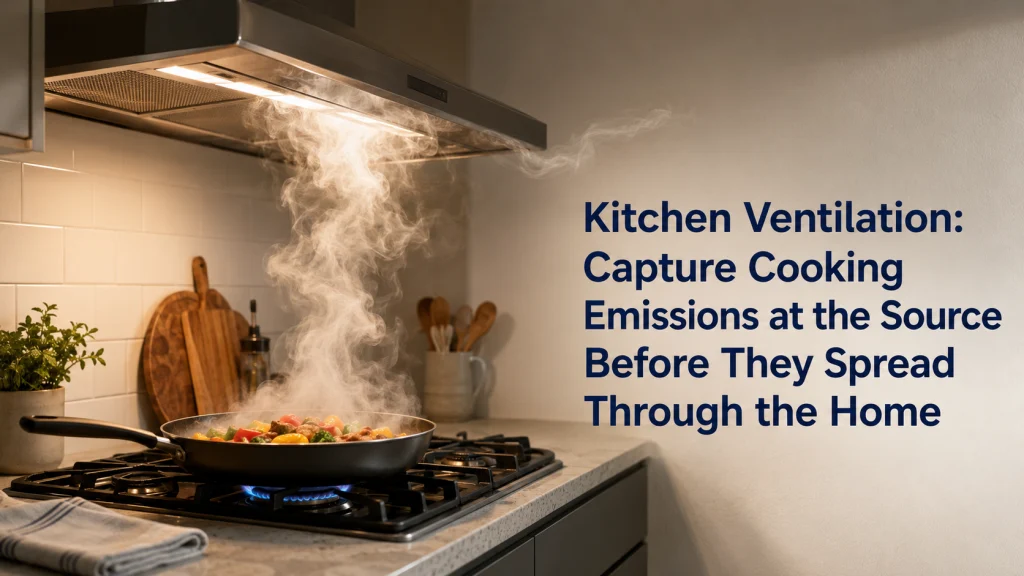
The Same Pan Can Produce Three Different Capture Outcomes
The food, heat, and cooking method stay the same. What changes is the position of the pan and the path available above it.
In the first kitchen, the pan sits on a front burner beneath a shallow hood. Steam and odor move upward, but part of the plume rolls past the hood edge and into the room. In the second, the pan sits on a back burner beneath the deeper part of the capture area. In the third, a fan runs above the stove but sends the air back into the kitchen rather than outdoors.
| Cooking position | What happens near the pan | What the household notices | First practical question |
|---|---|---|---|
| Front burner under a shallow hood | Part of the rising plume may move beyond the capture area | Odor and moisture spread even though the fan is running | Can the active cooking move farther under the hood? |
| Back burner under the capture area | The plume begins closer to the hood’s deeper coverage | Less of the plume appears to drift past the front edge | Does the unit vent outdoors and remain usable at that speed? |
| Recirculating unit with no outdoor duct | Air passes through the unit and returns to the kitchen | The room may still hold heat, moisture, and lingering odor | Which emissions remain after filtration and recirculation? |
For the person cooking, the difference is felt later: the smell that follows them into the next room, the moisture that hangs around after dinner, or the relief of finishing without the whole home carrying the cooking event with it.
The broader guide to creating an air path through the home covers general ventilation. This article stays at the cooking source, where capture has the best chance to happen before emissions spread.
Define Cooking Emissions, Local Exhaust, Capture, Ducted, Recirculating, Airflow, Makeup Air, and Continued Run Time
Cooking emissions is a broad term for particles, gases, moisture, heat, grease, and odors produced during cooking. The amount and pattern vary with the food, cooking method, temperature, burner, pan, and duration.
Local exhaust removes air near the source. In a kitchen, the usual goal is to capture the rising plume before it mixes through the room. Capture describes how much of that plume enters the hood or exhaust opening.
A ducted unit sends captured air through a duct to an outdoor termination. A recirculating unit passes air through one or more filters and returns it to the kitchen. A grease filter is intended to collect grease from the airstream according to the unit design and maintenance instructions.
Airflow describes moving air, often discussed through a rated value. Real-home capture also depends on hood geometry, burner position, duct route, installation, pressure, and actual fan use.
Makeup air is replacement air that enters as exhaust removes indoor air. Its need, design, code requirements, and interaction with combustion equipment are professional questions. Continued run time means leaving the exhaust operating after active cooking according to current official and product guidance rather than switching it off the instant the burner stops.
The wider indoor air quality framework places kitchen capture beside source control, filtration, moisture management, cleaning, and building maintenance.
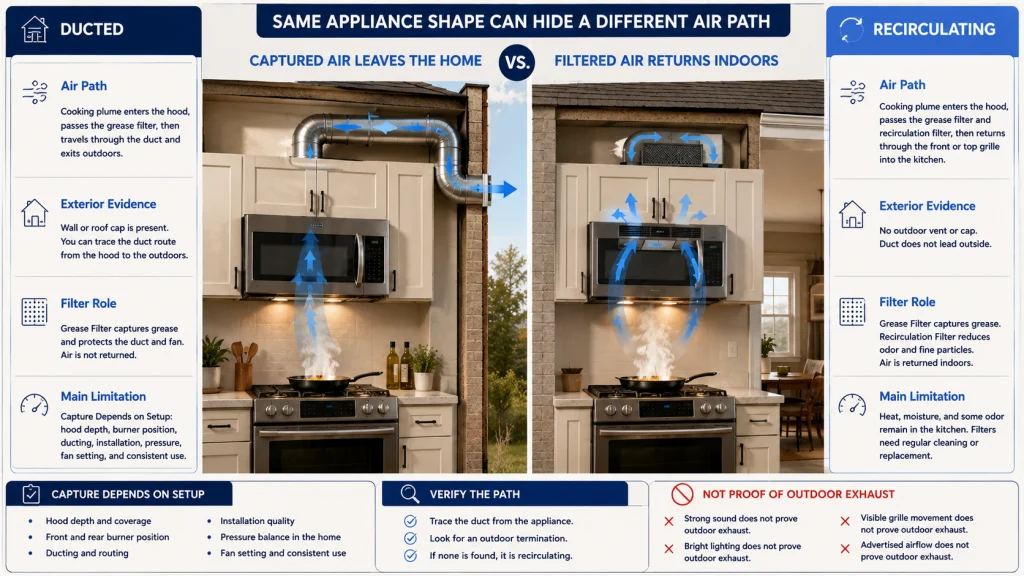
Identify Whether the Existing Unit Vents Outdoors or Recirculates
A fan above the cooking surface can look substantial and still recirculate air. Over-the-range microwave units are especially easy to misunderstand because the same exterior form may be configured for outdoor ducting or recirculation.
| Feature | Ducted configuration | Recirculating configuration |
|---|---|---|
| Air path | Captured air travels through a duct to an outdoor termination | Air passes through filters and returns to the kitchen |
| Exterior evidence | May have a wall or roof termination connected to the unit | No outdoor exhaust path for that unit |
| Filter role | Grease filtration protects the unit and duct path | Grease filtration plus any recirculation filter specified by the design |
| Main limit | Capture still depends on geometry, ducting, installation, and use | Filtered air returns indoors, so source removal is limited |
- Find the exact model information and installation or use manual.
- Look for a documented outdoor duct route and exterior termination.
- Check whether the unit was installed in recirculating, rear-ducted, or upward-ducted configuration.
- Identify every accessible filter and its stated purpose.
- Do not infer the path from fan noise, lighting, grille shape, or air felt at the front of the unit.
- Do not remove panels, alter ducts, or test wiring to determine the configuration.
- Ask a qualified professional when the path, termination, or installation is unclear.
Nora’s practical rule is to verify the path before comparing features. Once that question is settled, quieter controls, better lighting, easier cleaning, and accessible filters become meaningful because they affect whether the household will actually use the unit.
Turn Outdoor-Vented Exhaust On Early Instead of Waiting for Visible Smoke
Waiting for the kitchen to look smoky means the plume has already moved beyond the pan. Visible smoke is only one sign of cooking emissions, and odor alone is not a reliable measure of what the hood captured.
When an outdoor-vented hood is available and safe to operate, turn it on as cooking begins rather than after the room feels uncomfortable. Use a speed that the household can tolerate and that matches the installed equipment guidance.
This is where noise becomes a practical design issue. A setting that is technically available but so disruptive that no one uses it does not support a consistent routine. Lower, earlier operation may be more realistic than waiting and then using a louder setting after the plume has spread.
Nora looks at the control from the person’s point of view: can it be reached with messy hands, can the speed be changed without searching for a hidden button, and is the sound tolerable enough that the fan stays on through the task?
A routine that begins before the pan becomes a problem can feel calmer. The cook is no longer reacting to smoke, opening doors in a rush, or carrying the worry that the smell will linger through the rest of the evening.
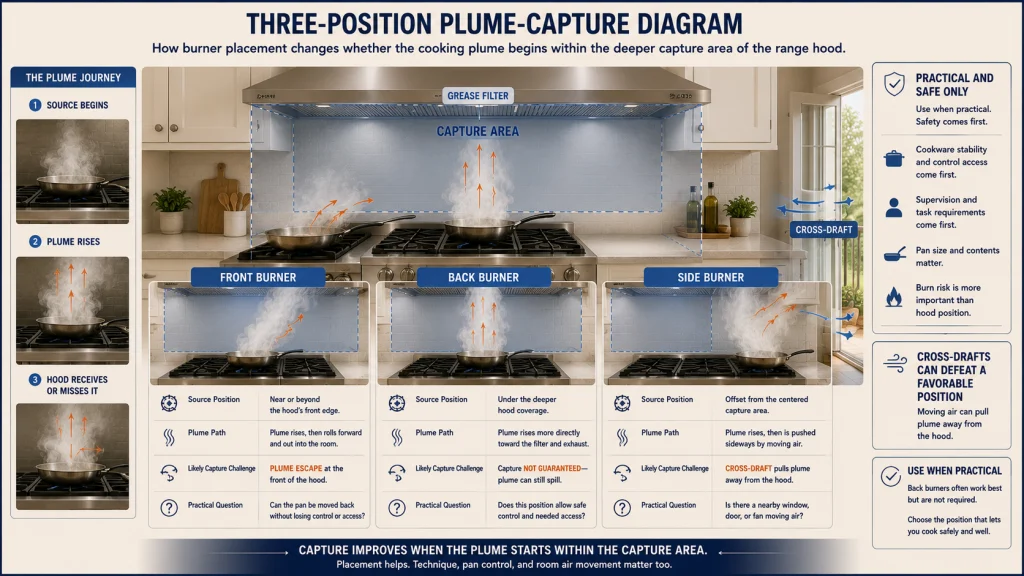
Use Back Burners When Practical to Keep the Pan Under the Capture Area
Burner position changes where the cooking plume begins. A pan on a front burner may sit partly beyond a shallow hood, while a back burner places the source farther beneath the capture surface.
Back burner → plume rises within deeper hood coverage → air reaches filter and exhaust path
Front burner → plume rises near or beyond front hood edge → part of the plume may enter the room
Side burner → plume may miss centered capture area → cross-drafts can carry it farther away
Use a back burner only when it is practical and safe for the pan, cookware, controls, supervision, and cooking task. The goal is not to force every meal onto one burner. It is to notice whether the active source sits beneath the part of the hood designed to receive it.
Keep cross-drafts in mind as well. A strong nearby fan, open door, or window can pull the plume away from the hood even when the burner position looks favorable.
Continue Operation After Cooking According to Current Guidance
The burner may be off while heat, moisture, odor, and residual plume remain near the cooking area. Switching the exhaust off immediately can leave that final portion in the room.
Continue operating the outdoor-vented exhaust according to current official guidance and the exact product instructions. This article does not provide one universal number of minutes because the cooking event, equipment, control design, and home conditions differ.
Use a review point rather than leaving the fan on indefinitely. Check whether active cooking has ended, the immediate plume has cleared, the unit remains safe and stable, and the manufacturer allows the selected operation.
A routine is easier to remember when the endpoint is attached to another action, such as clearing the cooking surface or beginning cleanup, rather than relying on a vague intention to return later.
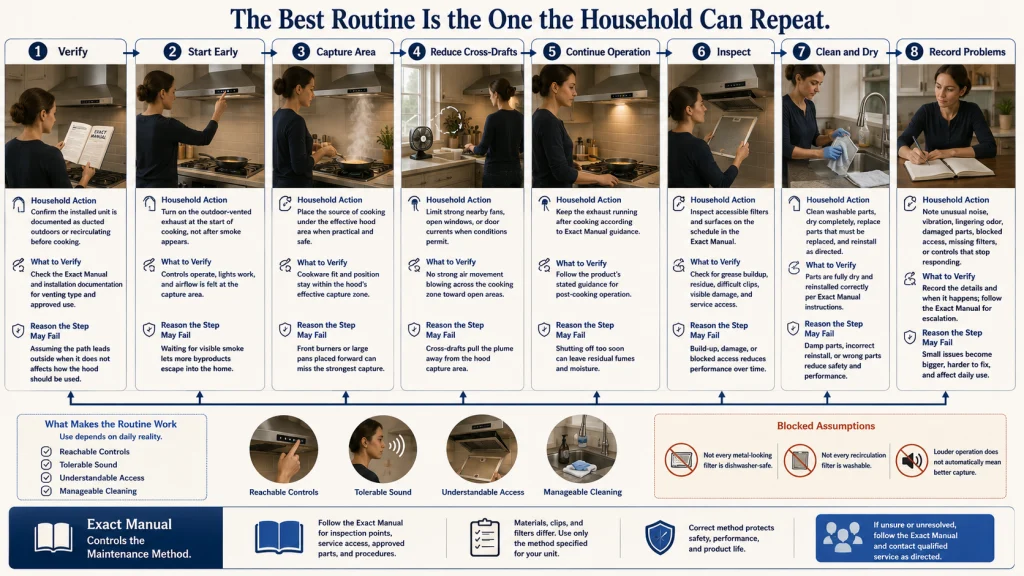
Clean Grease Filters and Accessible Surfaces According to the Exact Manual
Grease filters and accessible hood surfaces are part of the air path. As residue accumulates, cleaning becomes harder, odors may linger, and the unit may become less pleasant to use.
Follow the exact manual for filter removal, cleaning method, drying, replacement, reinstallation, and any parts that should not be washed. Do not assume that every metal-looking filter is dishwasher-safe or that every recirculation filter can be cleaned and reused.
- Verify that the unit is outdoor-vented or recirculating.
- Turn outdoor-vented exhaust on at the start of cooking.
- Place active cooking under the capture area when practical.
- Keep strong cross-drafts from pulling the plume away.
- Continue operation according to official and product guidance.
- Inspect accessible filters and surfaces on the schedule in the manual.
- Clean, dry, replace, and reinstall each part exactly as instructed.
- Record unusual noise, vibration, odor, damaged parts, or controls that stop responding.
Easy cleaning can shape real use. Nora notes that a filter hidden behind awkward clips or a surface with difficult seams may turn a simple task into something repeatedly postponed.
There is also a small emotional payoff in a routine that stays manageable. A filter that is easy to remove and reinstall makes it less likely that cleaning becomes one more unfinished household job waiting in the background.
Fan Noise, Lighting, and Air Movement Do Not Prove Outdoor Exhaust or Effective Capture
This is the point where sensory impressions can mislead. A loud unit may be moving air through a difficult path, while a quieter one may be connected to a useful outdoor termination. Sound alone cannot explain what happened to the plume.
Lighting tells you that the light works. Air felt near a front grille may simply be recirculated air returning to the kitchen. A paper or tissue test near the filter can show that air is entering the unit, but it cannot measure capture across the pan, verify rated airflow, or confirm safe installation.
Advertised airflow also needs context. The installed result depends on the duct route, turns, termination, pressure relationships, makeup-air requirements, and the speed the household is willing to use.
When performance seems poor, document the model, configuration, controls, filter condition, burner position, noise, and visible installation path. That record gives a qualified professional something more useful than “the fan sounds strong but the kitchen still smells.”
Use Windows or Other Exhaust Only When Outdoor Conditions and Safety Permit
When no outdoor-vented hood is available, an open window or another outdoor-exhaust path may help move some indoor air. It does not recreate capture directly above the pan.
Check outdoor smoke, pollution, humidity, heat, cold, rain, wind, pollen conditions, security, children, pets, and safe opening limits before using windows. A cross-draft that moves room air may also pull the cooking plume away from the hood.
The guide to deciding when windows are suitable helps evaluate outdoor conditions before using them as a fallback.
In apartments, exterior openings, shared ducts, sealed windows, landlord responsibilities, and building rules may limit the available path. Use apartment indoor-air guidance when the ventilation problem depends on shared systems or building access.
Use Filtration as a Supplement, Not a Replacement for Source Capture
Filtration can address selected airborne material after it has entered the room. Source capture aims to intercept the plume before that spread happens.
A recirculating hood, HVAC filter, or portable air cleaner may have a supporting role according to its design and instructions. None should be described as equivalent to a properly designed outdoor-exhaust path above the cooking source.
Filtration also does not remove heat and moisture in the same way as outdoor exhaust, and one filter type does not address every gas, particle, odor, or cooking condition.
Use filtration as one layer in the healthy home environment approach, alongside source control, cleaning, moisture management, maintenance, and appropriate ventilation.
Prepare Professional Questions About Duct Route, Termination, Airflow, Noise, Makeup Air, and Combustion
A qualified consultation should begin with the home and the cooking setup, not a single advertised airflow number.
| Professional question area | Questions to bring |
|---|---|
| Capture geometry | How do hood depth, width, mounting position, and burner layout affect source capture? |
| Duct route | Where will the duct run, how will it terminate outdoors, and what constraints affect the route? |
| Airflow | What installed airflow is appropriate, and how will it be verified rather than assumed from a label? |
| Noise | What sound can occupants expect at the settings they are likely to use? |
| Makeup air | What current code, pressure, and replacement-air requirements apply to this home? |
| Combustion | How will fireplaces, fuel-burning appliances, attached garages, and other exhaust devices be evaluated? |
| Electrical and controls | What wiring, controls, interlocks, lighting, and service access are required? |
| Maintenance | How are filters, fans, ducts, exterior terminations, and replacement parts accessed? |
| Documentation | Which manuals, settings, warranty terms, permits, and verification records will be provided? |
Whole-home pressure and permanent ventilation may also affect the decision. The overview of whole-house ventilation systems helps separate kitchen source capture from broader mechanical ventilation.
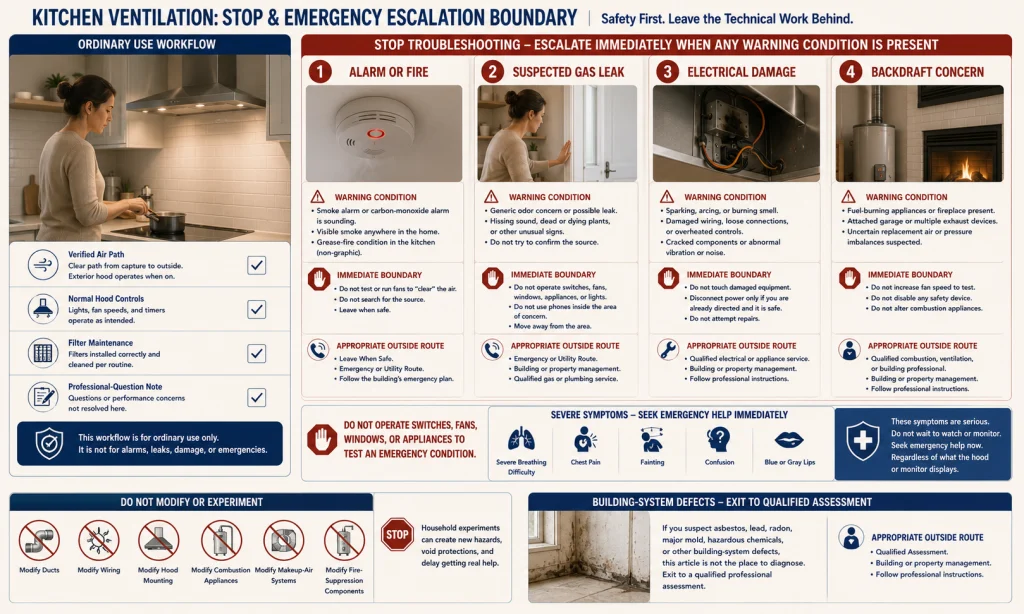
Stop for Gas Odor, Alarms, Fire, Damaged Wiring, or Backdraft Concerns
Gas, fire, electrical, and installation boundary: A sounding smoke or carbon monoxide alarm, visible fire or smoke, a suspected gas leak, a grease fire, damaged or sparking wiring, or a suspected combustion backdraft requires stopping ordinary troubleshooting. Leave the area when safe and contact emergency, utility, building, or qualified professional services as appropriate. Do not operate switches, fans, windows, or appliances to test an emergency condition.
Severe breathing difficulty, chest pain, fainting, confusion, blue or gray lips, or other emergency signs require immediate appropriate help. Persistent or worsening symptoms require qualified medical guidance.
Do not modify ducts, electrical connections, hood mounting, combustion equipment, makeup-air systems, or fire-suppression components as a household experiment. Suspected asbestos, lead, radon, major mold, hazardous chemicals, or building-system defects require appropriately qualified assessment.
Verify the Path, Capture Early, Use It Consistently, Maintain It, and Escalate Installation Questions
Begin with the installed path, then focus on use. Turn outdoor-vented exhaust on at the start of cooking, keep the active pan beneath the capture area when practical, reduce cross-drafts, and leave the system operating according to current official and product guidance after the burner stops.
Keep filters and accessible surfaces maintained exactly as the manual requires. The strongest routine is not the most complicated one. It is the one the household can repeat because the controls are reachable, the sound is tolerable, and cleaning does not become a barrier.
Windows and filtration can support the plan when conditions permit, but they serve different roles from source capture. Duct routing, airflow, makeup air, combustion, electrical work, code, and installation belong with qualified professionals.
The practical goal is a kitchen that does not demand emergency reactions every time the pan gets hot. It is a clear, usable path that catches more of the cooking event close to where it begins and lets the rest of the home feel less involved.
FAQs
🍳 When should I turn on kitchen ventilation?
When an outdoor-vented hood is available and safe to operate, turn it on as cooking begins rather than waiting for visible smoke. Early operation gives the hood a chance to capture the plume before it spreads.
🏠 How can I tell whether my range hood vents outdoors?
Check the exact model manual, installed configuration, duct route, and exterior termination. Do not infer the path from fan noise, a front grille, lighting, or air movement near the unit.
🔄 Does a recirculating microwave fan remove cooking fumes?
A recirculating unit passes air through its specified filters and returns it to the kitchen. It can have a supporting role, but it does not provide the same source-removal path as outdoor exhaust.
🔥 Do back burners improve range hood capture?
They can place the pan farther beneath the hood’s capture area when the cookware and task can be used there safely. Burner position is only one factor, alongside hood geometry, cross-drafts, fan use, ducting, and installation.
⏱️ How long should the hood run after cooking?
Follow current official guidance and the exact instructions for the installed unit. This article does not give one universal number because cooking events, equipment, controls, and home conditions differ.
🧼 How often should I clean a grease filter?
Use the schedule and method in the exact manual. Filter types differ, and some parts are cleaned while others must be replaced rather than washed.
🚩 When should I stop troubleshooting kitchen ventilation myself?
Stop for alarms, visible fire or smoke, a suspected gas leak, damaged wiring, a grease fire, or suspected backdrafting. Duct, electrical, makeup-air, combustion, code, and installation work require qualified help.