Stress triggers are easier to identify when you look beyond the final visible event. Map the immediate spark, the background load that made it matter, the meaning attached to the situation, and the limits on what could be changed. Then check whether the pattern repeats, look for counterexamples, and choose one small observation or adjustment. This framework helps organize everyday stressors without diagnosing a condition, assigning blame, or treating trauma-related reactions as ordinary routine problems.
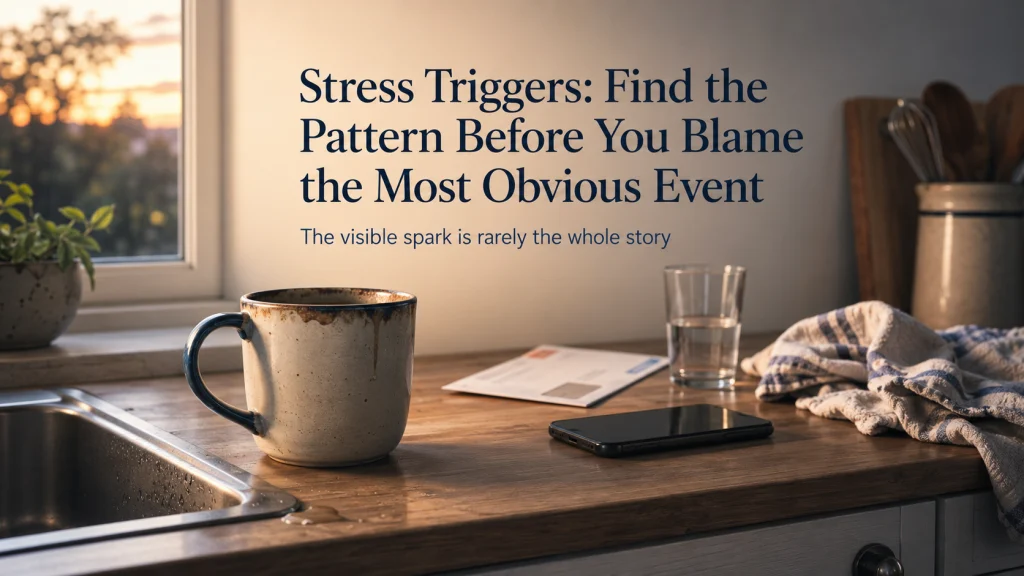
The Argument About the Mug Did Not Begin With the Mug
An argument appears to start when one person sees an unwashed mug beside the sink. The mug is visible, immediate, and easy to name. It looks like the trigger.
Now reconstruct the previous six hours. Sleep ended earlier than usual. Lunch was skipped. Notifications interrupted the afternoon. One delayed task remained unresolved. There was no quiet transition between work and home. Then the mug appeared in a shared kitchen that already felt crowded.
| Layer | What happened | Why it matters to the pattern |
|---|---|---|
| Background fuel | Shortened sleep, hunger, repeated interruptions, unresolved work, and no recovery window | Several demands were already consuming attention and patience. |
| Immediate spark | An unwashed mug in a shared space | The final event made the accumulated strain visible. |
| Interpretation | “I am the only one noticing what needs to be done.” | The event carried meaning beyond the object itself. |
| Response | A sharp comment followed by an argument | The visible reaction occurred after the full chain, not only after the mug. |
The last event may be the spark without being the whole fuel source. Useful trigger tracking looks backward far enough to see the load that made the spark matter.
Use the broader guide to manage stress in daily life when you need the full decision framework. Once the pattern is clearer, practical coping skills for stress can help match the response to the part of the chain that is still active.
Define Stressor, Trigger, Background Load, and Response
These terms are useful only when they describe different parts of the pattern. Treating them as interchangeable makes it harder to see what can be observed or changed.
| Term | Plain-language meaning | Example from a changed work request |
|---|---|---|
| Stressor | A demand, condition, uncertainty, conflict, or constraint that places pressure on the person. | An unclear project, limited time, and several people waiting for answers |
| Trigger | An event or cue that reliably precedes a noticeable response in a particular context. | A message changing the deadline after preparation has already begun |
| Background load | The demands already present before the immediate event. | Two unfinished tasks, repeated interruptions, and no clear decision owner |
| Response | The change in thoughts, emotions, attention, behavior, or physical comfort that follows. | Rushed reading, task switching, frustration, and a brief reply that creates more questions |
A trigger is not a diagnosis, a character flaw, or proof that one event caused everything that followed. It is a practical label for a repeated point in the sequence that may help the person decide what to observe next.
If the response itself is still difficult to recognize, review changes that may occur during stress before trying to map what came first.
The Final Event Is Not Always the Main Cause
The final event receives attention because it happens closest to the reaction. An email arrives, a child interrupts, a colleague changes the plan, traffic stops, or a household item is left out. The timing makes that event easy to blame.
But proximity is not the same as importance. The same email may feel manageable after sleep, food, clear expectations, and uninterrupted work. It may feel overwhelming after a rushed morning, several unresolved decisions, and no space to recover.
Look backward in widening circles:
- Last minute: What happened immediately before the response?
- Earlier in the hour: What interruptions, delays, conflicts, or uncertainties were already active?
- Earlier in the day: What happened with sleep, food, workload, caregiving, privacy, and recovery?
- Recent pattern: Has the same combination appeared on other days?
This reconstruction does not prove causation. It prevents the investigation from stopping at the most visible event when a broader pattern may be more useful.
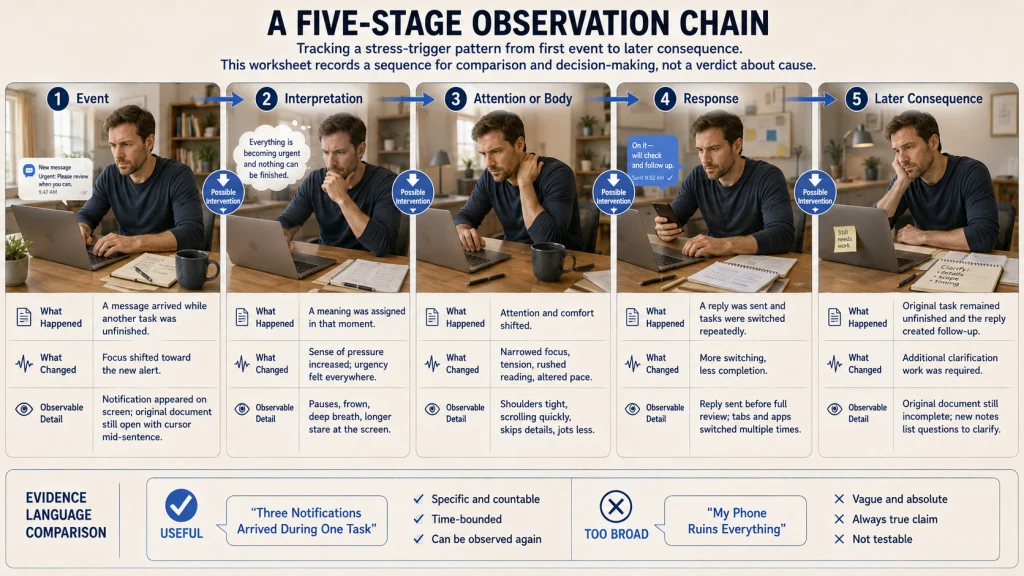
Build the Trigger Chain From Event to Later Consequence
A trigger chain records the sequence without turning it into a verdict. The goal is to see where the pattern changes direction and where a small intervention might be possible.
| Chain step | Question | Example entry |
|---|---|---|
| Event | What happened first in the visible sequence? | An urgent message arrived while another task was unfinished. |
| Interpretation | What did the event seem to mean in that moment? | “Everything is becoming urgent, and I cannot finish anything.” |
| Body or attention change | What changed in focus, tension, breathing, pace, or physical comfort? | Attention narrowed, shoulders tightened, and reading became rushed. |
| Response | What did the person do next? | Switched tasks repeatedly and sent a brief reply without checking it. |
| Later consequence | What happened afterward? | The original task remained unfinished, and the reply created more clarification work. |
Write observable details where possible. “Three notifications arrived during one task” is easier to test than “My phone ruins everything.” “I assumed the request had to be handled immediately” is more useful than “The sender made me stressed.”
Map Immediate Triggers Without Treating Them as Universal
Immediate triggers may include deadlines, conflict, noise, interruptions, uncertainty, unexpected change, unclear requests, waiting, public mistakes, crowded spaces, or competing demands. The category does not predict the response by itself.
A deadline can feel clarifying when the task is understood and resources are available. The same deadline can feel much harder when instructions conflict, decisions are pending, and several people expect updates. Noise may fade into the background on one day and become difficult to tolerate on another.
Record the event with enough detail to distinguish it from a broad label:
- “Three messages arrived during the final twenty minutes of a task” rather than “notifications.”
- “The meeting began without a decision owner” rather than “work stress.”
- “The kitchen was loud while two people needed the same counter” rather than “noise.”
- “The plan changed after preparation was complete” rather than “unexpected change.”
The more specific description makes it easier to compare similar events and identify which part of the situation may be changeable.
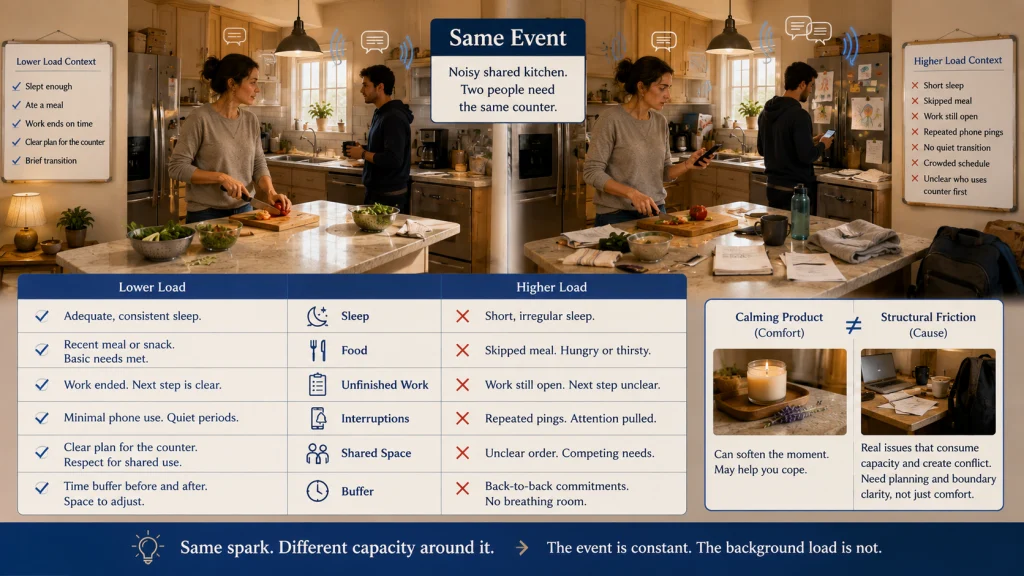
Look for Background Load Before the Spark
Some days feel crowded before anything visibly goes wrong. The room is the same, the messages are ordinary, and the unfinished task is familiar, yet there is less space left for one more demand.
Background load includes demands that reduce available time, attention, privacy, patience, or recovery before the immediate trigger appears. Common examples include poor sleep, hunger, caregiving, crowded schedules, unresolved tasks, financial uncertainty, illness in the household, and repeated interruption.
These conditions may not create a visible reaction on their own. They often make the system less flexible. A small delay matters more when the schedule has no buffer. A noisy room matters more when concentration has already been interrupted all afternoon.
One practical environmental review can include lighting, noise, clutter, shared-space conflict, setup friction, and maintenance tasks that keep returning. A calming object or relaxation product may be pleasant, but it is unlikely to solve unclear expectations, overcommitment, or a workspace that requires constant interruption.
Use neutral language. “I had no meal break and three unresolved tasks” records load. “I cannot handle normal life” turns one difficult pattern into a judgment about the whole person.
Include Personal Meaning and Expectations
People rarely respond only to the surface event. They also respond to what the event seems to say about time, fairness, safety, competence, or whether their effort mattered.
The same event can carry different stakes for different people without implying pathology. A late reply may mean inconvenience to one person and possible job risk to another. A change in plans may feel minor when the day is flexible and costly when transportation, childcare, or caregiving has already been arranged.
Ask what the event appeared to threaten or demand:
- Time that was already scarce
- Control over a shared plan
- Fairness in a relationship or household
- Competence or reputation at work
- Safety, predictability, privacy, or financial stability
- A promise or responsibility that matters to the person
Meaning should be recorded as an interpretation, not a diagnosis. “I read the change as evidence that my preparation did not matter” is a workable observation. It can later be checked against what was actually communicated and what options were available.
Once the event and its meaning are separated, the next question is whether the same combination appears often enough to guide a decision.
Separate Predictable Patterns From One-Off Coincidence
One difficult event can be memorable without being a reliable trigger. A pattern becomes more useful when similar conditions repeatedly appear before a similar response.
Compare several features:
| Pattern question | What supports a repeated pattern | What suggests caution |
|---|---|---|
| Timing | The response repeatedly follows a similar sequence. | The event and response happened together only once. |
| Context | Similar background load is present across several examples. | The surrounding conditions differ substantially each time. |
| Response | A recognizable thought, behavior, or physical change returns. | The response is different or absent in similar situations. |
| Function | The combination repeatedly changes work, relationships, sleep, or self-care. | The event is irritating but does not create a continuing pattern. |
Do not force consistency where it does not exist. A trigger map can remain uncertain while more observations are collected.
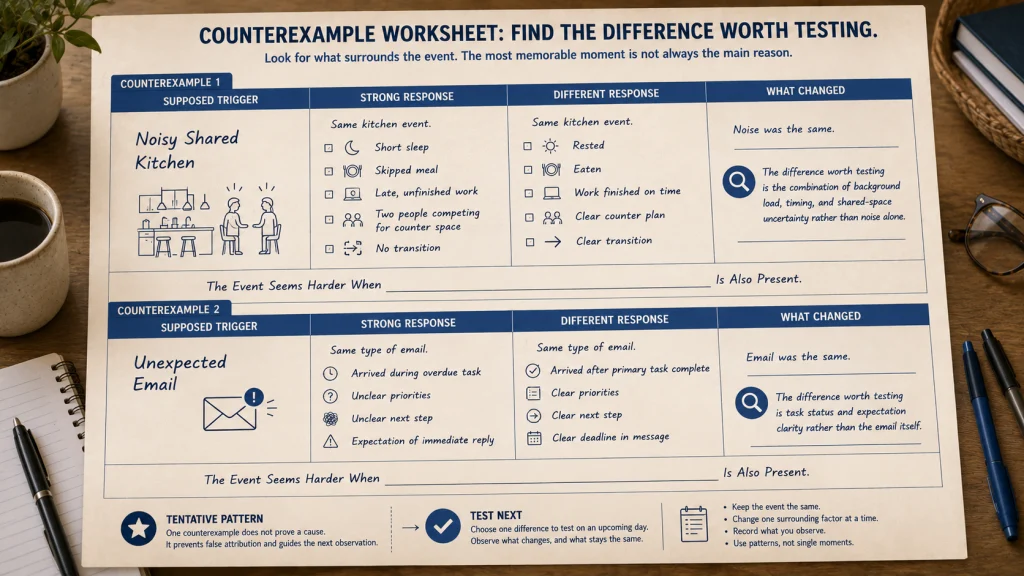
Use Counterexamples to Reduce False Attribution
A counterexample is a time when the supposed trigger occurred without the same response. It helps identify what else was different.
| Supposed trigger | Day with a strong response | Day without the same response | Difference worth testing |
|---|---|---|---|
| A noisy shared kitchen | Short sleep, skipped meal, late work, two people competing for the counter, and no quiet transition | Rested, fed, work ended on time, and the counter plan was clear | The combination of load, timing, and shared-space uncertainty may matter more than noise alone. |
| An unexpected email | Arrived during an overdue task with unclear priorities | Arrived after the main task was complete and the request had a clear deadline | Task status and expectation clarity may change the response. |
Complete the exercise with one sentence: “The event seems harder when _____ is also present.” That wording keeps the conclusion testable and avoids declaring one universal trigger.
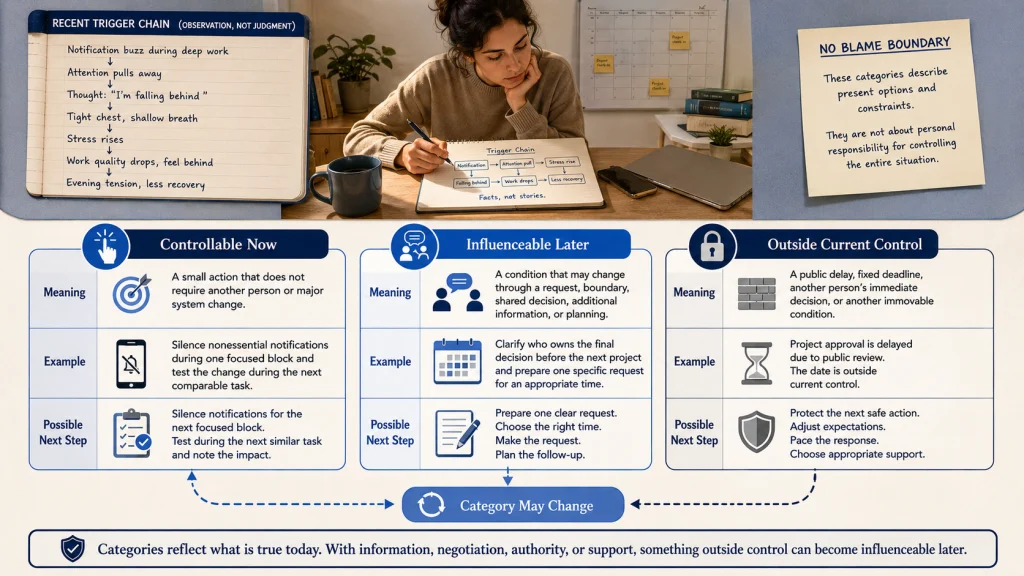
Mark What Is Controllable, Influenceable, or Outside Current Control
Trigger tracking becomes more practical when the map separates what can change now from what may require negotiation, planning, or acceptance of a limit.
| Control category | Meaning | Example | Possible next step |
|---|---|---|---|
| Controllable now | A small action is available without waiting for another person or major system change. | Silence nonessential notifications during one focused block. | Test the change during the next comparable task. |
| Influenceable later | The condition may change through a request, boundary, plan, or shared decision. | Clarify who owns the final decision before the next project begins. | Prepare one specific request and choose when to raise it. |
| Outside current control | The condition cannot be changed immediately by the person. | A public delay, another person’s decision, or a fixed deadline | Protect the next safe action, adjust expectations, and choose support for the response. |
The categories can change over time. Something outside control today may become influenceable after more information or support appears. The purpose is not to blame the person for failing to control the situation. It is to avoid spending the entire response on a part of the chain that cannot move right now.
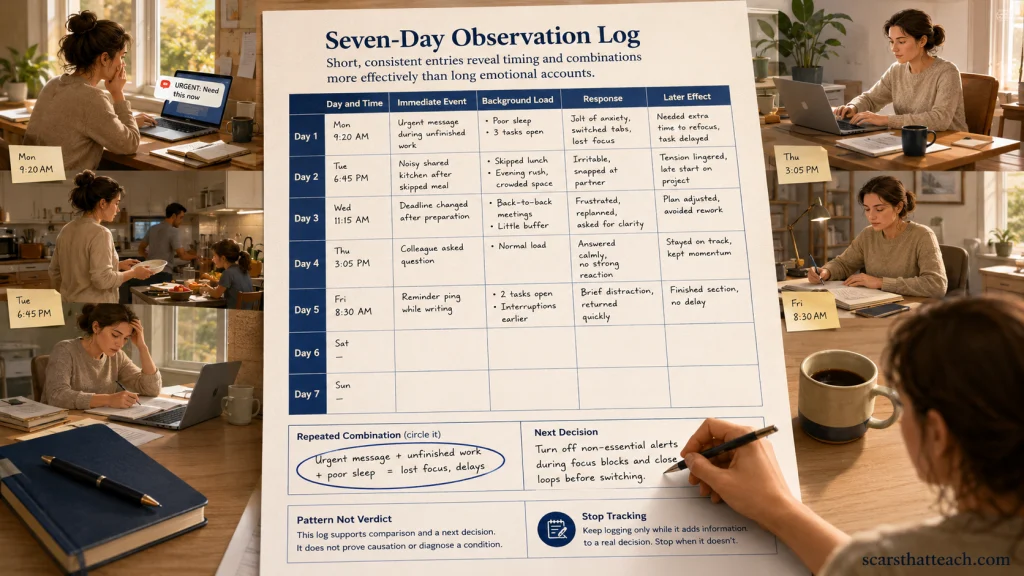
Run a Seven-Day Trigger Log With Five Fields
Keep the log short enough to use. Record only the information needed to compare timing, background load, and later effect.
| Day and time | Immediate event | Background load | Response | Later effect |
|---|---|---|---|---|
| Day 1: ______ | ________________ | ________________ | ________________ | ________________ |
| Day 2: ______ | ________________ | ________________ | ________________ | ________________ |
| Day 3: ______ | ________________ | ________________ | ________________ | ________________ |
| Day 4: ______ | ________________ | ________________ | ________________ | ________________ |
| Day 5: ______ | ________________ | ________________ | ________________ | ________________ |
| Day 6: ______ | ________________ | ________________ | ________________ | ________________ |
| Day 7: ______ | ________________ | ________________ | ________________ | ________________ |
At the end of the week, circle repeated combinations rather than the most dramatic single event. When continued tracking is useful, the guide to keeping a simple stress journal can help organize observations without turning them into a diagnosis.
Test One Small Change Without Redesigning the Entire Routine
Choose one variable that is both relevant to the mapped chain and realistic to change. Keep the rest of the routine as stable as possible so the result is easier to interpret.
Small-change experiment: Name the repeated pattern, change one controllable element, observe the next comparable situation, and record what changed afterward.
Examples include creating one quiet transition after work, silencing nonessential notifications during one task, eating before a recurring late meeting, clarifying the deadline on one request, or preparing a shared surface before two people need it.
The experiment should not be framed as a cure. If the response changes, record the difference. If it does not, return to the chain and consider whether the chosen variable was secondary rather than central.
Choose Coping Based on the Part of the Chain You Mapped
Problem-focused coping aims at a condition that can be changed or influenced. Response-focused coping supports the person’s emotional or physical response when the stressor cannot be removed immediately. Many situations need both, but they solve different parts of the problem.
If unclear expectations are driving repeated rework, the practical step may be clarification or a decision owner. If the deadline cannot move today, the immediate need may be a pause, support, pacing, or another safe way to reduce the response enough to choose the next action.
The guide to problem-focused and emotion-focused coping explains how to match these routes without assuming one is always better. A personal stress management plan can then record what to do when the same chain appears again.
Do Not Let Trigger Language Replace Evaluation
A trigger map cannot diagnose a medical or mental health condition. It should not be used to explain persistent pain, severe sleep disruption, major mood changes, panic-like experiences, neurological symptoms, substance-use changes, or other unexplained concerns.
Seek qualified support when distress is persistent or severe, when daily function is declining, when symptoms are worsening or unexplained, or when the person cannot manage essential responsibilities safely. An identified stressor does not rule out another cause.
Use urgent support when needed: Immediate danger, severe confusion, loss of consciousness, chest pain, severe breathing difficulty, sudden weakness, or risk of harm requires urgent attention. Do not continue a trigger exercise while safety is uncertain.
Keep Trauma and Clinical Triggers Outside This Framework
This article covers everyday events, demands, environments, expectations, and background conditions. It does not interpret trauma triggers, flashbacks, PTSD, panic disorders, phobias, sensory-processing disorders, neurodevelopmental conditions, or other clinical patterns.
Do not use this framework to test tolerance, deliberately recreate distressing situations, or decide that a trauma-related reaction is ordinary frustration. Those areas require qualified, condition-appropriate support.
If a reaction feels overwhelming, causes functional impairment, involves trauma-related experiences, or creates uncertainty about safety, stop the self-guided experiment and seek appropriate professional help.
Name One Spark, One Background Load, and One Next Experiment
Start with one recent pattern. Name the immediate spark, then look backward for one background load that may have made the event matter more. Add the interpretation or expectation that raised the stakes, and mark one element as controllable now, influenceable later, or outside current control.
Choose one small experiment and observe the next comparable situation. The goal is not to prove a complete cause. It is to replace vague blame with a clearer chain and a next step that fits the part of the pattern you can actually address.
FAQs
🔥 What is the difference between a stressor and a trigger?
A stressor is a demand, condition, uncertainty, conflict, or constraint. A trigger is an event or cue that repeatedly appears near a recognizable response in a particular context.
🧩 Can a small event trigger a strong reaction?
Yes, especially when background load is already high. The small event may be the immediate spark while sleep loss, hunger, interruption, uncertainty, or unresolved tasks form the larger context.
🔍 How do I know whether I identified the right trigger?
Look for repeated timing, a similar response, comparable background conditions, and counterexamples. Keep the conclusion tentative when the pattern appears only once.
📝 How long should I keep a trigger log?
The framework uses a seven-day log to reveal repeated combinations without creating an endless tracking task. Continue only when additional entries are helping a real decision.
🎛️ What if the trigger is outside my control?
Separate what cannot change now from what may be influenceable later. Then choose a safe response-focused action, protect the next practical decision, or seek support rather than spending all effort on an immovable condition.
🧪 Should I change several things at once?
No. Change one controllable variable and observe the next comparable situation. Multiple simultaneous changes make it harder to identify what affected the pattern.
🚩 When should I stop using a self-guided trigger framework?
Stop and seek qualified support when distress is severe or persistent, daily function is declining, symptoms are unexplained, trauma-related reactions are involved, or safety is uncertain.