Stress and anxiety can feel similar, so one sensation is not enough to tell them apart. A more useful distinction looks at what started the experience, whether it eases when the situation changes, and how much it is affecting work, sleep, relationships, or ordinary choices. A clear external pressure may point toward a stress response, while persistent apprehension, avoidance, or distress without an immediate demand deserves professional assessment rather than self-diagnosis. The next step may be simple lifestyle observation, a scheduled conversation with a qualified professional, or urgent support when safety is at risk.
The Same Sensation Can Follow a Different Pattern
On Monday, worry rises before a difficult meeting. The person feels tense, sleeps poorly, and keeps replaying what might happen. After the meeting ends and a decision is made, the pressure gradually eases.
On Thursday, the same sense of dread remains even though no immediate demand is waiting. It begins changing ordinary choices. The person avoids a familiar errand, struggles to focus on routine work, and keeps expecting something to go wrong without being able to name one current problem that explains the intensity.
Both experiences may involve restlessness, a racing heart, muscle tension, disrupted sleep, or difficulty concentrating. Shared sensations do not create the same pattern. The useful distinction is not one symptom. It is what starts the experience, how long it stays, and how much it changes daily life.
This article explains a practical stress vs anxiety distinction without asking you to diagnose yourself. For the broader lifestyle framework, review how to manage stress in daily life. When the main question is which coping response fits a manageable situation, use the guide to choosing coping skills for stress.
Define Stress, Anxious Feelings, and Anxiety Disorders Separately
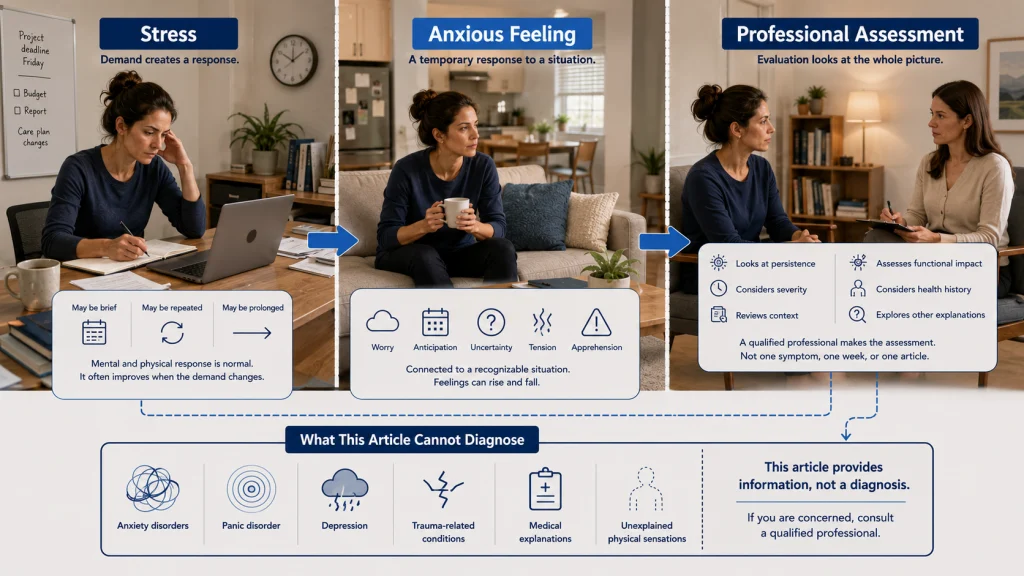
Stress is a mental and physical response to a demand, challenge, threat, or difficult situation. The pressure may be brief, repeated, or long lasting. It may come from work, money, conflict, caregiving, illness, uncertainty, or a major life change. Stress is not always harmful. A manageable amount can sharpen attention or support action, while excessive or prolonged stress can make daily functioning harder.
An anxious feeling is a human experience that can occur during stress, uncertainty, anticipation, or perceived danger. Feeling worried before a difficult conversation does not by itself establish a mental health condition. Ordinary anxious feelings can be uncomfortable while still being temporary and connected to a recognizable situation.
An anxiety disorder is a clinical matter. It cannot be identified from one article, one symptom, one difficult week, or the absence of an obvious stressor. A qualified mental health or health care professional considers the full pattern, including persistence, severity, context, functional impact, health history, and other possible explanations.
What This Article Cannot Diagnose: This article cannot determine whether you have an anxiety disorder, panic disorder, depression, a trauma-related condition, or a medical problem. It also cannot prove that a physical sensation is caused by stress. Symptoms that keep returning, become more intense, lack a clear explanation, or make ordinary life harder need qualified evaluation.
Use Three Pattern Questions Instead of a Symptom Quiz
A symptom quiz can create false confidence because many mental and physical experiences overlap. A better first step is to describe the pattern in plain language. These three questions organize what is happening without assigning a diagnosis.
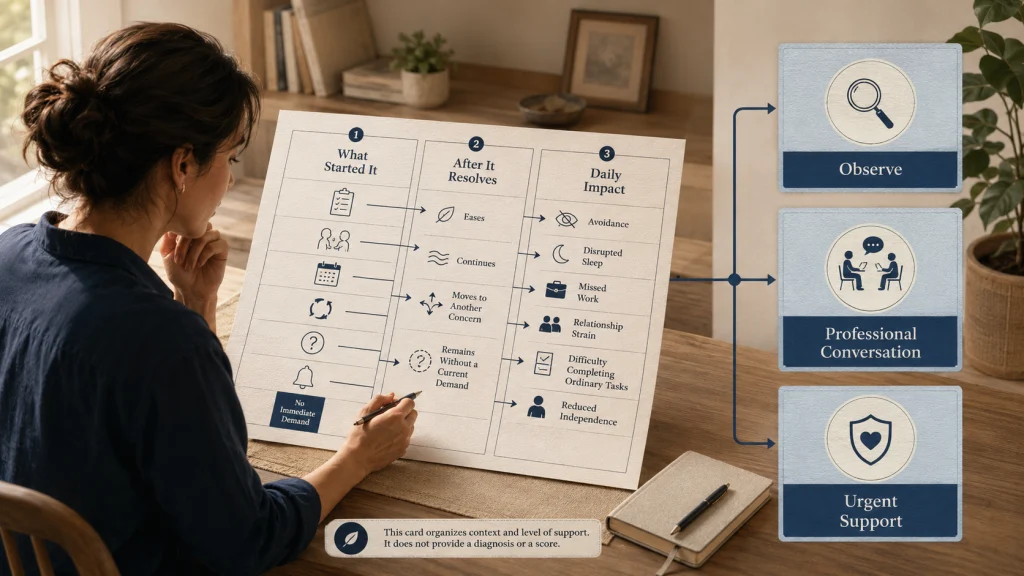
Three-question decision card
- What started it? Name any identifiable demand, conflict, deadline, change, uncertainty, or reminder that came before the reaction.
- What happens when the situation resolves? Notice whether the reaction eases, continues at the same level, moves to a new concern, or remains without an immediate demand.
- What daily activities are changing? Record avoidance, disrupted sleep, missed work, relationship strain, difficulty completing routine tasks, or loss of normal independence.
The answers do not produce a diagnosis. They help route the next step. A brief, situation-linked response that eases may be suitable for ordinary coping and observation. A persistent or escalating pattern that changes daily life deserves a scheduled professional conversation. Immediate danger or thoughts of self-harm require urgent support.
Compare the Overlap Without Treating It as Proof
Stress and anxiety can both affect thoughts, emotions, behavior, sleep, and the body. Worry, tension, restlessness, poor concentration, sleep disruption, headaches, stomach discomfort, and a faster heartbeat may appear in either pattern. These experiences matter, but they do not identify the cause on their own.
| Shared experience | Why it proves little by itself | Context worth recording |
|---|---|---|
| Worry | It can rise around a visible pressure or continue as broader apprehension. | What the worry is attached to, whether it shifts, and what happens after the situation changes. |
| Sleep disruption | Deadlines, uncertainty, habits, physical discomfort, and many other factors can disturb sleep. | When the change began, how often it occurs, and whether sleep improves when the pressure eases. |
| Tension or physical discomfort | The same sensation can have emotional, behavioral, or physical explanations. | Timing, severity, persistence, and whether ordinary activities have become harder. |
| Restlessness or poor concentration | Both can appear during short-term pressure as well as a longer pattern of distress. | Which situations bring them on and whether they interfere with work, relationships, or routine tasks. |
The table is not a scoring system. Its purpose is to show why the surrounding pattern carries more useful information than the symptom name. A person can have a clear stressor and still need professional help, while another person may feel anxious during a difficult event without having an anxiety disorder.
When the main task is noticing how your own body, thoughts, or behavior respond under pressure, the guide to recognizing personal stress signals stays focused on observation rather than diagnosis.
One Symptom Cannot Settle the Question
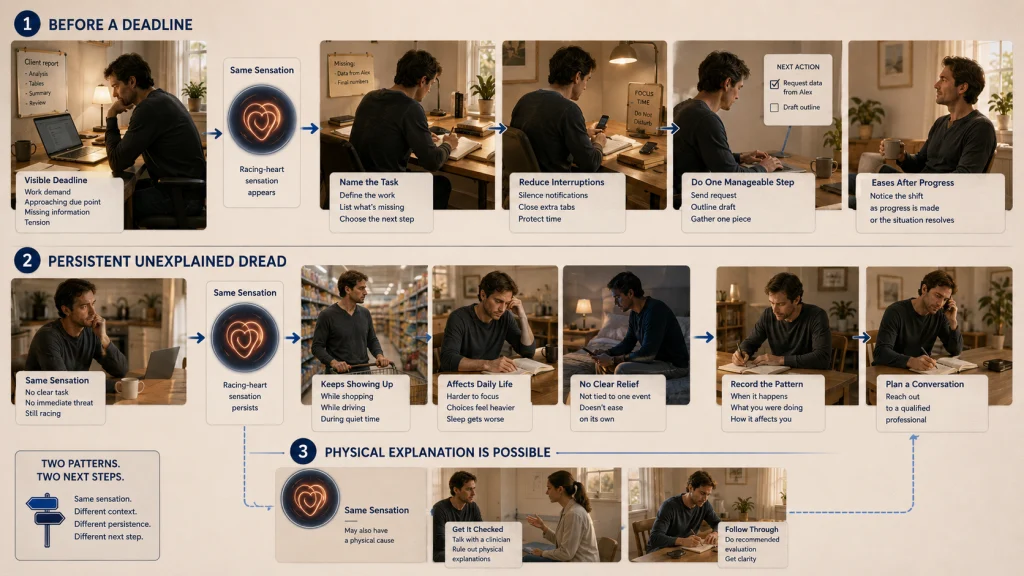
A racing heart can happen before a deadline because the body is responding to a visible demand. The same sensation can also appear during persistent dread when there is no immediate task to complete. It can have other physical explanations as well. The sensation is real in every case, but its presence does not identify the cause.
Consider two different next steps:
- Before a deadline: The person identifies the task, breaks the next action into a manageable step, reduces avoidable interruptions, and observes whether the reaction eases after progress or resolution.
- During unexplained persistent dread: The person records the context and impact, avoids making a self-diagnosis, and arranges a conversation with a qualified professional, especially when the pattern is recurring or changing ordinary choices.
The same caution applies to sleep loss, muscle tension, stomach discomfort, restlessness, or difficulty concentrating. Each can occur for many reasons. A pattern can guide action, but a single sensation cannot confirm stress, anxiety, or a medical explanation.
Look for an Identifiable Demand Without Assuming It Explains Everything
An external pressure is a demand or condition that can be described separately from the response it creates. It may be a deadline with missing information, conflict that requires a decision, a sudden caregiving change, or a financial task with a fixed due date.
Name the demand before choosing a response. A crowded deadline may become more manageable after clarifying what is required and identifying the first workable step. Conflict may call for a pause or a scheduled conversation, while a caregiving change could require practical help from another person. When paperwork or money is the immediate problem, gathering the missing information may be more useful than trying to calm every feeling before taking action.
This approach separates the source of pressure from the response without claiming that the source explains everything. A visible stressor can coexist with another mental or physical concern, and a severe or continuing reaction should not be dismissed simply because a difficult situation is present.
To look backward at the conditions that repeatedly precede a response, use the guide to identifying stress triggers. The purpose is to find a practical target, not to explain away every physical or emotional change.
Persistent Apprehension and Avoidance Need a Different Next Step
Apprehension that remains after an event passes, appears without an immediate threat, or repeatedly moves from one concern to another may need more than a lifestyle adjustment. The same is true when distress begins controlling ordinary decisions.
Avoidance is especially important to describe. A person may stop driving a familiar route, delay routine calls, avoid social contact, miss work, or rely on someone else for tasks they previously handled. Avoidance may provide short-term relief while gradually narrowing daily life. That pattern is a reason to arrange professional assessment, not proof of a particular diagnosis.
Functional impact can also be quiet. The person may still appear productive while losing sleep, spending hours preparing for low-risk situations, seeking repeated reassurance, or finding it difficult to be present in relationships. The question is not whether the person can force themselves through one more day. It is whether the pattern is persistent, worsening, or changing how they live.
Key decision: When apprehension, avoidance, or distress does not settle and is interfering with ordinary activities, schedule a conversation with a qualified mental health or health care professional. Do not wait for a home checklist to provide certainty.
A Pattern Can Include Both Stress and Anxiety
Real life does not always fit into two separate boxes. A difficult situation can create a stress response, and anxious feelings can remain even after part of the situation improves. Persistent anxiety can also make an ordinary demand feel harder to approach, which may create more missed tasks, conflict, or uncertainty.
For example, a person may face a genuine financial deadline and also experience ongoing dread that spreads into unrelated parts of the day. Solving the paperwork may reduce one source of pressure without fully resolving the apprehension. In that case, practical problem-solving and professional support may both be appropriate.
This overlap is another reason not to search for a single definitive symptom. The useful question is what kind of support is needed now. That may include changing a concrete demand, using a low-risk coping step, asking a trusted person for practical help, or arranging qualified assessment.
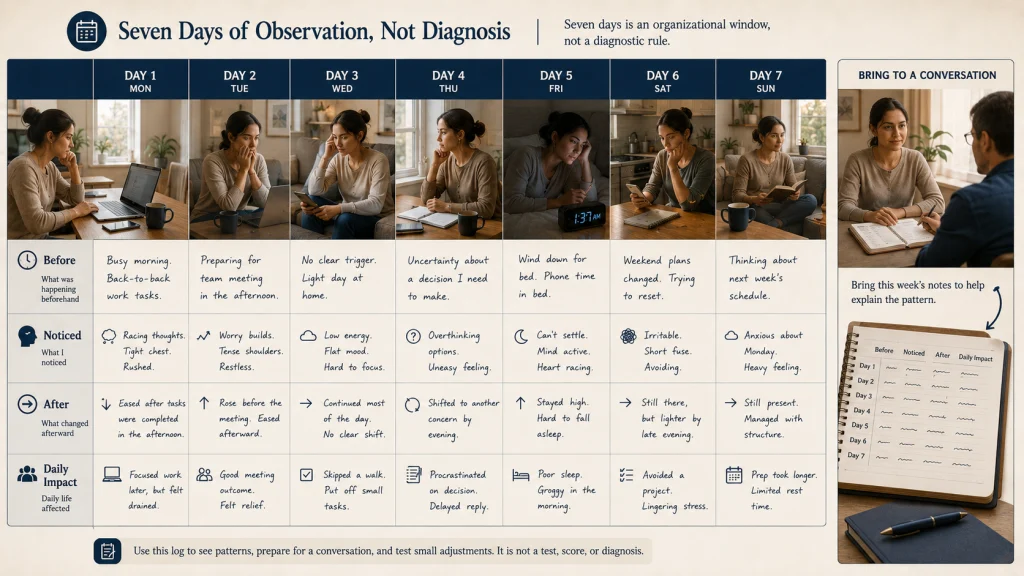
Use a Seven-Day Context Log Without Turning It Into a Test
A short context log can help you describe the pattern more clearly. It should record what happened and how daily life changed, not generate a score or label. Seven days is an observation window for organization, not a diagnostic threshold.
| Day | What was happening beforehand? | What did I notice? | What changed afterward? | What part of daily life was affected? |
|---|---|---|---|---|
| Day 1 | Situation, demand, uncertainty, or no clear trigger | Thoughts, emotions, behavior, sleep, or body sensations | Eased, continued, shifted, or intensified | Work, relationships, routine tasks, rest, or choices |
| Day 2 | Record briefly | Record briefly | Record briefly | Record briefly |
| Day 3 | Record briefly | Record briefly | Record briefly | Record briefly |
| Day 4 | Record briefly | Record briefly | Record briefly | Record briefly |
| Day 5 | Record briefly | Record briefly | Record briefly | Record briefly |
| Day 6 | Record briefly | Record briefly | Record briefly | Record briefly |
| Day 7 | Record briefly | Record briefly | Record briefly | Record briefly |
Keep each entry short enough to maintain. Useful details include the immediate context, whether there was a visible demand, how long the reaction stayed, whether it eased after the situation changed, and whether you avoided or lost access to an ordinary activity.
Bring the log to a professional conversation when the pattern is persistent or difficult to explain. It can help you describe timing and impact, but it should not be used to delay help, rule out a medical issue, or decide that the experience is harmless.
Use Low-Risk Supportive Steps While You Observe or Arrange Help
Simple coping steps may make a difficult period more manageable, but they do not prove what is causing the experience and do not replace professional care when symptoms persist or interfere with life.
- Keep a regular routine where possible: Use predictable times for meals, basic tasks, movement, and winding down rather than trying to repair the whole week at once.
- Protect a realistic sleep opportunity: Create enough time for rest and reduce avoidable late-night stimulation without expecting one good night to settle the question.
- Reduce excess caffeine: Notice whether coffee, energy drinks, or other caffeinated products are adding to restlessness or sleep disruption. Avoid abrupt changes when a health professional has given different instructions.
- Use social support: Tell a trusted person what has been happening and ask for a specific kind of help, such as company, a ride, practical assistance, or help arranging an appointment.
- Choose one calm activity: A quiet walk, gentle movement, a familiar household task, or another low-pressure activity may create a manageable pause without being treated as a cure.
When the immediate experience feels like too many demands arriving at once, the guide to responding to overwhelm can help identify one next action. Stop using self-help as the only plan when the pattern keeps returning, becomes harder to manage, remains unexplained, or begins narrowing daily life.
Do Not Use a Quiz, Device, or Product Response as Proof
Some tools can organize observations, but none can independently determine whether an experience is stress, anxiety, an anxiety disorder, or a medical problem.
- Quizzes and brief snapshots: An online score or one difficult night may prompt reflection, but neither establishes a lasting pattern or accounts for other explanations.
- Wearables and body signals: A device may estimate changes from heart rate patterns or other measurements, yet it cannot determine why the signal changed or provide a mental health diagnosis.
- Feeling better after an activity or product: A calmer response after a walk, app, breathing exercise, drink, supplement, or device does not reveal the cause of the original experience.
The same limit applies to one physical symptom. A racing heart, headache, stomach discomfort, or muscle tension can occur in several contexts. These observations become useful when they help describe timing, surroundings, and daily impact. They become misleading when they are treated as proof.
Contact a Qualified Professional When the Pattern Persists or Interferes
Arrange a conversation with a qualified mental health or health care professional when worry, apprehension, tension, sleep disruption, avoidance, or difficulty coping does not go away, keeps returning, becomes more intense, or begins interfering with work, relationships, self-care, or ordinary responsibilities.
Professional evaluation is also appropriate when symptoms are unexplained, when physical sensations are new or worsening, or when you are unsure whether a medical condition or medication effect could be involved. Do not assume that distress is only psychological or only stress-related.
You do not need to arrive with the correct label. A useful description can be simple: what was happening when the pattern began, what you notice, how often it occurs, what makes it better or worse, and which parts of daily life are changing. The context log can support that conversation without trying to replace it.
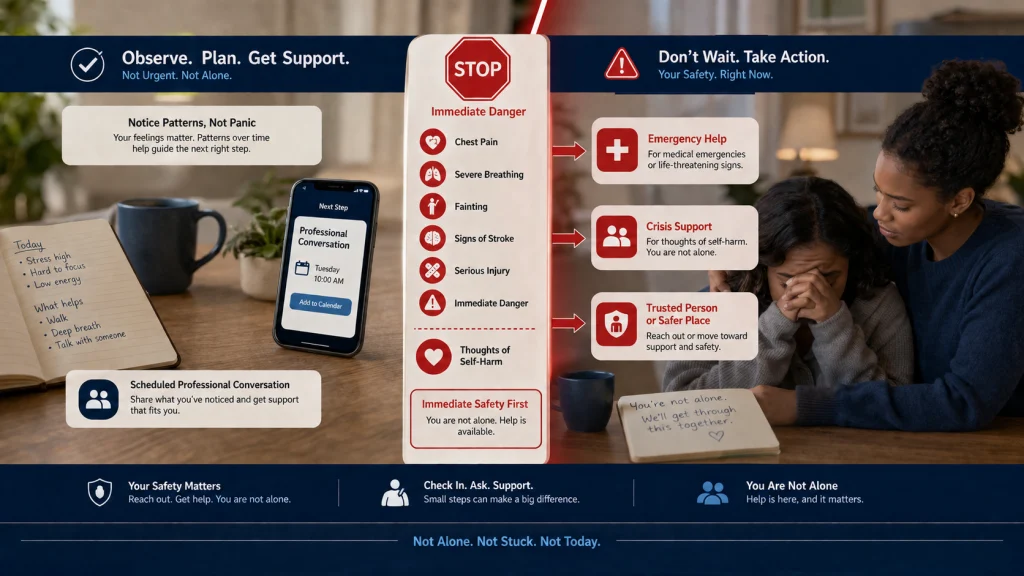
Use Urgent Support When Safety Is at Risk
Call emergency services or go to the nearest emergency department for chest pain, severe breathing difficulty, fainting, signs of stroke, a serious injury, immediate danger, or another potentially life-threatening situation. Do not wait for a stress-management step or online explanation.
If you are in the United States and are thinking about harming yourself, call or text 988 now. If there is immediate danger, call 911. Stay with a trusted person or move to a safer place when you can do so without increasing danger.
If you are supporting someone else, take statements about self-harm or immediate danger seriously. Contact emergency or crisis support rather than trying to settle whether the experience is stress or anxiety first.
Describe the Pattern, Then Choose the Level of Support
Use plain language instead of forcing a label. Describe what started the experience, whether it eased when the situation changed, how long it stayed, and what daily activities are becoming harder or avoided.
A brief, situation-linked pattern that is not impairing daily life may be suitable for lifestyle observation and low-risk coping. Distress that continues, becomes harder to manage, lacks a clear explanation, or interferes with ordinary life calls for a scheduled professional conversation. Immediate danger, urgent medical warning signs, or thoughts of self-harm require urgent support now.
FAQs
🧭 Is stress always caused by one obvious problem?
No. A stressor may be clear, repeated, complex, or difficult to separate from several changes happening at once. The practical task is to describe any visible demands without assuming they explain every symptom.
🌫️ Does anxiety without a clear cause mean I have a disorder?
No. The absence of an obvious stressor does not establish an anxiety disorder. Persistent apprehension, avoidance, or impairment is a reason to seek qualified assessment, not a basis for self-diagnosis.
💓 Can a racing heart tell me whether it is stress or anxiety?
No. A racing heart has several possible emotional and physical explanations, so new, severe, continuing, or unexplained changes need appropriate evaluation.
📱 Can a wearable stress score identify anxiety?
No. A consumer wearable can provide limited observations from body signals, but it cannot diagnose anxiety or determine why a signal changed. Use the information as context, not proof.
📝 Is a seven-day log long enough to diagnose the problem?
No. The log is only a way to organize context, timing, persistence, and functional impact. It should support observation or a professional conversation, not produce a diagnosis.
🤝 When should I talk to a professional?
Arrange help when the pattern persists, worsens, remains unexplained, causes avoidance, or interferes with work, relationships, sleep, self-care, or routine tasks. You can describe the pattern without knowing the correct label first.
🚨 What should I do if I feel unsafe or might harm myself?
In the United States, call or text 988 now. Call 911 when there is immediate danger, and move toward a trusted person or safer location when possible without increasing the risk.