Signs of stress are easier to recognize as changes from your own usual pattern than as a universal symptom list. Notice what shifts across thoughts, emotions, behavior, and physical comfort, then connect those changes to timing, context, clustering, and daily function without assuming stress is the cause. Choose a small early action before the pattern becomes harder to manage, and record only enough detail to guide the next decision. New, severe, persistent, worsening, or unexplained symptoms need qualified evaluation rather than a stress label.
Compare an Ordinary Tuesday With a High-Pressure Tuesday
On an ordinary Tuesday, a person may move through work, meals, conversation, and bedtime with a familiar level of attention and energy. On a high-pressure Tuesday, the same person may notice several changes at once. The useful signal is often not that one experience exists, but that it is different from what is usual for that person.
| Domain | Ordinary Tuesday | High-pressure Tuesday |
|---|---|---|
| Thoughts | Can prioritize routine tasks, recover after interruptions, and make ordinary decisions. | Replays one problem, loses perspective, and spends extra time deciding where to begin. |
| Emotions | Has a usual range of patience, concern, and frustration. | Feels more irritable, worried, and easily frustrated than usual. |
| Body | Has familiar energy, appetite, and physical comfort. | Notices shoulder tension, an unsettled stomach, and difficulty winding down. |
| Behavior | Answers messages, takes normal breaks, and follows the usual evening routine. | Delays one important task, skips breaks, and withdraws from a planned conversation. |
None of these changes proves that stress caused them. The comparison simply makes a pattern easier to describe. Stress patterns are easier to see when ordinary behavior is the comparison point.
For the broader framework, use the guide to manage stress in daily life. When the pattern is recognizable and the next question is how to respond, review practical coping skills for stress.
Treat a Stress Sign as a Possible Change, Not Proof of Cause
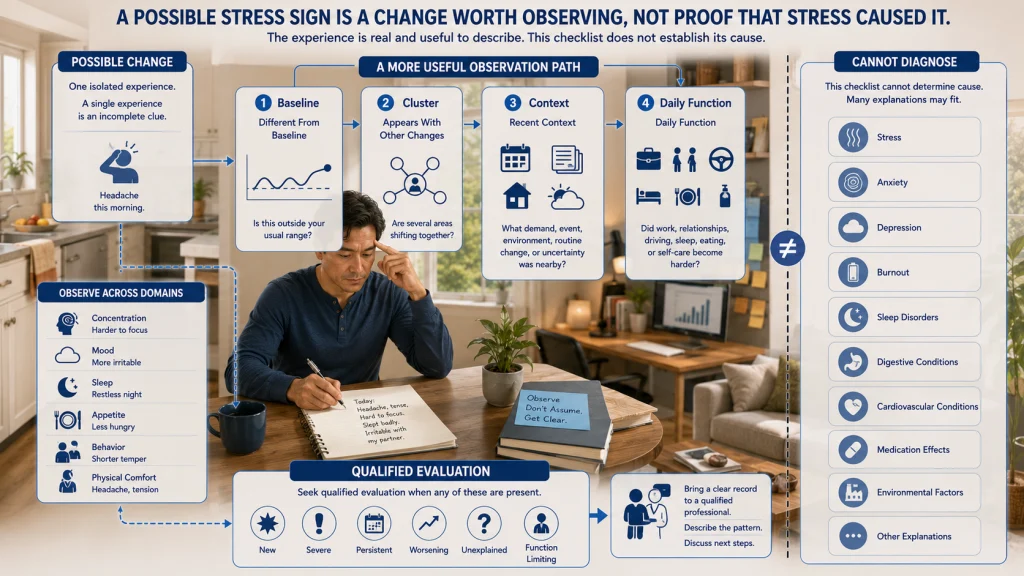
A stress sign is best understood here as a change that may occur during a difficult or demanding period. It might involve concentration, mood, sleep, appetite, behavior, or physical comfort. The word “possible” matters because many of these experiences can also have medical, psychological, environmental, or routine-related explanations.
One headache, one restless night, or one impatient conversation does not establish a stress pattern. A more useful observation asks whether the experience differs from baseline, appears alongside other changes, follows a recognizable context, and affects ordinary function.
What this article cannot determine: This article cannot diagnose stress, anxiety, depression, burnout, a sleep disorder, a digestive condition, a cardiovascular problem, or any other cause. Do not use a checklist to dismiss new, severe, continuing, worsening, or unexplained symptoms. Seek qualified evaluation when the pattern or symptom needs more than observation.
If the main question is whether a pattern looks more like a situation-linked stress response or persistent anxiety, use the guide to compare stress and anxiety patterns without trying to diagnose yourself.
Use a Four-Domain Baseline Inventory
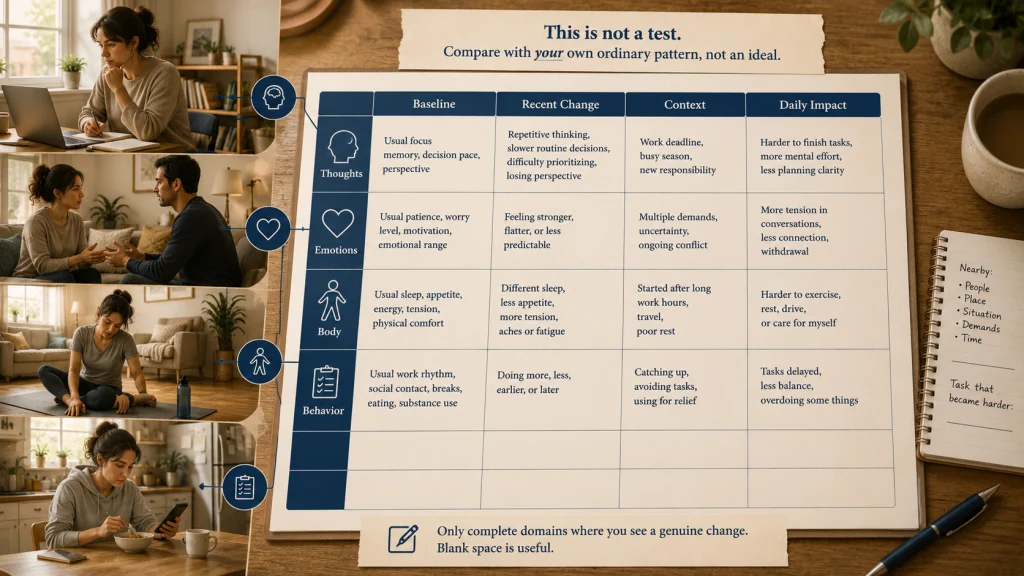
Separate observations into thoughts, emotions, body, and behavior. This prevents a single physical sensation or difficult feeling from carrying the entire interpretation. It also makes quieter changes visible, such as losing patience, avoiding a familiar task, or taking much longer to make a routine decision.
| Domain | Usual baseline | Recent change | Context | Effect on daily life |
|---|---|---|---|---|
| Thoughts | Usual focus, memory, decision pace, and perspective | What feels different now? | What was happening before or during the change? | What task or responsibility became harder? |
| Emotions | Usual patience, worry level, motivation, and emotional range | What feels stronger, flatter, or less predictable? | Does it rise around a particular demand? | How are conversations or relationships changing? |
| Body | Usual sleep, appetite, energy, tension, and physical comfort | What sensation or routine has changed? | When does it begin, settle, or return? | Does it limit movement, rest, driving, or self-care? |
| Behavior | Usual work rhythm, social contact, breaks, eating, and substance use | What are you doing more, less, earlier, or later? | Which events or settings appear nearby? | What are you avoiding, delaying, or overdoing? |
Complete only the rows that show a real change. Blank space is useful because it prevents the worksheet from turning into a search for problems that are not present.
Notice Changes in Concentration, Memory, and Perspective
Cognitive changes may include difficulty concentrating, forgetting routine details, taking longer to make ordinary decisions, replaying the same concern, or losing perspective about what needs attention first. These experiences can appear during demanding periods, yet the surrounding pattern matters more than the symptom name.
Compare the current pattern with a normal workday or household routine. Someone who usually answers a straightforward email quickly may reread it several times and still feel unable to respond. Another person may move between tasks without finishing the first one, then spend the evening mentally replaying what remains undone.
The useful observation is concrete: “I spent forty minutes switching among three routine tasks and completed none of them.” That description is more informative than “My brain is broken” or “Stress is ruining my memory.” It records the change without turning it into a diagnosis or a permanent conclusion.
Pay attention to whether the change settles after the immediate pressure reduces. A cognitive problem that is new, severe, worsening, unexplained, or continuing beyond the situation needs appropriate evaluation rather than an assumption that stress explains it.
Notice Irritability, Worry, Frustration, or Emotional Flatness
Emotional changes may show up as reduced patience, stronger worry, quick frustration, sadness, numbness, or feeling unusually overwhelmed by small decisions. The change may be obvious, such as an angry outburst, or quieter, such as feeling detached during a conversation that would normally matter.
Use baseline language instead of moral judgment. “I interrupted twice and had less patience than usual” is an observation. “I am becoming a terrible person” is a conclusion that does not help identify timing, context, or the next action.
It is also possible to feel several emotions at once. A caregiving change may bring concern, resentment, affection, and fatigue into the same day. The presence of mixed emotions does not mean the person is handling the situation incorrectly. What matters for this inventory is whether the emotional pattern is changing daily life or becoming difficult to manage.
Persistent sadness, emotional numbness, loss of interest, intense fear, or difficulty coping deserves professional attention. Do not use a stress label to delay that conversation.
Look for Avoidance, Overworking, Isolation, and Routine Changes
Behavior often reveals a pattern before the person has found words for it. Possible changes include procrastinating on a familiar task, avoiding calls, withdrawing from people, working without normal breaks, staying busy to avoid thinking, or repeatedly checking work that is already complete.
Eating and sleep routines may also shift. A person may delay meals, eat more or less than usual, stay up trying to regain personal time, or sleep at unfamiliar hours. These changes are observations, not proof that stress caused them.
Pay particular attention to increased use of alcohol, tobacco, or other substances to relax, sleep, focus, or get through the day. The important question is not whether the amount looks dramatic from the outside. It is whether use has changed, become harder to control, or is beginning to affect safety and daily function.
Avoidance may provide short-term relief while making the next contact, task, or decision feel larger. When the pattern is already narrowing ordinary life, qualified support may be more appropriate than another self-help reminder.
Record Physical Changes With Clear Caution
Physical experiences that may occur during stressful periods include muscle tension, headache, stomach discomfort, fatigue, restlessness, sweating, trouble sleeping, appetite changes, or a racing feeling. Because the same sensations can arise in many contexts, the useful task is to describe them accurately rather than attach a cause too quickly.
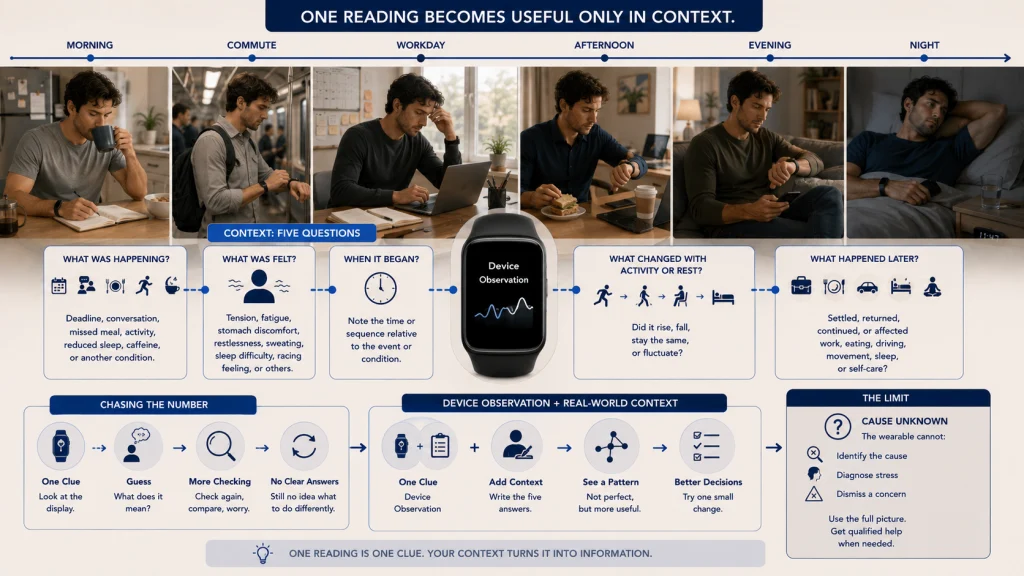
Describe what happened without naming the cause: where the sensation occurred, when it began, whether it changed with activity or rest, how long it lasted, and whether it returned. Note any effect on movement, eating, sleep, driving, work, or self-care.
Editorial observation: A watch may show changes in heart rate, sleep, or activity, but the reading becomes meaningful only when it is placed beside real-world context. A short note about what was happening, what you felt, and what happened later is often more useful than chasing one metric.
Do not use a normal-looking wearable reading to dismiss a concerning symptom, and do not use an elevated score to diagnose stress. Consumer data can add one observation to the record, but it cannot explain the change or replace clinical interpretation.
Compare the Change With Baseline and Recent Context
Baseline does not mean an ideal version of yourself. It means the usual range you recognize across ordinary weeks. Someone who naturally needs quiet after work has a different baseline from someone who usually calls friends during the commute. The signal is the change, not whether either routine looks more social or productive.
Then add recent context. A deadline, conflict, disrupted sleep, caregiving demand, financial task, illness in the household, travel, or a major change may sit near the pattern. Keep the wording descriptive: “The tension increased during the week of the deadline.” That preserves the timing without claiming a complete explanation.
When signals are visible but the preceding conditions are still unclear, use the guide to identify possible stress triggers. The goal is to find a practical condition worth addressing, not to prove a complete explanation.
Look for Clusters and Timing Instead of One Isolated Signal
A cluster is a group of changes that appears in the same period. For example, a person may sleep later, lose patience more quickly, skip lunch, and replay one work problem during a deadline week. No single item settles the question, but the combination gives the person a clearer early-warning pattern to discuss and respond to.
Timing adds another layer. Notice whether the pattern begins before a recurring meeting, rises after several nights of reduced sleep, continues through the weekend, or settles when one demand is resolved. A pattern that keeps shifting to new situations or remains without an immediate pressure may require a different kind of professional conversation.
Do not wait for a large cluster before taking a small action. Two familiar early changes may be enough to protect a break, reduce an avoidable demand, ask for help, or schedule support. The threshold should be based on what reliably precedes difficulty for that person, not on collecting the longest possible list.
Rate the Effect on Daily Function
Functional impact asks what the pattern is changing in real life. This is often more useful than rating how dramatic a feeling seems in the moment.
| Area | Low impact | Growing impact | Needs prompt attention |
|---|---|---|---|
| Home | Routine tasks take slightly longer. | Meals, cleaning, bills, or caregiving tasks are repeatedly delayed. | Essential needs or safety cannot be maintained. |
| Work | Focus dips briefly but returns. | Errors, missed deadlines, absence, or avoidance are increasing. | The person cannot perform usual responsibilities safely. |
| Relationships | Patience is lower during one difficult period. | Withdrawal, conflict, or repeated reassurance is changing important relationships. | There is immediate danger, abuse, or inability to stay safe. |
| Driving | The person notices tension but remains attentive and safe. | Concentration, sleepiness, panic, or agitation makes driving feel less reliable. | Do not drive when symptoms or impairment make it unsafe. |
| Self-care | One routine is shortened on a busy day. | Eating, sleep, hygiene, medication routines, or appointments are repeatedly disrupted. | Essential care cannot be maintained or the person cannot cope safely. |
The categories are descriptive, not a diagnostic scale. If an activity is unsafe, stop and use appropriate support rather than trying to earn a lower rating.
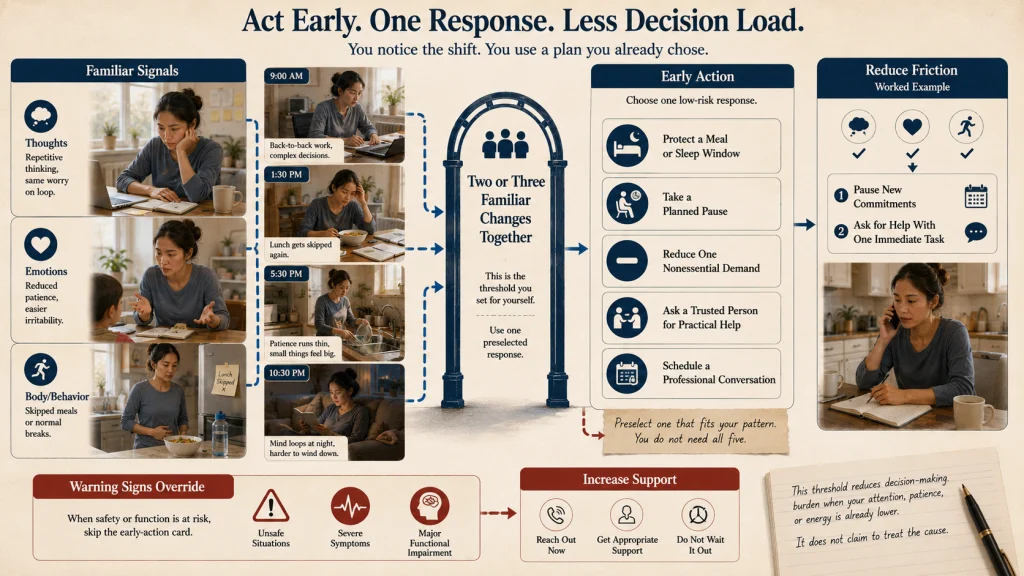
Choose an Early Action Threshold
An early action threshold links a small set of personal signals to one predefined response. It prevents the person from having to design a plan while attention, patience, or energy is already reduced.
Early-warning threshold: When two or three familiar changes appear together, complete one low-risk action within the same day. Choose an action that reduces friction or increases support, not one that claims to treat the cause.
Examples include protecting a meal or sleep window, taking a planned pause, reducing one nonessential demand, asking a trusted person for practical help, or scheduling a professional conversation. Someone whose first signals are skipped meals, repetitive thinking, and reduced patience might use the threshold to pause new commitments and ask for help with one immediate task.
If the immediate problem is that several demands feel impossible to sort, the guide to choose one next step when overwhelmed can help simplify the moment. An early action is not meant to override warning signs or replace care.
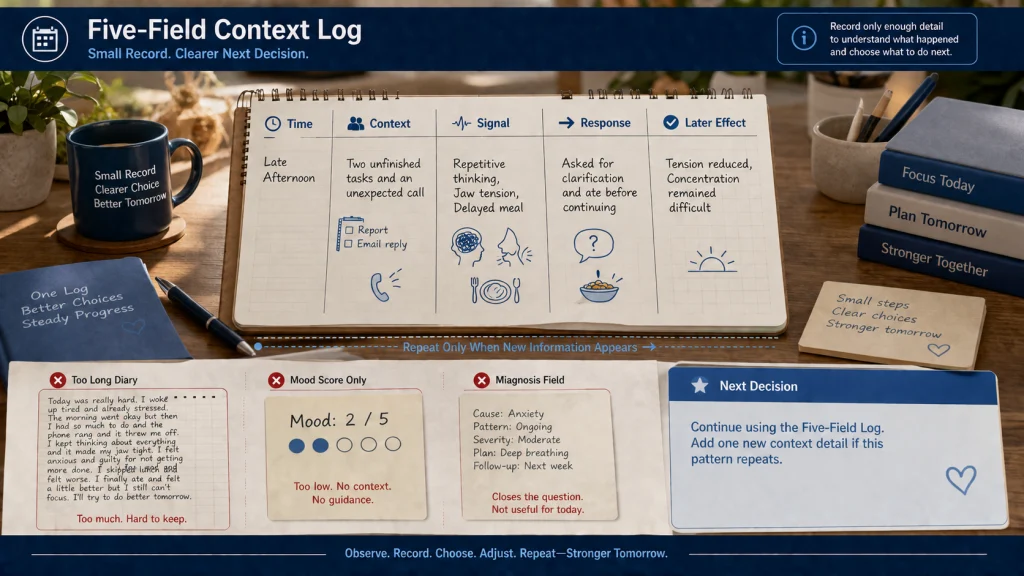
Record Only What Helps the Next Decision
A useful log is short enough to maintain and specific enough to reveal timing. It does not need a mood score, a long diary entry, or a diagnosis field.
| Time | Context | Signal | Response | Later effect |
|---|---|---|---|---|
| When did it begin? | What demand, event, setting, or routine change was nearby? | What changed in thoughts, emotions, body, or behavior? | What did you do next? | Did it settle, continue, shift, or interfere with something? |
| Example: late afternoon | Two unfinished tasks and an unexpected call | Repetitive thinking, jaw tension, delayed meal | Asked for clarification and ate before continuing | Tension reduced, but concentration remained difficult |
Record repeated entries only when they add something new. If longer tracking is useful, the guide to keeping a simple stress journal can help organize observations without turning the record into a self-diagnostic test.
Do Not Blame Concerning Changes on Stress Without Evaluation
Stress may occur alongside pain, sleep disruption, appetite change, concentration problems, digestive discomfort, fatigue, or a racing heartbeat. The fact that these changes appear during a difficult period does not make stress the safest explanation.
A recent deadline, family conflict, wearable score, or temporary improvement after relaxation can add context, but none closes the question of cause. A symptom can ease and still deserve evaluation. It can also occur during a stressful period for a reason unrelated to stress.
New neurological changes, persistent physical symptoms, marked changes in mood or behavior, worsening substance use, or difficulty completing normal activities need qualified attention. The same applies when the person is uncertain whether a medication, health condition, sleep problem, or another factor may be involved.
The safest wording is descriptive: “This began during a difficult week, and I do not know the cause.” That statement preserves context without closing off other explanations.
Use Professional or Urgent Care for Red Flags
Arrange a qualified medical or mental health evaluation when symptoms are new, persistent, worsening, unexplained, or interfering with work, relationships, driving, sleep, eating, or self-care. You do not need to decide whether stress is responsible before asking for help.
Seek urgent help now: Chest pain, severe shortness of breath, fainting, signs of stroke, severe confusion, immediate danger, or another potentially life-threatening change requires emergency care. Do not wait for a coping exercise or a pattern log.
If you are in the United States and have thoughts of harming yourself, call or text 988 now. Call 911 when there is immediate danger. Move toward a trusted person or safer location when that can be done without increasing risk.
If someone else may be in immediate danger or is talking about self-harm, take it seriously and contact crisis or emergency support. Identifying the correct label can wait until safety is addressed.
Choose Three Early Signals and One Linked Action
Select three changes that are personally recognizable across different domains, such as repetitive thinking, reduced patience, and skipping normal breaks. Write one action that becomes available when two or more appear together.
Keep the language observational: what changed, what was happening, what daily function was affected, and what happened after the response. Use the pattern to act earlier, not to diagnose the cause. When symptoms are concerning, continuing, or unsafe, move from self-observation to qualified or urgent support.
FAQs
🧭 Is one bad day a sign of stress?
One difficult day can happen for many reasons. Compare it with your baseline, recent context, other changes, and daily function before treating it as part of a recurring pattern.
🧠 Can poor concentration happen during stress?
Difficulty concentrating may occur during a stressful period, but it is not specific to stress. Record when it began and how it affects routine tasks, and seek evaluation when it is new, severe, continuing, or unexplained.
💬 Is irritability always caused by stress?
No. Irritability has many possible contexts and explanations. It is more useful to notice whether it differs from your usual pattern, appears with other changes, and is affecting relationships or daily responsibilities.
⌚ Can a smartwatch confirm that I am stressed?
No. A wearable may show changes in heart rate, sleep, or activity, but it cannot establish why the change occurred. Use the data as one observation, not clinical proof.
📝 How much should I record in a stress log?
Record only what helps the next decision: time, context, signal, response, and later effect. A short consistent entry is usually more useful than a long account that becomes difficult to maintain.
🤝 When should I contact a professional?
Arrange qualified help when changes persist, worsen, remain unexplained, or interfere with work, relationships, driving, sleep, eating, or self-care. You do not need a confirmed stress label before starting that conversation.
🚨 What should I do if I might harm myself?
In the United States, call or text 988 now. Call 911 for immediate danger, and move toward a trusted person or safer location when possible without increasing risk.