When everything feels urgent, the first job is not solving the whole situation. It is reducing the number of decisions competing for the next ten minutes. Protect safety and essential responsibilities, stop new inputs, write every open loop in one rough list, sort only into now, today, and later, then choose one physical next action. Persistent, worsening, unexplained, or function-limiting overwhelm requires qualified support, while immediate danger, self-harm thoughts, or severe medical symptoms require urgent help.
Reduce Eight Urgent Notes to Three Decisions
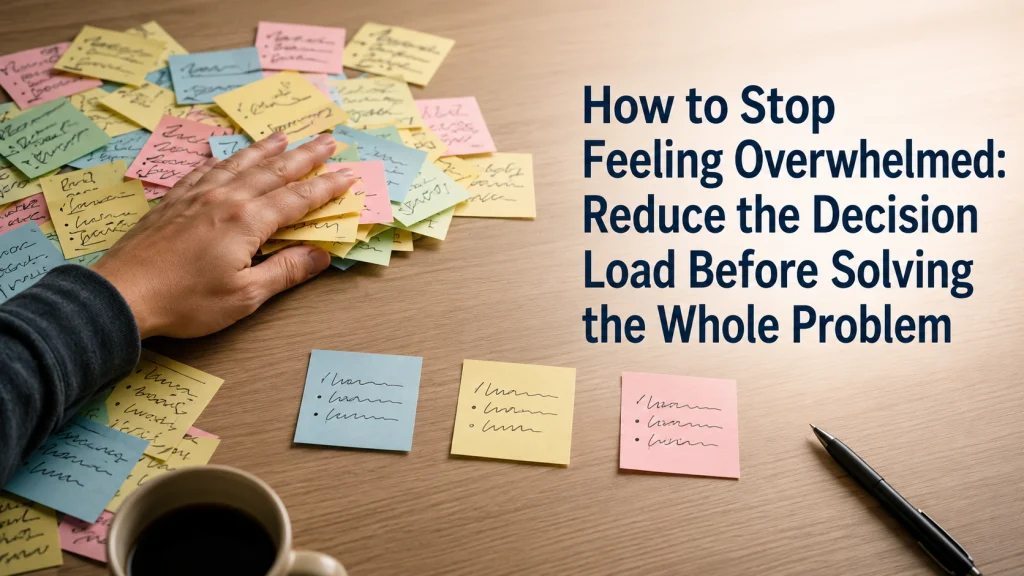
Imagine a table covered with eight sticky notes. Every note says urgent. One is a work deadline, one is a bill, one is a family message, one is an appointment, one is a household task, one is a decision, and two are reminders that arrived while the first six were still open.
Trying to choose among all eight can create more switching, freezing, and delay. Now remove every note except three: one labeled safety, one labeled today, and one labeled later. The underlying problems still exist, but the next ten minutes no longer contain eight competing decisions.
| Eight-Note Table | Three-Decision Table |
|---|---|
| Every item is marked urgent. | One item protects safety or an essential responsibility. |
| Messages, tasks, worries, and decisions compete at once. | One meaningful task is held for today. |
| The reader keeps reorganizing instead of acting. | Everything else is moved to later, delegated, or scheduled. |
| The full problem remains mentally active. | Only the next physical action stays in view. |
The first task is not finishing everything. It is reducing the number of decisions competing for the next ten minutes. Clarity often returns after the load is made smaller and visible.
| First-Ten-Minute Flow | What to Do | What This Prevents |
|---|---|---|
| 1. Safety check | Protect immediate safety, caregiving, transportation, medication, or another essential function. | Using an organization exercise when urgent action is required. |
| 2. Stop new inputs | Silence nonessential notifications, close extra tabs, and pause optional conversations. | Letting the active list grow while trying to choose. |
| 3. Dump open loops | Write every task, decision, worry, message, and missing piece of information in one rough list. | Keeping the entire load active in memory. |
| 4. Sort into three groups | Mark safety or essential now, one meaningful item for today, and everything else as later, scheduled, or delegated. | Building a complicated priority system during overload. |
| 5. Choose one action or pause | Select one physical next step under ten minutes, or use one brief familiar reset before acting. | Trying to solve the whole problem before beginning. |
| 6. Send one communication | Clarify, request help, ask for more time, cancel, or set one boundary. | Carrying uncertainty or an avoidable responsibility alone. |
| 7. Reassess | Continue, schedule, delegate, stop, or move to support, then write the next review time. | Immediately reopening every item after the first step. |
For the broader framework, use the stress management guide. The coping skills guide can help compare possible responses after immediate overload has eased.
Define Overwhelm as More Demands Than Current Capacity Can Hold
After the eight notes are reduced to three, the situation may still feel heavy, but it is no longer shapeless. Overwhelm is useful here as a practical description, not a diagnosis. It describes a moment when tasks, decisions, worries, notifications, obligations, or emotions exceed the attention and time currently available.
The same workload may feel manageable on one day and unmanageable on another. Sleep, illness, caregiving, conflict, deadlines, noise, uncertainty, and missing information can change current capacity without changing the number of tasks.
Common practical signs include:
- switching repeatedly without finishing a first step;
- freezing because every choice seems equally important;
- opening more tabs, lists, or messages while trying to get organized;
- procrastinating because the full problem feels too large to enter;
- trying to solve tomorrow, next week, and the current hour at the same time.
This description does not determine whether anxiety, depression, ADHD, autism, trauma, burnout, panic, or another condition is present. Those questions require an appropriate professional route.
Run the Safety and Function Check First
Before touching the list, check whether immediate safety or basic function needs attention. When someone is overloaded, it is easy to keep organizing because organizing feels safer than facing the most urgent item. A planning sequence should not delay urgent action.
- Are you driving, supervising a child, supporting another person, or operating dangerous equipment?
- Is there fire, smoke, unsafe medication use, a hazardous environment, violence, or immediate danger?
- Are there severe medical symptoms such as chest pain, severe shortness of breath, fainting, stroke signs, or dangerous confusion?
- Are self-harm thoughts present, or are you unsure you can remain safe?
- Is one essential responsibility at risk if no action happens now?
If any urgent condition is present, use emergency, crisis, medical, workplace, or other qualified help appropriate to the situation. Do not continue sorting sticky notes while immediate safety is unresolved.
If the situation is not urgent, protect the most essential function first. That may mean stopping the car safely, arranging caregiving coverage, turning off equipment, taking a directed medication, or completing another necessary action before returning to the list.
Stop New Inputs for Ten Minutes
Once immediate safety is protected, the next kindness is to stop the situation from getting louder. Reduce what is still entering the system. The goal is not permanent disconnection. It is a short pause that prevents the list from growing while the first decision is being made.
- Silence nonessential notifications.
- Close extra browser tabs and documents that do not support the next action.
- Pause optional conversations and group chats.
- Move new requests into one holding place instead of answering each one.
- Set aside news, shopping, social feeds, and nonurgent searches.
Editorial observation: A new app, dashboard, or elaborate organization system can increase decision load when someone is already overloaded. A blank sheet, a basic phone note, fewer visible tabs, and the supplies for one task placed within reach may be more useful for the next ten minutes.
Put Every Open Loop Into One Rough List
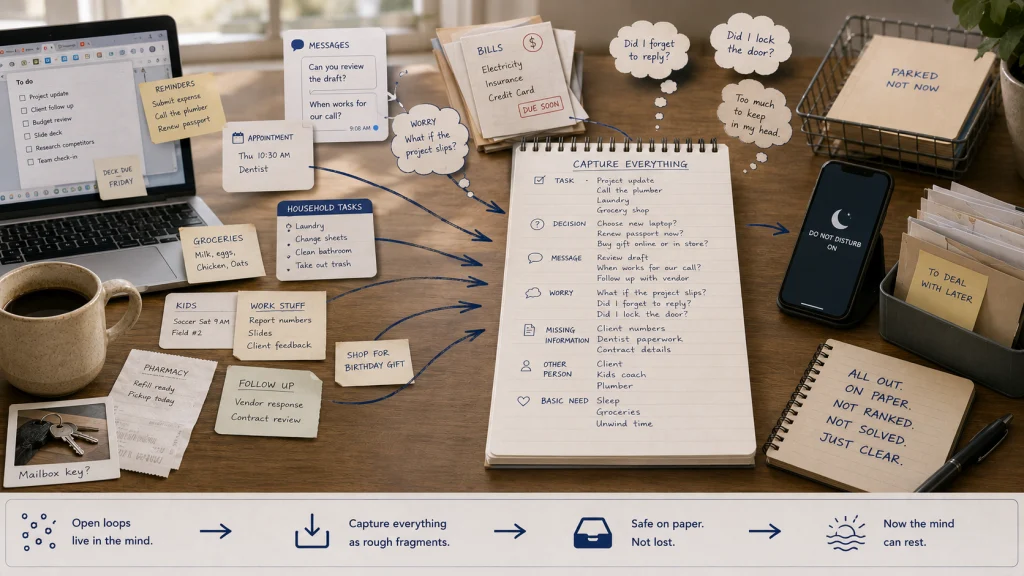
With the incoming noise paused, move what is already circulating in memory onto one page. The list does not need to be neat or intelligent. Do not organize, rank, solve, or rewrite while capturing. The first pass only answers, “What is asking for attention?”
- Task I need to complete: __________
- Decision I keep revisiting: __________
- Message or conversation waiting for me: __________
- Worry I cannot act on yet: __________
- Information I am missing: __________
- Responsibility involving another person: __________
- Basic need or safety issue: __________
- Anything else occupying attention: __________
Use fragments rather than full explanations. “Bill, confirm due date” is enough. “School form, ask which page is missing” is enough. The list should make the load visible without turning capture into another writing project.
Sort Into Safety Now, Meaningful Today, and Later
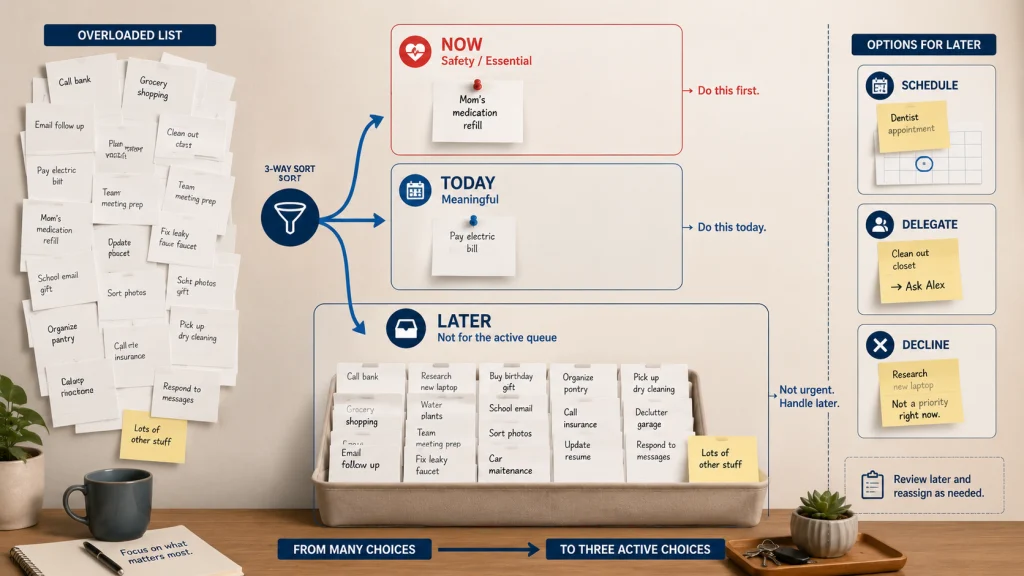
The rough list may look uncomfortable because it shows how much has been carried at once. Resist the urge to turn it into a perfect system. Use only three categories so the act of sorting does not become another source of overload.
| Category | What Belongs Here | Question |
|---|---|---|
| Safety or essential now | Immediate safety, caregiving, required medication, transportation, urgent deadline protection, or another essential function | What becomes unsafe or significantly worse if nothing happens now? |
| Meaningful today | One task that genuinely matters today but does not outrank safety | Which completed action would reduce the most real pressure before the day ends? |
| Later, scheduled, or delegated | Everything that can wait, be assigned, clarified, declined, or given a return time | Can this be moved out of the next ten minutes without creating immediate harm? |
Essential-today-later card: Choose no more than one active item from safety or essential now and one item from meaningful today. The later category can contain many items because it is not an active work queue.
Choose One Physical Next Action Under Ten Minutes
Once only one item is active, the next step should feel small enough to enter without another planning session. The selected action should be visible and concrete. “Fix finances” is too broad. “Open the bill and confirm the due date” is an action. “Handle the project” is too broad. “Send the missing-file request” is an action.
Useful first actions often begin with a verb:
- open the document;
- move the needed supplies into reach;
- write the first sentence;
- call the named person;
- confirm the time;
- place the appointment on the calendar;
- turn off the unsafe equipment;
- put the next item by the door.
Less than ten minutes does not mean the whole problem must be solved quickly. The short action creates a clear entry point. When the task cannot be acted on yet, the physical action may be scheduling it, delegating it, requesting information, or writing the exact return time.
Decide Whether the Next Job Is Action or a Brief Pause
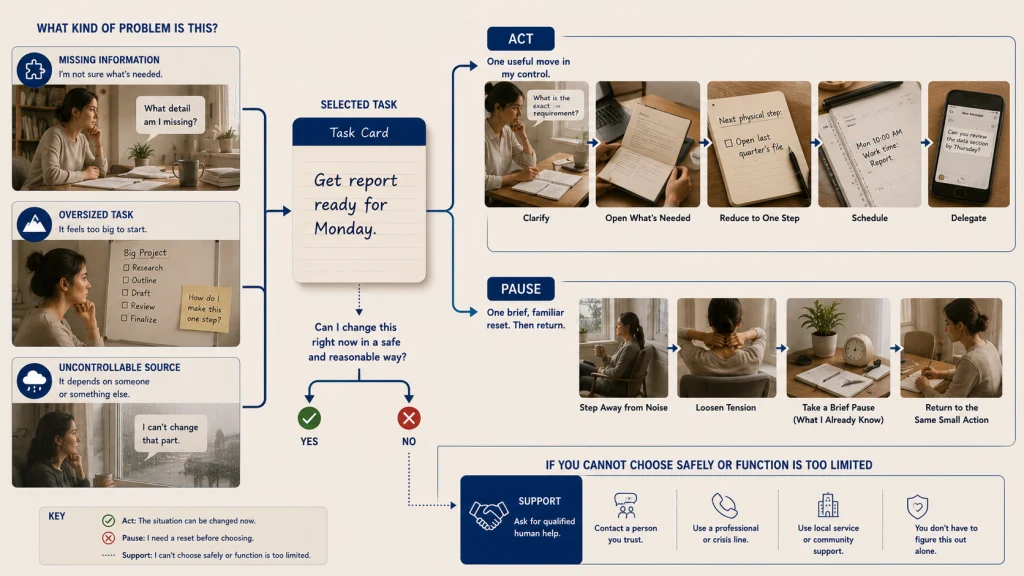
Even a small action can feel unreachable when the body and attention are still pulled in several directions. Sometimes the stressor can be changed immediately. Sometimes the person needs a short, practiced pause before a useful action is possible. The decision depends on controllability and current function.
| Current Situation | Problem-Focused Action | Response-Focused Pause |
|---|---|---|
| Information is missing | Ask one clarification question. | Pause briefly before sending several rushed messages. |
| A task is too large | Define the first physical step or reduce the scope. | Use a familiar reset so attention can return to the smaller step. |
| The source cannot change now | Schedule, document, delegate, or set a boundary where possible. | Use a practiced response to stay able to protect essentials. |
| The person cannot choose safely | Contact support rather than continuing alone. | Stop optional decisions until function improves. |
The guide comparing problem-focused and emotion-focused coping explains how the two routes can work together without pretending every stressor is personally controllable.
Use Only a Brief Reset That Is Already Familiar
Overload is not the time to learn a complicated breathing count, meditation course, or attention exercise. If a brief reset has already been practiced and is safe for the person, it may help create enough space for the next action.
Keep the reset short and recognizable. It might involve sitting down, stepping away from noise, loosening a tense posture, taking a familiar breathing pause, or using a previously learned grounding or mindfulness step.
Do not turn the reset into a requirement to feel fully calm. Its purpose is to support one safe decision, not erase the underlying work, financial, caregiving, relationship, or health problem.
Use the guide to breathing exercises for stress for body-based techniques and the guide to mindfulness for stress for attention-based practice. Learn and review those skills outside the overloaded moment when possible.
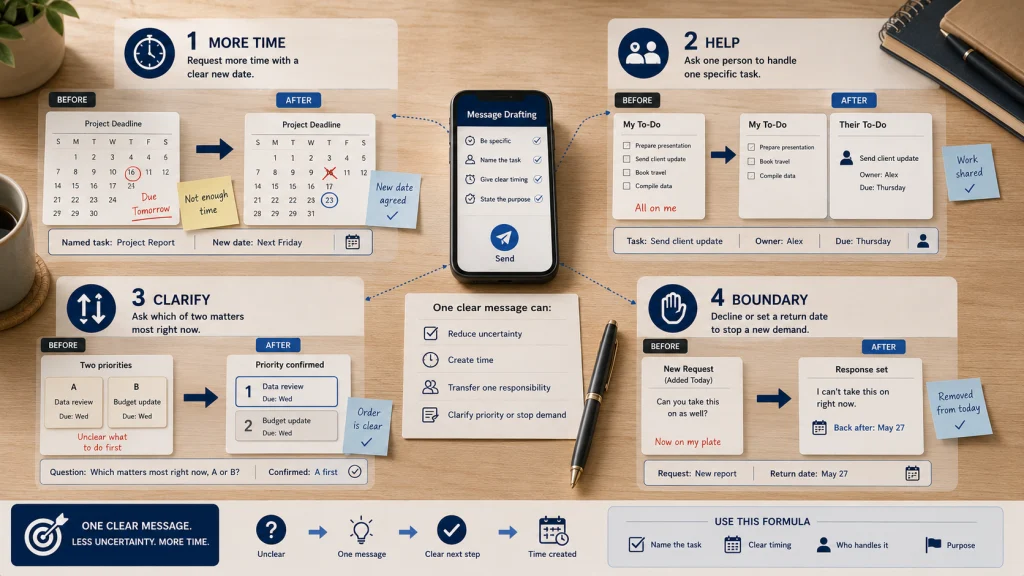
Send One Specific Communication
After one action or pause, another person may still hold the information, time, or support that the next step needs. A short message can reduce uncertainty, create time, transfer one responsibility, or stop new demands from entering. The communication should name the request rather than asking the other person to guess what help is needed.
- Request more time: “I cannot complete this by the current time. Can we move it to __________?”
- Ask for help: “Can you handle __________ before __________?”
- Clarify: “Which matters first: __________ or __________?”
- Set a boundary or cancel: “I cannot take this on today. I can revisit it on __________.”
One clear message is often more useful than several apologetic explanations. When communication may create danger, retaliation, or another serious risk, use qualified or trusted support rather than a generic script.
Protect Basic Needs Without Compensating With Harmful Extremes
Overwhelm can push ordinary needs out of view. Skipping meals, relying on excess caffeine, drinking alcohol to shut the day down, or working through the night may create a second problem without resolving the first.
Check the basics that affect the next few hours:
- Is food or water needed?
- Is a directed medication due?
- Is sleep being traded for an optional task?
- Does the person need a bathroom break, movement, quiet, or a change of location?
- Is caffeine, alcohol, or another coping response increasing agitation, avoidance, or risk?
Basic care does not solve structural stress, and it should not be used to blame the person for an impossible workload. It protects enough function to make the next decision safer.
The guide to coping responses with high later costs can help review relief, function, consequence, and risk without moral judgment.
Reassess After the First Action
Finishing one small step can create an urge to prove that the whole day is back under control. Do not immediately reopen the full list. Ask what the situation needs next.
| Result | Next Choice |
|---|---|
| The essential issue is now protected. | Continue with one meaningful-today item or stop for recovery. |
| The action revealed a clear next step. | Continue only if capacity remains adequate. |
| The task requires information or another person. | Schedule, delegate, or wait for the response. |
| Capacity is still too limited. | Stop optional work and use support. |
| Symptoms or danger increased. | Move to qualified, urgent, or emergency help. |
Set the next review time before walking away. “Recheck at 4:00 p.m.” is clearer than carrying the whole list in memory for the rest of the day.
Build a Future High-Stress Plan After the Episode Passes
The immediate sequence is intentionally small because a person in overload should not have to design an entire future while trying to survive the present hour. Once capacity returns, review what repeatedly created the overload and prepare choices before the next episode.
Bring forward:
- the recurring trigger or transition;
- the earliest useful signal;
- the action that reduced the decision load;
- the communication that helped;
- the coping response that created a later cost;
- the support person or service that should be named in advance.
Use the personal stress management plan to build low, medium, and high-stress responses after the immediate episode is over. That plan prepares future choices; this article handles the first ten minutes when no usable plan is available.
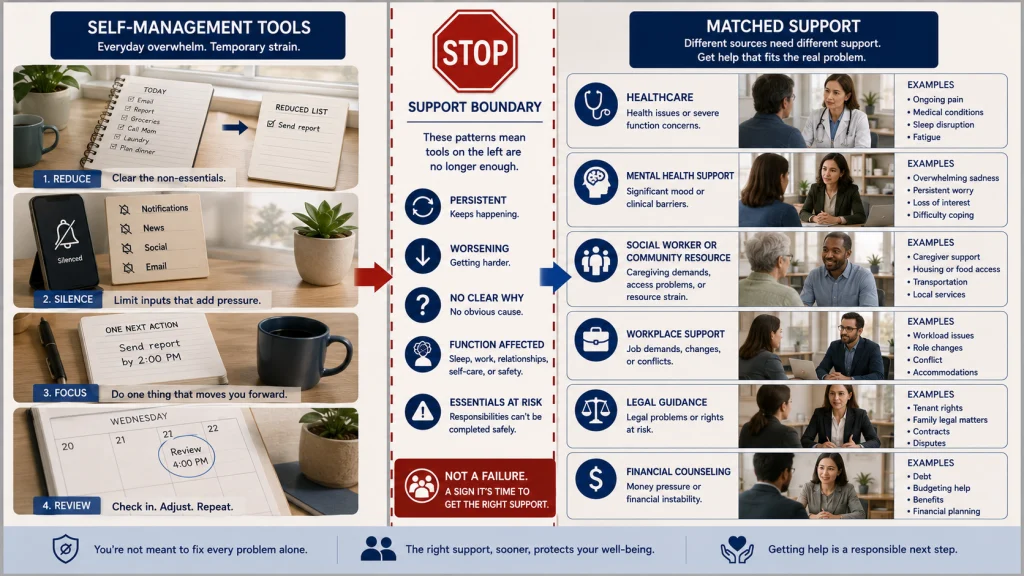
Seek Support When Overwhelm Is Persistent, Recurrent, or Impairing
Repeated overload can be connected to workload, caregiving, finances, relationship strain, health concerns, sleep, environmental demands, or another issue that cannot be solved through personal organization alone.
Qualified support is appropriate when overwhelm:
- continues despite reducing tasks and inputs;
- repeatedly disrupts sleep, work, relationships, self-care, or daily functioning;
- appears without a clear explanation;
- is worsening or happening more often;
- involves severe mood symptoms, substance use, trauma concerns, or another clinical barrier;
- makes it difficult to complete essential responsibilities safely.
The guide to recognizing stress signals can help organize changes in thoughts, emotions, body responses, and behavior without treating one sign as a diagnosis.
A physician, mental-health professional, social worker, qualified counselor, occupational resource, legal service, financial counselor, or other appropriate professional may be needed depending on the source and impact. The right route addresses the actual problem rather than simply adding more coping tasks.
Use Urgent Help for Crisis or Severe Medical Symptoms
Do not assume overwhelm is harmless. Some urgent situations may initially feel like confusion, panic, pressure, or an inability to choose.
Use urgent or emergency help for chest pain, severe shortness of breath, fainting, stroke signs, dangerous confusion, immediate danger, self-harm thoughts, inability to remain safe, or another severe medical or safety concern. Do not rely on a task-sorting worksheet while danger is active.
This article does not diagnose panic, anxiety disorders, depression, ADHD, autism, trauma, burnout, or a medical condition. It also does not replace a crisis plan, treatment plan, emergency response, or professional assessment.
Write the Next Action and the Next Review Time
Protect safety and essential responsibilities first. Stop new inputs for ten minutes, put every open loop into one rough list, and sort only into safety now, meaningful today, and later.
Choose one physical action that can begin in less than ten minutes, or use one brief familiar pause before acting. Send one specific communication when clarification, time, help, cancellation, or a boundary would reduce the load.
After the first action, decide whether to continue, schedule, delegate, or stop. Write the next review time rather than trying to hold the full solution in mind. When overwhelm is persistent, impairing, dangerous, or connected to severe symptoms, use qualified or urgent support.
FAQs
🗒️ What should I do first when everything feels overwhelming?
Check immediate safety and essential responsibilities, then stop new inputs for ten minutes. Put every open loop into one rough list and reduce the active choices to safety now, meaningful today, and later.
⏱️ Why use a ten-minute sequence?
The short window limits how many decisions are active at once. It is not a promise that the whole problem can be solved in ten minutes. It creates enough structure to choose one next action or deliberate pause.
📥 Should I organize the list while writing it?
No. Capture open loops in short fragments first. Organizing while writing can create more decisions and cause the person to edit, rank, or solve before the full load is visible.
🎯 How do I choose the one next action?
Choose a visible physical step that protects safety, advances the most meaningful item, or obtains missing information. Use a verb such as open, call, confirm, send, move, schedule, or ask.
💬 What should I say when I need help or more time?
Name the request and the time clearly. Ask someone to handle one task, request a new deadline, clarify which item comes first, or state when you can revisit a request.
🧘 Should I learn a new calming technique while overwhelmed?
A complicated new technique can add choice load. Use only a brief response that is already familiar and safe, then learn or review detailed breathing, grounding, or mindfulness skills after the episode passes.
🔄 What should I do after the first action?
Reassess capacity and the result. Continue with one item, schedule it, delegate it, wait for information, or stop. Set a specific review time before reopening the larger list.
🚩 When is overwhelm more than an ordinary overload problem?
Seek qualified support when overwhelm is persistent, worsening, unexplained, recurrent, or interfering with sleep, work, relationships, self-care, safety, or essential responsibilities. Immediate danger, self-harm thoughts, or severe medical symptoms require urgent help.