A personal stress plan should reduce decisions when attention, time, and patience are already limited. Build three functional levels, low, medium, and high stress, then pair one action for the source with one action for the stress response. Add a minimum version for busy or disrupted days, prepare support and environmental cues in advance, and schedule one review point. This worksheet is not a treatment plan, workplace policy, emergency plan, or suicide safety plan, and immediate danger or self-harm thoughts require crisis or emergency help.
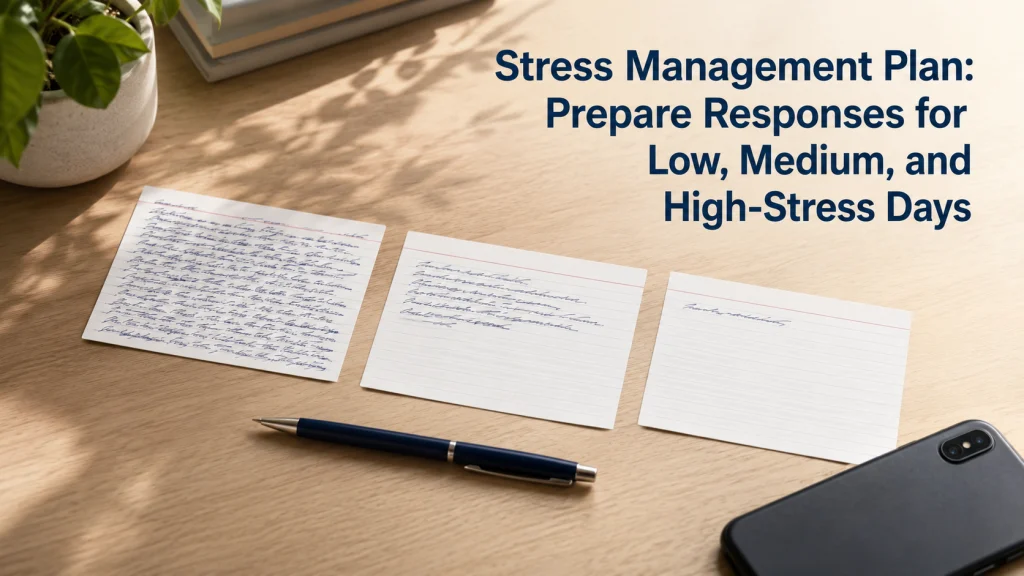
A Usable Plan Requires Fewer Decisions Than the Stressful Moment
Plan one says to meditate, exercise, sleep eight hours, journal, meal prep, stay positive, answer every message calmly, and keep the house organized. It sounds healthy on a quiet afternoon. Under pressure, it becomes another list of things that are not happening.
Plan two has three stress levels. Each level contains one action for the stressor, one action for the response, and one person to contact when support is needed. The reader does not have to search through a long coping list while already overloaded.
| Unrealistic Wellness List | Usable Three-Level Plan |
|---|---|
| Contains many ideal habits with no order. | Names what to do at low, medium, and high stress. |
| Assumes time, privacy, energy, and attention are available. | Includes a minimum version for disrupted days. |
| Mixes prevention, immediate coping, and long-term change. | Pairs one source-focused action with one response-focused action. |
| Does not say when outside help is needed. | Includes support contacts, boundaries, and a clear stop condition. |
The plan should get shorter as stress rises, not more ambitious. Use the coping skills guide to compare possible responses, and the stress management guide when several areas of life need to be considered together.
Define the Plan’s Job as Reducing Decisions Under Pressure
The plan is not a promise to stay calm or follow a perfect routine. On a difficult day, even a sensible option can feel far away when too many decisions are competing at once. The plan’s job is to shorten the distance between noticing stress and taking one prepared next step.
A useful plan answers four questions:
- What tells me stress is rising?
- What can I change about the situation?
- What helps me become able to take the next safe action?
- When do I involve another person or a different kind of support?
Keep the purpose narrow. This is a personal adult lifestyle plan for recurring, non-emergency stress, so every line should help with a predictable decision the reader can actually make.
Planning rule: Every item should make the next decision easier. Remove items that exist only because they sound healthy, impressive, or complete.
Gather Only Three Inputs From Prior Observation
You do not need to reopen every difficult day or explain yourself in full. Start with three inputs that can change what happens next, and leave the rest outside the worksheet.
| Input | What to Bring Forward | What to Leave Out |
|---|---|---|
| Recurring triggers | Repeated timing, setting, transition, expectation, interruption, or structural demand | A theory that one event explains every stressful response |
| Early signals | One or two thoughts, emotions, body sensations, or behavior changes that appear early | A long symptom inventory that is difficult to use in real time |
| Current coping costs | The response that gives short relief but creates a later problem | Moral labels about being disciplined, weak, productive, or difficult |
The five-field stress journal can supply these inputs after several entries. Use the guide to identifying stress triggers when the source still feels vague, and the guide to recognizing stress signals when the first changes are hard to name.
Create Low, Medium, and High-Stress Levels With Functional Descriptions
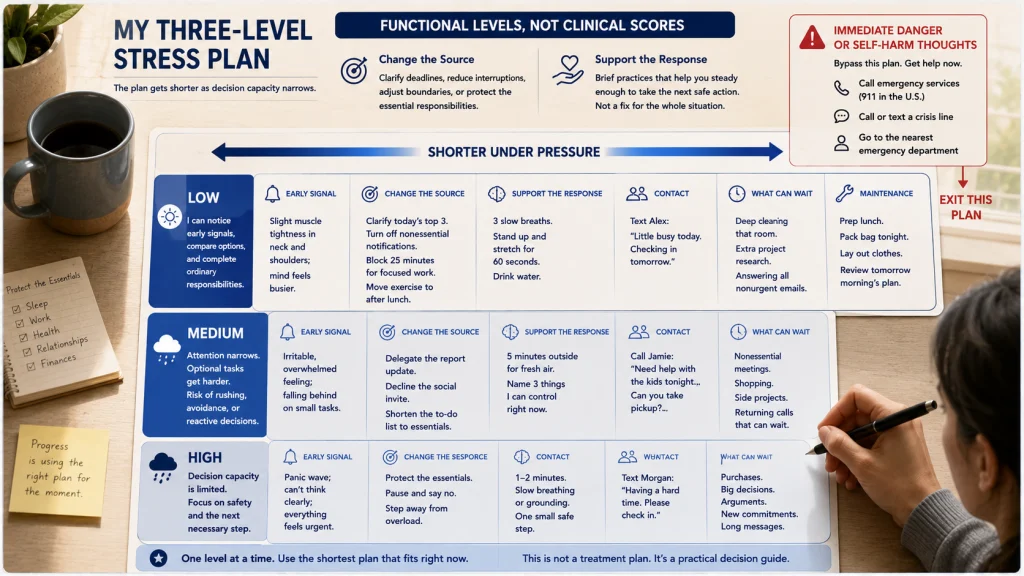
The levels describe what you can currently do, not how serious a diagnosis might be. Define each tier through attention, decision capacity, ordinary responsibilities, and the amount of support needed.
| Stress Level | Functional Description | Plan Length | Main Goal |
|---|---|---|---|
| Low | I can notice early signals, think through options, and complete ordinary responsibilities. | A short prevention and maintenance list | Reduce predictable friction before the situation intensifies. |
| Medium | My attention narrows, optional tasks feel harder, and I am more likely to avoid, rush, or react. | One practiced response, one source action, and one support request | Lower unnecessary demand and protect the next essential step. |
| High | I have limited decision capacity and need a very short sequence focused on safety and essential responsibilities. | The shortest practiced response and a contact step | Stop escalation, postpone nonessential decisions, and involve support. |
These levels are personal planning labels, not clinical scores. Their purpose is to shorten the plan as decision capacity narrows.
Use this unified template to keep all three levels in one place:
| Level | Early Signal or Functional Description | Source-Focused Action | Response-Focused Action | Support Contact or Request | What Can Wait |
|---|---|---|---|---|---|
| Low | When I notice __________ | I will change or clarify __________ | I will practice __________ | I may check in with __________ | I do not need to postpone anything unless __________ |
| Medium | When attention narrows or I begin __________ | I will reduce, delegate, or clarify __________ | I will use __________ | I will ask __________ for __________ | I will postpone __________ |
| High | When I can no longer manage __________ safely or reliably | I will protect only the essential responsibility of __________ | I will use the shortest practiced response: __________ | I will contact __________ | I will not decide, buy, argue about, or commit to __________ |
Use the Low-Stress Plan for Prevention and Routine Maintenance
Low stress is the best time to make the environment easier, clarify expectations, and practice the response you may need later. Because attention is still available, this tier can include a little preparation without becoming a full wellness schedule.
Choose:
- One early signal: The first reliable sign that demand is beginning to rise.
- One source-focused action: Clarify a deadline, reduce a recurring interruption, prepare needed information, or set a boundary.
- One response-focused action: A brief practiced action that helps you remain able to proceed.
- One maintenance step: Protect a realistic sleep opportunity, meal, break, movement period, or transition that supports the routine.
Low-stress planning should address structural pressure where possible. It should not imply that breathing, journaling, or positive thinking can fix an impossible workload, unsafe environment, inadequate support, or conflicting responsibilities.
Reduce Optional Load in the Medium-Stress Plan
At medium stress, the plan becomes shorter. This is often the point when several small demands begin to feel equally urgent, even though they are not equally important. The goal is not to restore the perfect day. It is to keep one essential responsibility moving while preventing avoidable demands from multiplying.
Write three steps:
- Reduce one optional demand: Delay, decline, shorten, delegate, or remove a nonessential task.
- Use one practiced coping response: Choose a response already familiar enough to use without learning new instructions.
- Ask for specific help: Name the person, the request, and the time window instead of writing only “reach out.”
A specific request might be, “Please handle pickup today,” “Can you confirm which deadline comes first?” or “I need ten quiet minutes before we decide.” The plan is easier to use when the support person does not have to guess what help means.
Keep the High-Stress Plan Short and Safety-Focused
When attention and patience are limited, a long list can feel like proof that the plan has failed. It has not. The plan should now protect safety and essential responsibilities without asking for a thoughtful review of every option. This tier is intentionally brief.
- Stop or move away from any unsafe action or environment when possible.
- Protect the most immediate essential responsibility, such as safe transportation, caregiving coverage, medication already directed by a clinician, or another necessary task.
- Postpone nonessential purchases, messages, arguments, commitments, and major decisions.
- Use the shortest practiced response that helps you take the next safe step.
- Contact the named support person or qualified service listed in the plan.
This tier is not designed to manage severe mental-health symptoms, substance dependence, self-harm risk, or a medical emergency. Immediate danger or self-harm thoughts require crisis or emergency help, not completion of this worksheet.
Pair One Problem-Focused Action With One Response-Focused Action
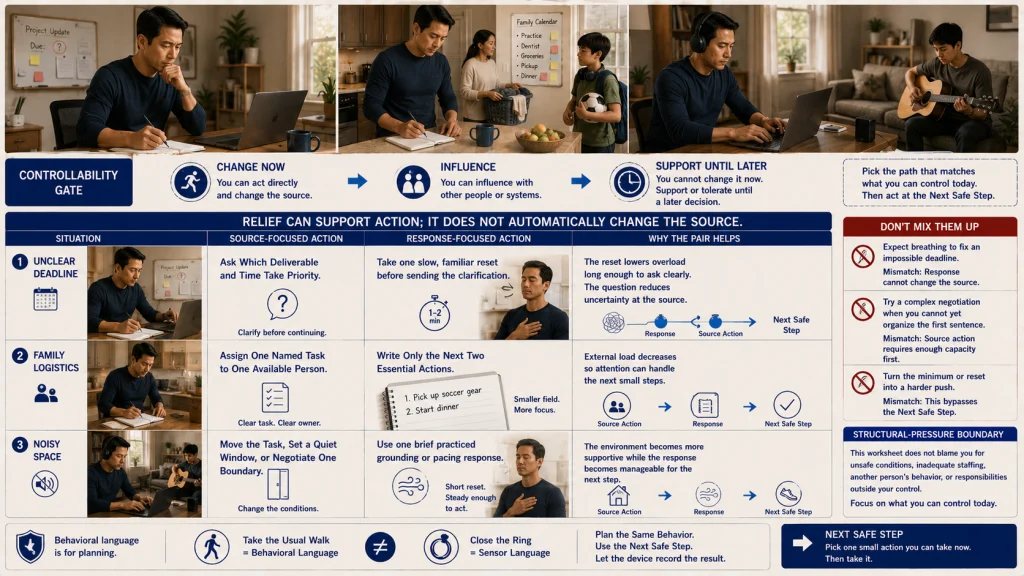
Stress can involve both an external demand and an internal response. Relief may make action possible, but it does not automatically change the source. Source-focused action may change the problem, but it can be difficult to start while attention and emotion are overloaded.
Use a controllability check before choosing the pair: What can be changed now, what can only be influenced, and what must be supported or tolerated until a later decision is possible? This keeps the plan from blaming the reader for structural pressure, another person’s behavior, or conditions outside personal control.
| Situation | Problem-Focused Action | Response-Focused Action | Why the Pair Helps |
|---|---|---|---|
| Unclear deadline | Ask which deliverable and time take priority. | Pause for one slow, familiar reset before sending the question. | The response step supports action, while the question addresses uncertainty. |
| Too many family logistics | Assign one named task to one available person. | Write only the next two essential actions. | The external load decreases and attention has a smaller field to manage. |
| Noisy shared space | Move the task, set a quiet window, or negotiate one boundary. | Use a brief grounding or pacing response already practiced. | The environment changes while the stress response becomes more manageable. |
The comparison of problem-focused and emotion-focused coping explains when each side of the pair is more useful.
Write a Minimum Version for Disrupted Days
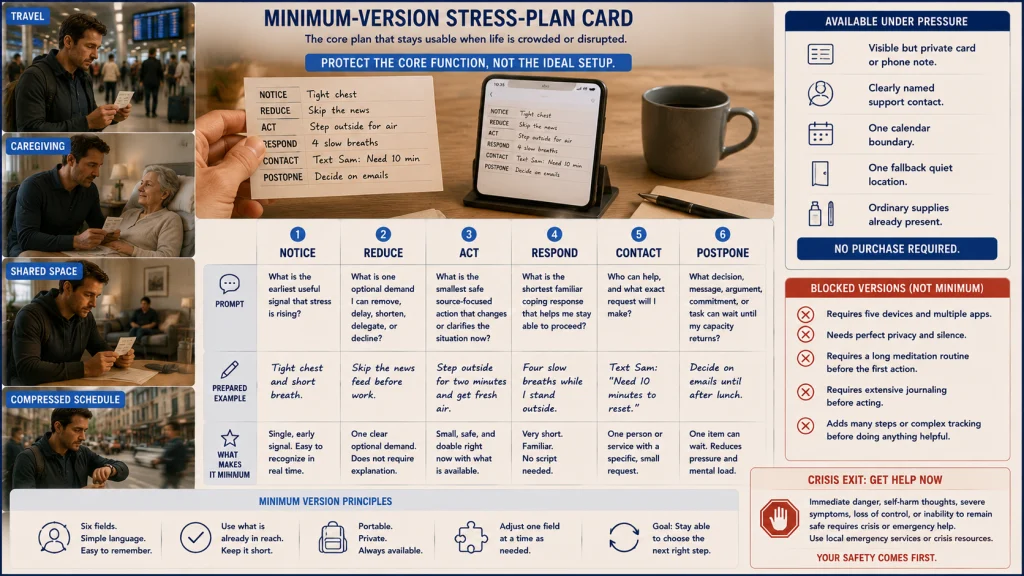
Busy days, travel, caregiving, shared rooms, limited privacy, and unexpected schedule changes can make the full plan unavailable. That does not make the reader unprepared or inconsistent. The minimum version protects the core function without requiring the ideal setup.
- Notice: My earliest useful signal is __________.
- Reduce: The one optional demand I can remove is __________.
- Act: The smallest source-focused action is __________.
- Respond: My shortest practiced coping response is __________.
- Contact: The person or service I will contact is __________.
- Postpone: The decision that can wait is __________.
A minimum version is not a lower-quality plan. It is the version designed for the exact days when friction, time, and attention are highest.
Prepare the Environment Without Requiring Purchases
A plan is easier to use when the first step is visible and available. Preparation can involve a card, phone note, contact list, quiet location, calendar boundary, ordinary supplies, or settings already present in the home.
- Place the short plan where it can be seen without exposing private details.
- Save support contacts under clear names rather than relying on memory.
- Mark one calendar boundary that protects an essential break or stopping time.
- Identify a quieter location or a brief fallback space in a shared home.
- Prepare ordinary items needed for the first action, such as a document, key, water bottle, or task list.
- Reduce nonessential alerts or visual clutter during the planned response window.
Editorial observation: A plan that depends on five devices, several apps, ideal privacy, and a long setup can fail before the first step begins. A visible card, a phone note, a prepared contact, and one environmental change may be easier to use and review. The best setup is the one that remains available on the day it is needed.
Add a Do-Not-Do List for Known High-Cost Coping
Under stress, a familiar response can feel automatic because it offers immediate relief, control, escape, or delay. A short do-not-do list interrupts the known pattern without turning the plan into a moral judgment.
- Do not send the angry message before the planned pause and review.
- Do not make a nonessential purchase during the high-stress tier.
- Do not agree to a new commitment before checking time and support.
- Do not use isolation to avoid a safety or essential responsibility.
- Do not add alcohol, substances, self-harm, or another dangerous response to this personal worksheet. Use qualified or urgent support instead.
Choose only the responses that are already known to create a significant cost. The guide to unhealthy coping mechanisms can help separate the function, immediate relief, later cost, and risk without shaming the person.
Define Review Timing and What Counts as Useful
A plan needs a review point because real weeks rarely behave exactly as expected. Review after the plan has been used in several relevant situations, or at a scheduled date if the trigger has not occurred. The review is a chance to make the plan kinder and easier to use, not to grade how well the reader handled stress.
| Review Question | Useful | Feasible | Too Costly |
|---|---|---|---|
| Did the step reduce decisions? | The next action became clearer. | The step could be completed with available time and attention. | The step required another complex routine or too much setup. |
| Did it address the source? | One demand, boundary, expectation, or environment changed. | The action was within the person’s control or support network. | The plan blamed the person for a structural problem they could not change alone. |
| Did it support the response? | The person became more able to take the next safe action. | The response was familiar and brief enough to use. | The response increased avoidance, rumination, conflict, spending, or another later cost. |
Change one part of the plan at a time when practical. A full redesign after every difficult day makes it hard to know which preparation actually helped.
Compare Three Completed Stress Plans
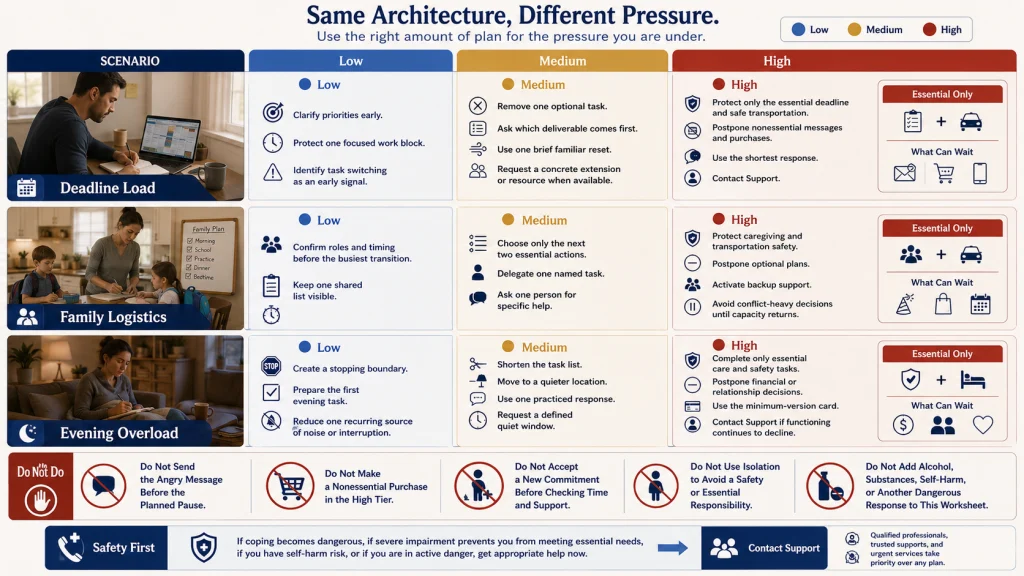
These scenarios show how the same architecture can fit different pressures. They are examples of structure, not universal prescriptions.
| Scenario | Low-Stress Plan | Medium-Stress Plan | High-Stress Plan |
|---|---|---|---|
| Deadline load | Clarify priorities at the start of the day, protect one focused block, and note the first sign of task switching. | Remove one optional task, ask which deliverable comes first, use a brief practiced reset, and request a concrete extension or resource if available. | Protect the essential deadline and safe transportation, postpone nonessential messages and purchases, use the shortest response, and contact the named support person. |
| Family logistics | Confirm roles and timing before the busiest transition, and keep one shared list visible. | Choose the next two essential actions, delegate one named task, and ask one person for a specific form of help. | Protect caregiving and transportation safety, postpone optional plans, contact backup support, and avoid conflict-heavy decisions until capacity returns. |
| Repeated evening overload | Set a stopping boundary, prepare the first evening task, and reduce one recurring source of noise or interruption. | Shorten the task list, move to the quieter location, use one practiced response, and tell the household what quiet window is needed. | Complete only essential care and safety tasks, postpone financial or relationship decisions, use the minimum-version card, and contact support if functioning continues to decline. |
When stress is already high and no plan exists, use the guide on what to do when feeling overwhelmed for a shorter immediate first-step workflow.
Distinguish This Personal Plan From Other Kinds of Plans
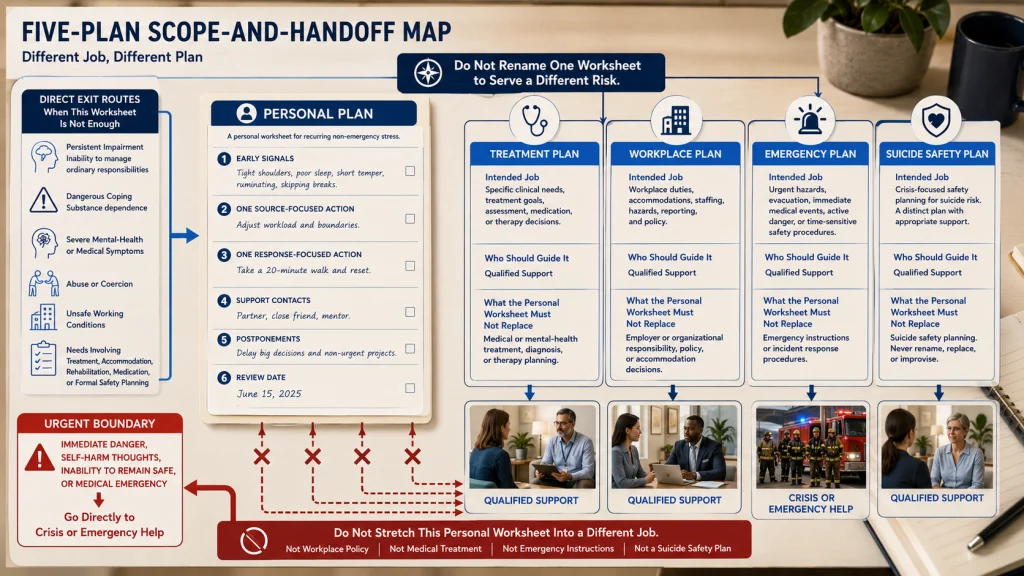
- Personal stress plan: Prepares ordinary lifestyle responses for recurring non-emergency stress.
- Treatment plan: Is created and managed within qualified healthcare or mental-health care for specific clinical needs.
- Employer or organizational plan: Addresses workplace responsibilities, accommodations, hazards, staffing, or policy.
- Emergency plan: Covers urgent hazards, medical emergencies, evacuation, or immediate safety procedures.
- Suicide safety plan: Is a distinct crisis-focused plan that should be created with appropriate qualified support and must not be replaced by this worksheet.
Do not rename this worksheet to make it serve a purpose it was not designed to handle. Severe symptoms, substance dependence, self-harm risk, abuse, medical emergencies, and immediate danger require a different route.
Know When Professional Support Should Create a Different Plan
Qualified support is appropriate when stress causes persistent impairment, the person cannot cope with ordinary responsibilities, coping responses are dangerous, or the situation involves needs outside a personal lifestyle worksheet.
Seek professional help when:
- distress repeatedly disrupts sleep, work, relationships, self-care, or daily functioning;
- substance use, self-harm risk, severe mental-health symptoms, or medical symptoms are present;
- the stressor involves abuse, coercion, unsafe working conditions, or another situation that cannot be managed through personal coping alone;
- the person needs treatment, accommodation, rehabilitation, medication guidance, or a formal safety plan;
- the low, medium, and high tiers remain unusable despite simplification and support.
Urgent boundary: Immediate danger, self-harm thoughts, inability to remain safe, or a medical emergency requires crisis or emergency help. Do not use this worksheet as a substitute while danger is active.
Complete the Three Levels and Place the Plan Where It Will Be Seen
Write functional descriptions for low, medium, and high stress. Give each level one source-focused action, one response-focused action, and a clear support step. As stress rises, shorten the plan and postpone nonessential decisions.
Add a minimum version, prepare the environment without requiring purchases, and name the coping responses that create unacceptable later costs. Then choose a review date and change one part at a time.
Keep the plan visible enough to use and private enough to feel safe. When the worksheet no longer fits the situation, use the support route already named in the plan rather than adding more steps.
FAQs
🗂️ What belongs in a personal stress management plan?
Include recurring triggers, early signals, current coping costs, low-medium-high functional levels, one source-focused action, one response-focused action, support contacts, a minimum version, boundaries, and a review date.
📉 Why should the plan get shorter as stress rises?
Higher stress can reduce attention, patience, and decision capacity. A shorter plan protects the essential next step instead of requiring the person to choose among many ideal coping options.
🧩 How do I define low, medium, and high stress?
Use functional descriptions such as how well you can think through options, complete ordinary responsibilities, regulate reactions, and ask for support. Do not treat the levels as diagnostic scores.
🔧 Should every tier include a problem-focused action?
Include one when part of the stressor can be changed safely. Pair it with a response-focused action when the stress response is making the source action difficult to begin.
🪪 What is a minimum-version card?
It is the shortest usable form of the plan for travel, caregiving, busy days, limited privacy, or shared spaces. It names one signal, one demand to reduce, one action, one response, one contact, and one decision to postpone.
🏠 Do I need an app or special product?
No. A card, phone note, prepared contact list, calendar boundary, quiet location, and ordinary supplies may be enough. The setup should reduce friction rather than create another system to maintain.
🚫 What belongs on the do-not-do list?
List only known responses that provide immediate relief but create significant cost or risk, such as impulsive messages, avoidable commitments, unnecessary purchases, unsafe isolation, or dangerous coping.
🚩 When is this worksheet not enough?
It is not enough for persistent impairment, severe mental-health symptoms, substance dependence, self-harm risk, abuse, medical emergencies, or immediate danger. Those situations require qualified, crisis, or emergency support.