A stress journal works best when it records a few comparable details instead of every thought from the day. Use five fields: context, signal, response, immediate effect, and later cost. Log either specific stressful events or one brief daily check-in, then wait until you have seven entries before reviewing for patterns. Stop the exercise if tracking increases distress, rumination, compulsive checking, self-harm thoughts, or difficulty functioning.
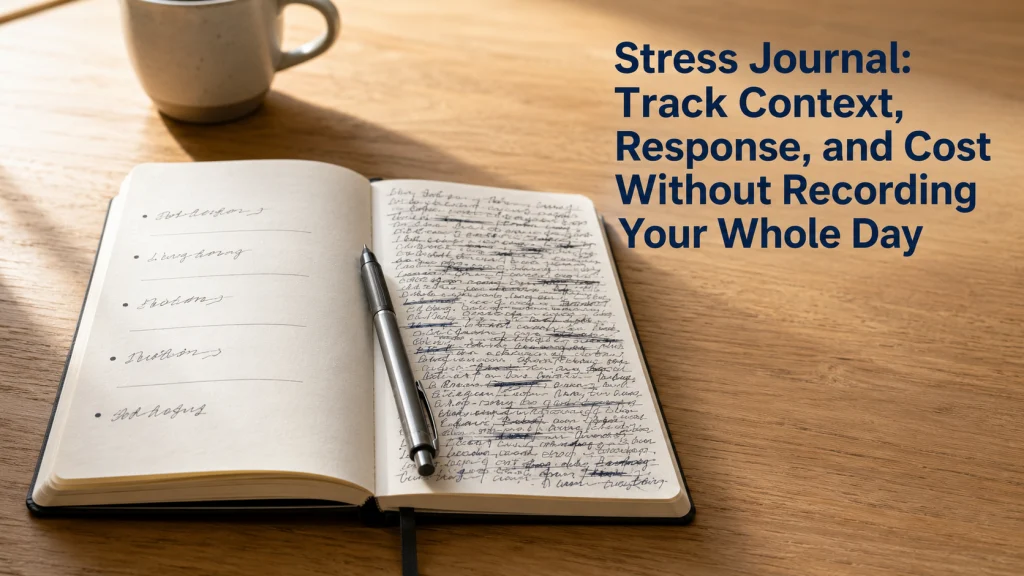
A Short Page Can Be Easier to Review Than Three Dense Pages
Place two journal pages side by side. The first contains three dense pages of thoughts, but no clear date, setting, trigger, response, or later result. The writing may have captured an important moment, yet comparing it with another stressful day would require reading everything again.
The second page has five short fields completed in about ninety seconds. It shows what was happening, the first signal noticed, what the person did next, what changed immediately, and what the response cost later. A week afterward, repeated situations are visible without reconstructing the entire day from memory.
| Dense Page | Minimal Five-Field Card |
|---|---|
| Captures many thoughts but may hide the event sequence. | Keeps the situation, response, and outcome in the same row. |
| May take too long to repeat during a busy week. | Can be completed with short phrases rather than full paragraphs. |
| Requires rereading before comparisons become clear. | Makes repeated timing, settings, and coping costs easier to scan. |
A useful stress journal is designed for review, not for producing the most writing. Use the coping skills guide for the broader range of responses, and the stress management overview when several parts of daily life need to be considered together.
Decide What the Journal Is For
Before choosing prompts or a format, name the job the journal needs to perform. A useful purpose is narrow enough to guide what you record and what you leave out.
- Pattern detection: Notice whether stress repeatedly appears at a certain time, setting, task transition, expectation, or interaction.
- Preparation: Identify the moments that need a planned pause, boundary, environmental change, or first action.
- Communication: Bring a short sequence of events and responses to a qualified professional without relying only on memory.
The journal is not a diagnostic test. A rating, repeated trigger, or difficult week cannot determine whether someone has anxiety, depression, trauma, another condition, or a specific cause.
Key decision: Write one sentence that begins, “I am using this log to notice…” If the purpose cannot be stated clearly, the journal may be collecting more information than the next decision requires.
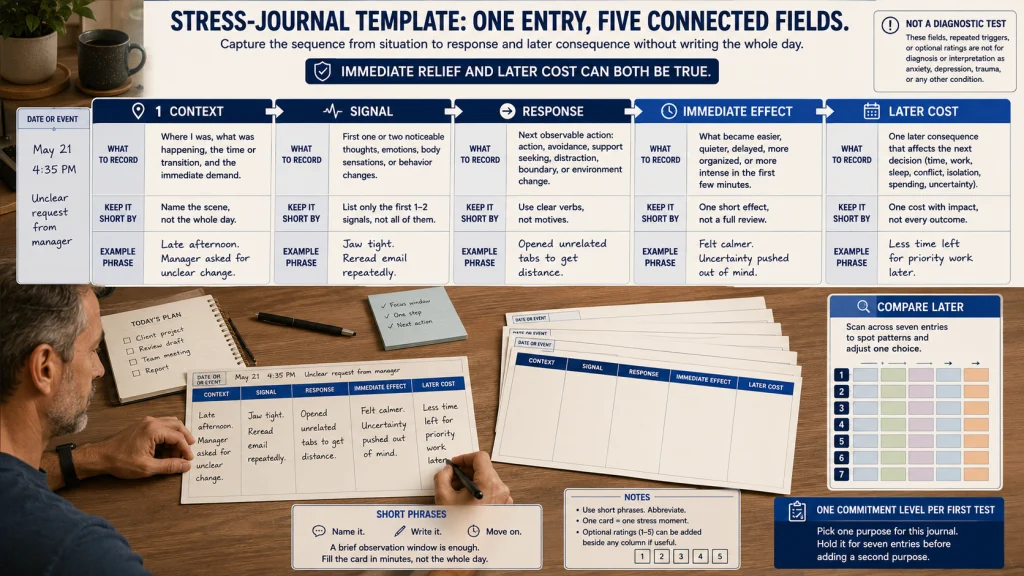
Use Five Fields That Can Be Compared Later
The five fields follow a short sequence from situation to consequence. Each field can be completed with a phrase rather than a full explanation.
| Field | What to Record | Keep It Short By |
|---|---|---|
| Context | Where you were, what was happening, the time or transition, and the immediate demand | Naming the scene rather than recounting the whole day |
| Signal | The first thought, emotion, body sensation, or behavior change you noticed | Choosing one or two early signals |
| Response | What you did next, including action, avoidance, support seeking, distraction, or environmental change | Using observable verbs |
| Immediate effect | What became easier, quieter, delayed, or more intense in the first few minutes | Recording the short-term result without judging it |
| Later cost | What happened afterward to sleep, time, work, relationships, money, recovery, or the original problem | Naming only the consequence that affects the next decision |
The same response can have both a helpful immediate effect and an unwanted later cost. Recording both prevents the journal from dividing every action into a simple good or bad category.
Use this printable template row:
| Date or Event | Context | Signal | Response | Immediate Effect | Later Cost |
|---|---|---|---|---|---|
| Note the date, time, or event cue. | Name the setting and immediate demand. | Record one or two early signs. | Write the next observable action. | State what changed right away. | Record the later consequence that matters. |
Choose Event-Based Logging or One Daily Check-In
Event-based logging works when stressful moments are distinct enough to recognize. Complete an entry after the situation has settled enough for brief observation, not while immediate safety or an urgent task still needs attention.
A daily check-in can fit better when stress builds gradually or several small events blend together. Choose one dependable time and record the most informative event from that day rather than summarizing every hour.
Do not run both systems at full detail unless there is a clear reason. A journal that creates constant monitoring can become another demand rather than a useful observation tool.
Add an Intensity Rating Only When It Improves Comparison
Once the five fields are stable, a rating can be added only if it makes those entries easier to compare. A simple scale may help distinguish a mild disruption from a moment that felt much harder to manage, but it should remain secondary to the context and response.
For example, a low number might mean, “I noticed stress but continued the task,” while a high number might mean, “The response interrupted what I needed to do.” The number is useful only when the description stays consistent enough to compare your own entries.
Note: A stress rating is not a clinical measurement, diagnosis, or comparison with another person’s experience. It is an optional personal shorthand. Remove it if choosing a number causes more effort than it saves.
Ratings can also create false precision. A change from four to five does not prove that the situation became medically or psychologically worse. Read the number beside the context, signal, response, and consequence.
Record Controllable Details Without Documenting Every Thought
A number can show that two moments felt different, but it cannot explain what made them different. The journal becomes more actionable when it records details that could change a future setup or decision, such as timing, missing information, interruptions, noise, unclear expectations, a skipped break, a difficult transition, or a coping response that delayed action.
You do not need a complete transcript of every thought. A short entry such as “unclear request, late afternoon, had not eaten, reread the message five times” may reveal more than several paragraphs that never name the working conditions.
Separate what happened from what you inferred:
- Observed detail: The message arrived ten minutes before the planned stopping time.
- Interpretation: I assumed the sender expected an immediate reply.
- Controllable next question: Was a response deadline actually stated?
The guide to understanding stress triggers can help when you need to distinguish the event, expectation, environment, and response without turning the journal into a search for one hidden cause.
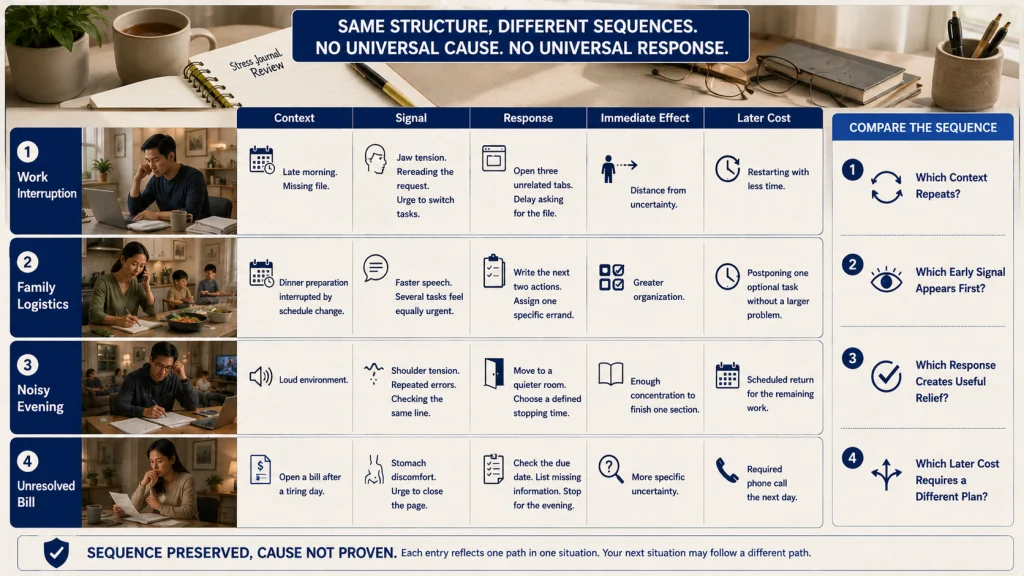
Compare Four Completed Entries
Those controllable details become easier to understand when they are kept inside the same five-field sequence. These examples use short phrases so the journal remains reviewable, while showing different contexts without claiming that the same pattern or response applies to every person.
| Context | Signal | Response | Immediate Effect | Later Cost |
|---|---|---|---|---|
| Interrupted work block, late morning, missing file | Jaw tension, rereading the request, urge to switch tasks | Opened three unrelated tabs and delayed asking for the file | Attention moved away from the uncertainty | The task restarted later with less time available |
| Family logistics changed during dinner preparation | Faster speech, several tasks felt equally urgent | Wrote the next two actions and asked one person to handle a specific errand | The situation felt more organized | One optional task was postponed without creating a larger problem |
| Noisy evening while trying to complete paperwork | Shoulder tension, repeated mistakes, checking the same line | Moved to a quieter room and set a defined stopping time | Concentration improved enough to finish one section | The remaining paperwork still needed a scheduled return |
| Unresolved bill opened after a tiring day | Stomach discomfort, urge to close the page immediately | Checked the due date, listed the missing information, then stopped for the evening | The uncertainty became more specific | A phone call still needed to be made the next day |
The entries are useful because they preserve sequence. They do not prove why the person reacted that way, and they do not diagnose a condition.
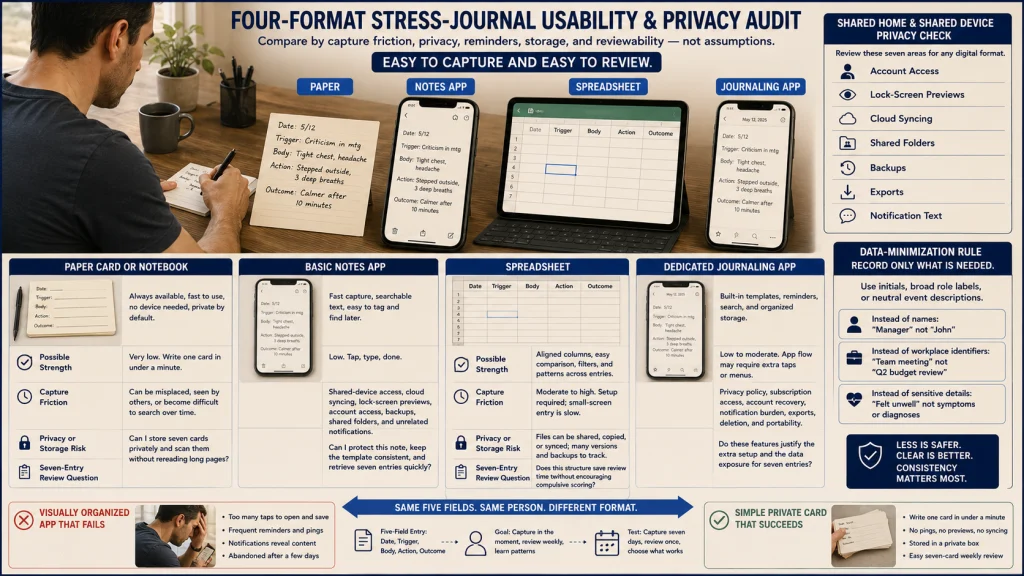
Choose a Format by Privacy, Friction, and Reviewability
After seeing what a complete entry looks like, the next question is where that entry can realistically live. The best format is the one you can complete consistently and review without creating unnecessary privacy or notification problems. Paper is not automatically more reflective, and digital tracking is not automatically more organized.
| Format | Possible Strength | Possible Friction or Risk | Review Question |
|---|---|---|---|
| Paper card or notebook | No device needed, easy to keep the five fields visible | Can be misplaced, seen by others, or difficult to search | Can you store it privately and compare entries without rereading long pages? |
| Basic notes app | Fast capture, familiar interface, searchable text | Shared-device access, cloud syncing, and unrelated notifications may reduce privacy or focus | Can you lock the note, use a consistent template, and find seven entries quickly? |
| Spreadsheet | Easy column comparison and pattern scanning | More setup, small-screen friction, and a tendency to over-measure | Does the structure save review time without encouraging constant scoring? |
| Dedicated journaling app | Templates, reminders, search, and organized storage may be built in | Privacy policy, account access, subscriptions, notification burden, and export limits vary | Do the privacy and review features justify the extra setup? |
Editorial observation: A format can look organized and still fail during a busy day if it takes too many taps, sends several reminders, hides older entries, or stores sensitive notes in a place shared with other household members. Usability includes both easy capture and easy review.
Protect Privacy on Shared Devices and in Shared Homes
A stress log may contain names, schedules, workplace details, financial concerns, family information, health observations, or notes about conflict. Record only what the journal’s purpose requires.
Privacy warning: On shared devices, check account access, lock-screen previews, cloud syncing, shared folders, backups, exports, and notification text before recording sensitive information. For paper, choose storage that fits the privacy needs of the household.
Initials, broad role labels, or a neutral event description may be enough for pattern review. Avoid unnecessary identifying detail when the same decision can be supported without it.
Privacy also affects communication. Bringing a concise log to a professional does not require giving another person unrestricted access to every entry or every device account.
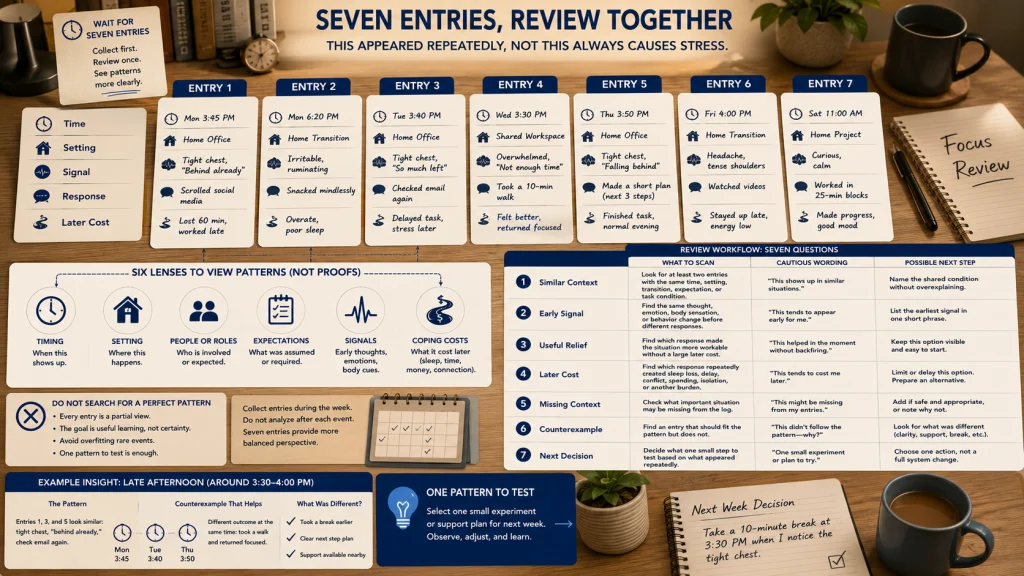
Review After Seven Entries, Not After Every Entry
Once the format and privacy setup are settled, the journal needs a clear review point. Reviewing immediately after each entry can pull you back into the stressful moment before enough comparison data exists. Seven entries create a small review point without requiring a fixed week or daily schedule.
Use this checklist:
- Are at least two entries linked to a similar time, setting, transition, or expectation?
- Do the same early signals appear before different coping responses?
- Which response created useful immediate relief without a large later cost?
- Which response repeatedly delayed action, reduced sleep, increased conflict, or created another burden?
- Is one important context missing because it was difficult or unsafe to record?
- What counterexample does not fit the first pattern you noticed?
- Is the next step a small experiment, a prepared support plan, or qualified guidance?
Do not turn the review into a search for a perfect pattern. The purpose is to find one decision worth testing, not to explain every stressful moment.
Look for Repeated Timing, Settings, Expectations, and Coping Costs
The checklist tells you what to scan; this next step tells you how to read what repeats. Begin with visible features before interpreting motives. Repeated late-afternoon entries may point to workload, missing breaks, transitions, hunger, noise, or accumulated decision demands. The time alone does not establish the cause.
Scan the seven entries by category:
- Timing: morning startup, late afternoon, bedtime, deadlines, or transitions;
- Setting: one room, commute, shared workspace, public place, or digital environment;
- People and roles: a type of interaction or expectation, without assuming one person is the entire cause;
- Expectations: unclear urgency, perfection, immediate availability, or too many simultaneous demands;
- Signals: repeated thoughts, emotions, body sensations, or behavior changes;
- Coping costs: lost time, poor sleep, isolation, conflict, spending, avoidance, or an unfinished task.
The article on recognizing signs of stress can help organize signals into thoughts, emotions, body responses, and behavior without treating one sign as proof of a condition.
Use Counterexamples to Avoid False Conclusions
Repeated details can suggest a direction, but they still need a check against the entries that do not fit. A pattern becomes more useful when you also look for an entry that should fit but does not. If every noisy evening seems difficult, find the noisy evening that was manageable and ask what else was different.
Counterexamples may reveal:
- the task was clearer;
- the person had more time or support;
- the noise was predictable rather than sudden;
- a break happened earlier;
- the coping response changed;
- the original conclusion was too broad.
Note: Seven entries can suggest a practical pattern, but they cannot prove causation. Use cautious wording such as “this appeared repeatedly” rather than “this always causes my stress.”
Convert One Pattern Into a One-Variable Experiment
Choose one repeated condition that can be changed safely and observe whether the next comparable entry looks different. Keep the experiment small enough that its effect can be understood.
| Repeated Pattern | One Variable to Change | What to Compare |
|---|---|---|
| Unclear requests repeatedly lead to rereading and delay | Ask one clarification question before opening other tasks | Time to begin, early signals, and later cost |
| Noisy evenings repeatedly disrupt paperwork | Move the first work block to a quieter location | Errors, stopping point, and unfinished work |
| Late-day decisions repeatedly lead to impulsive distraction | Prepare the first action and stopping rule earlier in the day | Whether the task starts and how long distraction lasts |
Change only one main variable when practical. Altering the time, room, reminder, task size, support person, and coping response at once makes the result difficult to interpret.
Move a useful finding into a stress management plan when it needs a prepared cue, action, fallback, or support route before the trigger returns.
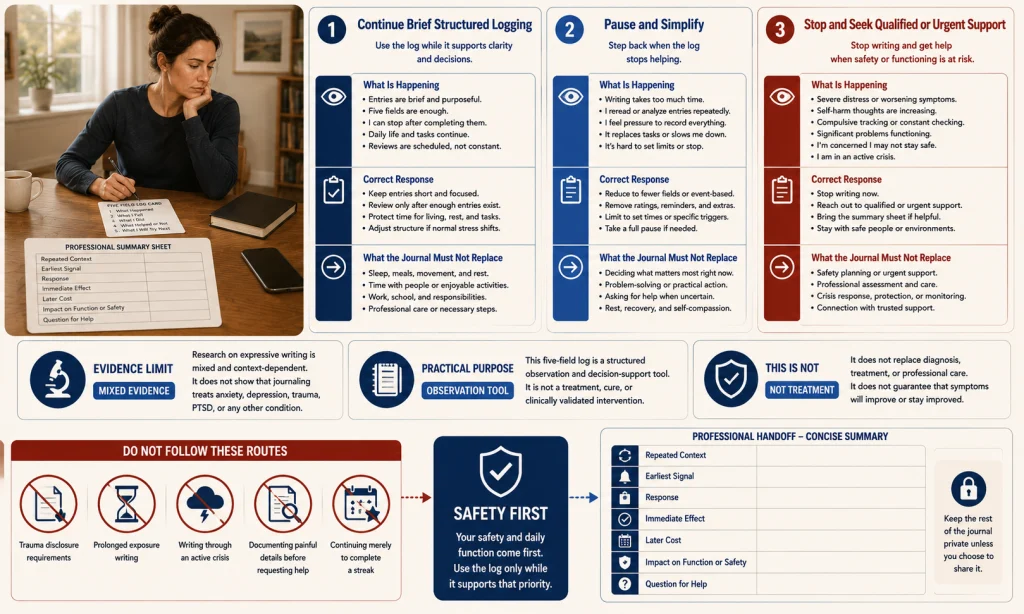
Stop When Journaling Increases Rumination, Distress, or Compulsive Tracking
A journal is not useful merely because it contains more detail. Stop the exercise when writing repeatedly intensifies distress, keeps you mentally replaying the event, creates pressure to track every thought, replaces a needed action, or becomes difficult to limit.
Safety warning: If journaling increases self-harm thoughts, severe distress, compulsive tracking, functional impairment, or concern that you may not remain safe, stop the exercise and seek appropriate qualified or urgent support. Do not continue writing in an attempt to manage an active crisis.
This article does not instruct trauma disclosure, prolonged exposure writing, or treatment for anxiety, depression, trauma, PTSD, or another condition. A person does not need to document painful details before asking for help.
Bring a Concise Log to a Qualified Professional When Needed
A short log may help communicate what is difficult to remember during an appointment or consultation. Bring the entries that support the question rather than every note you have written.
A concise summary can include:
- the repeated context or timing;
- the earliest signals noticed;
- the response that followed;
- the immediate effect and later cost;
- the pattern’s effect on sleep, work, relationships, safety, or daily functioning;
- the question you want help answering.
Seek qualified support when stress or tracking causes persistent distress, interferes with functioning, involves unsafe behavior, or raises concerns outside your competence. The journal can support communication, but it cannot replace assessment.
When a repeated coping response is creating harm or delaying needed action, the guide to evaluating coping costs can help frame the behavior, function, relief, and later consequence without using a moral label.
Create the Five-Column Template and Schedule One Review
Choose event-based entries or one daily check-in, then create columns for context, signal, response, immediate effect, and later cost. Add an intensity rating only when it makes your own entries easier to compare.
Collect seven entries before reviewing. Look for one repeated timing, setting, expectation, or coping cost, then test one safe variable while keeping the rest of the system stable.
Store the log privately, stop if it increases distress or compulsive tracking, and bring a concise summary to a qualified professional when the pattern affects functioning or safety.
FAQs
📝 What should I write in a stress journal?
Record the context, first signal, response, immediate effect, and later cost. Short phrases are enough. Include only the detail needed to compare entries and support a later decision.
⏱️ Do I need to journal every day?
No. Use event-based logging when stressful moments are distinct, or one daily check-in when stress builds gradually. Choose the lighter method that produces entries you can actually review.
🔢 Should I rate stress from one to ten?
Use a small rating scale only if it improves comparison between your own entries. Define the endpoints in practical language and read the number beside the context. The rating is not a clinical measurement or diagnosis.
📱 Is paper or a digital journal better?
Neither format is universally better. Compare privacy, capture friction, reminders, searchability, storage, and how easily seven entries can be reviewed. The best format is the one you can use consistently without creating a new burden.
🔍 When should I review my entries?
Review after seven entries rather than analyzing every entry immediately. Look for repeated timing, settings, expectations, signals, responses, and later costs, then check for a counterexample before drawing a conclusion.
🧪 What should I do after finding a pattern?
Choose one safe, controllable variable and compare the next similar event. Change the location, first action, timing, task size, or support step, but avoid redesigning several parts at once.
🔒 How can I keep a stress journal private?
On shared devices, review lock-screen previews, account access, syncing, shared folders, backups, and notification text. Store paper securely and avoid unnecessary names or identifying detail when broad labels are enough.
🚩 When should I stop journaling?
Stop when journaling increases distress, rumination, self-harm thoughts, compulsive tracking, avoidance, or difficulty functioning. Seek appropriate support instead of continuing a tool that is making the situation harder.